ICEF

Tale 37 · The Vāsiṣṭha Atlas

The Wish-Gem and the Piece of Glass

Nirvāṇa · first half · Mitra VI.1.88, 90 · 3,600 words

Doubt lets the real gem fly; craving keeps the glass.

Bhūmikā 2 · Vicāraṇā (inquiry)LightYour ally · The Wonder of Uncertainty

The essence

A rich and accomplished man spends years of rites and labour to win the cintāmaṇi, the wish-fulfilling gem, and at last it lies before him, ready for his hand. He cannot believe it. He asks whether it is real, fears his touch will soil it, recalls that no one wins it in this life, and concludes that a poor, worthless man like him cannot deserve it. While he hesitates, the gem flies away. Trying again, he is shown a shining piece of glass, set before him by an invisible siddha to mock him, and this he accepts at once: he gives away all he owns, abandons country, house and kin, and goes into a forest where the glass brings only calamity. Kumbha decodes it: the gem is the relinquishing of the mind's errors and desires; the glass is the austerity Śikhidhvaja chose instead. Doubt refuses the real; craving crowns the counterfeit.

What it teaches

  1. 01

    Unworthiness can disguise itself as prudence: the seeker's reasons for not reaching out ("so miserable a wretch") are statements of self-image, not evidence about the gem (VI.1.88.14).

  2. 02

    The mind that cannot trust a true gain trusts a false one at once, because the counterfeit asks nothing of its self-image (VI.1.88.15–23).

  3. 03

    Rumination is itself an absorption that blinds: "immerged in himself ... he overlooked and neglected to lay hold on his great gain" (VI.1.88.8).

  4. 04

    Changing the outer setting does not change the mind that carries its desires into the forest: "of what avail therefore is the abandonment of this world to one, when the infinite worlds of the universe are present before his mind" (VI.1.90.16).

  5. 05

    Harsh self-discipline can be the substitute satisfaction: austerity chosen "for some fond wish" is the glass taken for the gem (VI.1.90.19).

The Vāsiṣṭha Atlas

This tale’s coordinates

The wound and its virtue

At the moment of arrival the seeker's doubt traces back to a verdict on himself, “it is impossible that so miserable a wretch” could deserve the gem (VI.1.88.14), and while he argues it flies away. Kumbha's decoding explores what the doubt protects, a core sense of unworthiness, and shows the same mind then seizing the counterfeit glass of austerity without a question (VI.1.88.20); the Humour that heals Shame would have let him smile at his own verdict and stretch out his hand.

What it trains

The gem is lost to self-condemnation rather than to any real lack (VI.1.88.14), so the tale trains a kind, non-judging recognition of one's own inner verdicts, the self-awareness that allows good things to be received.

In other yogas

  • Patañjali · Yoga Sūtra · YS 1.30

    Patañjali lists doubt (saṃśaya) among the obstacles that scatter the mind. The seeker's spiral over whether the stone is a gem and whether to touch it (VI.1.88.9) is that obstacle at work on the very threshold of attainment.

  • Bhagavad Gītā · BG 4.40

    The Gītā says the doubting self (saṃśayātmā) finds happiness neither in this world nor beyond. The tale shows the mechanism: doubt refuses the real gem, and craving then crowns the glass.

  • Buddhist absorption · MN 10

    In the Satipaṭṭhāna Sutta doubt (vicikicchā) is one of the five hindrances, to be known as it arises and passes. Seeing the doubt as a mental event rather than a verdict on the gem is exactly what the seeker could not do.

IEAF: Integrative Emotional Alchemy Framework (Gallardo, Frontiers in Psychology, 2026). FP20: the Fundamental Peace Scale. ITM: the Integrative Transformation Model. Parallels in other yogas are contemplative correspondences, not claims of influence.

The tale

Having won the king's trust, Kumbha keeps his promise and tells the first of two parables.

There was once a rich man in whom opposite qualities lived together, as water and the submarine fire live together in the sea. He was skilled in arts and in arms, trained in every kind of dealing and expert in business; but the great ambition he brought to all his pursuits kept him from knowledge of the highest. He set all his effort on obtaining the cintāmaṇi, the wish-fulfilling gem, and after a long time his avidity and patience prevailed, "because there is nothing which may not be effected by the ardent zeal of man".

He saw the stone lying before him, ready to be grasped. And then he could not trust his eyes. Like a poor man told he has been made king, he doubted that the news was meant for him. He sank into himself in amazement for a long time and argued: Is this a gem or not? If it is, is it the wish-gem or some other stone? Shall I touch it or not? What if it flies from my touch, or my touch soils it? No one has ever won this stone; the scripture says that whoever obtains it does so in his next life. Perhaps my own miserliness makes me see it aslant. How could fortune rise so high, so soon? Few indeed are those whom fortune courts for a little pains. "I am but a poor and honest man ... it is impossible that so miserable a wretch, could ever be blessed with this masterpiece of perfection."

He hung between certainty and uncertainty and never stretched out his hand. While he hesitated, the gem flew from his sight, as an arrow leaves the string. Kumbha draws the moral: what is within anyone's reach is often missed through ignorance or negligence; prosperity brings wisdom when she comes and takes discretion when she goes.

Persevering as ever, the man tried to invoke the gem again. Before him now lay a brittle piece of glass, shining with the same false glare, placed there by the invisible hands of a siddha who had come to tempt him and deride his folly. This time there was no doubt at all. He took the bauble for the real gem, as the deluded mind mistakes eight for six and a foe for a friend, the rope for a snake, the mirage for water, poison for nectar, and the moon's reflection for a second moon. Believing the glass would grant every wish, he gave away in charity everything he owned. He found his country joyless and its people debasing, his house useless and his relatives hostile to his happiness; and, taking his false gem, he set out for a distant land and entered an uninhabited forest. There the glass, being of no use, loaded him with every calamity. The afflictions that come from one's own ignorance, Kumbha says, exceed those of old age and death.

After the second parable, of the elephant, Śikhidhvaja asks for the meaning of both, and Kumbha decodes the gem first. The seeker, learned in the sciences but without knowledge of truth, "is thyself". The real philosopher's stone is the relinquishing of errors, the abandonment of all. The king did give up kingdom, queen, wealth and friends and travelled far into the wilderness; but abandoning the world is not the highest felicity while the mind is flooded with thoughts and corroded by desire. "The thoughts constitute the mind, which is but another name for will or desire"; a busy mind summons the three worlds in an instant, so what is gained by leaving one of them? "After you have let slip the precious gem of resignation from your hand, you have chosen the false glossy gewgaw of austerity for some fond wish in your view." He has left an easy devotion full of bliss for painful mortification, which the scripture counts a suicide of the soul; he broke the bonds of princedom only to be bound tighter by asceticism, and must find at last that his prize is not worth a grain of glass.

The text speaks

Passages from Mitra’s translation (1891–99), cited by book, chapter and verse.

“He was then immerged in himself to think with amazement for a long time, he overlooked and neglected to lay hold on his great gain, and kept dubitating in his mind in the following manner.”
VI.1.88.8The moment of loss is an inward absorption: attention turns from the gem to the doubting mind.
“Whether this stone is gem or not, and if so, whether it be the philosopher's stone or any other; shall I touch it or not, for I fear lest it fly away from my touch or be soiled by it.”
VI.1.88.9The doubt-loop in its own words, ending in the fear of contaminating the good.
“I am but a poor and honest man, and one possest of very little qualification nor of any worth and account among mankind; and it is impossible that so miserable a wretch, could ever be blessed with this masterpiece of perfection.”
VI.1.88.14The root of the doubt is not the gem but the man's verdict on himself.
“He came to behold before him a brittle piece of glass, shining with its false glare as the former gem; and this was placed in his presence by the invisible hands of the siddha that had come to tempt him and deride his folly.”
VI.1.88.20The counterfeit arrives where the real was refused, and is accepted without a question.
“The thoughts constitute the mind, which is but another name for will or desire; and so long as these are found to be raging in one, it is in vain to talk of the subjection of the mind.”
VI.1.90.15The interpretation moves the problem from the forest to the mind.
“After you have let slip the precious gem of resignation from your hand, you have chosen the false glossy gewgaw of austerity for some fond wish in your view.”
VI.1.90.19The decoding in one sentence: gem = resignation, glass = austerity.

What the trance sees

ABS

Absorption

VI.1.88.8, 88.15

In the text"He was then immerged in himself to think with amazement for a long time, he overlooked and neglected to lay hold on his great gain"; he "hung for a long time in a state of suspense" and "did not even stretch out his hand".

In the clinicThe ruminative 'problem trance': narrowed, inward absorption that sustains the symptom and screens out available resources, as Yapko (1992) describes for depression; the clinical move is to redirect the same absorptive capacity outward and toward action.

HAL

Positive or negative hallucination

VI.1.88.20–23

In the textA "brittle piece of glass, shining with its false glare" is taken for the wish-gem; "the deluded mind ... sees the serpent in the rope and views the desert land as the watery expanse ... and spies another moon in the sky".

In the clinicDesire- and expectancy-driven positive hallucination, in which a perceptual object is transformed to match what is wanted, the mechanism hypnotic suggestion uses deliberately when a subject accepts a suggested object as real.

MET

Therapeutic metaphor / reframe

VI.1.90.3–7, 90.19, 90.26

In the text"That searcher after the philosopher's stone ... the same man is thyself"; the gem is the "relinquishing of errors", the glass "the false glossy gewgaw of austerity".

In the clinicAn isomorphic therapeutic metaphor (Gordon 1978) whose elements map one to one onto the client's situation; here the teacher decodes it explicitly for an analytic listener instead of leaving it to unconscious search.

Read upward — stage 1 at the bottom, stage 7 at the top

  1. Integration zone
    Self-inquiry joined to guided suggestion — narrative reframing and Socratic dialogue inside a gently focused state.

A note on what this map claims. The alignment between stages of knowledge and trance depths is a clinical map — a heuristic correspondence proposed for research, not a claim of identity between contemplative attainment and hypnotic depth.

Bhūmikā 2 · Vicāraṇā

The interpretation is a lesson in discrimination: "you have been labouring under the ignorance of what is to be abandoned and what is to be retained" (VI.1.90.11), which is the work of vicāraṇā.

Zone · Light

The parable is told and decoded in waking dialogue; the only trance-like state in it is the seeker's ruminative self-absorption (VI.1.88.8), a problem state rather than a therapeutic one.

In the therapy room

Indications

  • Impostor feelings and inability to accept success, love or recovery when it actually arrives.
  • Self-sabotage at the threshold of achievement; doubt-loops and checking ("shall I touch it or not").
  • Substitute satisfactions and compulsive pursuits that are seized with a certainty the real good never receives.
  • The 'geographical cure': the belief that leaving home and kin will bring peace (VI.1.88.24–25).
  • Spiritual over-striving, perfectionist austerity and self-punishing discipline.

Cautions

  • Mitra's text is harsh on the seeker ("fool", "folly"); with depressed or shame-prone clients, tell the parable without the verdicts.
  • VI.1.90.22 calls austerity "a suicide of his own soul"; omit this line with clients at any risk of self-harm.
  • Do not use the story to encourage abrupt renunciation of possessions or relationships; in the text that is precisely the counterfeit's effect.
From the bookThe full clinical note

Indications. Impostor feelings and the inability to accept success, love or recovery when it arrives. Self-sabotage at the threshold; doubt-loops and checking ("shall I touch it or not", 88.9). Substitute satisfactions seized with a certainty the real good never receives. The geographical cure, the belief that leaving home and kin will bring peace (88.24–25). Spiritual or professional over-striving in which a harsh discipline has become the prize.

How to use it. Tell the first half and stop when the gem flies away. Ask what the man was saying to himself. Most clients can recite it. Then tell the glass, and ask what they have taken up with no doubt at all. Only after both, offer Kumbha's key.

Cautions. Mitra's text is hard on the seeker ("fool", "folly", 88.20–21). With depressed or shame-prone clients, tell it without the verdicts. Verse 90.22 calls painful austerity "a suicide of his own soul"; omit this line with anyone at risk of self-harm, and note that within the frame story itself the king, having burnt his possessions, moves next to destroy his body, and Kumbha has to recall him to "the relinquishment of his mind and not of the body" (argument of VI.1.93). Screen accordingly. Never use the story to encourage abrupt renunciation of possessions or relationships: in the text that is precisely what the counterfeit produces.


The practice

Taking the Gem

  1. Settle the breath and recall a time when something good you had worked for finally arrived.
  2. Let the image of a luminous gem appear before you, close enough to touch, and notice its light and colour.
  3. Let the doubting voice speak exactly as the merchant's did ("Is it real? Will it fly? I am too small for this") and hear each sentence to its end without obeying it.
  4. Notice where in the body the hand holds back, and breathe into that place until it softens.
  5. Let the hand reach out and close around the gem; feel its weight and warmth, and allow it to be yours.
  6. Look for any piece of glass you have been holding instead, such as a substitute reward or a harsh discipline, and set it down beside you.
  7. Ask what the gem is when it is nothing but the release of an error, and let one word or image answer.
  8. Bring the hand to the heart, count up from one to five, and return with eyes open, alert and steady.

Practise with a qualified professional if you have a history of dissociation, trauma or psychosis.

From the book · to be read aloudThe full guided script

Taking the Gem

Read slowly, aloud; about ten minutes.

Before you begin. A light reflective practice with eyes closed. Do not use it while driving or operating anything. If you are in acute crisis or have a history of psychosis, practise with a clinician.

How to return at any moment. Open your eyes, press your feet into the floor, look around the room. Nothing in the practice requires you to stay.


Sit, and let the breath find its own pace. Let the shoulders drop a little on each out-breath, and let the hands rest open on the thighs, palms up, as if they could receive something.

Recall something good that you worked for, and that finally came. A place, a person, a recovery, a piece of work. Let it come back.

Now let it appear before you as a gem, close enough to touch. See its colour. See how it holds the light.

And let the doubting voice speak, exactly as it does. Is it real? Is it really for me? What if I touch it and it goes? I am too small for this. Hear each sentence to its end. You do not have to obey any of them.

Notice where in the body the hand holds back. The shoulder, the wrist, the chest. Breathe into that place until it softens a little.

Now let the hand reach out. Let it close around the gem. Feel its weight, its warmth. Let it be yours.

Breathe out.

Look beside you. Is there a piece of glass you have been holding instead: a substitute reward, a harsh rule, a busyness? Set it down. You need not throw it away. Simply set it down.

Ask the gem one question: what are you, when you are nothing but the release of an error? Let one word or one image answer.

Bring the hand to the heart, and feel the gem's warmth there, as though it had always been in your keeping.


Now return. One: the breath deepens. Two: feel the feet and the hands. Three: the sounds of the room. Four: a full breath in, stretch a little. Five: eyes open, alert and steady.

Say your name, the day and the place, and name three things you can see. Sit a moment before you stand.


Meta Pets World · Your ally · Meta Pet 48

The wish-gem that doubt let fly

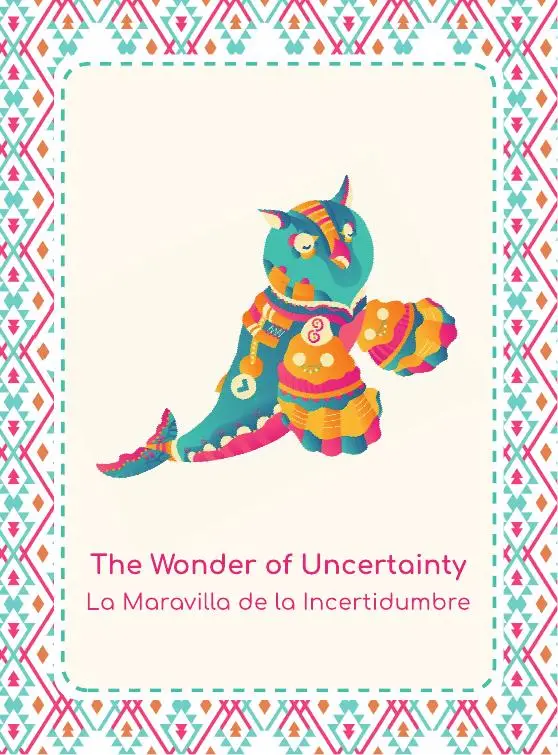
The Wonder of Uncertainty card
48The Wonder of UncertaintyI embrace uncertainty as the doorway to wonder.

The whole failure of the seeker is Inadequacy, the conviction that a man as poor and unworthy as he is cannot deserve the prize, and the real gem flies while he argues. The remedy Kumbha draws out is Resourcefulness, trusting the wealth already within reach, and Wisdom is the sight that tells the jewel from the glittering counterfeit seized in its place.

  1. Shadow · what you avoidInadequacy

    Inadequacy speaks at the very moment of arrival: “I am but a poor and honest man… it is impossible that so miserable a wretch, could ever be blessed with this masterpiece of perfection” (VI.1.88.14), and he never stretches out his hand.

  2. Gift · what is hidden in itResourcefulness

    Resourcefulness is Kumbha's decoding: the gem was never far away, it is the relinquishing of error, already in the king's hand until he “let slip the precious gem of resignation” (VI.1.90.19).

  3. Essence · what you embodyWisdom

    Wisdom is seeing the glass as glass, the bauble set before him “by the invisible hands of the siddha” to deride his folly (VI.1.88.20), and knowing that “the thoughts constitute the mind” which seeks it (VI.1.90.15).

Here is The Wonder of Uncertainty, and a seeker who stood before the wish-gem asking whether he deserved it. Not knowing is allowed. Reaching out anyway is allowed too.

— Felicia
Today’s contemplation

If the seeker doubted the real gem and felt certain only about the glass, where is your certainty pointing at glass, and what real good waits inside your uncertainty?

To close the night

Tonight, write one honest sentence about something good within your reach that you have told yourself you do not deserve.

The Ally Journey · about 15 minutes

Light trance, eyes open if you prefer. For the full, deeper script, see “The practice” above and its cautions.

  1. Threshold: three slow breaths, hands resting open on your thighs. Let the palms be soft and slightly warm.
  2. The tale in one line: a seeker finally finds the wish-gem, doubts he deserves it until it flies away, then seizes a piece of glass with total certainty (VI.1.88, 90).
  3. Meet the card: look at the art of The Wonder of Uncertainty and let one detail draw your eye. Read the affirmation aloud: “I embrace uncertainty as the doorway to wonder.”
  4. Shadow: this week, when did ‘I am too small for this’ make you hesitate before something good, a compliment, an invitation, rest, help? Name the moment and the sentence you said to yourself.
  5. Gift: with eyes open, let one hand slowly close as if around a warm gem, while the doubting voice speaks and you do not obey it. Feel its weight. Notice it can be yours.
  6. Essence: rest for three breaths in Wisdom, the clear sight that knows gem from glass. On each out-breath say: “I embrace uncertainty as the doorway to wonder.”
  7. Return: bring the hand to the heart, then feel both feet and both hands, look around with eyes fully open. Write tonight's honest sentence.

The 30-day Bond

Uncertainty is wonderful; certainty is the illusion: today, which gem did you let yourself hold?

The Sister · Chiyo

Ainu · Hokkaido, Japan · Iyaiyo Kamuy

Visit Chiyo, the Ainu storyteller and spirit-keeper of Hokkaido, who knows that a good story tells you what you hold before you can doubt it, just as Kumbha's parable did for the king.

Guided Meditation

#48 · The Wonder of Uncertainty

Voice & guidance: Prof. Luis Miguel GallardoWatch on YouTube (ES also available)
For facilitatorsA session with “The Wish-Gem and the Piece of Glass” and The Wonder of Uncertainty

Aim. To help the client recognise the voice of not-deserving at the threshold of a real good, and to let them receive it while discerning the substitutes they grab instead.

ITM 3 Gift Discovery. The tale's movement is from a doubt-loop to the discovery that the gem is within reach (VI.1.88.8–14; 90.19), which is the threshold of Gift Discovery.

The session (60–75 min)

  1. Arrival and Umbral: three breaths; ask what good thing has recently arrived, or nearly arrived, in the client's life (8 min).
  2. Telling the tale: the four-minute version of both halves, the gem that flies and the glass that is seized, told without Mitra's verdicts of ‘fool’ and ‘folly’; point to the tale page (5 min).
  3. The card: show The Wonder of Uncertainty, read Shadow → Gift → Essence and the affirmation; ask whether certainty or doubt feels safer (7 min).
  4. Shadow inquiry: write down the client's own doubting sentences, word for word, as the seeker's were (‘Is it real? Will it fly? I am too small for this’), and ask whose voice each one sounds like (12 min).
  5. Trance practice: “Taking the Gem”, the full guided script on the tale page, at light depth; let the hand reach out slowly and let any substitute ‘glass’ be set down gently (18 min).
  6. Gift and Essence integration: name one real good to receive this week and one substitute reward or harsh discipline to set aside (12 min).
  7. Closing and Bond: hand to heart, count up and re-alert; set the 30-day Bond (8 min).

Integration questions

  • What happened in your body when the hand finally closed around the gem?
  • What piece of glass have you been holding in its place, and what has it cost you?
  • Which good thing will you let yourself receive this week without first proving that you deserve it?

In a circle

For 8–20 people, tell the parable and pause at the moment the seeker hesitates, inviting everyone to finish his doubting sentence silently in their own words. Pass a smooth stone or glass bead around the circle: each person holds it for one breath and, if they wish, names a good thing they are learning to receive. Guide “Taking the Gem” at light depth for the whole circle. Close in pairs, each person naming one substitute they will set down this week, then say the affirmation together.

Cautions

  • Mitra's text is harsh on the seeker (‘fool’, ‘folly’); with depressed or shame-prone clients, tell the parable without the verdicts.
  • Omit the line that calls austerity a ‘suicide’ of the soul with any client at risk of self-harm.
  • Do not use the story to encourage abrupt renunciation of possessions or relationships; in the text that is precisely the counterfeit's effect.

Training and certification in the Meta Pets Method: metapetsworld.org/facilitators ↗

The correspondence between tales and Meta Pets is contemplative: the Yoga Vāsiṣṭha does not contain the Meta Pets; each tale enacts its ally’s arc. Felicia is an artificial-intelligence companion; her words are contemplative reflections, not clinical advice.

The song

From the cycle The Sixty-Four Tales

The Gem and the Glass

na karmaṇā na prajayā dhanena / tyāgenaike amṛtatvam ānaśuḥ

Title: The Gem and the Glass Título: La gema y el vidrio

Figure: The rich man who won the wish-gem and doubted it, told by Kumbha to Śikhidhvaja: "the same man is thyself"

Where in the text: Book VI (first half, Nirvāṇa-prakaraṇa), Mitra chapters 88 (the parable) and 90 (its interpretation)

Hypnotic phenomenon the song enacts: ABS and HAL: the doubts circle in waltz time, one per bar, absorbing the singer until "so miserable a wretch" lands on the downbeat and the gem is gone; then the siddha's glass returns on the same melody, a bright detuned copy, and is taken without a single question.

Mantra: na karmaṇā na prajayā dhanena / tyāgenaike amṛtatvam ānaśuḥ (न कर्मणा न प्रजया धनेन त्यागेनैके अमृतत्वमानशुः) Source: Kaivalya Upaniṣad, verse 3 (the same line stands in the Mahānārāyaṇa Upaniṣad). Meaning: "Not by works, not by offspring, not by wealth: by letting go alone have some reached the deathless."


Lyrics (English)

Performance: a waltz. Verse 1 is long and patient, the labour before the gem. The gem's theme enters on beat one of its last line. In verse 2 each doubt takes one bar and climbs a step; the gem leaves on the downbeat of "wretch". In verse 3 the same theme returns on a bright, slightly detuned instrument: the glass.

Verse 1 Skilled in the arts and skilled with arms, he poured out prayers and rites and years like the sea-fire drinking the sea; and his zeal won at last: the wish-gem lay before him, ready for his hand.

Verse 2 Is it a gem? Is it that gem? Touch it? Will it fly? Will I stain it? No one wins it in this life. How could my fortune rise so soon? I'm a poor man, of no account, so miserable a wretch —

Chorus It lay in full view, in the open; he never stretched out his hand. He hung in the balance a long time, and it flew like an arrow from the string.

Verse 3 He called it back. There lay a glass with the same false glare, set down by a siddha's invisible hands. No doubt now: he gave it all away, left country, house and kin, and in the empty forest the glass brought every calamity.

Chorus It lay in full view, in the open; he never asked if it was true. The rope was a snake, the sand was a sea, the moon in the water a second moon.

Bridge — mantra, hushed choir na karmaṇā na prajayā dhanena tyāgenaike amṛtatvam ānaśuḥ (not by rites, children, wealth: by letting go, some reached the deathless)

Outro — Kumbha to the king That man is you, my king. The gem is letting errors go; the glass, the austerity you chose. Open the hand that holds the glass: the open hand is the gem. Your house and kin were never the glass. Keep it in your breast, and go home.


Letra (castellano cantable)

Interpretación: un vals. El verso 1 es largo y paciente: el trabajo antes de la gema. El tema de la gema entra en el primer tiempo de su último verso. En el verso 2 cada duda ocupa un compás y sube un escalón; la gema se va en el primer tiempo de "desdichado". En el verso 3 vuelve el mismo tema en un instrumento brillante y algo desafinado: el vidrio.

Verso 1 Diestro en las artes, diestro en las armas, derramó rezos y ritos y años como el fuego del mar que se bebe el mar; y su celo venció por fin: la gema de los deseos, ante él, al alcance de la mano.

Verso 2 ¿Es una gema? ¿Es esa gema? ¿La toco? ¿Se irá volando? ¿La mancharé? Nadie la gana en esta vida. ¿Cómo iba a subir tan pronto mi suerte? Soy un pobre hombre, sin cuenta, un desdichado tan miserable…

Estribillo Estaba a la vista, al descubierto; nunca alargó la mano. Colgó en la balanza mucho tiempo, y voló como la flecha de la cuerda.

Verso 3 La llamó otra vez. Allí había un vidrio con el mismo falso fulgor, puesto por las manos invisibles de un siddha. Ya no dudó: lo regaló todo, dejó patria, casa y parientes, y en el bosque vacío el vidrio le trajo todas las desgracias.

Estribillo Estaba a la vista, al descubierto; nunca preguntó si era verdad. La cuerda era serpiente, la arena era mar, la luna en el agua, otra luna.

Puente — mantra, coro en voz baja na karmaṇā na prajayā dhanena tyāgenaike amṛtatvam ānaśuḥ (ni por ritos, ni por hijos, ni por riqueza: soltando, algunos alcanzaron lo inmortal)

Final — Kumbha al rey Ese hombre eres tú, mi rey. La gema es soltar los errores; el vidrio, la austeridad que escogiste. Abre la mano que sujeta el vidrio: la mano abierta es la gema. Tu casa y tu gente nunca fueron el vidrio. Guárdala en el pecho, y vuelve a casa.


One line to carry

EN: Open the hand that holds the glass: that is the gem. ES: Abre la mano que sujeta el vidrio: esa es la gema.


Libreto note

A waltz for the moment the good thing finally arrives and cannot be received. The rich man labours years for the wish-gem; it lies before him, ready for his hand, and he cannot believe it: is it real, will my touch soil it, how could a man like me? The doubts climb one bar at a time until "so miserable a wretch" falls on the downbeat and the gem flies like an arrow from the string. A siddha sets down a piece of glass, and the same tune, detuned, is welcomed without a question. Kumbha names the man: you. The gem is letting go. The hand that opens is the hand that holds it.


Source check

Source check (Mitra, Book VI first half)

  1. The rich man "skilled in arts, as he was practiced in arms … trained up in all dealings"; his pujas and rites "as the submarine fire wants to devour the waters"; "there is nothing which may not be effected by the ardent zeal of man"; the stone "lying before him, and ready to be grasped in his hand" — ch. 88, vv. 2–6.
  2. The doubts: "Whether this stone is gem or not … shall I touch it or not, for I fear lest it fly away from my touch or be soiled by it"; no one obtains it in this life; "How could the tide of my fortune run so high at once"; "I am but a poor and honest man … so miserable a wretch"; "he did not even stretch out his hand"; the gem flies "as the shaft flies from its string" — ch. 88, vv. 9–17.
  3. "A brittle piece of glass, shining with its false glare … placed in his presence by the invisible hands of the siddha"; the deluded mind "sees the serpent in the rope and views the desert land as the watery expanse … and spies another moon in the sky in the reflexion of the true one" — ch. 88, vv. 19–22.
  4. He gives away all he has, finds country, house and relatives useless, enters "an uninhabited forest", where the false gem "loaded him all imaginable calamities" — ch. 88, vv. 23–26.
  5. The interpretation: "the same man is thyself"; "it is relinquishing of errors, which is said to be the philosopher's stone"; "After you have let slip the precious gem of resignation from your hand, you have chosen the false glossy gewgaw of austerity"; "store its purport in the casket of your breast" — ch. 90, vv. 3, 5, 19, 27.

Read the full text

Source: Vihari-Lala Mitra, The Yoga-Vasishtha Maharamayana of Valmiki (1891–99), public domain.

Collaborate on this research

Researchers, clinicians and institutions are welcome to write. Replication, data-sharing and site partnerships for the trials in progress are all open conversations.

Educational and scholarly content. Hypnotherapy and regression material is complementary and not a substitute for medical or psychiatric care.