ICEF

Tale 29 · The Vāsiṣṭha Atlas

The Stone: The Stony Sheath of the Soul

Nirvāṇa · first half · Mitra VI.1.46 · 2,107 words

Every lotus carved in stone is still the stone.

Bhūmikā 6 · Padārthābhāvanī (melting of objects)DeepYour ally · The Cresting Wave

The essence

Rāma has understood the bel fruit as the compact intellect; Vasiṣṭha adds a second image. Somewhere there is a vast block of stone, bright, cold and smooth, that never wears away, and within its bosom lies a clear lake of open lotuses, water-lily buds, plants of every habit and conch shells. Rāma says he has seen it: the sālagrāma in Viṣṇu's shrine. Vasiṣṭha corrects him: he means the unperforated, hollowless stone of the divine mind, which contains the universe “as nothing” — ideas, not substances. As a carved lotus is not separate from the stone, no part of existence is separate from the intellect; the changes of the worlds do not make their container changeable, for “the container is not necessarily of the nature of its contents”. Seen truly, all motion is as fixed as figures carved in rock, “somnolent in the Divine mind”. The parable gives an anchor of stillness that does not deny content.

What it teaches

  1. 01

    The container is not of the nature of its contents (VI.1.46.26): turbulent thoughts do not make turbulent the awareness that holds them.

  2. 02

    Change can be read as development or as illusion, and both readings are allowed (VI.1.46.30); the healer can meet a client in either frame.

  3. 03

    Distress is coloring added to an uncolored ground: the fanciful mind paints its pictures on the crystal rock of the soul (VI.1.46.20).

  4. 04

    A sacred symbol can point or imprison: Rāma's sālagrāma must be exchanged for the “unperforated and hollowless stone” of mind (VI.1.46.13–14); symbols help until they are taken literally.

The Vāsiṣṭha Atlas

This tale’s coordinates

The wound and its virtue

Rāma shrinks Vasiṣṭha’s image to the sālagrāma he once saw in Viṣṇu’s shrine (VI.1.46.14), and the parable sets out to name that limitation: the mind taking a part for the whole. The virtue is Ease, seeing worlds revolve and scenes change without needing to deny them or obey them, since ‘the container is not necessarily of the nature of its contents’ (VI.1.46.26); the secondary note is belonging, no carved lotus ‘set apart’ from the stone (VI.1.46.22).

What it trains

The stone holds lotuses, lilies and every kind of plant without becoming any of them (VI.1.46.8; VI.1.46.26), an image of a self that stays coherent across every state it contains.

In other yogas

  • Patañjali · Yoga Sūtra · YS 4.18

    Patañjali holds that the mind’s fluctuations are always known because their witness does not change; Vasiṣṭha’s stone, which contains the revolving worlds without becoming changeable (VI.1.46.26), is the same claim carved in rock.

  • Bhagavad Gītā · BG 9.4–6

    Kṛṣṇa says all beings rest in him yet he does not rest in them, as the great wind moves always within space; the container that is not of the nature of its contents is the Gītā’s paradox in another image.

  • Buddhist absorption · MN 10

    Contemplation of mind in the Satipaṭṭhāna knows a mind with craving as with craving and a mind without it as without it, adding nothing; it is the working form of Vasiṣṭha’s stance, contents fully seen and never mistaken for the knowing that holds them.

IEAF: Integrative Emotional Alchemy Framework (Gallardo, Frontiers in Psychology, 2026). FP20: the Fundamental Peace Scale. ITM: the Integrative Transformation Model. Parallels in other yogas are contemplative correspondences, not claims of influence.

The tale

Rāma tells Vasiṣṭha that he has understood the parable of the bel fruit: it stands for the compact intellect, single and identical with itself, in which the personalities of I, you, this and that form one plenum with not the least difference between them. Vasiṣṭha agrees, with a refinement. The intellect is like the bel fruit that contains the universe as its kernel, yet not literally so, for the world decays and dissolves while the mind of God does not. It is better likened to the hard coat of a pepper seed with its soft pith inside, or to a block of stone in which sculptured figures lie peacefully sleeping. And he tells another story.

There is a huge block of stone somewhere, as thick and solid as it is big, bright and glossy, cold and smooth to the touch; it never wears out and never grows dark or dim. Within its bosom lies a limpid lake full of open lotuses and countless buds of water-lilies. Other plants grow there too, some with long, broad leaves and some with jointed foliage; flowers with heads lifted or bowed, petals hanging before them; some on a common stalk and some apart; some hidden and some in view; some with roots of fibre, some rooted at the top, some without roots at all. Conch shells lie about them, and “unnumbered diseases also strewn all about.”

Rāma says this is true: he has seen such a stone on his travels, the sālagrāma kept in the shrine of Viṣṇu amid a bed of lotus flowers. Vasiṣṭha replies that Rāma has indeed seen that stone and knows its inside; but does he know the unperforated and hollowless stone of the divine mind, which holds the universe in its concavity and is the life of all living beings — not the dull, lifeless, hollow stone that people worship as its emblem? The stone he means is marvellous and supernatural: it contains all things in its “voidless bosom” as nothing, as ideas and not substances. It is called a stone for its solidity, cohesion and indivisibility. Dense and without pores as it is, it holds all the worlds as space holds the air; there is no hole in it that something does not fill.

As men paint lotuses and conch shells on blocks of stone, the fanciful mind paints its pictures on the solid rock of the soul, which in itself is a pure crystal. All things stand in the world as figures carved on the breast of a stone, seemingly separate though raised from the same relief. The carved lotus is not distinct from the stone; formal creation is not separate from the formless intellect. The revolving worlds neither rise nor fall in it; their changing scenes do not prove the container changeable, because the container need not share the nature of its contents. All changes sink back into it as waves into the sea, and the only change observable in the supreme intellect is its absorption of all finite changes into its infinity.

Vasiṣṭha allows two readings: the divine unfolds as a seed into stem, flowers and fruit, condensing slowly into a compact world; or the world is a display of māyā, like water in a mirage. Since intellect and dull matter cannot combine, the ideal world is like marks inscribed in a stone, marks under marks — the three worlds lying one beneath another in the womb of the unity of God, like the sleeping, silent lotuses and conches carved in a rock.

Nothing in the course of the world rises or sets; everything is as fixed as an inscription. The figures in a stone have no action or motion of their own, and the agents of the world have none of theirs. All things are filled with the essence of God and “remain as somnolent in the Divine mind”, motionless as carvings asleep in a hollow stone. Variety and change belong to a mistaken view; considered in the true light, Vasiṣṭha concludes, neither body nor change presents itself to sight.

The text speaks

Passages from Mitra’s translation (1891–99), cited by book, chapter and verse.

“There are many full blown lotuses, and unnumbered buds of water lilies, growing amidst the limpid lake of water, contained within the bosom of this wondrous stone.”
VI.1.46.8The central image: living multiplicity inside solid stillness.
“but do you know the unperforated and hollowless stone of the divine mind, that contains the universe in its concavity, and is the life of all living beings”
VI.1.46.14Vasiṣṭha redirects Rāma from the cult object to the mind it symbolizes.
“As the carved lotus is not distinct from the body of the stone, so no part of existence is set apart from the substantiality of the divine intellect; which represents its subtile ideas in their condensed forms.”
VI.1.46.22Non-separation of content and ground, the basis of the stability anchor.
“The revolution of worlds and their changing scenes, that are seen to take place in their situation in the Divine Intellect, do not prove the changeableness of the all containing Infinite Mind, because its contents of finite things are so changeable in their nature. (The container is not necessarily of the nature of its contents).”
VI.1.46.26The witness principle stated as a logical rule.
“All things are filled with the essence of God, and remain as somnolent in the Divine mind; the various changes and conditions of things that appear to us in this world, are the mere vagaries of our erroneous fancy”
VI.1.46.40Mitra's trance-adjacent word “somnolent” for the stillness of all forms.

What the trance sees

MET

Therapeutic metaphor / reframe

VI.1.46.7–16

In the textA stone “bright and glossy, and cold and smooth to touch” holds a lake of lotuses within it; Vasiṣṭha explains it is “figuratively called a stone from its solidity, cohesive impenetrability and indivisibility”.

In the clinicA stability metaphor that unites solidity and inner life, comparable to the grounding and container images used in the stabilization phase of trauma therapy.

CAT

Catalepsy

VI.1.46.38–41

In the text“As the figures in the stone, have no action or motion of their own; so the agents of the world have no action of theirs”; all actions are “as motionless in mind of God, as the carved lie asleep in the hollow of a stone.”

In the clinicCataleptic stillness as an image and a convincer: the felt immobility that accompanies deep trance, here suggested through figures that are “asleep” in rock.

WIT

Witness position / dis-identification

VI.1.46.26–27

In the textThe changes of the worlds “do not prove the changeableness of the all containing Infinite Mind… (The container is not necessarily of the nature of its contents)”; its only change is “its absorption of all finite changes into its infinity.”

In the clinicSelf-as-context in Acceptance and Commitment Therapy (Hayes, Strosahl & Wilson 1999) and Deikman's observing self (1982): awareness as the unchanging space in which changing contents occur.

Read upward — stage 1 at the bottom, stage 7 at the top

  1. Integration zone
    Perceptual shift — the boundaries of things soften; consciousness expands past its usual partitions.

A note on what this map claims. The alignment between stages of knowledge and trance depths is a clinical map — a heuristic correspondence proposed for research, not a claim of identity between contemplative attainment and hypnotic depth.

Bhūmikā 6 · Padārthābhāvanī

The tale ends by melting objects into their ground: “considered in the true and spiritual light, there is neither body nor any change that presents itself to our sight” (VI.1.46.41) — padārthābhāvanī.

Zone · Deep

The stillness the image asks for — forms fixed and “asleep” in the stone (VI.1.46.38–41) — corresponds to the immobility and absence of movement-impulse typical of deep trance, deeper than the medium zone of the first pass.

In Mitra’s words

In Calcutta in the 1890s, the translator chose the vocabulary of hypnotism to name these states. More →

  • sleepingThe intellect resembles the hard coating of the pepper seed, containing the soft substance of its pith inside it, and is likened also to block of stone, bearing the sculptured figures peacefully sleeping in it.VI.1.46.5
  • somnolentAll things are filled with the essence of God, and remain as somnolent in the Divine mind; the various changes and conditions of things that appear to us in this world, are the mere vagaries of our erroneous fancy; for every thing is as fixed and unchanged in the mind of God, as the dormant images on a stone.VI.1.46.40

In the therapy room

Indications

  • Emotional flooding and panic: a stability anchor that does not require suppressing content
  • Rumination: thoughts seen as carved figures that cannot move the stone
  • Clients whose spirituality is attached to a sacred object, as a bridge from symbol to inner referent
  • Preparation for exposure or processing work, as a ground to return to

Cautions

  • Avoid immobility suggestions with clients showing depressive psychomotor slowing, catatonic features or trauma-related freezing
  • Can reinforce emotional numbing in trauma survivors if used as avoidance
  • The doctrine that “the agents of the world have no action of theirs” (VI.1.46.38) should not be used to remove a client's sense of agency or responsibility
From the bookThe full clinical note

Indications. Emotional flooding and panic: an anchor that does not require suppressing content. Rumination: thoughts as carved figures that cannot move the stone. Preparation for exposure or processing, as a ground to return to between sets. Clients whose faith is attached to a sacred object, as a bridge from symbol to inner referent, offered with full respect for the symbol.

How to use it. Build the stone first, then the lake, then let the present content take its place among the flowers; establish lotus in stone as a cue before any difficult work, and return to it whenever arousal rises beyond the window of tolerance.

Cautions. Avoid immobility suggestions with clients showing depressive psychomotor slowing, catatonic features, or trauma-related freezing; for them, make the stone a warm one that breathes, and leave the fingers free to move. With trauma survivors the anchor can slide into numbing; watch for flattening rather than settling. Never use "the agents of the world have no action of theirs" (VI.1.46.38) to remove a client's sense of agency or responsibility.


The practice

The Lotus in the Stone: A Stability Anchor

  1. Sit as a stone: feel weight, coolness, smoothness, a surface that never wears away (VI.1.46.7).
  2. Inside, find a still lake with lotuses — open, in bud, bowed, lifted, some hidden and some in view (VI.1.46.8–10).
  3. Let each present thought or feeling take its place as one carved flower among the others.
  4. Recognize that the carved lotus is not distinct from the stone (VI.1.46.22–23); nothing inside can leave or crack it.
  5. Let even movement appear as relief carved in rock, marks under marks (VI.1.46.34–39); allow the body to grow pleasantly still.
  6. Rest as the stone that is not of the nature of its contents (VI.1.46.26).
  7. Return: let stone become body again — warmth, small movements of fingers and toes, a deeper breath, eyes opening — keeping “lotus in stone” as a cue for later.

Practise with a qualified professional if you have a history of dissociation, trauma or psychosis.

From the book · to be read aloudThe full guided script

The Lotus in the Stone: A Stability Anchor

Read slowly; twelve to fifteen minutes.

Before you begin. This practice goes into stillness. Do not use it alone if you are severely depressed, if you have ever had catatonic symptoms, or if stillness tends to make you freeze or go numb; work with a clinician, and keep your fingers free to move throughout. Sit, supported. Never practise while driving or operating anything.

How to return at any moment. Move your fingers, press your feet down, open your eyes and name three things you see.


Sit, and feel your weight. Let it sink, as a stone rests on the earth.

Feel the surface of the body as the surface of a great stone: cool, smooth, solid. It does not wear away. It does not grow dim.

Now find, inside the stone, a lake. Clear, limpid, still. Lotuses float on it, some open, some in bud. Some flowers lift their heads; some bow. Some are hidden; some are in view.

Whatever you are feeling now, let it take its place among them: a worry here, a sadness there, a pain, a memory. Each one a flower. Even an illness has its place in the lake. None of them is outside the stone.

Notice: the carved lotus is not separate from the stone. Nothing inside can leave it. Nothing inside can crack it.

Let the flowers change if they change. Let them open, close, bow. The stone is not of the nature of what it holds.

And let the body grow pleasantly still, as figures rest in rock. Only as still as is comfortable. The fingers can move whenever they like.

Rest as the stone.

(Silence: two to four minutes.)


Now let the stone warm. Let it become a body again, breathing.

Move the fingers. Move the toes. Take a fuller breath. Roll the shoulders once.

I will count from one to five; on five the eyes open, alert and steady. One, warmth returning. Two, the breath full. Three, the sounds of the room. Four, a stretch. Five, eyes open, here, now.

Say your name, the day and the place. Name three things you can see and two you can hear. Stand slowly and walk a few steps before anything else. When the waters rise later, say quietly, lotus in stone.


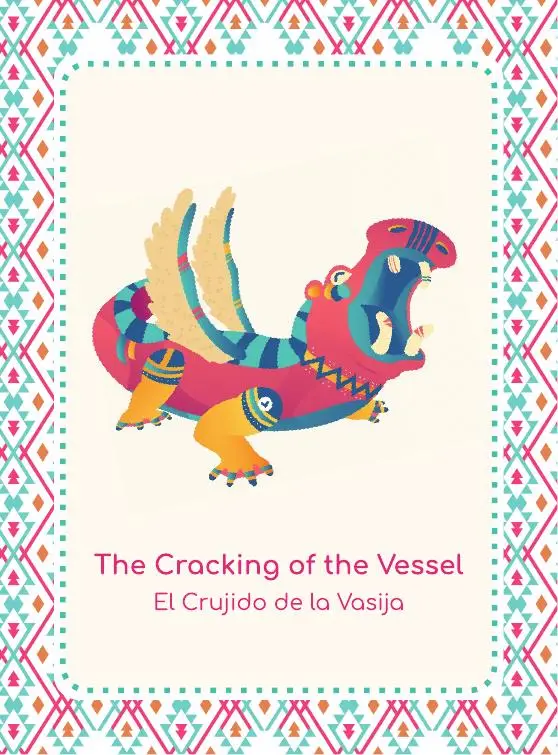
Meta Pets World · Your ally · Meta Pet 60

The stone that is not its carvings

The Cresting Wave card
60The Cresting WaveI ride the cresting wave of change.

Worlds revolve, scenes change, ‘unnumbered diseases’ lie strewn among the lotuses, and Rāma first shrinks the image to the small stone he once saw in a shrine: the confinement that is The Cresting Wave’s Shadow, Limitation. Vasiṣṭha’s Realism neither denies the changes nor obeys them: the container is not of the nature of its contents. And since no carved lotus is set apart from the stone, the arrival is Justice, an order in which every part belongs.

  1. Shadow · what you avoidLimitation

    Limitation is taking the image for the whole: Rāma knows the sālagrāma in Viṣṇu’s shrine, but Vasiṣṭha asks, ‘do you know the unperforated and hollowless stone of the divine mind, that contains the universe in its concavity’ (VI.1.46.14)?

  2. Gift · what is hidden in itRealism

    Realism is seeing the changes clearly without granting them the last word: ‘The revolution of worlds and their changing scenes… do not prove the changeableness of the all containing Infinite Mind… (The container is not necessarily of the nature of its contents)’ (VI.1.46.26).

  3. Essence · what you embodyJustice

    Justice is the equity of belonging: ‘As the carved lotus is not distinct from the body of the stone, so no part of existence is set apart from the substantiality of the divine intellect’ (VI.1.46.22).

Rough week? Let it be carved, every bit of it: the lotus, the bowed bud, even the sore one. Then lay your palm on the stone underneath. Cool. Smooth. Not cracked. Still yours.

— Felicia
Today’s contemplation

If the wave crests and falls while the ocean never moves, and the carved lotus is never apart from the stone, which change this week are you mistaking for the stone itself?

To close the night

Tonight, write one honest sentence about a limit you met today and what stayed steady beneath it.

The Ally Journey · about 15 minutes

Light trance, eyes open if you prefer. For the full, deeper script, see “The practice” above and its cautions.

  1. Threshold. Sit with your weight well into the chair, as heavy and settled as a stone. Three slow breaths.
  2. The tale in one line: Vasiṣṭha shows Rāma a stone in which every lotus, bud and shell is carved, and none is ever apart from the stone (VI.1.46).
  3. Meet The Cresting Wave. Look at the card’s art, follow the wave with your eyes, and read: ‘I ride the cresting wave of change.’
  4. Shadow. Where this week did a change or limit feel like a wall: a diagnosis, a rule, a ‘no’, the clock? Name it simply, without arguing with it.
  5. Gift. Picture a still lake inside a smooth stone, lotuses open and in bud, some bowed. Let that limit, and each worry, take its place as one carved flower among the others. Notice: none of them cracks the stone.
  6. Essence. Rest for three breaths as the stone that holds everything and is not any of it. Then say the affirmation slowly.
  7. Return. Let stone become body again: warmth, small movements of fingers and toes, a deeper breath. Open the eyes fully, keeping ‘lotus in stone’ as a cue. Write the honest line.

The 30-day Bond

The wave crests and falls; the carved lotus never leaves the stone: what in me has never moved?

The Sister · Theodora

Greek Orthodox · Mount Athos, Greece · Doxa Patri

Visit Theodora, the Greek Orthodox nun and iconographer, who knows that an image on wood or stone points beyond itself; her ‘Doxa Patri’ gives thanks for the ground that holds every figure.

Guided Meditation

#60 · The Cresting Wave

Voice & guidance: Prof. Luis Miguel GallardoWatch on YouTube (ES also available)
For facilitatorsA session with “The Stone: The Stony Sheath of the Soul” and The Cresting Wave

Aim. To install a stability anchor that lets the client hold change, limitation and strong feeling without suppressing them and without being defined by them.

ITM 2 Conscious Recognition. The anchor works through Conscious Recognition: seeing a thought or a limit as a carved figure, a content, rather than the stone (VI.1.46.26), is the step on which later work rests.

The session (60–75 min)

  1. Arrival and Umbral: three breaths; the client names the change or limitation that feels most confining now (8 min)
  2. Tell the tale in a 3-minute version: Rāma’s reading of the bel fruit, the stone with its lake and lotuses, the sālagrāma, the stone of the divine mind; point to the tale page for the full retelling (5 min)
  3. The card: The Cresting Wave’s art, affirmation and koan; link the ocean that never moved to the stone that never cracks (7 min)
  4. Shadow inquiry on Limitation: separate what is truly fixed from what is felt as fixed; note which limits are realistic to accept and which can be worked with (13 min)
  5. Trance practice: ‘The Lotus in the Stone: A Stability Anchor’, following the full guided script on the tale page, at light to medium depth only; offer stillness as comfort, never as immobility, and keep the client’s sense of agency explicit (17 min)
  6. Gift and Essence integration: the client chooses one practical step within the limit and rehearses the ‘lotus in stone’ cue for moments of flooding (12 min)
  7. Closing and Bond: assign the 30-day Bond with the varied koan; warm the body back from stone, count up, open the eyes (6 min)

Integration questions

  • When your limit became one carved flower among many, what happened to its weight?
  • What, in your own words, is the ‘stone’ that was there before this week and will be there after it?
  • Which practical step within the limit now looks possible?

In a circle

In a circle, bring a smooth stone for each person, or one large stone passed round during the Umbral. Tell the tale, then invite everyone to name silently the limit they are living with. Guide the lotus-in-stone image at light depth, inviting each limit to take its place as one carved flower, and end with a warm, active return. Ask people to share in pairs one realistic step within their limit, and close with each person resting a palm on their stone while saying the affirmation together.

Cautions

  • Avoid immobility suggestions with clients showing depressive psychomotor slowing, catatonic features or trauma-related freezing.
  • The image can reinforce emotional numbing in trauma survivors if it is used as avoidance.
  • Never use the teaching that ‘the agents of the world have no action of theirs’ to remove a client’s sense of agency or responsibility.

Training and certification in the Meta Pets Method: metapetsworld.org/facilitators ↗

The correspondence between tales and Meta Pets is contemplative: the Yoga Vāsiṣṭha does not contain the Meta Pets; each tale enacts its ally’s arc. Felicia is an artificial-intelligence companion; her words are contemplative reflections, not clinical advice.

The song

From the cycle The Sixty-Four Tales

Lotus in the Stone

Nityaḥ sarvagataḥ sthāṇur acalo 'yaṃ sanātanaḥ

Figure — The stone with a living lake inside it: Vasiṣṭha, and Rāma, who thinks he has seen it in Viṣṇu's shrine.

Where in the text — Book VI (first half, Nirvāṇa-prakaraṇa), Mitra chapter 46.

Hypnotic phenomenon the song enacts — WIT and CAT: a stone-struck pulse that never varies holds a choir whose chords change one voice at a time — contents moving, container unmoved — until everything lies still as figures asleep in rock, and then rises.

Mantra — Nityaḥ sarvagataḥ sthāṇur acalo 'yaṃ sanātanaḥ (नित्यः सर्वगतः स्थाणुरचलोऽयं सनातनः). Source: Bhagavad Gītā 2.24, second half. Meaning: "It is eternal, everywhere, standing firm, unmoving, ever the same": the stone that "never wastes or wears out" (VI.1.46.7) and holds every carved lotus without turning; the stone that is the mind, not the stone in the shrine.


Lyrics (English)

Performance: the stone-struck pulse never changes, from the first bar to the last. The choir sings in long held chords; between lines only one voice moves. Verse 3 is a single voice. In the bridge the mantra is sung on one pitch beneath the moving choir. In the outro the choir stops, the pulse plays alone for a bar, then one bar of silence, then the voices rise.

Verse 1 Somewhere there is a block of stone as big as it is thick and solid, bright and glossy, cold and smooth; it never wears, it never dims. And in the bosom of the stone there lies a limpid lake of water.

Verse 2 Lotuses full blown upon it, water-lily buds unnumbered, heads uplifted, heads cast down, some on one stalk, some apart, some hidden, some in open view, conch shells — and sicknesses — strewn among them.

Chorus Every lotus carved in the stone is the stone. Every shell and every sickness, carved, asleep, and still the stone. The worlds go round inside it, and the stone does not turn.

Verse 3 (one voice: the prince, then the sage) "I have seen it," said the prince, "in Viṣṇu's shrine, on a bed of lotus: the sālagrāma, marked inside." "You have seen it," said the sage, "but do you know the stone with no hole, no hollow, that holds the worlds as nothing, and is the life of all that lives?"

Chorus Every lotus carved in the stone is the stone. The changes sink down into it like waves and drops into the sea: that is the only way it moves, and the stone does not turn.

Bridge (mantra) nityaḥ sarvagataḥ sthāṇur (ever, everywhere, standing fast) acalo 'yaṃ sanātanaḥ (unmoving, ancient: the stone that is the mind)

Outro All that moves lies sleeping in it, still as the carved lie asleep in rock. (pulse alone; one bar of silence) Now rise: the stone is the life of all that lives. The lake is full; the lotuses open, bow, and hide. Go back among them — a lotus, and the stone.


Letra (castellano cantable)

Interpretación: el pulso de piedra golpeada no cambia nunca, del primer compás al último. El coro canta en acordes largos sostenidos; entre verso y verso solo se mueve una voz. El verso 3 es una sola voz. En el puente el mantra se canta en una sola nota bajo el coro que se mueve. En el final el coro calla, el pulso suena solo un compás, luego un compás de silencio, y las voces se alzan.

Verso 1 En algún lugar hay un bloque de piedra tan grande como grueso y macizo, brillante y pulido, frío y liso; no se gasta, no se apaga. Y en el seno de la piedra hay un lago de agua limpia.

Verso 2 Lotos abiertos sobre el agua, capullos de nenúfar sin cuento, cabezas alzadas, cabezas bajas, unos de un tallo, otros aparte, unos ocultos, otros a la vista, caracolas — y dolencias — esparcidas entre ellos.

Estribillo Cada loto tallado en la piedra es la piedra. Cada caracola y cada dolencia, tallada, dormida, y piedra aún. Los mundos giran dentro, y la piedra no gira.

Verso 3 (una voz: el príncipe, luego el sabio) «La he visto», dijo el príncipe, «en el templo de Viṣṇu, sobre lotos: el sālagrāma, marcado por dentro». «La has visto», dijo el sabio, «pero ¿conoces la piedra sin agujero ni hueco, que guarda los mundos como nada, y es la vida de todo lo que vive?»

Estribillo Cada loto tallado en la piedra es la piedra. Los cambios se hunden en ella como olas y gotas en el mar: es su único movimiento, y la piedra no gira.

Puente (mantra) nityaḥ sarvagataḥ sthāṇur (siempre, en todas partes, firme) acalo 'yaṃ sanātanaḥ (inmóvil, antigua: la piedra que es la mente)

Final Todo lo que se mueve duerme en ella, quieto como lo tallado duerme en la roca. (el pulso solo; un compás de silencio) Ahora levántate: la piedra es la vida de todo lo que vive. El lago está lleno; los lotos se abren, se inclinan, se esconden. Vuelve entre ellos: un loto, y la piedra.


One line to carry

EN: The worlds go round in you; the stone does not turn. ES: Los mundos giran en ti; la piedra no gira.


Libreto note

The bel fruit's sister-image, one step deeper. Vasiṣṭha sets a block of stone before Rāma, cold and smooth and never worn, and inside it a living lake: lotuses opening, bowing and hiding, conch shells, even sicknesses, all carved in the one rock. Rāma remembers the sālagrāma in Viṣṇu's shrine; the sage asks, gently, whether he knows the stone with no hollow. For the trance this is an anchor that does not deny what it holds: the contents change, the container does not. A stone-struck pulse that never varies, a choir that changes one voice at a time; the figures sleep, and then you rise and walk among them.


Source check

Source check (Mitra, Book VI first half)

  1. "A huge block of stone… as big as it is thick and solid; it is bright and glossy, and cold and smooth to touch; it never wastes or wears out, nor becomes dark and dim": ch. 46, v. 7.
  2. "Many full blown lotuses, and unnumbered buds of water lilies, growing amidst the limpid lake of water, contained within the bosom of this wondrous stone"; flowers "with their up lifted and down cast heads… some having a combined or common footstalk… some are concealed and others manifest… many without their roots at all"; "a great many conch shells… and unnumbered diseases also strewn all about": ch. 46, vv. 8–12.
  3. Rāma: "I have seen this large stone of sálgráma… placed in the shrine of Vishnu, amidst a bed of lotus flowers"; Vasiṣṭha: "do you know the unperforated and hollowless stone of the divine mind… and is the life of all living beings", which "contains in its voidless bosom all things as nothing": ch. 46, vv. 13–15.
  4. "As the carved lotus is not distinct from the body of the stone"; "the revolution of worlds… do not prove the changeableness of the all containing Infinite Mind"; changes "subside… as the waves and drops of water sink down in the Sea", the only change being "its absorption of all finite changes": ch. 46, vv. 22, 26–27.
  5. All things "somnolent in the Divine mind"; "all actions and motions of things are as motionless in mind of God, as the carved lie asleep in the hollow of a stone": ch. 46, vv. 40–41.

Read the full text

Source: Vihari-Lala Mitra, The Yoga-Vasishtha Maharamayana of Valmiki (1891–99), public domain.

Collaborate on this research

Researchers, clinicians and institutions are welcome to write. Replication, data-sharing and site partnerships for the trials in progress are all open conversations.

Educational and scholarly content. Hypnotherapy and regression material is complementary and not a substitute for medical or psychiatric care.