ICEF

Tale 6 · The Vāsiṣṭha Atlas

Karkaṭī, the Demoness Who Became a Needle

Utpatti · Creation · Mitra III.68–83 · 27,942 words

Hunger made small is still hunger; made wise, it guards.

Bhūmikā 5 · Asaṃsakti (non-clinging)PlenaryYour ally · Transmuting the Past

The essence

Karkaṭī, a giant rākṣasī of the Himalaya whose hunger nothing can fill, performs a thousand years of austerity and asks Brahmā to turn her into an iron needle so that she can slip into living bodies and drink their heart-blood. She becomes Visūcikā, the colic that pierces the intemperate, and in the same breath Brahmā gives the wise a mantra and an imagery protocol against her. The shrunken appetite cannot be satisfied: a needle holds one drop of blood. Remorse drives her back to the mountain, where, standing on her single point for thousands of years with her senses stilled, she passes Indra's test and wakes into knowledge. When Brahmā returns she no longer wants anything; he restores her body anyway and tells her that meditation must be compatible with action. Re-embodied, she tests a king and his minister with paradoxical riddles, is answered, gives them the healing mantra, and ends as the protector worshipped as Maṅgalā. The devourer is not destroyed; she is given lawful work.

What it teaches

  1. 01

    Craving made smaller is not craving made less: the needle-form holds a drop of blood while the hunger stays mountain-sized (III.70.17; III.71.2–3).

  2. 02

    Brahmā issues the affliction and its remedy together: a disorder can be personified, located in the body by touch, imaged as defeated and met with expectant belief in recovery (III.69.13–17).

  3. 03

    Absorption deep enough to still the senses is a stage, not a home: Brahmā requires the meditator to return and make stillness compatible with action (III.75.15–18).

  4. 04

    Time is a product of the mind: calamity stretches one night into twelve years, and an idea turns a twinkling into a kalpa (III.80.43; III.81.49).

  5. 05

    The devouring nature is not exterminated but given lawful work: Karkaṭī ends as a guardian against the very disease she embodied (III.82.29–34; III.83.1–2).

The Vāsiṣṭha Atlas

This tale’s coordinates

The wound and its virtue

Turned into a needle, Karkaṭī finds her new form 'contemptible' and her hunger unsatisfied (III.70.17), and remorse drives her back to the mountain to stand for ages on a single point. Forgiveness here is restoration, not erasure: Brahmā gives back her body (III.75.16), and the former devourer discovers her gift, handing the healing mantra to a king and being worshipped as Maṅgalā, guardian against the very sickness she was (III.83.1–2).

What it trains

The devourer is not destroyed but integrated, and Brahmā insists that 'thy meditativeness must be compatible with thy worldly affairs' (III.75.16): hunger, stillness and service become one coherent self.

In other yogas

  • Buddhist absorption · MN 86

    In the Aṅgulimāla Sutta a killer becomes a monk and then speaks a truth-act that eases a woman's labour; Karkaṭī likewise passes from taking life to giving a healing mantra, and Buddhist lore adds a further echo in Hārītī, the devouring yakṣiṇī who becomes a protector of children.

  • Patañjali · Yoga Sūtra · YS 2.43

    Patañjali says austerity, by destroying impurity, perfects body and senses; Karkaṭī's ages on one point, her senses stilled (III.72.24), burn the hunger away instead of feeding it.

  • Bhagavad Gītā · BG 3.8

    Kṛṣṇa urges prescribed action as better than inaction; Brahmā's counsel that meditation must sit alongside worldly affairs (III.75.16) gives the reformed demoness lawful work rather than a cave.

IEAF: Integrative Emotional Alchemy Framework (Gallardo, Frontiers in Psychology, 2026). FP20: the Fundamental Peace Scale. ITM: the Integrative Transformation Model. Parallels in other yogas are contemplative correspondences, not claims of influence.

The tale

North of the Himalaya lived Karkaṭī, a rākṣasī dark as ink and tall enough to reach half the sky, also called Visūcikā. Her hunger burned like the fire beneath the ocean. She longed to go to Jambudvīpa and devour its people in one swoop, but men are guarded by mantras, medicines and devotion; so she resolved to win power by austerity. She climbed an inaccessible peak, sat with her eyes fixed on one object, and bore heat and cold for a thousand years.

When Brahmā appeared, she saluted him in her mind and asked to have her body turned into an iron needle, thin enough to enter hearts unseen, as scent enters the nostrils. Brahmā read her motive and granted it with a sentence: she would be the colic pain, falling chiefly on the intemperate and on those who live in unhealthy places. In the same speech he gave the wise their defence: a mantra to be worn on the left arm. The sufferer rubs the painful place with that hand, pictures Karkaṭī crushed and driven wailing beyond the hills, and holds the healing moon in his heart, believing himself free of death and disease; his faith, Brahmā says, will heal his pain.

Karkaṭī shrank, from mountain to tree, to man, to cubit, to span, to finger, to needle, and found her mind as bright as a golden needle. As wind she entered the bodies of the gluttonous and the weak, and lurked in dust, stagnant pools, soiled cloth and the pores of the body. But a needle is fed by a thread. Her new form held a drop of blood; her appetite had not shrunk at all. Slipping from fingers, trodden into dirt, she mourned the body she had traded like a precious jewel for a piece of glass.

So she went back to the Himalaya to regain it. She saw her needle-form entering her heart with her breath and was carried by that breath to the summit; she rode inside a young vulture and stepped out of it onto the peak. There she stood on her one point, mouth turned to the sky, a pencil of sunlight through her eye and her shadow her only companions. Indra had the dust of meat blown into her mouth; she would not swallow it. Fire, hail and wind did not move her. Over thousands of years her senses fell still, and her impurity, Visūcī, became purity, Sūcī: she knew the knowable, saw past and future, and felt bliss. The mountain blazed and the worlds trembled; the wind-god Pavana found her and dared not even speak to her.

When Brahmā came to grant a boon, she found she had nothing left to ask. He gave it anyway: take back your body, live, and act within justice; meditation that has become the anaesthesia of a stock and stone must be made compatible with worldly life. She grew back at once into her cloud-like form, cast off her fiendish nature like a snake's slough, meditated six months more, and woke hungry, resolved to eat nothing unlawful. A voice from the wind-god told her: teach the ignorant, and take as food only those who refuse that knowledge.

On a pitch-dark night among the Kirāta hills she met King Vikrama and his minister on their rounds. Rather than eat them, she tested them. She roared; they stayed calm. Then she posed her riddles: what atom is one yet many, void yet not void, moving yet unmoved; to whom is a twinkling a kalpa? The minister and the king answered: it is the atom of consciousness, in which mountains and ages are held, whose idea makes an instant into an age. Her heart cooled like earth under moonlight. She promised to kill no one, gave the king Brahmā's mantra by the river, and accepted his offer: felons for food, meditation on the mountain, visits to court every few years. Freed while living, she guarded the Kirātas from disease and danger. When at last she passed away in meditation, they raised a temple to her as Kandarā, Maṅgalā Devī, the auspicious goddess.

The text speaks

Passages from Mitra’s translation (1891–99), cited by book, chapter and verse.

“Let the patient think the medicinal moon to be seated in his heart, and believe himself to be freed from death and disease; and his faith will save his life and heal his pain.”
III.69.16A complete healing suggestion (image, belief, expected outcome) embedded in the boon itself: the tale's clinical core.
“Her object was to have her food, and not the contemptible form of the pin; her heart desired one thing, and she found herself in another form, that was of no use to her purpose.”
III.70.17The precise mechanism of misdirected craving: the means chosen defeats the end.
“She saw in her mind her form of the needle, entering into her heart with her breathings.”
III.72.3An induction by breath-paced imagery, the turning point from hunting to austerity.
“The holy hermit who is devoted to his purpose, loses in time the motion of his external organs; but obtains by the exercise of his reason, the light of true knowledge in his soul.”
III.72.24Catalepsy and insight named together: the body's stillness accompanies, rather than replaces, knowing.
“I am now a perfect being, and am delivered from my doubts; what blessing therefore is it, that I have need of asking (either for myself or others), beyond this state of beatitude; which I already possess in my peace and tranquility, and the bliss of contentment and self-resignation.”
III.75.3The moment the wish itself falls away; evidence for non-clinging rather than mere restraint.
“But thy meditativeness must be compatible with thy worldly affairs, and the body like the breeze, is nourished best by its constant agitation.”
III.75.16Brahmā's instruction to emerge: the text's own warning against remaining in withdrawal.
“It is calamity that prolongs the course of time, as our prosperity on the otherhand diminishes its duration; as the short space of a single night, appeared as a period of twelve long years to king Haris Chandra in his misery.”
III.80.43An explicit statement of affect-driven time distortion.
“It is the cogitation of one’s own mind that is best guide in all things or else, O Ráma! there is no other better preceptor for men.”
III.74.28Vasiṣṭha's moral: the inner inquiry, not the boon-giver, is the teacher.

What the trance sees

IND

Induction

III.68.17; III.72.3–4

In the textShe sits on the summit 'with her steadfast eyeballs ... fixed on one object'; in the second austerity she 'saw in her mind her form of the needle, entering into her heart with her breathings' and is wafted by that breath to the peak.

In the clinicEye-fixation induction (Braid's Neurypnology, 1843) followed by breath-paced imagery, the two most common entry routes in clinical hypnosis.

CAT

Catalepsy

III.72.23–24; III.75.2; III.75.8

In the text'the feet of the firm ... never move from their place'; she 'loses in time the motion of his external organs'; when Brahmā comes she 'wanted the external organs of sense' to speak and is 'quite abstracted from all external sensations, and the use of her bodily organs.'

In the clinicFull-body catalepsy with loss of voluntary speech, the profound unresponsive state Dave Elman called the Esdaile state (Hypnotherapy, 1964).

ANA

Analgesia / anaesthesia

III.72.21–22; III.74.2–4; III.75.15

In the textFire, hail, lightning and burning sun do not move her; Brahmā names the state 'the anaesthesia of thy meditation (to the state of a stock and stone).'

In the clinicHypnotic analgesia (Hilgard & Hilgard, Hypnosis in the Relief of Pain, 1975); Mitra's word recalls Esdaile's mesmeric surgeries in India (1846), a generation before his translation.

DIR

Direct suggestion

III.69.15–17

In the textThe sufferer rubs the painful part, imagines the colic crushed and driven beyond the hills, thinks the medicinal moon seated in the heart and is to 'believe himself to be freed from death and disease; and his faith will save his life and heal his pain.'

In the clinicDirect healing suggestion reinforced by touch and imagery and powered by response expectancy (Kirsch, 1985); structurally a pain-relief script for visceral pain.

MET

Therapeutic metaphor / reframe

III.69.14–15; III.82.11–12

In the textThe illness is given a name, a home 'in the north of the snowy mountain' and a face, so that it can be addressed and banished; the king later seeks the mantra because colic 'is not removed from the hearts of men by any medicine.'

In the clinicExternalization of the problem (White & Epston, Narrative Means to Therapeutic Ends, 1990): the symptom personified becomes something the patient can act upon.

TEST

Trance testing / ratification

III.72.18–19; III.77.25–33

In the textIndra has meat-dust thrown into her mouth 'for the purpose of frustrating the efficacy of its devotion'; she does not swallow it. Later she herself resolves to 'make a trial of them' before deciding whether to eat the king and minister.

In the clinicChallenge suggestions used to ratify depth, as in the Stanford Hypnotic Susceptibility Scales (Weitzenhoffer & Hilgard, 1959): the state is confirmed by what the subject does not do.

PARA

Paradox / confusion technique

III.79.2–4; III.79.10

In the text'What is that thing which is a void yet no-void, which is something yet nothing?' 'What is it that moveth unmoved and unmoving'; 'To whom is a twinkling of the eye, as long as a Kalpa millennium.'

In the clinicParadoxical riddles comparable to Erickson's confusion technique (1964); here the paradox is posed by the client-figure, and its resolution cools her own doubt (III.82.2).

TD

Time distortion

III.80.39–43; III.81.47–49

In the text'Sometimes a twinkling—instant represents a Kalpa'; 'the short space of a single night, appeared as a period of twelve long years to king Haris Chandra in his misery'; 'It is the idea only that makes a twinkling, appear a kalpa or many.'

In the clinicTime distortion (Cooper & Erickson, Time Distortion in Hypnosis, 1954), including its affective direction: suffering expands subjective time, which is why pain work often uses suggested time condensation.

OBE

Out-of-body / thought-body travel

III.72.4; III.73.35–42

In the textShe is 'wafted by her vital breath to the top of the hill'; 'the living soul of Súchí' enters the heart of a young vulture, is carried to the mountain and 'issued from the body of the bird, in the manner of the spirit coming out of it.'

In the clinicThought-body relocation imagery of deep hypnosis; clinically, the imagined removal of the self to another place is used in dissociative pain and distress techniques while the body remains.

EMG

Emergence / re-alerting

III.75.16–18; III.76.4–5; III.82.58

In the textBrahmā insists meditation be compatible with worldly affairs; 'Being roused to her sense, she felt the pains of her thirst and hunger'; thereafter she rises from devotion every four to seven years to visit the court.

In the clinicRe-alerting and reorientation with integration into ordinary life; the tale also names the risk of using absorption to avoid living, akin to what Welwood called spiritual bypassing.

Read upward — stage 1 at the bottom, stage 7 at the top

  1. Integration zone
    Post-trance integration — sustained non-reactivity carried into behaviour; what was seen in depth becomes how one lives.

A note on what this map claims. The alignment between stages of knowledge and trance depths is a clinical map — a heuristic correspondence proposed for research, not a claim of identity between contemplative attainment and hypnotic depth.

Bhūmikā 5 · Asaṃsakti

In her second austerity she knows 'the truly knowable' (III.72.26) and, offered a boon, finds nothing to ask (III.75.3–7); she then lives 'as a liberated being' while acting in the world (III.82.60), which is non-clinging amid activity.

Zone · Plenary

Her austerity reaches total sensory abstraction: she cannot use her organs to answer Brahmā and is 'quite abstracted from all external sensations' (III.75.2, 8), the state Brahmā calls the anaesthesia of a stock and stone (III.75.15); the tale's teaching is the emergence from it.

In Mitra’s words

In Calcutta in the 1890s, the translator chose the vocabulary of hypnotism to name these states. More →

  • anaesthesiaIf by thy constant practice of Yoga meditation, thou hast accustomed thyself to a state of habitation (death like Samádhi), for thy intellectual delight, and hast there by become assimilated to the anaesthesia of thy meditation (to the state of a stock and stone).III.75.15
  • entrancedIt is now passed six months, O prince! that I have risen from my entranced meditation, and fostered my desire for food, which I wholly renounce today.III.82.17

In the therapy room

Indications

  • Compulsive appetite and addiction, especially when the craving goes covert or shrinks into a smaller substitute without diminishing
  • Functional visceral pain (colic, irritable bowel) as metaphor and as a structured imagery script modelled on Brahmā's protocol
  • Shadow work with a destructive or predatory part that needs a lawful role rather than exile
  • Meditators or clients who over-use withdrawal, absorption or dissociation to avoid ordinary life
  • Remorse and the mourning of a former self-image (III.71) as a doorway to change

Cautions

  • The tale glorifies fasting and extreme austerity; do not use it as a model with clients who have eating disorders or self-starvation
  • Abdominal pain requires medical evaluation before any hypnotic pain work
  • Personifying an illness as a demon can increase shame if the client identifies with the demoness rather than the healer
  • The ending (felons supplied as food) is cultural and mythic; frame it explicitly as symbolic
  • Practices of deep sensory withdrawal must always include deliberate re-alerting
From the bookThe full clinical note

Indications. Compulsive appetite and addiction, especially when craving goes covert without diminishing; functional visceral pain; shadow work with a destructive part that needs a lawful role rather than exile; overuse of withdrawal or dissociation to avoid ordinary life; remorse for a former self-image (III.71) as a doorway to change.

How to use it. As metaphor, the needle tells an addicted client that making the habit smaller is not the same as making it less hungry. As protocol for pain, Brahmā's sequence can be followed almost literally in trance: a hand on the painful place, the pain given a form and sent beyond the hills, a cool moon in the heart, an expectation of relief. As parts work, ask the devouring part what it could guard; Karkaṭī's final office is the model.

Cautions. The tale glorifies fasting and extreme austerity; do not use it as a model with clients who have eating disorders or patterns of self-starvation. Abdominal pain requires medical evaluation before any hypnotic pain work. Personifying an illness as a demon can increase shame if the client identifies with the demoness rather than the healer; let the client choose the figure. The ending, felons supplied as food (III.82.42–57), is mythic and must be framed as symbolic. Mitra's own glosses on the rākṣasas' complexion and origins (III.84.2–4) are the translator's nineteenth-century racial speculation, not the text, and have no place in clinical use. Every practice of deep sensory withdrawal must include deliberate re-alerting.


The practice

From Needle to Guardian

  1. Fix the gaze on a single point and slow the breath until the eyes wish to close (III.68.17).
  2. Let the craving or pain take a shape; allow it to shrink, mountain to tree to finger to needle, and notice that the hunger itself has not shrunk (III.70.1–4; III.70.17).
  3. Breathe the needle-image into the heart and stand on one point: sensation is noticed without being fed (III.72.3–9).
  4. An offer arrives, the meat-dust of Indra: feel its pull and let it pass unswallowed (III.72.18–19).
  5. Rest where the wish to ask for anything falls quiet (III.75.3–7).
  6. Ask the devouring part what it could guard, and agree on its lawful work (III.82.14–20; III.83.1–2).
  7. For pain: a hand on the painful place, the healing moon in the heart, the colic driven beyond the hills, and the expectation of relief (III.69.15–16).
  8. Re-alert on Brahmā's instruction: feel the body's weight and warmth, count up, open the eyes, and carry the stillness into action (III.75.16).

Practise with a qualified professional if you have a history of dissociation, trauma or psychosis.

From the book · to be read aloudThe full guided script

From Needle to Guardian

Read slowly, aloud; about fifteen to twenty minutes. Sit upright.

Before you begin. This practice works with a craving or a pain. If the pain is new, severe or abdominal, see a doctor first; hypnotic work does not replace diagnosis. If you have, or have had, an eating disorder, omit the craving section and use only the pain section, or use neither without a clinician. If you live with a dissociative or psychotic illness, practise only with professional support. Never practise while driving, operating anything, or in or near water.

How to return at any moment. Open your eyes, press your feet into the floor, say your name and the date aloud.


Choose a single point in front of you, a little above eye level, and rest your gaze on it. Let the breath slow. When the eyes wish to close, let them.

Let the craving, or the pain, take a shape. Do not choose it; notice it. Now let the shape shrink: mountain, tree, a person's height, a forearm, a hand, a finger, a needle. Notice, without judging, that the hunger inside it has not shrunk at all.

Breathe the needle inward, into the centre of the chest. Let it stand there on its one point. Sensation is noticed; it is not fed.

Now an offer comes, sweet and close, the way the dust of meat was blown toward her mouth. Feel its pull. You do not fight it. You simply do not swallow. Let it pass.

Rest where the wish to ask for anything falls quiet. Nothing to ask for. Nothing to refuse.

From here, ask the hungry part, gently: What could you guard? Wait. Let it answer in its own time. Agree on its work.

If there is pain, place a hand over the place that hurts and rub it slowly. See the pain gathered into a small dark figure and sent wailing beyond far hills. Then feel a cool full moon resting in the heart, its light spreading through the place where the hand is. Expect relief. Let it come at its own pace.

(Silence: one to two minutes.)


Now come back, as she was told to: stillness that is compatible with life.

I will count from one to five, and on five your eyes open.

One. Feel the weight of the body, its warmth, its hunger and thirst.

Two. Feel your feet on the floor and your hands where they rest.

Three. The sounds of the room return.

Four. Take one deep breath; stretch.

Five. Eyes open. Here. Now. Fully alert.

Say your name aloud, the day and the place, and name three things you can see. Drink some water. Then do one ordinary task with the stillness you brought back.


Meta Pets World · Your ally · Meta Pet 47

Karkaṭī, the devourer who became a guardian

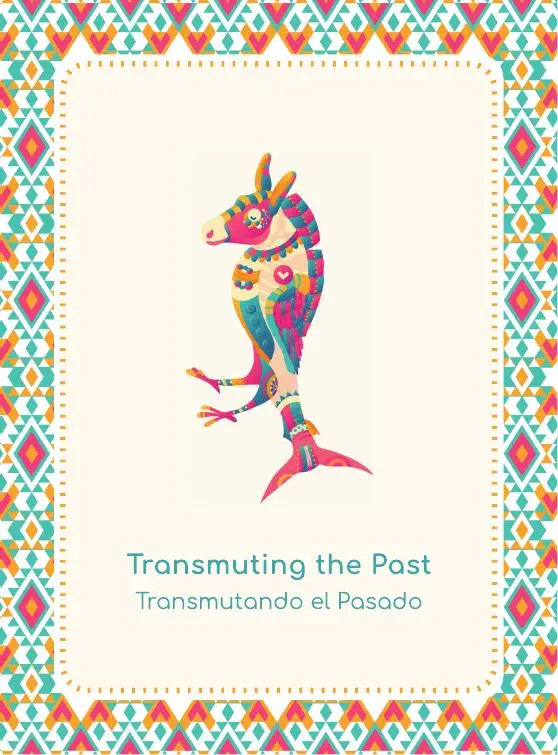
Transmuting the Past card
47Transmuting the PastI transmute my past into golden wisdom.

Transmuting the Past walks with Karkaṭī because her predicament is Oppression: a hunger she was born with, heavy as a mountain, that no shrinking can satisfy. Her turning is Transmutation, the long stillness on one point in which that hunger is held without being fed, and her arrival is Transfiguration, the devourer returned to a body and given lawful work as Maṅgalā, the protector.

  1. Shadow · what you avoidOppression

    Oppression: turned into a needle, Karkaṭī finds that 'her heart desired one thing, and she found herself in another form, that was of no use to her purpose' (III.70.17); the hunger stays mountain-sized.

  2. Gift · what is hidden in itTransmutation

    Transmutation: back on the mountain 'she saw in her mind her form of the needle, entering into her heart with her breathings' (III.72.3), stood on one point with her senses stilled, and let Indra's offering pass unswallowed.

  3. Essence · what you embodyTransfiguration

    Transfiguration: Brahmā restores her body, saying 'thy meditativeness must be compatible with thy worldly affairs' (III.75.16); she gives the king the healing mantra and is worshipped as Maṅgalā, guardian against the very sickness she was (III.83.1–2).

Transmuting the Past, and a hungry giantess who tried to make her hunger small. It didn't work. Ask yours a better question: what would you like to protect?

— Felicia
Today’s contemplation

If Karkaṭī's devouring past could become Maṅgalā the guardian, and that past was only ever held in mind, which old hunger of yours is waiting not to be destroyed but to be given work?

To close the night

Tonight, write one honest sentence about a hunger in you that will not be made smaller, and what it might protect.

The Ally Journey · about 15 minutes

Light trance, eyes open if you prefer. For the full, deeper script, see “The practice” above and its cautions.

  1. Threshold: sit steady, feet flat, eyes resting on one point in front of you. Take three slow breaths and let the gaze soften without closing. This is the Umbral.
  2. The tale in one line: Karkaṭī, a giantess of endless hunger, shrinks herself to a needle, finds the hunger unchanged, and through stillness becomes Maṅgalā, a protector (III.70.17; III.83.1–2).
  3. Meet the card: look at Transmuting the Past for a few breaths. Notice where the light gathers. Read the affirmation once: I transmute my past into golden wisdom.
  4. Shadow: where did an old hunger or weight press on you this week, a craving, a family pattern, a familiar heaviness? Name one moment and how you tried to make it smaller.
  5. Gift: let that hunger take a simple shape. Do not shrink it or fight it. Ask it quietly: what could you guard? Wait for one word, and give it one small, lawful task for tomorrow.
  6. Essence: rest for three breaths, saying the affirmation, and picture the shape standing at a doorway, no longer devouring, keeping watch over something you love.
  7. Return: feel the weight of your body and the warmth of your hands. Move your fingers and toes, open your eyes fully, and write tonight's honest line.

The 30-day Bond

You transmuted the past, though the past never existed: today, what is your old hunger guarding?

The Sister · Wičáŋȟpi

Lakota · Pine Ridge, South Dakota · Wakȟáŋ Tȟáŋka Tȟuŋkášila

Visit Wičáŋȟpi, the Lakota Star-Woman and pipe-carrier of Pine Ridge, whose white sage clears without destroying; like Maṅgalā, she keeps a sacred relationship rather than banishing what once did harm.

Guided Meditation

#47 · Transmuting the Past

Voice & guidance: Prof. Luis Miguel GallardoWatch on YouTube (ES also available)
For facilitatorsA session with “Karkaṭī, the Demoness Who Became a Needle” and Transmuting the Past

Aim. To help the person stop trying to shrink a compulsive or inherited hunger, find its positive intention, and give it protective work in daily life.

ITM 3 Gift Discovery. The tale's move is to ask the devouring part what it could guard, the very search for the positive intention that defines Gift Discovery.

The session (60–75 min)

  1. Arrival and Umbral: three slow breaths together; ask about appetite, cravings and any physical pain, and check that pain has been medically assessed (8 min)
  2. Telling the tale: a 4-minute version of Karkaṭī's hunger, the needle, the stillness on the mountain and her becoming Maṅgalā; present the ending as symbolic; point to the tale page for the full text (5 min)
  3. The card: show Transmuting the Past, read the affirmation and the koan, and ask what 'the past never existed' stirs (7 min)
  4. Shadow inquiry: map the hunger, when it began, whose it was before, and every attempt to make it smaller; notice, as Karkaṭī did, that shrinking left the hunger intact (12 min)
  5. Trance practice: From Needle to Guardian, using the full guided script on the tale page at LIGHT to MEDIUM depth only, never the plenary stillness of the tale; leave out fasting imagery; use the pain step only after medical evaluation (16 min)
  6. Gift and Essence integration: agree the hunger's lawful work and one concrete way to carry stillness into action, as Brahmā required (12 min)
  7. Closing and Bond: deliberate re-alerting by counting up; set the 30-day Bond with the koan variation (7 min)

Integration questions

  • What did the hunger say when you asked what it could guard?
  • Which part of this weight was handed to you, and which part have you been carrying by choice?
  • What is one place this week where stillness and action can meet, as Brahmā asked of Karkaṭī?

In a circle

In a circle, tell the tale as a story about hunger finding its work, and say plainly that it is not about fasting or dieting. Lead the first half of From Needle to Guardian at light depth, eyes open allowed: the hunger takes a shape and is held without being fed. Then each person, in silence, asks the shape what it could guard and writes the answer. In pairs, share only the guardian task, not the history of the hunger. Close with a round of one-word answers, 'My hunger guards…', and a firm, shared re-alerting: stand, stamp the feet lightly, look around the room.

Cautions

  • The tale glorifies fasting and extreme austerity: do not use it as a model with anyone who has an eating disorder or a history of self-starvation.
  • Abdominal pain needs medical evaluation before any hypnotic pain work.
  • Personifying an illness or craving as a demon can deepen shame if the person identifies with the demoness rather than the healer; stay with the guardian she becomes.
  • Deep sensory withdrawal must always end with deliberate re-alerting; frame the tale's ending, felons given as food, explicitly as symbolic.

Training and certification in the Meta Pets Method: metapetsworld.org/facilitators ↗

The correspondence between tales and Meta Pets is contemplative: the Yoga Vāsiṣṭha does not contain the Meta Pets; each tale enacts its ally’s arc. Felicia is an artificial-intelligence companion; her words are contemplative reflections, not clinical advice.

The song

From the cycle The Sixty-Four Tales

The Needle and the Moon

Oṃ hrīṃ hrāṃ rīṃ rāṃ viṣṇuśaktaye namaḥ … himavantaṃ gaccha … candramaṇḍalagato'si svāhā

Title: The Needle and the Moon Título: La aguja y la luna

Figure — Karkaṭī, the rākṣasī of the Himalaya, who became Sūcī the needle and ended as Maṅgalā, guardian of the Kirāta hills.

Where in the text — Book III (Utpatti Prakaraṇa), Mitra chapters 68–83.

Hypnotic phenomenon the song enacts — CAT and EMG: the arrangement shrinks with her, mountain to needle, to one high held tone (the needle standing still on its point for thousands of years), then grows back to full size as Brahmā returns her body for lawful work; the bridge carries the text's own healing suggestion (DIR).

Mantra — Oṃ hrīṃ hrāṃ rīṃ rāṃ viṣṇuśaktaye namaḥ … himavantaṃ gaccha … candramaṇḍalagato'si svāhā (ॐ ह्रीं ह्रां रीं रां विष्णुशक्तये नमः … हिमवन्तं गच्छ … चन्द्रमण्डलगतोऽसि स्वाहा). Source: Yoga Vāsiṣṭha III.69.14, the mantra Brahmā gives against Visūcikā, which Karkaṭī herself later teaches the king at the river (III.82.34); Mitra renders it "Om, I bow to hring, hrang and ring, rang—the powers of Vishnu … drive away this colic pain, far beyond the Himálayas, and afar to the orb of the moon." Meaning: "Om, homage to the power of Viṣṇu … go to the snowy mountain … you have gone to the orb of the moon. So be it."


Lyrics (English)

Performance: the pulse slows verse by verse as she shrinks; at the needle on its point it is one high tone, then only breath. The riddles are her low voice; the king and his minister answer in unison. The second chorus and the bridge open into a warm choir over drone.

Verse 1 — Karkaṭī (industrial pulse) North of the snows I stood half the sky, ink-black, hungry as the fire under the sea. A thousand years I sat, and asked: make me a needle, thin as a scent, to slip into hearts and drink their blood.

Verse 2 (thinning) Mountain, tree, man, cubit, span, finger: needle. I hid in the dust, in the threads of cloth. A needle holds one drop of blood. I gave my jewel for a piece of glass.

Chorus One drop, and the hunger mountain-high, trodden in the dirt, fed with the end of a thread. Take me back to the snows.

Verse 3 (one high tone, then breath) I breathed the needle into my heart; the breath carried me to the peak. I stood on my one point, mouth to the sky, a thread of sunlight through my eye. Indra blew meat-dust in my mouth. I did not swallow. Fire, hail, wind. Thousands of years. I wanted nothing.

Chorus (growing) "Take back your body," Brahmā said; "a body, like the breeze, lives by moving." Span, cubit, tree, cloud, and I came down.

Bridge (mantra) (night, by the Kirāta hills; call and response) (her) What atom is one, and many as the sea? (two men) The mind, finer than air. (her) To whom is a twinkling an age? (two men) The thought alone makes it so. (her heart cools like earth under moonlight; at the river she sings the cure) Oṃ hrīṃ hrāṃ rīṃ rāṃ viṣṇuśaktaye namaḥ (Om, homage to Viṣṇu's power) himavantaṃ gaccha (go to the snows) candramaṇḍalagato'si svāhā (you have gone to the moon; so be it)

Outro At the river I gave them the cure: a hand on the place that hurts, the pain sent wailing beyond the hills, the moon in your heart. "Well, raja," I said, "let us go together."


Letra (castellano cantable)

Interpretación: el pulso se ralentiza verso a verso mientras ella se encoge; en la aguja sobre su punta es una sola nota aguda, y luego solo respiración. Los enigmas los canta su voz grave; el rey y su ministro responden al unísono. El segundo estribillo y el puente se abren en un coro cálido sobre el bordón.

Verso 1 — Karkaṭī (pulso industrial) Al norte de las nieves medía medio cielo, negra como la tinta, hambrienta como el fuego bajo el mar. Mil años me senté, y pedí: hazme una aguja, fina como un aroma, para entrar en los pechos y beber su sangre.

Verso 2 (adelgazando) Montaña, árbol, hombre, codo, palmo, dedo: aguja. Me escondí en el polvo, en los hilos de la ropa. En una aguja cabe una gota de sangre. Di mi joya por un trozo de vidrio.

Estribillo Una gota, y el hambre alta como un monte, pisada en el barro, cebada con la punta de un hilo. Llévame de vuelta a las nieves.

Verso 3 (una nota aguda, luego respiración) Me respiré la aguja hasta el corazón; el aliento me subió a la cumbre. Me sostuve en mi única punta, la boca al cielo, un hilo de sol por mi ojo. Indra me sopló polvo de carne en la boca. No lo tragué. Fuego, granizo, viento. Miles de años. No quería nada.

Estribillo (creciendo) "Recobra tu cuerpo", dijo Brahmā; "un cuerpo, como la brisa, vive moviéndose." Palmo, codo, árbol, nube, y bajé.

Puente (mantra) (de noche, junto a los montes de los Kirāta; pregunta y respuesta) (ella) ¿Qué átomo es uno, y muchos como el mar? (dos hombres) La mente, más fina que el aire. (ella) ¿Para quién un parpadeo es una era? (dos hombres) Solo el pensamiento lo hace así. (su corazón se enfría como la tierra bajo la luna; en el río canta el remedio) Oṃ hrīṃ hrāṃ rīṃ rāṃ viṣṇuśaktaye namaḥ (Om, homenaje al poder de Viṣṇu) himavantaṃ gaccha (vete a las nieves) candramaṇḍalagato'si svāhā (te has ido a la luna; así sea)

Final En el río les di el remedio: una mano en el sitio que duele, el dolor echado, gimiendo, más allá de los montes, la luna en tu corazón. "Bien, rey", le dije, "vamos juntos."


One line to carry

EN: Hunger made small is still hunger; made wise, it guards. ES: El hambre encogida sigue siendo hambre; sabia, protege.


Libreto note

The strangest healer in the cycle. A giantess whose hunger burns like the fire under the sea asks to become a needle, the better to drink hearts, and learns what every craving learns: made small, it is not made less. She goes back to the mountain, stands on her one point through fire and hail, will not swallow Indra's meat-dust, and stops wanting. Brahmā gives her body back unasked: a body, like the breeze, lives by moving. The devourer becomes Maṅgalā, the guardian, and hands the king the cure for herself. A pulse that slows to one high tone, then breath; riddles answered in unison; and the tale's own mantra, sending the pain to the moon.


Source check

Source check (Mitra, Book III)

  1. Karkaṭī "on the north of Himálaya … as dark as ink", her stature "reaching half way to the sky", hunger like "the submarine flame"; a thousand years of austerity; the wish "to become as thin as a minute pin, in order to enter imperceptibly into the hearts of animals, as the odor of flowers enters the nostrils" and "suck the heart-blood": ch. 68, vv. 2–10, 19; ch. 69, vv. 1–5.
  2. The shrinking "to the shape of the branch of a tree … the figure of a man … a cubit … a span … a finger's length … as lean as a needle"; hiding "in the dust of the ground … in the threads of cloths"; "fed with the fag end of a thread"; "a drop of blood"; "a precious jewel for a paltry piece of glass"; "trodden and trampled … in the filth": ch. 70, vv. 2–3, 38, 53; ch. 71, vv. 2, 6, 11.
  3. "Her form of the needle, entering into her heart with her breathings … wafted by her vital breath to the top of the hill"; standing on her one point, "upraised face"; "the ray of light issuing as a pencil from the needle hole"; Indra's "powdered dust of meat" not swallowed; fire, hail, "a thousand years"; "many thousand years": ch. 72, vv. 3–27; nothing left to ask: ch. 75, vv. 3–7.
  4. Brahmā: "the body like the breeze, is nourished best by its constant agitation"; regrowth "of the measure of a span … a cubit … as a tree … the form of a cloud"; she "descended slowly" to the Kirātas: ch. 75, vv. 16, 20; ch. 76, vv. 14–15.
  5. Riddles "What is that atomic minim which is one yet many, and as vast as the ocean"; "To whom is a twinkling of the eye, as long as a Kalpa"; answers: the intellect "minuter than a particle of air", "It is the idea only that makes a twinkling, appear a kalpa"; her heart cooled "as the earth is cooled by … moon-light": ch. 79, vv. 2, 10; ch. 80, v. 4; ch. 81, v. 49; ch. 82, vv. 2, 5. The cure: rub the painful part, the colic "driven back beyond the hills with loud wailing", "the medicinal moon … seated in his heart": ch. 69, vv. 14–16; given at the river: ch. 82, vv. 31–34; "Well raja, let us go together": ch. 82, v. 50; warding off the people's diseases as Maṅgalā: ch. 83, vv. 2, 6.

Read the full text

Source: Vihari-Lala Mitra, The Yoga-Vasishtha Maharamayana of Valmiki (1891–99), public domain.

Collaborate on this research

Researchers, clinicians and institutions are welcome to write. Replication, data-sharing and site partnerships for the trials in progress are all open conversations.

Educational and scholarly content. Hypnotherapy and regression material is complementary and not a substitute for medical or psychiatric care.