ICEF

Tale 59 · The Vāsiṣṭha Atlas

The Hewn Statue

Nirvāṇa · second half · Mitra VI.2.168 · 2,349 words

The figure was always in the wood.

Bhūmikā 6 · Padārthābhāvanī (melting of objects)LightYour ally · The Diamond of the Self

The essence

Vasiṣṭha has been teaching that creation rises from the Intellect of itself, as branches rise from a tree and whirlpools from the sea, with no intention behind them. Rāma objects: if everything springs up by chance, how can memory exist, when memory needs earlier impressions? Vasiṣṭha answers with an image. The one soul lies unseen within its own Intellect, 'as the uncarved doll remains unseen, in the wood of every forest tree.' We watch the carpenter carve a puppet out of a trunk, but we do not see the soul that carves the world. The statue does not show itself in the rough block until it is hewn, and the world does not appear in the Intellect until the Mind brings it into view. Nothing is added: what the chisel reveals was wood all along. The Intellect even imagines itself as the mind, the ego and the 'I, thou, he' of persons, and all the while it stays transparent. Memory is no exception: remembering is only the dream of something.

What it teaches

  1. 01

    The form is already in the material before the chisel touches it. Nothing is added from outside; a figure is uncovered, not manufactured (VI.2.168.40–42).

  2. 02

    The mind's images are not just stored copies. A dream shows sights 'unseen and unthought of before' (VI.2.168.21), so a vivid inner image is no proof that it happened.

  3. 03

    Remembering and dreaming are made of the same stuff: 'What is the remembrance of a thing, any more than the dream of something' (VI.2.168.53).

  4. 04

    Even the sense of being a person is a carving. The Intellect 'deems itself as the root of the knowledge of I, thou, he, and others' (VI.2.168.47) and stays transparent beneath every role (168.50).

  5. 05

    What keeps suffering going is habit, not evidence: 'It is the longstanding and deep rooted prejudice, that produces the erroneous conceptions of the creation and destruction of the world' (VI.2.168.33).

The Vāsiṣṭha Atlas

This tale’s coordinates

The wound and its virtue

The soul lies unseen 'as the uncarved doll remains unseen, in the wood of every forest tree' (VI.2.168.40), a worth hidden in an inert block. This is Repression, with the Shame wound beneath it. Honesty appears in the refusal to add anything: the chisel only reveals what was wood all along (VI.2.168.42), and even memory is admitted to be 'the dream of something' (VI.2.168.53). The tale dramatises Discovering the Gift: the capacity was latent in the material before the carver touched it.

What it trains

The Intellect carves itself into 'I, thou, he' and stays transparent beneath every role (VI.2.168.47, 50), so the person is held as a carving rather than a fixed self.

In other yogas

  • Patañjali · Yoga Sūtra · YS 4.3

    Patañjali compares the cause of transformation to a farmer who only breaks the dyke so that water flows by its own nature. The carver likewise adds nothing to the wood but removes what hides the figure.

  • Buddhist absorption · SN 22.95

    The Pheṇapiṇḍūpama Sutta likens perception to a mirage and the aggregates to foam and a magician's trick. Vasiṣṭha's claim that remembering is only 'the dream of something' (VI.2.168.53) shares that suspicion of what the mind presents as fact.

  • Māṇḍūkya Upaniṣad · MāU 2

    Māṇḍūkya 2 declares that all this is Brahman and this self is Brahman. The one soul hidden in every tree, uncarved yet present (VI.2.168.40), is that identity seen through the image of wood.

IEAF: Integrative Emotional Alchemy Framework (Gallardo, Frontiers in Psychology, 2026). FP20: the Fundamental Peace Scale. ITM: the Integrative Transformation Model. Parallels in other yogas are contemplative correspondences, not claims of influence.

The tale

The court had been listening to Vasiṣṭha for days. Now he took up again the question of how the world comes to be. A tree, he said, does not intend its branches, its shrubs and its creepers; it simply displays them. The ocean does not plan its whirlpools; they turn on its surface without any concern of its own. In the same way the spirit of God shows the airy semblance of creation on the surface of its own emptiness, unconcerned. It gives living beings mind, understanding and egoism, and these rise from the Intellect as waves rise from the sea. The world is a painting, and a painting is nothing apart from its canvas: the world is drawn on the Intellect and is that Intellect, shining.

The best example of creation, Vasiṣṭha went on, is the dream everyone has every night. Ask what is solid in it. And a dream is not just old memories played back, because it shows us sights 'unseen and unthought of before'. Worlds rise in the Intellect as waves rise in a river and then run on like a current. Whatever is born without a cause is no different from the unborn. A gem's lustre grows in it of itself and is no separate substance, and the world's appearance is like that lustre. Only an old, deep-rooted prejudice makes us believe in the creation and destruction of things. Wisdom sees the same world as the wondrous display of the Divine Mind.

Rāma pressed the point. If all these powers spring up spontaneously, how can the power of memory arise all at once? Memory is known to come from earlier impressions in the mind.

Vasiṣṭha promised to destroy the doubt 'as the lion kills an elephant'. There is one universal soul, he said, invisible in the vacuum of its own Intellect, as the uncarved doll remains unseen in the wood of every forest tree. We see the carpenter carving a puppet from the wood, but we do not see the soul that chisels the figure of the world out of what Mitra calls 'the great bulk of Instinct'. The statue does not appear in the rugged block until the skill of the carver hews it out. Just so, the hidden world does not appear in the Intellect until the Mind, the universal architect, brings it to view. Before that the uncarved body of the world already exists in its airy state, its original form within the Intellect.

At the start of creation, Vasiṣṭha said, the Intellect forms the concept of the future world, which appears to the soul like an airy dream, a doll gliding about inside itself. Then the Intellect imagines itself into one role after another. It imagines that it is the seed of the world, the living soul and the seat of egoism. It imagines that it is understanding and mind, the container of space and time, and the root of the knowledge of 'I, thou, he, and others'. It sees in itself the senses, the faculties, the subtle and the gross bodies, the gods Brahmā, Viṣṇu and Śiva, and sun, moon and stars. Yet all these are the Intellect's own imaginings. Nothing exists beside it, and it stays transparent, with no concrete matter in it and no duality.

So what is remembrance, Vasiṣṭha asked, more than the dream of something that is nothing in reality? And what is time, except a device of the mind in empty air? What lies inside the dense Intellect is exactly what appears outside it, and both are only its glitter. He ended sadly. He had given these lectures again and again, yet deluded people take the world of their dream for waking, and even knowing it to be unreal they will not give up their rooted prejudice.

The text speaks

Passages from Mitra’s translation (1891–99), cited by book, chapter and verse.

“There is an only universal soul, that is invisible amidst the vacuum of his Intellect; as the uncarved doll remains unseen, in the wood of every forest tree.”
VI.2.168.40The central image: the form is latent in the substrate.
“We see the carpenter that carves out the puppet, from the wood of the tree (and the mason who hues out the statue from the block of stone); but we know not the soul, which chisels out the figure of the world from the great bulk of Instinct.”
VI.2.168.41It names the carver we never see.
“The statue does not appear in the rugged block, unless and until it <is> hewn out by the skill of carver, so the hidden world does not make its appearance in the Intellect, till it is brought to view by the ingenuity of the Mind (the universal architect).”
VI.2.168.42Manifestation is revealing, and the revealing agent is the Mind.
“As a picture is nothing except its canvas, so the world which is no more than a painting, is drawn on the substratum of the intellect; and this is a vacuous substance, with the lustre of the world in it.”
VI.2.168.6The companion image: figure and ground are one substance.
“The dream is not the effect of any impression in the mind, nor the result of remembrances stored in the memory; because it shows us many sights, unseen and unthought of before; say therefore how these come to pass.”
VI.2.168.21It denies that inner images are mere playback, which bears on how trance imagery is understood.
“What is the remembrance of a thing, any more than the dream of something, which is nothing in reality; and what is time of which we have no conception, except it be an imagination or devise of the mind in empty air.”
VI.2.168.53Memory and time are placed with dream and imagination.

What the trance sees

MET

Therapeutic metaphor / reframe

VI.2.168.40–43

In the textThe world is 'the uncarved doll' unseen in the forest log, and the statue that 'does not appear in the rugged block' until hewn. Mitra's gloss ties this to Aristotle and Addison: future images lie in blocks of wood and stone.

In the clinicThis is a resource metaphor in the Ericksonian manner: the change is uncovered, not installed. It suits solution-focused presuppositions that the client already contains what is needed.

WIT

Witness position / dis-identification

VI.2.168.46–50

In the textThe Intellect 'conceives itself' as living soul, egoism, mind, understanding and 'the root of the knowledge of I, thou, he', yet 'it is quite transparent in its essence... nor any duality whatsoever'.

In the clinicThis is dis-identification from roles and self-concepts, as in the observing self of mindfulness-based and ACT work. Every role is held as a shape in a substrate that the role does not change.

Read upward — stage 1 at the bottom, stage 7 at the top

  1. Integration zone
    Perceptual shift — the boundaries of things soften; consciousness expands past its usual partitions.

A note on what this map claims. The alignment between stages of knowledge and trance depths is a clinical map — a heuristic correspondence proposed for research, not a claim of identity between contemplative attainment and hypnotic depth.

Bhūmikā 6 · Padārthābhāvanī

The chapter dissolves the separate thinghood of objects. 'There is no such thing, as the visible or phenomenal world at any time' (VI.2.168.57), and every form is wood of the one tree. That is the vision of padārthābhāvanī.

Zone · Light

This is a discursive teaching in waking dialogue between Rāma and Vasiṣṭha, with no trance event in the chapter. The image is meant for reflection or a light contemplative state.

In the therapy room

Indications

  • Clients who fear 'falling apart' or losing themselves: the material never stops being itself
  • Over-identification with roles (job, diagnosis, family position): each is a carving in the same wood
  • Creative blocks and perfectionism: the figure is already in the block, and the work is removal
  • Psychoeducation about memory: inner images can be new productions, not records

Cautions

  • In memory work, do not treat images arising in trance as recovered fact; the chapter itself says dreams show what was 'unseen and unthought of before' (VI.2.168.21)
  • The teaching on 'no phenomenal world' (168.57) can unsettle clients prone to derealisation; keep it to the image and do not press the metaphysics
From the bookThe full clinical note

Indications. Clients who fear losing themselves in change or crisis: the wood never stops being wood. Over-identification with a role, a job, a diagnosis, a family position: each is a carving in the same grain. Creative block and perfectionism: the figure is already in the block, and the work is removal. Psychoeducation about memory, especially before any work with recalled images.

As metaphor. The image travels well in a single sentence: the figure was always in the wood. For a client who believes change means becoming someone else, it reframes change as uncovering. For a client terrified of losing a role, it shows that the role was never the whole log.

Cautions. In memory work, do not treat images arising in trance as recovered fact; the chapter itself says dreams show what was "unseen and unthought of before" (VI.2.168.21). The teaching that there is "no such thing, as the visible or phenomenal world" (168.57) can unsettle clients prone to derealisation or depersonalisation; keep to the image and leave the metaphysics aside. Screen for dissociative symptoms before using the dis-identification step.


The practice

The Figure in the Wood

  1. Settle and feel the body as one block of wood, dense and uniform in grain.
  2. Notice sensations, thoughts and feelings as shapes carved on the surface, and feel the same grain running through each (VI.2.168.40–42).
  3. Name one role you carry ('I', 'you', 'he' or 'she') and see it as a carving, wood through and through (168.47).
  4. Let an image arise 'unseen and unthought of before' and allow it without asking where it came from or whether it is true (168.21).
  5. Let the carving soften back into the uncarved block (168.43).
  6. Rest as the material itself, transparent and with nothing added (168.50).
  7. Return: feel weight, breath and the room, move your fingers and open your eyes.

Practise with a qualified professional if you have a history of dissociation, trauma or psychosis.

From the book · to be read aloudThe full guided script

The Figure in the Wood

Read slowly, aloud; about twelve minutes.

Before you begin. This is a light, reflective practice. If you are prone to feeling unreal or detached from your body, keep your eyes half open and your feet firmly on the floor throughout, and stop if the feeling grows. Sit in a safe place; never practise while driving.

How to return at any moment. Press your feet down, say "I am here," count from one to five and open your eyes.


Sit, and let the eyes close or rest half open.

Feel the body as one block of wood. Dense. Warm. The same grain from the crown to the soles of the feet.

Breathe out.

Now notice what is on the surface. A tightness somewhere. A thought. A mood. Let each be a shape carved lightly in the wood. Run your attention along the grain and feel it continue under each shape, unbroken.

Breathe out.

Name one role you carry. Parent. Worker. Patient. The one who copes. See it as a figure carved from the block, with its own face and posture. Look at it kindly. It is wood all through.

Now I. Now you. Now he, she. Shapes in the same grain.

Notice that nothing had to be added to the wood to make any of them. Each was already there, waiting for the chisel. Each can be softened without the wood being harmed.

Let an image come, any image, one you have not seen before. Do not ask where it came from or whether it is true. It is a new carving. Let it be.

Now let the carvings soften. Edges rounding. Faces smoothing back into the block. Nothing is lost. The wood is all there.

Rest as the wood. Nothing added. Nothing taken away.

(Silence: one minute.)


One. Feel your weight on the seat.

Two. Feel your hands. Move the fingers.

Three. Feel your feet on the floor.

Four. Hear the room. Take a full breath.

Five. Open your eyes, fully alert.

Say your name, the day and where you are. Look at your hands: carved, and wood all through. If you feel at all distant, stand, walk a few steps and drink some water.


Meta Pets World · Your ally · Meta Pet 8

The figure that was always in the wood

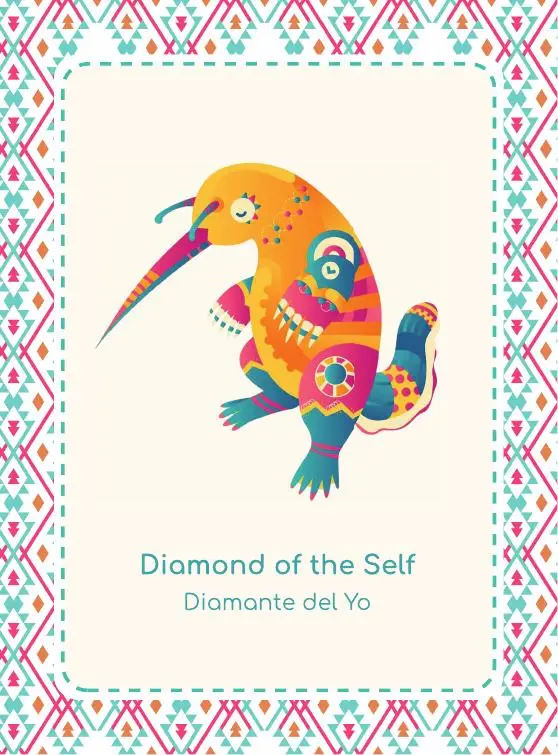
The Diamond of the Self card
08The Diamond of the SelfI am a diamond of infinite facets.

The Diamond of the Self walks with the hewn statue because Vasiṣṭha's image follows its arc exactly. The rough block that shows nothing, a figure unseen in every tree, is Mediocrity; the carver's chisel that uncovers rather than adds is Stylishness; and the discovery that the figure was wood all along, with nothing added, is the Diamond of the Self.

  1. Shadow · what you avoidMediocrity

    Mediocrity: the soul lies unseen 'as the uncarved doll remains unseen, in the wood of every forest tree' (VI.2.168.40); the rugged block shows nothing of what it holds.

  2. Gift · what is hidden in itStylishness

    Stylishness: 'the statue does not appear in the rugged block, unless and until it is hewn out by the skill of carver' (VI.2.168.42), and the skill lies in uncovering, not adding.

  3. Essence · what you embodyThe Diamond of the Self

    The Diamond of the Self: the world is drawn on the intellect as a picture on its canvas, 'a vacuous substance, with the lustre of the world in it' (VI.2.168.6); the figure was wood all along.

Here's a secret from the woodcarver: nothing gets added. The figure was in the wood all along. So today, don't build a better you. Just take one thing away.

— Felicia
Today’s contemplation

If the figure was always in the wood and the diamond has no flaws, what are you polishing, and what could the chisel simply take away?

To close the night

Tonight, write one honest sentence about where you made yourself smaller today in order to fit in.

The Ally Journey · about 15 minutes

Light trance, eyes open if you prefer. For the full, deeper script, see “The practice” above and its cautions.

  1. Threshold. Sit upright and let your body feel solid, like one block of wood. Take three slow breaths, the Umbral, with your eyes open or lowered.
  2. The tale in one line: the soul lies unseen in the Intellect 'as the uncarved doll remains unseen, in the wood of every forest tree', until carving brings it into view (VI.2.168.40).
  3. Meet the card. Look at the art of The Diamond of the Self and let the light in its facets catch your eye. Read the affirmation: 'I am a diamond of infinite facets.'
  4. Shadow. Where did you stay a rough block this week, blending in, playing safe, hiding your own way of doing things? Name one place where you made yourself ordinary to avoid standing out.
  5. Gift. Choose one small act of style today that removes rather than adds: drop a habit of over-explaining, wear what you like, say it your own way. Let the chisel uncover.
  6. Essence. Feel the same grain running through every sensation, thought and role, wood throughout, with nothing added. Rest for three breaths: 'I am a diamond of infinite facets.'
  7. Return. Feel your weight, your breath and the room. Move your fingers, open your eyes fully, and write tonight's honest sentence.

The 30-day Bond

The diamond of the self has no flaws: each day of the Bond, ask what you are polishing, and take one thing away instead.

The Sister · Selene di Marco-Amari

Italian-Moroccan · Venice, Italy · Sā Tā Nā Mā · Kirtan Kriya

Visit Selene di Marco-Amari, the Italian-Moroccan heiress-in-exile of Venice, whose stone is the diamond and whose Kirtan Kriya, 'Sā Tā Nā Mā', is a chisel of sound that uncovers rather than adds.

Guided Meditation

#8 · The Diamond of the Self

Voice & guidance: Prof. Luis Miguel GallardoWatch on YouTube (ES also available)
For facilitatorsA session with “The Hewn Statue” and The Diamond of the Self

Aim. To help the client move from conformity toward authentic expression by discovering that what is most their own is uncovered, not manufactured.

ITM 4 Essence Embodiment. The tale's teaching is that nothing is added, the figure was always in the wood (VI.2.168.40–42): Essence Embodiment, living from what one already is rather than straining to become it.

The session (60–75 min)

  1. Arrival and Umbral (5 min): three slow breaths, sitting as one solid block; the client gives one word for how ordinary they feel today.
  2. The tale (3 min): Rāma's question about memory, Vasiṣṭha's image of the uncarved doll in the wood, the statue that appears only when hewn, nothing added. Point to the tale page for the full text.
  3. The card (8 min): The Diamond of the Self, its affirmation and koan. Ask what the client polishes, and for whom.
  4. Shadow inquiry (12 min): explore conformity: where the client suppresses their own voice, and what fear of standing out keeps them a rough block. Distinguish style from appearance.
  5. Trance practice (20 min): 'The Figure in the Wood', from the full guided script on the tale page, at light depth, the tale's own level. Allow images that arise 'unseen and unthought of before' without treating them as memory.
  6. Gift and Essence integration (12 min): identify one chisel act of removal for the week; say the affirmation; sit with the koan, what is being polished that never needed polish?
  7. Closing and Bond (5 min): weight, breath, room, eyes open; assign the 30-day Bond with The Diamond of the Self and its daily koan.

Integration questions

  • Which role did you see as a carving, wood through and through?
  • What would you remove this week, rather than add, to let your own style show?
  • What have you been polishing that was never flawed?

In a circle

In a circle, pass a rough piece of wood from hand to hand while the tale is told. Lead the practice at light depth for about fifteen minutes. Afterwards, each person names one role they carry ('the reliable one', 'the quiet one') and says, 'This is a carving; the wood is me.' Then, in pairs, each names one thing they will take away this week, rather than add, so that their own style can show. Close with the koan spoken slowly together and a minute of silence.

Cautions

  • In memory work, do not treat images arising in trance as recovered fact; the chapter itself says dreams show what was 'unseen and unthought of before' (VI.2.168.21).
  • The teaching that there is no phenomenal world can unsettle clients prone to derealisation; keep to the image of the wood and do not press the metaphysics.

Training and certification in the Meta Pets Method: metapetsworld.org/facilitators ↗

The correspondence between tales and Meta Pets is contemplative: the Yoga Vāsiṣṭha does not contain the Meta Pets; each tale enacts its ally’s arc. Felicia is an artificial-intelligence companion; her words are contemplative reflections, not clinical advice.

The song

From the cycle The Sixty-Four Tales

The Doll in the Wood

Svadeham araṇiṃ kṛtvā praṇavaṃ cottarāraṇim · Oṃ

Title: The Doll in the Wood Título: La muñeca en la madera

Figure: Vasiṣṭha answering Rāma's question about memory with the carpenter's doll, unseen in the wood of every forest tree

Where in the text: Book VI (second half, Nirvāṇa-prakaraṇa), Mitra chapter 168

Hypnotic phenomenon the song enacts: MET and WIT — the arrangement works like the carver, by removal: dense at first, one instrument taken away each verse, until the melody that was there from the first bar stands clear; the third verse watches the Intellect carve itself into soul, ego, I, thou, he, and stay as clear as it was.

Mantra: Svadeham araṇiṃ kṛtvā praṇavaṃ cottarāraṇim · Oṃ Source: Śvetāśvatara Upaniṣad 1.14 (the verse continues dhyāna-nirmathanābhyāsād devaṃ paśyen nigūḍhavat, "by the friction of meditation one sees the god, as if hidden"); Oṃ is sung as the uncarved block before the first word and after the last. Meaning: "Making your own body the lower fire-wood, and Om the upper" — the hidden thing in the wood, brought out by working it.


Lyrics (English)

Performance: the song opens with one long Oṃ, then everything at once — drone, strings, choir, woodblock — the melody present but buried. An instrument drops away with each verse. Verse 3 is one voice, each line answered by a single strike of the woodblock. The bridge and outro are the voice alone, and the song ends on the Oṃ it began with.

Verse 1 A tree doesn't mean its branches, its shrubs, its creepers: it just shows them. The sea doesn't plan the whirlpools turning on its face. A picture is nothing but its canvas, and the world's a picture painted on the canvas of the mind.

Verse 2 (the strings fall away) Rāma said: if all of it springs up by itself, like whirlpools, like branches, where does remembering come from? Vasiṣṭha said: I'll kill that doubt the way a lion kills an elephant. Every night you dream what you never saw and never thought of.

Chorus The doll is in the wood of every tree in the forest. Nobody sees it there till the carpenter cuts it out, and when it stands up, it's still wood.

Verse 3 (one voice; a woodblock strike after each line) It carved itself a living soul. It carved the one who says "I". It carved the mind, the space, the hour, the I, the you, the he, the others, the sun, the moon, the stars inside it, and stayed as clear as it was.

Chorus (one voice and the woodblock) The doll is in the wood of every tree in the forest. Nobody sees it there till the carpenter cuts it out, and when it stands up, it's still wood.

Bridge (mantra) (voice alone) Svadeham araṇiṃ kṛtvā praṇavaṃ cottarāraṇim (Make your body the lower wood, and Om the upper) Oṃ…

Outro (voice alone) What is remembering but the dream of a thing? What's in the wood is what comes out, the same glitter, in and out. Now open your eyes on the carved world: the tree, the whirlpool, the lustre in the gem. It's full. It's full of glory. Oṃ.


Letra (castellano cantable)

Interpretación: la canción abre con un Oṃ largo y luego todo a la vez —bordón, cuerdas, coro, bloque de madera—, con la melodía presente pero enterrada. En cada verso se retira un instrumento. El verso 3 es una sola voz, y a cada verso le responde un único golpe del bloque de madera. El puente y el final son la voz sola, y la canción termina en el mismo Oṃ con que empezó.

Verso 1 El árbol no quiere sus ramas, sus arbustos, sus enredaderas: las muestra. El mar no planea los remolinos que giran en su cara. Un cuadro no es nada sin su lienzo, y el mundo es un cuadro pintado en el lienzo de la mente.

Verso 2 (se retiran las cuerdas) Preguntó Rāma: si todo brota solo, como remolinos, como ramas, ¿de dónde sale el recordar? Dijo Vasiṣṭha: mataré esa duda como el león mata al elefante. Cada noche sueñas lo que nunca viste ni pensaste.

Estribillo La muñeca está en la madera de cada árbol del bosque. Nadie la ve ahí hasta que el carpintero la saca, y cuando se pone en pie, sigue siendo madera.

Verso 3 (una voz; un golpe de madera tras cada verso) Se talló un alma viva. Talló al que dice "yo". Talló la mente, el espacio, la hora, el yo, el tú, el él, los otros, el sol, la luna, las estrellas por dentro, y siguió tan clara como era.

Estribillo (una voz y el bloque de madera) La muñeca está en la madera de cada árbol del bosque. Nadie la ve ahí hasta que el carpintero la saca, y cuando se pone en pie, sigue siendo madera.

Puente (mantra) (la voz sola) Svadeham araṇiṃ kṛtvā praṇavaṃ cottarāraṇim (Haz de tu cuerpo la madera de abajo, y del Om la de arriba) Oṃ…

Final (la voz sola) ¿Qué es recordar sino el sueño de una cosa? Lo que hay en la madera es lo que sale, el mismo brillo, dentro y fuera. Abre ahora los ojos al mundo tallado: el árbol, el remolino, el brillo de la gema. Está lleno. Lleno de gloria. Oṃ.


One line to carry

EN: The figure was always in the wood. ES: La figura siempre estuvo en la madera.


Libreto note

Rāma asks: if the world simply springs up, where does memory come from? Vasiṣṭha answers with a carpenter's doll. The figure is already in the wood of every forest tree; no one sees it until the carver cuts it free, and when it stands up it is still wood. Soul, mind, I and you and he: each is a carving in the same clear grain. For the clinician this is the resource metaphor at its plainest, and a caution: a vivid inner image is a carving, not a recording. The song is built by removal, an instrument lost each verse, until one voice and a woodblock show the melody that was there from the first bar.


Source check

Source check (Mitra, Book VI, second half)

  1. "As the unconscious tree, displays various forms in its branches"; "as the ocean describes the whirlpools, insensibly upon its surface"; the tree's forms "of a plant, a shrub, a creeper"; "as a picture is nothing except its canvas, so the world which is no more than a painting, is drawn on the substratum of the intellect" — ch. 168, vv. 1–2, 6, 8.
  2. The dream "shows us many sights, unseen and unthought of before"; Rāma's question, "how can the mental power of memory be produced on a sudden"; "I will destroy your doubt, as the lion kills an elephant" — ch. 168, vv. 21, 38–39.
  3. "As the uncarved doll remains unseen, in the wood of every forest tree"; "we see the carpenter that carves out the puppet, from the wood of the tree"; "the statue does not appear in the rugged block, unless and until it is hewn out by the skill of carver" — ch. 168, vv. 40–42.
  4. The Intellect imagining itself "the source of life and the living soul, and the receptacle of egoism… the understanding and the mind… the reservoir of space and time… the root of the knowledge of I, thou, he, and others"; seeing "the sun, moon and stars all in itself"; yet "quite transparent in its essence" — ch. 168, vv. 46–50.
  5. "What is the remembrance of a thing, any more than the dream of something"; inside and outside "but the glitterings of the Intellect"; the world's appearance like the gems' "lustre inherent in them"; "the world is full of the glory of God" — ch. 168, vv. 26, 53–54, 59.

Read the full text

Source: Vihari-Lala Mitra, The Yoga-Vasishtha Maharamayana of Valmiki (1891–99), public domain.

Collaborate on this research

Researchers, clinicians and institutions are welcome to write. Replication, data-sharing and site partnerships for the trials in progress are all open conversations.

Educational and scholarly content. Hypnotherapy and regression material is complementary and not a substitute for medical or psychiatric care.