ICEF

Tale 44 · The Vāsiṣṭha Atlas

The Stag and the Huntsman

Nirvāṇa · first half · Mitra VI.1.124 · 1,724 words

The stag ran past; the sage, resting in the fourth, saw nothing.

Bhūmikā 6 · Padārthābhāvanī (melting of objects)SomnambulisticYour ally · Silence The Diamond Path

The essence

Vasiṣṭha explains how the divine soul descends into the condition of the living soul. A will born of self-consciousness drives action, and action drives bondage, so the one remedy is to shrink desire. One mind must break another, “as they break the iron pegs by force of iron hammers”. Of the three bodies, gross, mental and spiritual, only the third is to be trusted. When Rāma asks what turya is, Vasiṣṭha calls it the state in which ego and non-ego, being and non-being, drown in impassibility, and “one remains as a mere witness and spectator”. He then gives an instance. A huntsman chasing a wounded stag with an arrow in its back asks a silent forest sage which way it ran. The sage answers that sages are cool as stones. The egoism that directs the senses has long since dissolved in him, and he rests in the fourth state, “wherein there is no vision of the visibles”. The huntsman does not understand and walks away. Turya looks like death but keeps life within it.

What it teaches

  1. 01

    Perception needs an owner. The sage explains that “it is the mind, which conducts all the actions of the senses” (VI.1.124.32). When egoism dissolves, a wounded animal can pass before open eyes without being seen. Attention, not the eye, makes the world.

  2. 02

    One part of the mind can be used to break another, “as they break the iron pegs by force of iron hammers” (VI.1.124.15). The reasoning mind is the tool against the sensuous mind, and nothing outside is needed.

  3. 03

    Release from past and future is a practical instruction: “Concern not thyself with thy past acts, or thy cares for future … but discharge well thy present duties” (VI.1.124.13).

  4. 04

    From outside, the witness state can look like the dullness of the ignorant (VI.1.124.26). Stillness alone cannot tell a clinician whether a client is witnessing or numbed, and the two must not be confused.

  5. 05

    Readiness decides whether a teaching lands. The huntsman hears the plainest account of turya and “departed to his own way without uttering a word” (VI.1.124.34). Words offered to a mind in pursuit pass straight through it.

The Vāsiṣṭha Atlas

This tale’s coordinates

The wound and its virtue

The huntsman is the mind driven through the senses by desire, sure that everyone must have seen his prey (VI.1.124.30), and he cannot take in an answer that does not fit his chase, so he walks away (VI.1.124.34). The sage embodies Ease as the essence of the path: his egoism “long before dissolved”, he rests in turya, “wherein there is no vision of the visibles” (VI.1.124.33), a stillness that looks like death and is not, which separates true calm from numbness.

What it trains

Turya is defined as the state in which the feelings of mine and thine are wanting and one remains a mere witness (VI.1.124.24), the reduction of self-referential rigidity taken to its limit.

In other yogas

  • Māṇḍūkya Upaniṣad · Māṇḍūkya 7

    The Māṇḍūkya's fourth is cognisant neither inwardly nor outwardly, unseen, ungraspable and peaceful. The sage's account of resting beyond waking, dream and sleep, with no vision of the visibles, is a narrative portrait of turīya.

  • Bhagavad Gītā · BG 2.69

    What is night for all beings, the self-restrained one is awake in, and what wakes beings is night for the seeing sage. The huntsman and the sage stand on either side of this verse, each blind to what the other sees.

  • Buddhist absorption · MN 20; MN 43

    The Vitakkasaṇṭhāna Sutta removes an unwholesome thought with a wholesome one, as a carpenter knocks out a coarse peg with a fine one; Vasiṣṭha's iron pegs broken by iron hammers (VI.1.124.15) is the same method. The Mahāvedalla Sutta (MN 43), which separates the attainment of cessation from death, mirrors the claim that turya looks like death but keeps life.

IEAF: Integrative Emotional Alchemy Framework (Gallardo, Frontiers in Psychology, 2026). FP20: the Fundamental Peace Scale. ITM: the Integrative Transformation Model. Parallels in other yogas are contemplative correspondences, not claims of influence.

The tale

Vasiṣṭha tells Rāma that the Lord, the divine soul, lowers itself to take on the nature of the living, animal soul, the way a man born a Brahmin might take on a menial role for some mean purpose. All beings first come forth from the divine essence without any cause. After that, their own actions become the cause of their wandering from birth to birth. Action comes from will, and will comes from awareness of oneself. Since will binds, release is nothing other than release from the bond of desire. So choose what is right, Vasiṣṭha says, and draw your wishes into the narrowest compass. Do not possess and do not be possessed. Whatever pleases you is the string that ties you to the earth. Do not think of yourself as the doer, the giver or the eater of anything. Leave past acts and future cares alone, and do well the duty that is in your hand now.

The passions are strung together on the heart, so cut those strings with a brave heart. Break the sensuous mind with the reasoning mind, as iron pegs are broken with iron hammers, as one poison removes another and soldiers meet steel with steel. Every living being has three forms. The first is the gross body of limbs, fed on food. The second is an inner body made of all its wishes, the mental body. The third is the transcendental body, the simple intellectual soul, without beginning, end or change. Hold to the third and reject the other two. This is the pure turya, the state of living liberation.

Rāma says he has understood waking, dreaming and deep sleep, but turya has not yet been defined, and he asks for it. Vasiṣṭha answers that it is the state in which the feelings of egoism and non-egoism, of existence and non-existence, are drowned in a total impassibility, and the mind settles into an unvarying calm and clarity. “Mine” and “thine” are gone, and one remains as a mere witness and spectator of the affairs of life. It is not waking, because it has no wish or concern. It is not deep sleep, because deep sleep is perfect insensibility. Its evenness is like turbid water once the mud has settled to the bottom.

Then he gives an instance. A huntsman roaming the forest for prey came upon a sage sitting silent and alone. Finding this strange, he called out to him: “Have you seen, O sage, a wounded stag flying before me this way, with an arrow fixed in its back?” The sage replied that sages who live in the forest are as cool as blocks of stone and insensible of everything that happens on earth. They lack the egoism needed to carry on worldly business, and it is the mind that conducts all the actions of the senses. The feeling of ego, he said, had long since dissolved in his mind. He no longer perceived the three states of waking, dreaming and deep sleep, and rested quietly in the fourth, where no visible thing is seen. The huntsman heard all this and could make nothing of it. He went his way without a word.

So, Vasiṣṭha tells Rāma, there is no state beyond the fourth. Waking is the dark state, open to every passion. Dreaming is the quiet state. Deep sleep is the insensible state. The state beyond these three looks like death, yet that death-like figure holds the principle of life within it, and yogis carefully guard it from harm and decay. The soul that rests after giving up all desire is what the sages call the coma, the cool calm of itself: the liberated state of the devout yogi on earth.

The text speaks

Passages from Mitra’s translation (1891–99), cited by book, chapter and verse.

“Now break your sensuous mind by the power of your reasoning mind, and restrain its rage of running into errors; as they break the iron pegs by force of iron hammers (and remove one thing by another of the same kind--similia similibus curantur.)”
VI.1.124.15The text's own principle of using mind against mind, with Mitra's homeopathic gloss.
“It is that state in which the selfish feelings of mine and thine, are altogether wanting; and in which one remains as a mere witness and spectator of the affairs of life. This is the turya state of living liberation.”
VI.1.124.24The definition of turya as the witness position.
“Have you seen, O sage, a wounded stag flying before me this way, with an arrow fixed in its back?”
VI.1.124.30The huntsman's question, the only line he speaks and the hinge of the anecdote.
“Know that the feeling of my egoism, has been long before dissolved in my mind; and I have no perception whatever of the three states of waking, dreaming and sound sleep. But I rest quiet in my fourth state of impossibility, wherein there is no vision of the visibles.”
VI.1.124.33The sage's account of why the stag went unseen: a negative hallucination grounded in the dissolution of ego.
“The huntsman heard these words of the sage, but being quite at a loss to comprehend its meaning, he departed to his own way without uttering a word.”
VI.1.124.34The teaching does not land on a mind that is still in pursuit.
“The state of sound sleep is one of insensibility, and the state beyond these three bears the feature of death in it. Yet this dead like figure possesses the principle of life in it, which is diligently preserved by yogis from harm and decay.”
VI.1.124.38Describes the cataleptic, death-like stillness of turya, with life preserved inside it.

What the trance sees

WIT

Witness position / dis-identification

VI.1.124.23–27

In the textTurya is defined as the state in which “one remains as a mere witness and spectator of the affairs of life”. It is neither waking, since it has no wish, nor deep sleep, since it is not insensible.

In the clinicThe hidden observer (Hilgard 1977) and the observing-self stance of decentering. Awareness is kept, but personal ownership of what happens is not.

HAL

Positive or negative hallucination

VI.1.124.30–33

In the textA wounded stag has just fled past, yet the sage, his ego dissolved, says he rests in the fourth state “wherein there is no vision of the visibles”. He explains that the mind conducts all the actions of the senses (124.32).

In the clinicNegative hallucination: a present, salient stimulus is not consciously perceived. The sage's explanation anticipates attentional accounts of hypnotic negative hallucination, in which the stimulus reaches the senses but has no owner to register it.

CAT

Catalepsy

VI.1.124.31; VI.1.124.38

In the textSages are “as cool as blocks of stone”, and the fourth state “bears the feature of death in it. Yet this dead like figure possesses the principle of life in it”.

In the clinicCatalepsy and the immobile, waxy stillness of deep trance. It also matches the yogic suspended animation that clinical hypnosis meets only in its mildest forms.

Read upward — stage 1 at the bottom, stage 7 at the top

  1. Integration zone
    Perceptual shift — the boundaries of things soften; consciousness expands past its usual partitions.

A note on what this map claims. The alignment between stages of knowledge and trance depths is a clinical map — a heuristic correspondence proposed for research, not a claim of identity between contemplative attainment and hypnotic depth.

Bhūmikā 6 · Padārthābhāvanī

The sage has “no vision of the visibles” (VI.1.124.33): objects no longer appear to him, which is padārthābhāvanī. In the previous tale Manu identifies the self-unconsciousness of the sixth stage with turya (VI.1.120.8), the very word the sage uses for his state.

Zone · Somnambulistic

The sage speaks clearly and to the point, eyes open, while a vivid stimulus fails to register at all. Coherent speech together with negative hallucination is the profile of somnambulistic trance.

In Mitra’s words

In Calcutta in the 1890s, the translator chose the vocabulary of hypnotism to name these states. More →

  • comaNow Ráma, the soul which remains in its quiet rest, after its renunciation of all desire, is said by sages to be in the coma or cool calmness of itself, and the liberated state of the holy and devout yogi on earth.VI.1.124.39
  • insensibleYou ask me, where your stag has fled; but my friend, know that sages like ourselves and living in the forest, are as cool as blocks of stone (and insensible of every occurrence on earth).VI.1.124.31
  • impassibilityIt is that state of the mind, in which the feelings of one's egoism and non-egoism, and those of his existence and inexistence are utterly drowned under a total impassibility; and the mind is settled in one invariable and uniform tenor of tranquillity and transparency.VI.1.124.23
  • fourth state of impossibilityBut I rest quiet in my fourth state of impossibility, wherein there is no vision of the visibles.VI.1.124.33

In the therapy room

Indications

  • Hypervigilance and anxiety in which every passing ‘stag’ (a sound, a thought, a bodily sensation) captures attention. The sage models selective inattention.
  • Intrusive thoughts in OCD-spectrum or post-traumatic presentations: practising letting a thought cross the field unseen, without chasing it.
  • Rumination about past and future (VI.1.124.13).
  • Chronic pain, by moving attention away from the sensation rather than fighting it.
  • Clients who need a clear distinction between witnessing and numbing (VI.1.124.25–26).

Cautions

  • The ‘cool as blocks of stone’ stance must not be held up as a model for clients with dissociative numbing, depersonalisation or flat affect. The text itself notes the outward likeness to the insensibility of the ignorant (VI.1.124.26).
  • The sage's indifference to a wounded animal is ethically ambiguous. Present the tale as a demonstration of a perceptual state, not as a rule for relating to others.
  • Do not suggest the absence of all perception to clients prone to derealisation or psychosis.
From the bookThe full clinical note

Indications. Hypervigilance and anxiety, in which every passing "stag", a sound, a thought, a heartbeat, captures attention. Intrusive thoughts in obsessive and post-traumatic presentations, practised as letting a thought cross the field without being chased. Rumination about past and future (124.13). Chronic pain, by attention moved away rather than fought. And any client who needs to learn the difference between witnessing and numbing (124.26).

How to use it. The tale is short enough to tell whole inside trance, and its most useful moment is the question that does not have to be answered. The huntsman's leaving (124.34) is also a teaching for the therapist on timing: offer the deepest frame when the client has stopped running, not while the chase is still on.

Cautions. The "cool as blocks of stone" stance must not be held up as a model to clients with dissociative numbing, depersonalisation or flat affect; screen for them. Do not suggest the absence of all perception to clients prone to derealisation or psychotic experience. Present the sage's indifference to a wounded animal as a demonstration of a perceptual state, not as a rule for how to treat others.


The practice

The Unseen Stag: resting in the fourth

  1. Settle and take inventory of the three bodies (VI.1.124.17–20): first the gross body of hands and feet, then the mental body of wishes, then the awareness that knows both. Rest attention there.
  2. Put down the past act and the future care, and attend only to the present duty, which for now is breathing (VI.1.124.13).
  3. Iron against iron: when a pull or craving appears, meet it with one calm sentence from the reasoning mind and let that sentence do the work (VI.1.124.15).
  4. Imagine sitting as the sage in a forest clearing. Sounds of pursuit come and go, and the huntsman's question arrives. Notice that attention does not have to turn toward it.
  5. Let a ‘stag’, an intrusive thought or a sensation, cross the clearing. You are witness and spectator only, and it passes without being followed (VI.1.124.24).
  6. Rest in evenness, like turbid water once the mud has settled (VI.1.124.27).
  7. Return. The huntsman goes his way. Count up from one to five, let the ‘principle of life’ (VI.1.124.38) flow back into the limbs, move the fingers, open the eyes and take up the present task.

Practise with a qualified professional if you have a history of dissociation, trauma or psychosis.

From the book · to be read aloudThe full guided script

The Unseen Stag: resting in the fourth

Read aloud, slowly; about fifteen minutes. Sit upright, eyes closed or resting on the floor.

Before you begin. This practice trains attention to let things pass without following them. Do not use it alone if you have a dissociative disorder, experiences of unreality or of not being in your body, or a psychotic illness; work with a clinician. Never practise while driving, operating anything, or in or near water.

How to return at any moment. Open your eyes, name five things you can see, and press your feet into the floor.


Let the breath settle.

Take inventory of the three bodies. First the body of hands and feet: feel the weight of the hands, the contact of the feet. Then the body of wishes: notice what you want right now, even small things, and let them be there. Then the third: the awareness that knows both. Rest attention there, lightly.

Put down the past act. Put down the future care. The only duty in your hand now is breathing. Do it well.

If a pull or a craving rises, let the reasoning mind answer with one calm sentence, this too can pass, and let the sentence do the work, as iron breaks iron.

Now imagine sitting as the sage sits, alone in a forest clearing, still. Around you, sounds of a chase: running, branches, a voice calling. They come, and they go. Notice that attention does not have to turn toward them.

A voice asks you a question. You do not need to answer it.

Now let a stag cross the clearing: a thought, a sensation, a memory that usually pulls you. Let it come in from one side. You are witness and spectator only. Let it cross. Let it leave by the other side, unfollowed.

Let another cross. Unfollowed.

Rest in evenness, like water in which the mud has settled. Clear above, quiet below.

(Silence: one to two minutes.)


The huntsman goes his own way. The clearing remains.

Now let the principle of life flow back into the limbs. Breathe more fully. Move the fingers. Move the feet.

One. Breath full and ordinary.

Two. Hands and feet warm and your own.

Three. Sounds of the room returning.

Four. Stretch, and roll the shoulders.

Five. Eyes open. Fully alert.

Say your name, the day and the place. Name three things you can see and one you can hear. If anything feels distant or unreal, look around the room, touch the chair, and count again from one to five before you stand. Then take up the present task.


Meta Pets World · Your ally · Meta Pet 24

The sage who never saw the wounded stag

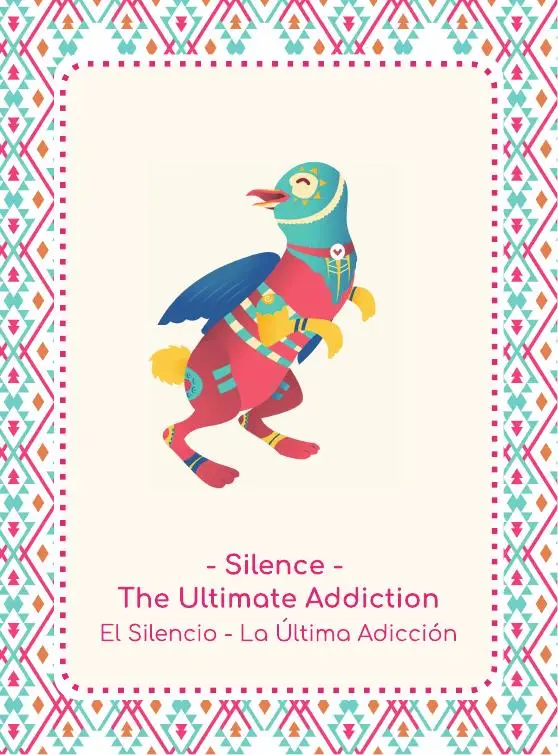
Silence The Diamond Path card
24Silence The Diamond PathIn silence I discover the diamond path.

The huntsman racing after his wounded stag is the mind under Addiction, compelled by senses and desire and certain that the whole world must be watching the same prey. Vasiṣṭha's remedy is Invention, one mind breaking another as iron breaks iron, and its fruit is the sage's Silence, cool as stone, in which the chase passes through without being seen.

  1. Shadow · what you avoidAddiction

    Addiction is the chase itself, the huntsman crashing through the forest and calling out, “Have you seen, O sage, a wounded stag flying before me this way, with an arrow fixed in its back?” (VI.1.124.30).

  2. Gift · what is hidden in itInvention

    Invention is the inner turn Vasiṣṭha prescribes: “break your sensuous mind by the power of your reasoning mind… as they break the iron pegs by force of iron hammers” (VI.1.124.15).

  3. Essence · what you embodySilence

    Silence is the sage's answer: “the feeling of my egoism, has been long before dissolved in my mind… I rest quiet in my fourth state” (VI.1.124.33), a “mere witness and spectator of the affairs of life” (VI.1.124.24).

Here is Silence: The Diamond Path, and a sage so quiet that a hunter's whole chase passed straight through him. When the next craving gallops by, you are allowed not to follow.

— Felicia
Today’s contemplation

When the hunter's question arrives and the stag runs past, who in you is listening, and who does not need to turn?

To close the night

Tonight, write one honest sentence about the ‘stag’ your attention chased most often today.

The Ally Journey · about 15 minutes

Light trance, eyes open if you prefer. For the full, deeper script, see “The practice” above and its cautions.

  1. Threshold: three slow breaths. Put down the past act and the future care for a moment, and attend only to the present duty, which for now is breathing.
  2. The tale in one line: a huntsman asks a silent forest sage whether a wounded stag ran past; the sage, resting in the fourth state, saw nothing, and the huntsman leaves bewildered (VI.1.124.29–34).
  3. Meet the card: look at the art of Silence: The Diamond Path and let the eyes rest in its stillest point. Read the affirmation aloud: “In silence I discover the diamond path.”
  4. Shadow: what pulled you along this week, a screen, a snack, a worry, a habit, again and again? Name the pull and the discomfort it helped you avoid.
  5. Gift: iron against iron. When the pull appears, meet it with one calm sentence from your reasoning mind, for example “This will pass if I let it.” Say it once and let it work.
  6. Essence: imagine a clearing where a thought crosses like a stag and you simply do not follow. Rest for three breaths. On each out-breath say: “In silence I discover the diamond path.”
  7. Return: let life flow back into the limbs, move fingers and toes, open your eyes fully and take up the present task. Write tonight's honest sentence.

The 30-day Bond

In the diamond of silence, who was listening when today's stag passed by unchased?

The Sister · Bari

Korean · Jeju Island, South Korea · Nammu Amitabul

Visit Bari, the Korean mudang of Jeju Island, and let her Nammu Amitabul be the one calm phrase you meet a craving with, as the sage met the hunter with quiet.

Guided Meditation

#24 · Silence The Diamond Path

Voice & guidance: Prof. Luis Miguel GallardoWatch on YouTube (ES also available)
For facilitatorsA session with “The Stag and the Huntsman” and Silence The Diamond Path

Aim. To help the client meet compulsive pulls with a calm counter-thought and to practise letting intrusive thoughts or cravings cross awareness without being pursued.

ITM 3 Gift Discovery. The tale offers a usable Gift, iron against iron (VI.1.124.15), that turns the mind's own power against its compulsions before any lasting silence is asked for.

The session (60–75 min)

  1. Arrival and Umbral: three breaths with past and future set aside; ask which pull has been strongest this week (8 min).
  2. Telling the tale: Vasiṣṭha's three bodies and the definition of turya in brief, then the huntsman and the sage; point to the tale page for the full chapter (5 min).
  3. The card: show Silence: The Diamond Path, read Shadow → Gift → Essence and the affirmation; ask what the pull distracts from (7 min).
  4. Shadow inquiry: map one compulsive loop, trigger, chase, brief relief, return, and find the moment where a reasoning sentence could enter (12 min).
  5. Trance practice: “The Unseen Stag”, the full guided script on the tale page, at light to medium depth only, never the somnambulistic insensibility of the tale; the stag crosses and is witnessed, not erased (18 min).
  6. Gift and Essence integration: write the client's own ‘iron hammer’ sentence and agree when to use it; distinguish clearly between witnessing and numbing (12 min).
  7. Closing and Bond: let the principle of life flow back into the limbs, count up and re-alert; set the 30-day Bond (8 min).

Integration questions

  • What happened to the stag when you did not turn towards it?
  • Which sentence worked as your iron hammer, and how did the pull respond?
  • How will you tell, this week, whether you are witnessing a craving or simply numbing it?

In a circle

For 8–20 people, tell the tale and then run a simple exercise: the facilitator calls out ordinary distractions, a phone buzzing, a smell of coffee, a worry, while the circle practises letting each ‘stag’ cross without turning towards it. Each person writes their own iron-hammer sentence and, if they wish, reads it aloud once. Guide “The Unseen Stag” at light depth for the whole group. Close with Bari's Nammu Amitabul said softly together, a minute of shared silence, and the affirmation.

Cautions

  • The ‘cool as blocks of stone’ stance is not a model for clients with dissociative numbing, depersonalisation or flat affect.
  • The sage's indifference to a wounded animal is ethically ambiguous; present the tale as a perceptual state, not a rule for relating to others.
  • Do not suggest the absence of all perception to clients prone to derealisation or psychosis.

Training and certification in the Meta Pets Method: metapetsworld.org/facilitators ↗

The correspondence between tales and Meta Pets is contemplative: the Yoga Vāsiṣṭha does not contain the Meta Pets; each tale enacts its ally’s arc. Felicia is an artificial-intelligence companion; her words are contemplative reflections, not clinical advice.

The song

From the cycle The Sixty-Four Tales

The Stag Ran Past

Oṃ

Figure — The silent forest sage resting in the fourth state (turya), and the huntsman who asks him which way the wounded stag ran.

Where in the text — Book VI (first half, Nirvāṇa-prakaraṇa), Mitra chapter 124.

Hypnotic phenomenon the song enacts — HAL and WIT, with CAT: a negative hallucination held in the witness state. The chase runs over a drone that never changes; the stag passes and the sage sees nothing; the fourth state is a bar of silence with the drone, the life, still sounding under it.

Mantra — Oṃ (A–U–M and the silent fourth), with amātraś caturtho 'vyavahāryaḥ prapañcopaśamaḥ śivo 'dvaitaḥ (अमात्रश्चतुर्थोऽव्यवहार्यः प्रपञ्चोपशमः शिवोऽद्वैतः). Source: Māṇḍūkya Upaniṣad 8–12, where A, U and M are waking, dream and deep sleep, and verse 12 names the fourth. Meaning: "The fourth has no measure; it has no dealings with the world; in it the world grows still; it is peaceful, and not two."


Lyrics (English)

Performance: two layers that never touch. Under everything, from the first bar to the last, one held drone and a low hummed voice: the sage, never changing pitch or volume. Above it, the chase: frame drums at a run, a hunting horn, the huntsman's tenor. The chase never alters the drone; the drone never follows the chase. The huntsman's question is sung once. In the bridge the three states step down in pitch, then one full bar of silence for the fourth, with only the drone. The song ends with footsteps walking away and the drone going on alone.

Verse 1 (huntsman, at a run) Roaming the forest for my prey, a stag flying on ahead of me, my arrow fixed in its back — this way, this way, this way — and there, alone, a sage sitting silent. Strange, I thought. I called to him:

Verse 2 "Have you seen, O sage, a wounded stag flying this way before me, with an arrow fixed in its back?" (the drone; the hum) "You ask me where your stag has fled. My friend, we who live in the forest are as cool as blocks of stone."

Chorus (the sage, low, on the drone's note) Cool as a block of stone, mud gone down to the bottom of the water; the "I" that drives the eyes melted long ago — I saw no stag go by.

Verse 3 (the sage) It's the mind that drives the senses, and the feeling "mine" dissolved in me long ago. I don't see waking, I don't see dreams, I don't see the deep sleep; I rest in the fourth, where there's no seeing of the seen.

Chorus

Bridge (mantra) (each line a step lower) Waking, the dark one — A — dreaming, the quiet one — U — deep sleep, the one that feels nothing — M — (one bar of silence; only the drone) amātraś caturtho 'vyavahāryaḥ (the fourth has no measure, no dealings with the world) Oṃ

Outro (footsteps going away; the drone stays) The huntsman heard, and could make nothing of it; he went his way without a word. It looks like death, this sitting figure, but the life is kept inside it. The forest goes on; he sees it all go on.


Letra (castellano cantable)

Interpretación: dos capas que nunca se tocan. Debajo de todo, del primer compás al último, un bordón sostenido y una voz grave que tararea: el sabio, sin cambiar de altura ni de volumen. Encima, la persecución: panderos a la carrera, un cuerno de caza, el tenor del cazador. La persecución nunca altera el bordón; el bordón nunca sigue la persecución. La pregunta del cazador se canta una sola vez. En el puente los tres estados bajan un escalón cada uno, y luego un compás entero de silencio para el cuarto, solo con el bordón. La canción acaba con pasos que se alejan y el bordón que sigue solo.

Verso 1 (el cazador, a la carrera) Recorría el bosque tras mi presa, un ciervo volando delante de mí, mi flecha clavada en su lomo — por aquí, por aquí, por aquí — y allí, solo, un sabio sentado en silencio. Qué extraño, pensé. Le llamé:

Verso 2 "¿Has visto, oh sabio, un ciervo herido que huyera por aquí delante de mí, con una flecha clavada en el lomo?" (el bordón; el tarareo) "Me preguntas adónde huyó tu ciervo. Amigo, los que vivimos en el bosque somos fríos como bloques de piedra."

Estribillo (el sabio, grave, en la nota del bordón) Frío como un bloque de piedra, el barro asentado en el fondo del agua; el "yo" que mueve los ojos se deshizo hace mucho — no vi pasar ningún ciervo.

Verso 3 (el sabio) Es la mente la que mueve los sentidos, y el sentir "mío" se me deshizo hace tiempo. No veo la vigilia, no veo los sueños, no veo el sueño hondo; descanso en el cuarto, donde no se ve lo visible.

Estribillo

Puente (mantra) (cada verso un escalón más abajo) La vigilia, la oscura — A — el sueño, la quieta — U — el sueño hondo, la que no siente — M — (un compás de silencio; solo el bordón) amātraś caturtho 'vyavahāryaḥ (el cuarto no tiene medida, ni tratos con el mundo) Oṃ

Final (pasos que se alejan; el bordón se queda) El cazador lo oyó, y no entendió nada; siguió su camino sin decir palabra. Parece la muerte, esta figura sentada, pero la vida está guardada dentro. El bosque sigue; él lo ve todo seguir.


One line to carry

EN: Let the stag run past; the stillness keeps the life. ES: Deja pasar al ciervo; la quietud guarda la vida.


Libreto note

The shortest teaching story in the book, and one of the strangest. A huntsman, running after a stag with his arrow in its back, finds a sage sitting silent and asks the only question he has: which way? The sage answers that the "I" which drives the eyes melted long ago; he rests in the fourth state, where nothing seen is seen. The stag went by, and no one was there to see it. Hypnosis calls this negative hallucination. The huntsman walks off baffled, as most of us would. A drone that never moves, a chase that never touches it, three steps down, one bar of silence, and the life kept inside.


Source check

Source check (Mitra, Book VI first half)

  1. "A huntsman, roaming for his prey in some part of a forest, chanced to see a sage sitting silent in his solitude; and thinking it as something strange, he accosted him"; "Have you seen, O sage, a wounded stag flying before me this way, with an arrow fixed in its back?": ch. 124, vv. 29–30.
  2. "You ask me, where your stag has fled; but my friend, know that sages like ourselves and living in the forest, are as cool as blocks of stone"; "it is the mind, which conducts all the actions of the senses": ch. 124, vv. 31–32.
  3. "The feeling of my egoism, has been long before dissolved in my mind; and I have no perception whatever of the three states of waking, dreaming and sound sleep … my fourth state … wherein there is no vision of the visibles"; "mine and thine … altogether wanting"; turya like "the setting of the turbid waters underneath": ch. 124, vv. 24, 27, 33.
  4. "The huntsman heard these words of the sage, but being quite at a loss to comprehend its meaning, he departed to his own way without uttering a word": ch. 124, v. 34.
  5. Waking, dreaming and sound sleep as "the dark, quiet and insensible states"; the fourth "bears the feature of death in it. Yet this dead like figure possesses the principle of life in it"; the calm "in which the wise man sees every thing, to be going on in the world": ch. 124, vv. 26, 36–38.

Read the full text

Source: Vihari-Lala Mitra, The Yoga-Vasishtha Maharamayana of Valmiki (1891–99), public domain.

Collaborate on this research

Researchers, clinicians and institutions are welcome to write. Replication, data-sharing and site partnerships for the trials in progress are all open conversations.

Educational and scholarly content. Hypnotherapy and regression material is complementary and not a substitute for medical or psychiatric care.