ICEF

Tale 22 · The Vāsiṣṭha Atlas

Uddālaka

Upaśama · Dissolution · Mitra V.51–56 · 18,671 words

Uddālaka talks his own mind down into trance, and back out.

Bhūmikā 6 · Padārthābhāvanī (melting of objects)PlenaryYour ally · The Healing Power of the Mind

The essence

Uddālaka, a young ascetic on Gandhamādana, longs for "holy and transcendent thoughtlessness", but his "apish" mind swings between the inner light and the objects of sense. He finds a perfect cave, sits in padmāsana and talks to himself: he rebukes his mind, searches his body "from the head to foot" without finding an "I", and reasons his way to the stainless intellect, Mitra's "rational rapture". Then he practises. He sounds Om and, in three breath-stages, sees his body burned to ash, scattered by the wind, rained on by lunar nectar and raised again in Viṣṇu's form; he withdraws the senses, half-closes his eyes, passes through a flash of clear light, restlessness, drowsiness and hypnagogic shapes, and reaches the "samádhi or trance, which no language can describe". After six months "he awoke from his trance", declined heaven, alternated meditation with life in the world, and finally left his body by choice. It is the Yoga Vāsiṣṭha's own self-hypnosis protocol, spoken in the first person, with its obstacles mapped.

What it teaches

  1. 01

    Motivation and setting come first: the protocol begins with a sustained longing for rest (V.51.17–37) and a place whose light is "neither too hot nor too cold" (V.51.52), not with technique.

  2. 02

    Self-talk moves from rebuke to reasoning: Uddālaka scolds his mind, then realises "it is only by reasoning with the mind that men are enabled to govern their hearts" (V.52.25).

  3. 03

    Searching the body for the "I" and failing to find it (V.52.36–43) loosens identification more reliably than merely asserting that one is not the body.

  4. 04

    The descent has predictable hazards (a flash of clarity lost to restlessness, then drowsiness, then empty imagery: V.54.45–50), and each is met by the return of reason, not by force.

  5. 05

    Even the deepest trance has an exit: after six months "he awoke from his trance" (V.54.74), his later life alternates sitting and rising (V.54.89–90), and the final departure is his own choice (V.55.12).

The Vāsiṣṭha Atlas

This tale’s coordinates

The wound and its virtue

Uddālaka begins at war with his ‘apish’ mind, rebuking it as ‘senseless’ and listing the deer, the moth and the fish as accusations (V.52.8): self-directed anger and aversion, the Rejection wound turned inwards. His turning is the Welcoming movement, ‘it is only by reasoning with the mind that men are enabled to govern their hearts’ (V.52.25), Gentleness as method.

What it trains

The protocol replaces forcing with reasoning and lets attention pass through the mapped hazards, a flash of light, restlessness, drowsiness, hypnagogic shapes, without suppressing them, until the trance ‘which no language can describe’ (V.54.53).

In other yogas

  • Patañjali · Yoga Sūtra · YS 1.30

    Patañjali lists the obstacles that scatter the mind, among them dullness, carelessness, false perception and failure to hold a stage once reached; Uddālaka’s descent maps the same hazards from the inside, a clarity glimpsed and lost, restlessness, drowsiness.

  • Bhagavad Gītā · BG 6.26

    Wherever the restless mind wanders, the Gītā says, draw it back and settle it in the self; Uddālaka’s mind swinging between inner light and sense objects (V.51.44) receives the same patient return once he stops scolding it.

  • Vijñāna Bhairava Tantra · VBT

    Among the Tantra’s dhāraṇās is the imagined burning of one’s own body by a fire rising from the foot until only peace remains; Uddālaka’s Oṃ-guided vision of his body burned to ash, scattered by the wind and raised again is a close relative.

  • Yoga nidrā

    His head-to-foot search for an ‘I’ that is nowhere found (V.52.36) is the inquiring ancestor of the body rotation of yoga nidrā, where attention travels part by part and identification with the body loosens as it goes.

IEAF: Integrative Emotional Alchemy Framework (Gallardo, Frontiers in Psychology, 2026). FP20: the Fundamental Peace Scale. ITM: the Integrative Transformation Model. Parallels in other yogas are contemplative correspondences, not claims of influence.

The tale

On the north-western heights of Gandhamādana, among camphor groves and crystal streams, lived the young sage Uddālaka, who had taken up austerities before he was grown. When reason dawned in him he began to ask what gain would end all seeking. When, he wondered, would his desires subside like waves, when would he sit so still that birds would nest in his hair, when would he see the world as a scene in a dream and stay apart from it? But his "apish" mind kept turning, now towards the inner light, now back to the senses, and found rest only in the twilight between them. He shook like a tree in a storm and wandered over the mountain.

At last he found a cave no creature visited, floored with moonstones and grass, lit by gems whose glow was "neither too hot nor too cold". He spread leaves and a deerskin, sat in padmāsana with his face upturned, counted his beads and restrained the deer of his mind. Then he spoke to himself: "O my senseless mind!" Why chase pleasures that end in pain, like the deer lured by the hunter's horn, the elephant by the decoy, the fish by the bait, the moth by the flame, the bee by the elephant's ichor? Then he checked himself: scolding is useless; only reasoning governs the heart. He searched his body from head to foot, through flesh, blood, bones, breath and the organs of sense, and found no "I" anywhere. He noticed that his eyes and limbs work without his will. He reasoned that the intellect has no birth or death, that egoism is a mirage, that body and mind are at war and both may go. "I find myself to be now situated in a state of transparency and buoyancy", he concluded: the rational rapture.

Then he practised. With half-closed eyes he uttered Om, ringing like a bell up to the crown of his head. In the first stage of the syllable he breathed out until the body was empty, and the fire of his heart burned it to ash. In the second, holding the breath, the fire went out and the bones and ashes were scattered by the wind. In the third, breathing in, his breath rose to the moon, cooled, and fell back as a dew of nectar that raised his body again, bright as the moon and four-armed like Nārāyaṇa. Then his body returned to its natural state.

He fixed his posture, chained the five senses, half-closed his eyes with unmoving pupils and drew the senses in as a tortoise draws in its limbs. Doubts rose and he drove them off with reason. A beautiful light appeared, but worldliness devoured it; his mind grew drowsy and tipsy; reason shook off the sleep; the empty sky filled with fancied animals and peacocks; then his own light returned and replaced the void with self-awareness. His limbs dropped as in sleep, and he entered "that state of samádhi or trance, which no language can describe". From self-consciousness he passed to intellect, to the intellect of intellect, to the one universal intellect; he went beyond the confines of his body into a sea of joy and floated there "for many years", still as a lamp in windless air.

Siddhas and gods gathered at his door; he paid them no heed. After six months "he awoke from his trance". When the Siddhas invited him to heaven and its pleasures, he honoured them without being moved and sent them away. He roamed the great mountains as a living-liberated yogi, then settled in a cave, rising from meditation after a day, a month or years, and moving among people with a reserved, abstracted mind.

After a long time he chose to leave the body. He sat once more, closed the nine gates, pressed his tongue to the palate, stopped the breath until his hair stood on end, and dissolved into a bliss beside which Indra's wealth was a straw. His frame withered under sun and wind, until the goddess Cāmuṇḍā, coming with Pārvatī and the Mothers, set his skeleton on her crown as her most precious jewel.

The text speaks

Passages from Mitra’s translation (1891–99), cited by book, chapter and verse.

“Thus turning by turns from the inner to the outer world, and then from this to that again; his mind found its rest in the intermediate space, lying between the light of the one and darkness of the other.”
V.51.44The oscillating attention that precedes induction, and its first resting place in a twilight state.
“O my senseless mind! said he, why is it, that thou art occupied in thy worldly acts to no purpose; when the sensible never engage themselves, to what proves to be their bane afterwards.”
V.52.8The protocol is self-administered: the practitioner addresses his own mind in the second person.
“I analysed my body at each atom from the head to foot, but failed to find what we call the “I” in any part of it, and what makes my personality.”
V.52.36A head-to-foot body inquiry used to dissolve identification, the core of the witness stage.
“I see my will also is not always the cause of my actions, because I find my eyes and the other organs of sense are employed in their respective functions, without the direction of my volition.”
V.52.59The experience of nonvolition, the hallmark of suggested responses, observed by the subject in himself.
“Then he uttered the word with an elevated voice and high note, which rang with a resonance like the ringing of a bell.”
V.54.3Vocal resonance as the opening of the formal induction.
“The same fell as a dew drop on the remaining ashes, as the stream of the heavenly Gangá fell on the crest of Siva; and this resuscitated the burnt body to its former form.”
V.54.22The renewal image that completes the dissolution sequence of the praṇava yoga.
“In this manner his misty mind, being freed from its shades of light and darkness, and from the dross of its drowziness and error; obtained its rest in that state of _samádhi_ or trance, which no language can describe.”
V.54.53The arrival point, reached only after the obstacles of light, drowsiness and error have been passed.
“Uddálaka thus remained in his holy seat for six months, after which he awoke from his trance; and removed from there to another place, as the sun gets out of the mists of frost in the vernal season.”
V.54.74Self-terminated emergence after a bounded period: the protocol includes its own return.
“A man becomes the agent of an act, even without his doing it actually, who is fully intent upon the action; as the unmoving man thinks himself to be moving about, and falling down in a ditch (startles even at the thought, as if it were in actuality).”
V.56.14Vasiṣṭha's coda describes the ideomotor effect of vividly imagined action.

What the trance sees

IND

Induction

V.52.3–7; V.54.1–6; V.54.28–37

In the textA prepared seat of leaves and deerskin, padmāsana, beads (52.3–6); "with his half shut eye-lids" he sounds Om, which "rang with a resonance like the ringing of a bell" (54.1–3), with regulated exhalation; later "his pupils remained as fixed and unmoved" (54.32) and the senses are withdrawn "as the tortoise contracts his limbs" (54.34).

In the clinicA complete self-induction: posture, partial eye closure with fixed gaze (compare the upward gaze of Spiegel's eye-roll sign, Spiegel 1972), vocal rhythm, breath regulation, then sensory withdrawal, the components of structured self-hypnosis (Fromm & Kahn 1990).

DIR

Direct suggestion

V.52.8–25

In the text"O my senseless mind! said he, why is it, that thou art occupied in thy worldly acts to no purpose" (52.8); then "it is only by reasoning with the mind that men are enabled to govern their hearts" (52.25).

In the clinicAutosuggestion in the second person (Coué), moving from admonition to reasoned self-instruction, as cognitive restructuring of self-talk is folded into modern self-hypnosis.

WIT

Witness position / dis-identification

V.52.36–44; V.53.71–73

In the text"I analysed my body at each atom from the head to foot, but failed to find what we call the “I” in any part of it" (52.36); "I am none of the elements of the body, nor the mind nor its desire" (52.44).

In the clinicDis-identification by systematic body inquiry: the observing self (Deikman 1982), also the central move of mindfulness-based decentering.

HAL

Positive or negative hallucination

V.54.7–24; V.54.49

In the textIn the three stages of the praṇava, the body is burned to ashes, the ashes scattered, then a lunar dew "resuscitated the burnt body to its former form" bearing "the four arms of Vishnu" (54.8–23); later "the broad expanse of the blue firmament, filled with fancied forms of animals, and flights of peacocks" (54.49).

In the clinicDeliberate guided imagery of dissolution and renewal (compare Leuner's Guided Affective Imagery), followed by spontaneous hypnagogic imagery that the practitioner treats as an obstacle to pass, not a goal.

DEEP

Deepening

V.54.40–58

In the textA clear light appears and is lost to rajas, tamas brings drowsiness, reason shakes it off, the void gives way to self-consciousness (54.45–51); then "from that of his consciousness of himself" to intellectuality, to "the intellect of his intellect", to "the pure universal intellect" (54.55–57).

In the clinicStaged deepening with named levels and recovery from setbacks, a self-guided form of graded deepening and of Vogt's fractionation.

CAT

Catalepsy

V.54.54; V.55.22

In the text"his limbs dropped down as in the drowziness of sleep" (54.54); "His great body remained as fixed as an image in painting" (55.22).

In the clinicRelaxation heaviness of the kind trained in autogenic training (Schultz), progressing to sustained catalepsy.

OBE

Out-of-body / thought-body travel

V.54.60–62

In the text"He passed out of the confines of his body and then went to a certain spot, where leaving his ordinary form, he became as a sea of joy".

In the clinicOut-of-body experience reported in deep trance: dissolution of the felt body boundary with expansive positive affect.

TD

Time distortion

V.53.44; V.54.61; V.54.74

In the textHis intellect "remained there for many years" on the sea of joy (54.61), yet "Uddálaka thus remained in his holy seat for six months" (54.74); earlier he notes that the mind "makes the long of short and the short of long" (53.44).

In the clinicTime distortion (Cooper & Erickson 1954), both experienced and theorised by the subject.

EMG

Emergence / re-alerting

V.54.74; V.54.89–90

In the text"after which he awoke from his trance"; later "in the course of a day, and then of a month, and sometimes after the lapse of a year or years, that he rose once from his meditation" (54.89); "After his yoga was over, he came out and mixed with the world" (54.90).

In the clinicSelf-terminated emergence and a practised rhythm of entering and leaving trance; re-entry into ordinary activity is part of the protocol, as in fractionation used as a way of life.

Read upward — stage 1 at the bottom, stage 7 at the top

  1. Integration zone
    Perceptual shift — the boundaries of things soften; consciousness expands past its usual partitions.

A note on what this map claims. The alignment between stages of knowledge and trance depths is a clinical map — a heuristic correspondence proposed for research, not a claim of identity between contemplative attainment and hypnotic depth.

Bhūmikā 6 · Padārthābhāvanī

The protocol passes through sattvāpatti (Mitra glosses the first clear light as "sáttwikabháva or state of purity", V.54.45) to absorption in which particulars vanish and he becomes "one with the sole vacuous intellect" (V.54.58), Mitra's sixth stage of "trance or sound sleep" (VI.1.120.4). His deliberate bodiless departure (V.55.12–25) belongs to the seventh, which "relates to disembodied souls only" (VI.1.120.6).

Zone · Plenary

Six months of immobile, indescribable trance with loss of mortal awareness (V.54.53, V.54.74, V.55.23) is plenary; the stages before it (V.54.40–51) map the deep zone where the YVH Model works.

In Mitra’s words

In Calcutta in the 1890s, the translator chose the vocabulary of hypnotism to name these states. More →

  • samádhi—comatosityWhen shall I become like a cold clod of stone, in the cavern of a mountain, and have the calm coolness of my mind by an invariable _samádhi_—comatosity.V.51.33
  • torpidityWhen will the little birds of the forest, build their nest of grass in the braids of hair upon my head; when I remain fixed in my unalterable meditation, in my state of silence and torpidity.V.51.35
  • reveries (chapter argument)Uddálaka’s Remonstration with himself, amidst the reveries of his meditation.V.52
  • suggestionThat this is I and that is another, is the false suggestion of our delusive ignorance; which, like an epidemic disease, presents us with such fallacies for our destruction.V.52.32
  • rational rapture (chapter title)THE RATIONAL RAPTURE OF UDDÁLAKA.V.53
  • hybernation (samádhi)He strove to practise an unshaken hybernation (_samádhi_), and wanted to make himself appear as translucent, as the clear autumnal sky and air.V.54.29
  • samádhi or tranceIn this manner his misty mind, being freed from its shades of light and darkness, and from the dross of its drowziness and error; obtained its rest in that state of _samádhi_ or trance, which no language can describe.V.54.53
  • ecstacyHe passed out of the confines of his body and then went to a certain spot, where leaving his ordinary form, he became as a sea of joy (in the transport of his ecstacy).V.54.60
  • insoucianceHe now remained in his state of indifference, which lies between the two opposites of sorrow and joy; and neither of which is of long continuance, except the middle state of _insouciance_ which endureth for ever.V.54.68
  • tranceUddálaka thus remained in his holy seat for six months, after which he awoke from his trance; and removed from there to another place, as the sun gets out of the mists of frost in the vernal season.V.54.74
  • ecstacy (Samádhi)It is the enlightened soul which is exalted by ecstacy (Samádhi), that can have this common view of all as one; and not the ignorant (who can not make this highest generalization).V.55.8
  • raptureHe remained with an even composure, in his state of transcendent quietness; and enjoyed an even rapture in himself, with a placid countenance.V.55.20
  • enraptured yogiThe Bráhman then attained to that state of his _summum bonum_ which is unmeasurable, and pervades through all space of the measureless vacuum; and which fills the universe and is felt by the enraptured yogi alone.V.55.25
  • anaesthesia; insoucianceKnow the inaction of the mind, to be the best state of _anaesthesia_; and solity or singleness, as the best means to your _insouciance_.V.56.15
  • samádhi or non-chalanceWhen the mind is tranquil, after it is freed from its fears, griefs and desires; and the soul is set at its rest and quiet, in want of its passions; it is then called the state of its _samádhi_ or _non-chalance_.V.56.20

In the therapy room

Indications

  • Teaching self-hypnosis to motivated clients and to practitioners, stage by stage
  • Restless attention that swings between inner work and distraction (V.51.39–46)
  • Over-identification with body, illness or role, through the body search for the "I" (V.52.36–44)
  • Training in recognising and handling drowsiness and hypnagogic drift during practice (V.54.46–50)
  • Cravings and sensory compulsions, using the parable of the deer, elephant, fish, moth and bee (V.52.16–21)

Cautions

  • The self-cremation imagery (V.54.8–15) is unsuitable for clients with trauma involving fire, death or bodily harm, or with suicidal ideation; offer gentler dissolution imagery
  • Breath retention (kumbhaka, V.54.10–11; V.55.16–17) should not be taught to clients with cardiovascular or respiratory conditions, panic disorder, or in pregnancy
  • Prolonged withdrawal can deepen depersonalisation; keep sessions bounded with an explicit return
  • Vasiṣṭha's own warning: quietude practised with a fickle mind "turns to the reeling of a giddy or mad man" (V.56.10)
From the bookThe full clinical note

Indications. The tale is first of all a teaching text. For motivated clients and for practitioners learning self-hypnosis, it supplies a complete protocol in the first person, stage by stage, with its hazards named; I use it to teach the structure of a session before teaching any technique. Its opening is a precise portrait of restless attention that swings between inner work and distraction (V.51.39–46), and clients who say "I can't meditate" recognise themselves in it at once; the tale's answer, that oscillation is the starting point and not a failure, is often the first relief. The body search for the "I" (V.52.36–44) is useful for over-identification with a body, an illness or a role: the person who has become "the diabetic" or "the one with the bad back" can be invited to look for the self in the flesh, the blood, the bones, and to notice that it is not found there, and that the looking is calm. The map of obstacles (V.54.45–50) trains clients to recognise drowsiness and hypnagogic drift in their own practice and to meet them without alarm. And the parable of the deer, the elephant, the fish, the moth and the bee, each destroyed through a single sense (V.52.16–21), is a ready metaphor for cravings and sensory compulsions, one creature per sense, which the client can name for himself.

As metaphor. The tale's central move, from rebuke to reasoning (V.52.25, 29), can be offered almost unchanged to clients whose inner voice is harsh. Uddālaka scolds his mind, notices that scolding does not work, and changes his tone; the client can be invited to do the same and to hear the difference. The Siddhas at the door (V.54.63–67) are a gentle image for intrusive plans and worries during practice: they may come, they may wait, they may be honoured and sent away. The cave whose light is "neither too hot nor too cold" (V.51.52) is a safe-place image already written.

As protocol. The practice below follows the text's sequence: longing and place, posture and eyes, speaking to the mind, the search for the "I", Om on three breaths, withdrawal and the passing of obstacles, rest, and return. In the consulting room I shorten the rest to minutes and agree its length beforehand; the six months belong to the tale.

Cautions and screening. The text raises five, and each needs a decision before the tale is used.

  1. The self-cremation imagery (V.54.8–15). A body burned to ash and scattered is a powerful image of letting go, and for many people it is liberating. It is unsuitable for clients with trauma involving fire, death or bodily harm, for the recently bereaved who may have attended a cremation, and for anyone with suicidal ideation. Offer gentler dissolution imagery, snow melting, mist lifting, salt dissolving in water, keeping the renewal (the cool drop, the lake filling) intact.
  2. The chosen death (V.55.12–29). Uddālaka stops his breath and leaves his body by choice. In the text this is the completion of a long life, not an escape from pain, and it belongs with the other voluntary departures the book records, such as the mother's yogic death in the tale of Puṇya and Pāvana (Tale 18, V.19.21) and Rāma's own early resolve to stop eating and breathing (Tale 1, I.31.22–25). Screen for suicidal ideation before using the tale in full; with a client at risk, do not present chapter 55 at all, and do not let the story's ending stand as a model. The practice in this chapter ends with the return of chapter 54, not the departure of chapter 55.
  3. Breath retention. The kumbhaka (V.54.10–11; again, total, at V.55.16–17) should not be taught to clients with cardiovascular or respiratory conditions, panic disorder, or in pregnancy; for them, a natural pause at the end of the out-breath is enough.
  4. Depersonalisation. The witness inquiry and the dissolution of the body boundary (V.52.36–44; V.54.60) relieve when they are calm and distress when they are not. Screen for dissociative disorders and for a history of psychosis; for these clients, practise only with a clinician, keep sessions short and bounded with an explicit return, and stop if "not finding the I" turns from relief to fear.
  5. Vasiṣṭha's own warning. Quietude practised with a fickle mind "turns to the reeling of a giddy or mad man" (V.56.10). The text knows that withdrawal without steadiness can destabilise; that is why chapter 52's reasoning comes before chapter 54's practice, and why the clinician should not skip it.

Finally, the danger the whole book returns to: absorption without return (Tale 20, V.38.8–16). Uddālaka is the counter-example, the one who wakes by himself, but a client is not Uddālaka. Every use of this tale should end, as the practice does, with orientation to name, place and time.


The practice

The Self-Guided Descent

  1. Longing and place: name what you want rest from; choose a quiet place, neither too hot nor too cold, and prepare your seat (V.51.17–37, V.51.48–54; V.52.3–4).
  2. Posture and eyes: sit upright, eyelids half closed, gaze still (V.52.6; V.54.1, V.54.32).
  3. Speak to the mind: address it in the second person, first noticing its pulls, then reasoning with it rather than scolding (V.52.8–25).
  4. Search for the "I": move attention from head to foot, through flesh, blood, bones, breath and senses, asking where the "I" is (V.52.36–43).
  5. Om and three breaths: a long Om on the out-breath, a gentle pause, a cool in-breath; imagine the old self dissolving and a renewed, luminous form taking shape (V.54.3–24; omit retention where contraindicated).
  6. Withdraw and pass the obstacles: let the senses fold in like a tortoise; when light appears do not grasp it, when drowsiness comes let reason lift it, when shapes appear let them pass (V.54.34–50).
  7. Rest in the indescribable: let the limbs grow heavy and remain for the time agreed beforehand (V.54.53–54).
  8. Awake from the trance: return deliberately, feel the body, name the place and the time, stand, and go back to the world with the calm intact (V.54.74, V.54.89–90).

Practise with a qualified professional if you have a history of dissociation, trauma or psychosis.

From the book · to be read aloudThe full guided script

The Self-Guided Descent

Read slowly, aloud, in your own voice, leaving a breath between lines; twenty to twenty-five minutes. Record it and play it back if you wish. The voice that leads this trance is meant to be yours.

Before you begin. This is a self-hypnosis practice built on Uddālaka's own sequence: a longing, a seat, an inquiry, the breath of Om, a deepening, a rest, and a return. It is safe for most healthy adults. Do not practise it unsupervised if you have, or have had, a psychotic illness, a dissociative disorder, uncontrolled epilepsy, thoughts of ending your life, or trauma that still produces flashbacks; practise it with a clinician who knows your history. If images of fire, burning or death are difficult for you, wherever the text below says ash, read mist. If you are pregnant, or have uncontrolled high blood pressure, a heart or respiratory condition or a history of panic attacks, omit the breath-hold and simply pause naturally at the end of each out-breath. Never practise while driving, operating anything, standing, or in or near water. The breath-hold is gentle and never forced; if you feel dizzy, breathe normally at once. Sit, do not lie down, so that the body can tell you when it is time to return. Decide now how long you will rest in the silence: two to five minutes is plenty. If you like, set a soft chime.

How to return at any moment. If anything becomes uncomfortable, say aloud, "Breath coming back," take one full breath in, feel your feet, count up from one to five, and open your eyes on five. That is the whole of it. Nothing in the practice requires you to stay.


Sit down.

Before anything else, name what you want rest from. One word is enough. Say it once, quietly, and let it go.

Spread what you have under you, a folded blanket, a cushion, a chair. Sit as you would on leaves with a deerskin over them: supported, a little raised, nothing pressing. Let the spine rise. Let the face turn very slightly up, as if the ceiling held a little light. Let the hands rest, fingers free, as though they held beads they do not need to count.

Let the eyelids come half down. Not shut. Half. Let the eyes rest behind them, looking up a little, unmoving, as a lotus closes against the bees that go on buzzing outside. The thoughts can buzz. You do not have to open to them.

Breathe out.

Nothing reaches this room that you did not bring. No wind. The light is neither too hot nor too cold.

Breathe out.

All day the mind ran, out to things and back and out again, like a deer to the hunter's horn. You are not going to scold it. Scolding is wind against the rain. You are going to reason with it, gently, as the sage did, and let the reasoning do the quieting.

So ask.

This is the skin. Feel it where the air touches it, where the clothes rest, where the seat holds you. This is the skin. Is the one who says I in the skin?

This is the breath. Feel it leave, and feel it return without being asked. This is the breath. Is the I in the breath?

These are the bones, the long bones of the legs, the bowl of the hips, the stacked bones of the back holding you up without effort. Is the I in the bones?

This is the heartbeat, in the chest, perhaps in the fingers. It beats without permission. Is the I in the heart?

Listen for the word. I. In the ear it is a sound like any sound, and then it is gone. On the tongue it has no taste. Through the nose it has no scent. The eyes see without your telling them to. The hands can rest without it. Let the hands rest without you.

Breathe out.

Now the sound.

Take a slow, full breath in, and on the out-breath let a single syllable come, quietly, in your own pitch: Aaaaa. Let it ring like a bell rung once. Feel it in the skull, at the crown. Let the breath go out with it until the body is as empty as a sea drunk dry. Empty, easy, nothing left to hold.

And pause, where the out-breath ends. In that pause let the syllable change: Uuuuu, silent now, held in the stillness. The body is light as ash. The wind could lift it like morning mist. There is nothing to defend.

And breathe in, slowly, and let the third syllable fill the in-breath: Mmmmm, humming, cool. The breath rises to the full moon and comes back as one cool drop that falls on the ashes, and the body gathers itself around that drop, filling as a lake fills in spring, whole, bright.

And then the silence after the M. The half-measure. Rest there. There is nothing to do in it.

Again. A on the out-breath, emptying. U in the pause, light as ash. M on the in-breath, filling. And the silence.

Once more, slower. Out… hold… in… rest.

Now let the breath be ordinary again, and slow, and let each out-breath take you a little further down.

The senses draw in like the limbs of a tortoise. Sound is further away. Doubts rise, as they always do, like gnats, and the wind takes them. Let the wind take them.

The neck is straight as a mountain. The mind goes down into the cave of the heart, as an elephant is led into a mountain and lies down. Let it lie down.

Breathe out. Further.

If a light comes, let it come, and do not reach for it. If it goes and you feel restless, that is only the mind's old hunger; let it pass. If you feel dull and heavy-headed, that is only the middle stage; let a little clarity rise, as if a breeze moved the cloud, and the clear part comes back. If a blue field opens and fills with shapes, let them play and let them go. Each time you return, you return deeper. Each out-breath, deeper.

I am a lamp where no wind is.

I am a lake without a wave.

I am a cloud that has already rained.

I am not the skin, not the breath, not the bones. I am the one in whom these rest.

Rest here, for the time you chose. Let the limbs be heavy as they wish. Whoever comes to the door, plans, worries, the gods themselves, can wait there. You will know when it is time to come back. The body will tell you, and you will listen.

(Silence: two to five minutes, as agreed.)


Now the breath comes back, as the river came down from heaven, one cool drop at a time.

Let the in-breath grow fuller. Feel the body fill like a lake in spring: belly, chest, shoulders. The body is restored to its natural state, as the earth is after rain.

Feel the fingers. Move them. Feel the feet on the floor; press them down a little. Feel your weight on the seat. Let the neck be straight as Meru and the head balanced on it.

I will count from one to five, and on five the eyes open, clear and rested.

One. The breath is ordinary and full.

Two. The hands and feet are warm and your own.

Three. The sounds of the room return.

Four. Take one deep breath in, and let the shoulders roll once.

Five. Eyes open. Here. Now. Fully alert.

Sit a moment before you stand. Say your name aloud, and the day, and the place. Name three things you can see. If you feel at all slow, repeat the count from one to five, stand, walk a few steps, drink some water. Do not drive or operate anything for ten minutes.

Then go down the hill, as he did, and mix with the world.

Meta Pets World · Your ally · Meta Pet 18

Uddālaka and the mind that stops scolding

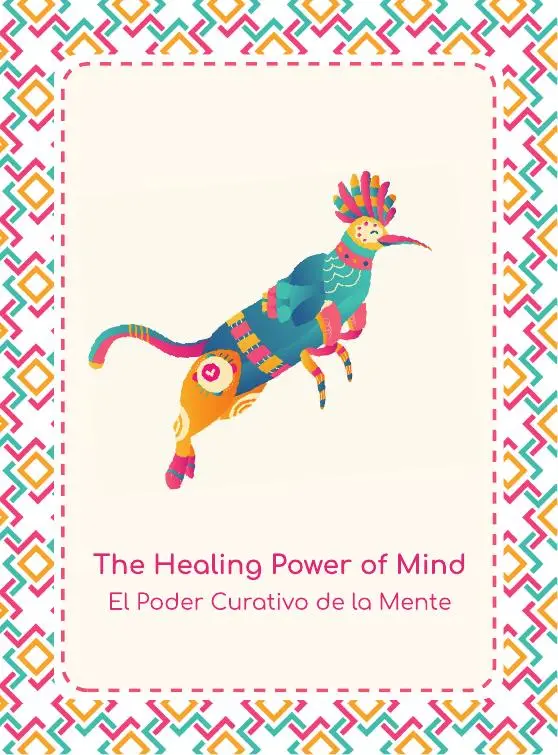
The Healing Power of the Mind card
18The Healing Power of the MindMy mind is a channel for healing energy.

Uddālaka begins by berating his own restless mind, the inner critic in full voice: the Judgment that is the Shadow of The Healing Power of the Mind. He turns when he sees that scolding is useless and only reasoning governs the heart, which is the Gift of Integrity, thought, word and practice aligned. What he finds at the end of the descent is the stainless intellect, beyond light and shade: Perfection.

  1. Shadow · what you avoidJudgment

    Judgment is the mind turned on itself: ‘O my senseless mind! said he, why is it, that thou art occupied in thy worldly acts to no purpose’ (V.52.8), followed by a catalogue of the deer, the moth and the fish as accusations.

  2. Gift · what is hidden in itIntegrity

    Integrity arrives when he checks himself: ‘it is only by reasoning with the mind that men are enabled to govern their hearts’ (V.52.25). He searches from head to foot and ‘failed to find what we call the “I” in any part of it’ (V.52.36).

  3. Essence · what you embodyPerfection

    Perfection is the mind ‘freed from its shades of light and darkness, and from the dross of its drowziness and error’, resting ‘in that state of samádhi or trance, which no language can describe’ (V.54.53).

Your mind has been told off quite enough, don’t you think? Uddālaka tried scolding too. Today, try reasoning with it kindly, the way you would with a clever, tired friend.

— Felicia
Today’s contemplation

The mind heals, but Uddālaka’s healed only when he stopped scolding it: what heals the mind that judges you?

To close the night

Tonight, write one honest sentence about something your inner critic said today, and what reason would answer.

The Ally Journey · about 15 minutes

Light trance, eyes open if you prefer. For the full, deeper script, see “The practice” above and its cautions.

  1. Threshold. Find a seat where the light is neither too bright nor too dim. Sit upright, eyelids half closed, and take three slow breaths.
  2. The tale in one line: the young sage Uddālaka talks his restless mind down from rebuke to reason, and into a peace no language can describe (V.51–56).
  3. Meet The Healing Power of the Mind. Look at the card’s art, then read gently: ‘My mind is a channel for healing energy.’
  4. Shadow. What did your inner critic say most often this week? Write or whisper its favourite sentence, exactly as it says it, without arguing yet.
  5. Gift. Now answer it as Uddālaka learned to: not ‘you fool’, but a calm reason. Then move attention slowly from head to feet, asking softly at each place, ‘is the “I” here?’
  6. Essence. Breathe out a long, soft ‘Om’, let the breath come back on its own, and rest three breaths in what is left when the scolding is quiet. Say the affirmation.
  7. Return. Feel your feet on the floor and your hands in your lap, look round the room, name the time and the place, and open the eyes fully. Write the honest line.

The 30-day Bond

The mind heals, and Uddālaka’s healed by reasoning instead of rebuke: what heals the mind today?

The Sister · Mariam

Coptic Egyptian · Wadi Natrun, Egypt · Kyrie Eléison

Visit Mariam, the Coptic Desert Mother of Wadi Natrun, who knew the solitary cave as Uddālaka did; her ‘Kyrie Eléison’ asks for mercy where he first reached for rebuke.

Guided Meditation

#18 · The Healing Power of the Mind

Voice & guidance: Prof. Luis Miguel GallardoWatch on YouTube (ES also available)
For facilitatorsA session with “Uddālaka” and The Healing Power of the Mind

Aim. To move the client’s self-talk from rebuke to reasoning, and to teach a bounded, stage-by-stage self-hypnosis with a deliberate return.

ITM 3 Gift Discovery. The tale’s turning is Gift Discovery: Uddālaka discovers that ‘only by reasoning with the mind’ (V.52.25) can he govern it, and that discovery opens the whole descent.

The session (60–75 min)

  1. Arrival and Umbral: three breaths; ask what the client longs to rest from, since the protocol begins with longing, not technique (8 min)
  2. Tell the tale in a 4-minute version: the restless young sage, the cave, the rebuke and the reasoning, the Om, the six months, the return; point to the tale page for the full retelling (6 min)
  3. The card: The Healing Power of the Mind’s art, affirmation and koan (6 min)
  4. Shadow inquiry on Judgment: collect the critic’s exact sentences, then practise answering one with reason instead of counter-attack (13 min)
  5. Trance practice: ‘The Self-Guided Descent’, following the full guided script on the tale page, taken only to light or medium depth for the time agreed beforehand; Om on the out-breath with no breath retention, and gentle dissolution imagery in place of the burning (18 min)
  6. Gift and Essence integration: debrief the obstacles met (a flash of light, drowsiness, images) and how reason returned; write one sentence of reasoning the client will use with the critic this week (12 min)
  7. Closing and Bond: assign the 30-day Bond with the varied koan; deliberate return, name place and time, stand (6 min)

Integration questions

  • What changed in your body when you answered the critic with reason rather than force?
  • When you searched from head to foot, where did you most expect to find the ‘I’, and what did you find?
  • Which obstacle, restlessness, drowsiness or images, visited you, and what brought you back?

In a circle

In a circle, begin by inviting each person to write the inner critic’s favourite sentence on a card, unsigned. Tell the tale, then have everyone, privately, write beneath it one calm reason in answer, as Uddālaka learned to do. Guide a short descent at light depth for the whole group: posture, the body search for the ‘I’, a shared soft Om on the out-breath with no retention, and a clear return. Read a few answering sentences aloud anonymously if the group agrees, and close with the affirmation together.

Cautions

  • Replace the self-cremation imagery with gentle dissolution for clients with trauma involving fire, death or bodily harm, or with suicidal ideation.
  • Do not teach breath retention to clients with cardiovascular or respiratory conditions, panic disorder, or in pregnancy.
  • Prolonged withdrawal can deepen depersonalisation; keep sessions bounded with an explicit return.
  • Vasiṣṭha’s own warning: quietude practised with a fickle mind ‘turns to the reeling of a giddy or mad man’; build steadiness first.

Training and certification in the Meta Pets Method: metapetsworld.org/facilitators ↗

The correspondence between tales and Meta Pets is contemplative: the Yoga Vāsiṣṭha does not contain the Meta Pets; each tale enacts its ally’s arc. Felicia is an artificial-intelligence companion; her words are contemplative reflections, not clinical advice.

The song

From the cycle The Sixty-Four Tales

Uddalaka Talks Himself Home

Oṃ ity etad akṣaram idaṃ sarvam

Título: Uddalaka se habla hasta casa

Figure — Uddālaka, the young sage of Gandhamādana, alone in his cave, talking his own mind to rest

Where in the text — Book V (Upaśama Prakaraṇa), Mitra chapters 51–56

Hypnotic phenomenon the song enacts — IND and DEEP: a first-person self-hypnosis script that induces and then deepens by slowing breath and tempo verse by verse, carrying WIT (the inquiry "where is the I?" as detached witnessing) and DIR (plain direct self-suggestion: "Let it lie down", "I am a lake without a wave") inside the spoken verses, and ending with the eyes opening.

Mantra — Oṃ ity etad akṣaram idaṃ sarvam (ॐ इत्येतदक्षरमिदं सर्वम्) — Māṇḍūkya Upaniṣad, verse 1. Meaning: "Om: this one syllable is all of this." Sung the way Uddālaka uses the praṇava in Mitra V.54: A on the out-breath (recaka), U on the held breath (kumbhaka), M on the in-breath (pūraka), and the half-mātrā of silence after the M as the resting place.


Lyrics (English)

[Verse 1 — spoken over tanpura. Induction. Every "Breathe out" is a real breath, heard.] Sit down, mind. Spread the leaves. The deerskin over them. Face up. Eyelids half down… down. All day you ran, a deer to the hunter's horn. No wind reaches this cave. The light is neither hot nor cold. Breathe out.

[Verse 2 — spoken, slower. Inquiry.] This is the flesh. This the blood. These the bones. This the breath, out… in. Where in all of it is the one who says "I"? In the ear, an empty sound. On the tongue, no taste. Let the hands rest without me. Breathe out.

[Chorus — sung. One full breath: out, hold, in.] Out, and the sea runs dry Hold, and I'm ash on the wind In, and the full moon rains A dew drop on the lotus leaf: touching, and not held in

[Verse 3 — spoken, slower still. Deepening.] Doubts rise like gnats. The wind has them. The mind goes into the cave of the heart like an elephant led into the mountain, and lies down. Let it lie down. I am a lamp where no wind is. I am a lake without a wave. I am a cloud already rained out. Breathe out.

[Chorus]

[Bridge — mantra, sung at the slowest tempo. The breath is the metronome.] Oṃ ity etad akṣaram idaṃ sarvam (Om: this one syllable is all of this) A… out. U… hold. M… in. The quiet after the M: I rest there. Oṃ…

[Outro — spoken. The breath returns, the tempo lifts a little; eyes open on the line that says so.] The breath comes back as the Gaṅgā came down, one cool drop on the ash; the body fills like a lake in spring. The gods can wait at the door. Fingers. Feet. Neck straight as Meru. On this breath in… I open my eyes. The hill. The camphor trees. The birds. I go down, and mix with the world.


Letra (castellano cantable)

[Verso 1 — hablado sobre tanpura. Inducción. Cada "Suelta el aire" es una respiración real, que se oye.] Siéntate, mente. Extiende las hojas. La piel de ciervo encima. La cara al cielo. Párpados a medias… del todo. Todo el día corriste, ciervo al cuerno del cazador. A esta cueva no llega el viento. La luz no quema ni enfría. Suelta el aire.

[Verso 2 — hablado, más lento. Indagación.] Esto es la carne. Esto la sangre. Estos los huesos. Esto el aliento, fuera… dentro. ¿Dónde, en todo esto, está el que dice "yo"? En el oído, un sonido vacío. En la lengua, ningún sabor. Que las manos descansen sin mí. Suelta el aire.

[Estribillo — cantado. Una respiración entera: fuera, quieto, dentro.] Fuera, y el mar se seca Quieto, y soy ceniza al viento Dentro, y llueve la luna llena Gota de rocío en la hoja del loto: la toco y no me quedo

[Verso 3 — hablado, aún más lento. Profundización.] Las dudas suben como mosquitos. El viento se las lleva. La mente baja a la cueva del corazón como el elefante que llevan al monte, y se echa. Déjala echarse. Soy una lámpara donde no hay viento. Soy un lago sin una ola. Soy una nube ya llovida. Suelta el aire.

[Estribillo]

[Puente — mantra, cantado al tempo más lento. El aliento es el metrónomo.] Oṃ ity etad akṣaram idaṃ sarvam (Om: esta sola sílaba es todo esto) A… fuera. U… quieto. M… dentro. El silencio tras la M: ahí descanso. Oṃ…

[Salida — hablado. El aliento vuelve, el tempo sube un poco; los ojos se abren en el verso que lo dice.] El aire vuelve como bajó el Ganges, una gota fresca en la ceniza; el cuerpo se llena como un lago en primavera. Los dioses pueden esperar a la puerta. Los dedos. Los pies. El cuello recto como el Meru. Con este aire que entra… abro los ojos. La colina. Los alcanforeros. Los pájaros. Bajo, y me mezclo con el mundo.


One line to carry

EN: Out, hold, in: the whole way home is one breath. ES: Fuera, quieto, dentro: el camino a casa es un aliento.


Libreto note

The tradition's own self-hypnosis script, in the first person, to a mind that will not sit. Uddālaka lays leaves and a deerskin in a cave no wind enters and talks himself down — this is the flesh, this the blood, these the bones, so where is the "I"? — until the question itself goes quiet. The ancient authors knew what every clinician learns: the voice that leads the trance can be your own. Spoken word over a tanpura, no drum but the breath, each verse slower than the last; the chorus is one breath cycle, the bridge is Om breathed as the text prescribes. Close your eyes and follow. He opens his at the end, and so do you.


Source check

Source check

  1. The seat of unfaded leaves with the deerskin spread over it, sitting in padmāsana with the face turned upward — Mitra V.52 (vv. 3–6); eyelids half shut — V.54 (v. 1).
  2. The cave that no wind enters, that no bird or beast frequents, whose light is "neither too hot nor too cold" — V.51 (vv. 48–52).
  3. The mind as a deer snared by the hunter's horn — V.52 (v. 16); "This is the flesh… these the bones… these my breaths, but where is that I?", and the "I" heard in the ear as an empty sound and tasted on the tongue as nothing — V.52 (vv. 40–43, 54–56).
  4. Om as emblem of Brahma: A with the out-breath (recaka) emptying the body like the sea drunk by Agastya; U with the held breath (kumbhaka), the body burnt to ash and scattered on the wind; M with the in-breath (pūraka), the breath resting in the orb of the full moon and falling as a dew drop on the ashes "as the stream of the heavenly Gangá fell on the crest of Siva", restoring the body, which fills "as when the lake is filled with sweet water… by the breath of spring" — V.54 (vv. 2–25).
  5. Doubts fleeing "like a flight of gnats driven by the wind"; the mind confined in the cavity of the heart "as they imprison the big elephant in a cavern of the Vindhya mountain"; the neck erect "like the peak of mount Meru"; "as still as a lamp in the breathless air… as the clear lake without its waves… as immovable as a cloud after it has poured out its waters" — V.54 (vv. 38–41, 62). The dew drop on the lotus-leaf — V.51 (v. 21). Hari, Hara and Brahmā waiting at his door; waking after six months; "he came out and mixed with the world" — V.54 (vv. 67, 74, 90).

Read the full text

Source: Vihari-Lala Mitra, The Yoga-Vasishtha Maharamayana of Valmiki (1891–99), public domain.

Collaborate on this research

Researchers, clinicians and institutions are welcome to write. Replication, data-sharing and site partnerships for the trials in progress are all open conversations.

Educational and scholarly content. Hypnotherapy and regression material is complementary and not a substitute for medical or psychiatric care.