ICEF

Relato 22 · The Vāsiṣṭha Atlas

Uddālaka

Disolución · Mitra V.51–56 · 18.671 palabras

Uddālaka conversa con su mente hasta el trance, y regresa.

Bhūmikā 6 · Padārthābhāvanī (disolución de los objetos)PlenarioTu aliado · El Poder Sanador de la Mente

La esencia

Uddālaka, joven asceta del monte Gandhamādana, anhela una "ausencia de pensamiento santa y trascendente", pero su mente "de mono" oscila entre la luz interior y los objetos de los sentidos. Halla una cueva perfecta, se sienta en padmāsana y se habla a sí mismo: reprende a su mente, recorre su cuerpo "de la cabeza a los pies" sin hallar ningún "yo" y llega razonando al intelecto sin mancha, el "arrobamiento racional" de Mitra. Después practica. Entona el Om y, en tres tiempos de respiración, ve su cuerpo reducido a ceniza, dispersado por el viento, rociado por un néctar lunar y resucitado con la forma de Viṣṇu; retira los sentidos, entorna los ojos, atraviesa un destello de luz clara, la inquietud, la somnolencia y las formas hipnagógicas, y alcanza el "samādhi o trance que ningún lenguaje puede describir". A los seis meses "despertó de su trance", rechazó el cielo, alternó la meditación con la vida en el mundo y al final dejó el cuerpo por decisión propia. Es el protocolo de autohipnosis del propio Yoga Vāsiṣṭha, en primera persona y con sus escollos señalados.

Lo que enseña

  1. 01

    Primero la motivación y el lugar: el protocolo empieza con un anhelo sostenido de descanso (V.51.17–37) y un sitio cuya luz no es "ni demasiado cálida ni demasiado fría" (V.51.52), no con la técnica.

  2. 02

    El diálogo interno pasa del reproche al razonamiento: Uddālaka riñe a su mente y luego comprende que "solo razonando con la mente se gobierna el corazón" (V.52.25).

  3. 03

    Buscar el "yo" por todo el cuerpo sin encontrarlo (V.52.36–43) afloja la identificación con más eficacia que limitarse a afirmar que uno no es el cuerpo.

  4. 04

    El descenso tiene escollos previsibles (un destello de claridad que la inquietud devora, luego la somnolencia, luego imágenes vacías: V.54.45–50), y a cada uno responde el regreso de la razón, no la fuerza.

  5. 05

    Incluso el trance más profundo tiene salida: a los seis meses "despertó de su trance" (V.54.74), su vida posterior alterna sentarse y levantarse (V.54.89–90), y la partida final es decisión suya (V.55.12).

El Atlas Vāsiṣṭha

Las coordenadas de este relato

La herida y su virtud

Uddālaka empieza en guerra con su mente «simiesca», reprendiéndola como «insensata» y enumerando el ciervo, la polilla y el pez como acusaciones (V.52.8): ira y aversión dirigidas contra sí mismo, la herida del Rechazo vuelta hacia dentro. Su giro es el movimiento de Acoger, «solo razonando con la mente pueden los hombres gobernar su corazón» (V.52.25): la Gentileza como método.

Lo que entrena

El protocolo sustituye el forzar por el razonar y deja que la atención atraviese los escollos cartografiados, un destello de luz, inquietud, somnolencia, formas hipnagógicas, sin suprimirlos, hasta el trance «que ningún lenguaje puede describir» (V.54.53).

En otros yogas

  • Patañjali · Yoga Sūtra · YS 1.30

    Patañjali enumera los obstáculos que dispersan la mente, entre ellos el embotamiento, el descuido, la percepción errónea y la incapacidad de sostener un estadio ya alcanzado; el descenso de Uddālaka cartografía esos mismos escollos desde dentro: una claridad entrevista y perdida, inquietud, somnolencia.

  • Bhagavad Gītā · BG 6.26

    Allí adonde vague la mente inquieta, dice la Gītā, hay que traerla de vuelta y asentarla en el sí mismo; la mente de Uddālaka, que oscila entre la luz interior y los objetos de los sentidos (V.51.44), recibe ese mismo regreso paciente cuando deja de reprenderla.

  • Vijñāna Bhairava Tantra · VBT

    Entre las dhāraṇās del Tantra está la quema imaginada del propio cuerpo por un fuego que sube desde el pie hasta que solo queda la paz; la visión de Uddālaka, guiada por el Oṃ, de su cuerpo reducido a ceniza, esparcido por el viento y vuelto a alzar, es un pariente cercano.

  • Yoga nidrā

    Su búsqueda de la cabeza a los pies de un «yo» que no aparece en ninguna parte (V.52.36) es el antecesor indagador de la rotación corporal del yoga nidrā, donde la atención recorre el cuerpo parte por parte y la identificación con él se afloja a su paso.

IEAF: Marco Integrativo de Alquimia Emocional (Gallardo, Frontiers in Psychology, 2026). FP20: Escala de Paz Fundamental. ITM: Modelo de Transformación Integrativa. Los paralelos con otros yogas son correspondencias contemplativas, no afirmaciones de influencia.

El relato

En las alturas del noroeste del Gandhamādana, entre bosquecillos de alcanforeros y arroyos de cristal, vivía el joven sabio Uddālaka, que había abrazado la austeridad antes de hacerse hombre. Cuando amaneció en él la razón, empezó a preguntarse qué logro pondría fin a toda búsqueda. ¿Cuándo, se decía, se aquietarían sus deseos como las olas, cuándo se sentaría tan inmóvil que los pájaros anidaran en su cabello, cuándo vería el mundo como una escena de un sueño y permanecería apartado de él? Pero su mente «simiesca» no dejaba de girar, ahora hacia la luz interior, ahora de vuelta a los sentidos, y solo hallaba reposo en el crepúsculo que media entre ambos. Temblaba como un árbol en la tormenta y vagaba por la montaña.

Por fin halló una cueva que ninguna criatura visitaba, con el suelo de piedras de luna y de hierba, alumbrada por gemas cuyo resplandor no era «ni demasiado cálido ni demasiado frío». Extendió hojas y una piel de ciervo, se sentó en padmāsana con el rostro alzado, desgranó las cuentas de su rosario y sujetó al ciervo de su mente. Entonces se habló a sí mismo: «¡Oh, mente mía insensata!». ¿Por qué perseguir placeres que acaban en dolor, como el ciervo atraído por el cuerno del cazador, el elefante por la hembra señuelo, el pez por el cebo, la polilla por la llama, la abeja por el icor del elefante? Luego se contuvo: reprender no sirve de nada; solo el razonamiento gobierna el corazón. Recorrió su cuerpo de la cabeza a los pies, a través de la carne, la sangre, los huesos, el aliento y los órganos de los sentidos, y no halló un «yo» en ninguna parte. Advirtió que sus ojos y sus miembros obran sin su voluntad. Razonó que el intelecto no tiene nacimiento ni muerte, que el egoísmo es un espejismo, que cuerpo y mente están en guerra y que ambos pueden marcharse. «Me encuentro ahora situado en un estado de transparencia y de ligereza», concluyó: el arrobo racional.

Después pasó a la práctica. Con los ojos entornados pronunció Om, que resonó como una campana hasta la coronilla. En la primera fase de la sílaba espiró hasta que el cuerpo quedó vacío, y el fuego de su corazón lo redujo a cenizas. En la segunda, reteniendo el aliento, el fuego se apagó y el viento dispersó los huesos y las cenizas. En la tercera, al inspirar, su aliento subió hasta la luna, se enfrió y volvió a caer como un rocío de néctar que levantó de nuevo su cuerpo, brillante como la luna y con cuatro brazos como Nārāyaṇa. Luego su cuerpo regresó a su estado natural.

Afirmó la postura, encadenó los cinco sentidos, entornó los ojos con las pupilas inmóviles y recogió los sentidos como la tortuga recoge sus miembros. Surgieron dudas y las ahuyentó con la razón. Apareció una luz hermosa, pero la mundanidad la devoró; su mente se volvió somnolienta y ebria; la razón sacudió el sueño; el cielo vacío se llenó de animales y pavos reales imaginados; después volvió su propia luz y sustituyó el vacío por la conciencia de sí. Sus miembros cayeron como en el sueño y entró en «aquel estado de samādhi o trance que ningún lenguaje puede describir». De la conciencia de sí pasó al intelecto, al intelecto del intelecto, al único intelecto universal; fue más allá de los confines de su cuerpo hasta un mar de gozo y flotó allí «durante muchos años», quieto como una lámpara en el aire sin viento.

Siddhas y dioses se congregaron a su puerta; no les prestó atención. Al cabo de seis meses «despertó de su trance». Cuando los siddhas lo invitaron al cielo y a sus placeres, los honró sin conmoverse y los despidió. Recorrió las grandes montañas como un yogui liberado en vida, y después se estableció en una cueva, de cuya meditación se levantaba al cabo de un día, de un mes o de años, y se movía entre la gente con una mente reservada y abstraída.

Pasado mucho tiempo, decidió abandonar el cuerpo. Se sentó una vez más, cerró las nueve puertas, apretó la lengua contra el paladar, detuvo el aliento hasta que se le erizó el vello y se disolvió en una dicha junto a la cual la riqueza de Indra era una brizna de paja. Su armazón se marchitó bajo el sol y el viento, hasta que la diosa Cāmuṇḍā, llegando con Pārvatī y las Madres, colocó su esqueleto en su corona como su joya más preciosa.

Habla el texto

Pasajes de la traducción de Mitra (1891–99), con libro, capítulo y verso.

“Thus turning by turns from the inner to the outer world, and then from this to that again; his mind found its rest in the intermediate space, lying between the light of the one and darkness of the other.”
V.51.44The oscillating attention that precedes induction, and its first resting place in a twilight state.
“O my senseless mind! said he, why is it, that thou art occupied in thy worldly acts to no purpose; when the sensible never engage themselves, to what proves to be their bane afterwards.”
V.52.8The protocol is self-administered: the practitioner addresses his own mind in the second person.
“I analysed my body at each atom from the head to foot, but failed to find what we call the “I” in any part of it, and what makes my personality.”
V.52.36A head-to-foot body inquiry used to dissolve identification, the core of the witness stage.
“I see my will also is not always the cause of my actions, because I find my eyes and the other organs of sense are employed in their respective functions, without the direction of my volition.”
V.52.59The experience of nonvolition, the hallmark of suggested responses, observed by the subject in himself.
“Then he uttered the word with an elevated voice and high note, which rang with a resonance like the ringing of a bell.”
V.54.3Vocal resonance as the opening of the formal induction.
“The same fell as a dew drop on the remaining ashes, as the stream of the heavenly Gangá fell on the crest of Siva; and this resuscitated the burnt body to its former form.”
V.54.22The renewal image that completes the dissolution sequence of the praṇava yoga.
“In this manner his misty mind, being freed from its shades of light and darkness, and from the dross of its drowziness and error; obtained its rest in that state of _samádhi_ or trance, which no language can describe.”
V.54.53The arrival point, reached only after the obstacles of light, drowsiness and error have been passed.
“Uddálaka thus remained in his holy seat for six months, after which he awoke from his trance; and removed from there to another place, as the sun gets out of the mists of frost in the vernal season.”
V.54.74Self-terminated emergence after a bounded period: the protocol includes its own return.
“A man becomes the agent of an act, even without his doing it actually, who is fully intent upon the action; as the unmoving man thinks himself to be moving about, and falling down in a ditch (startles even at the thought, as if it were in actuality).”
V.56.14Vasiṣṭha's coda describes the ideomotor effect of vividly imagined action.

Lo que ve el trance

IND

Induction

V.52.3–7; V.54.1–6; V.54.28–37

En el textoUn asiento preparado de hojas y piel de ciervo, padmāsana, cuentas (52.3–6); «con los párpados entornados» pronuncia Om, que «resonó como el tañido de una campana» (54.1–3), con una espiración regulada; más tarde «sus pupilas permanecieron fijas e inmóviles» (54.32) y los sentidos se retiran «como la tortuga contrae sus miembros» (54.34).

En la clínicaUna autoinducción completa: postura, cierre parcial de los ojos con la mirada fija (compárese con la mirada hacia arriba del signo de rotación ocular de Spiegel, Spiegel 1972), ritmo vocal, regulación de la respiración y después retirada sensorial, los componentes de la autohipnosis estructurada (Fromm & Kahn 1990).

DIR

Direct suggestion

V.52.8–25

En el texto«¡Oh, mente mía insensata!, dijo, ¿por qué te ocupas sin provecho en tus actos mundanos?» (52.8); y después: «solo razonando con la mente pueden los hombres gobernar su corazón» (52.25).

En la clínicaAutosugestión en segunda persona (Coué), que pasa de la amonestación a la autoinstrucción razonada, del mismo modo que la reestructuración cognitiva del diálogo interno se incorpora a la autohipnosis moderna.

WIT

Witness position / dis-identification

V.52.36–44; V.53.71–73

En el texto«Analicé mi cuerpo átomo por átomo, de la cabeza a los pies, pero no logré hallar en ninguna de sus partes lo que llamamos el “yo”» (52.36); «no soy ninguno de los elementos del cuerpo, ni la mente ni su deseo» (52.44).

En la clínicaDesidentificación mediante la indagación sistemática del cuerpo: el yo observador (Deikman 1982), también el movimiento central del descentramiento en las intervenciones basadas en mindfulness.

HAL

Positive or negative hallucination

V.54.7–24; V.54.49

En el textoEn las tres fases del praṇava, el cuerpo arde hasta quedar en cenizas, las cenizas se dispersan, y luego un rocío lunar «devolvió el cuerpo quemado a su forma anterior», portando «los cuatro brazos de Viṣṇu» (54.8–23); más tarde, «la amplia extensión del firmamento azul, poblada de formas imaginadas de animales y de bandadas de pavos reales» (54.49).

En la clínicaImaginería guiada deliberada de disolución y renovación (compárese con la Imaginería Afectiva Guiada de Leuner), seguida de una imaginería hipnagógica espontánea que el practicante trata como un obstáculo que atravesar, no como una meta.

DEEP

Deepening

V.54.40–58

En el textoAparece una luz clara que se pierde por obra de rajas, tamas trae la somnolencia, la razón la sacude, el vacío cede ante la conciencia de sí (54.45–51); después, «de aquella conciencia de sí mismo» a la intelectualidad, a «el intelecto de su intelecto», a «el puro intelecto universal» (54.55–57).

En la clínicaProfundización escalonada con niveles nombrados y recuperación tras los retrocesos, una forma autoguiada de profundización graduada y del fraccionamiento de Vogt.

CAT

Catalepsy

V.54.54; V.55.22

En el texto«sus miembros cayeron como en la modorra del sueño» (54.54); «su gran cuerpo permaneció tan fijo como una imagen pintada» (55.22).

En la clínicaLa pesadez de la relajación tal como se entrena en el entrenamiento autógeno (Schultz), que progresa hasta una catalepsia sostenida.

OBE

Out-of-body / thought-body travel

V.54.60–62

En el texto«Salió de los confines de su cuerpo y fue luego a cierto lugar donde, dejando su forma ordinaria, se volvió como un mar de gozo».

En la clínicaExperiencia extracorporal referida en el trance profundo: disolución del límite corporal sentido con un afecto positivo expansivo.

TD

Time distortion

V.53.44; V.54.61; V.54.74

En el textoSu intelecto «permaneció allí durante muchos años» sobre el mar de gozo (54.61), y sin embargo «Uddālaka permaneció así en su asiento sagrado durante seis meses» (54.74); antes había observado que la mente «hace largo lo corto y corto lo largo» (53.44).

En la clínicaDistorsión temporal (Cooper & Erickson 1954), a la vez vivida y teorizada por el propio sujeto.

EMG

Emergence / re-alerting

V.54.74; V.54.89–90

En el texto«tras lo cual despertó de su trance»; más tarde, «en el curso de un día, y después de un mes, y a veces tras el lapso de un año o de años, se levantaba una vez de su meditación» (54.89); «Concluido su yoga, salía y se mezclaba con el mundo» (54.90).

En la clínicaEmergencia autoconducida y un ritmo practicado de entrada y salida del trance; la reincorporación a la actividad ordinaria forma parte del protocolo, como en un fraccionamiento convertido en forma de vida.

Léase hacia arriba — el estadio 1 abajo, el estadio 7 arriba

  1. Zona de integración
    Cambio perceptivo — los límites de las cosas se ablandan; la consciencia se expande más allá de sus particiones habituales.

Nota sobre lo que este mapa afirma. La correspondencia entre los estadios del conocimiento y las profundidades del trance es un mapa clínico — una correspondencia heurística propuesta para la investigación, no una afirmación de identidad entre el logro contemplativo y la profundidad hipnótica.

Bhūmikā 6 · Padārthābhāvanī

El protocolo atraviesa sattvāpatti (Mitra glosa la primera luz clara como «sáttwikabháva o estado de pureza», V.54.45) hasta una absorción en la que se desvanecen los particulares y él se vuelve «uno con el único intelecto vacío» (V.54.58), la sexta etapa de Mitra, de «trance o sueño profundo» (VI.1.120.4). Su partida deliberada sin cuerpo (V.55.12–25) pertenece a la séptima, que «concierne solo a las almas desencarnadas» (VI.1.120.6).

Zona · Plenario

Seis meses de trance inmóvil e indescriptible con pérdida de la conciencia mortal (V.54.53, V.54.74, V.55.23) corresponden al extremo plenario; las etapas previas (V.54.40–51) cartografían la zona profunda en la que trabaja el Modelo YVH.

En palabras de Mitra

En Calcuta, en la década de 1890, el traductor eligió el vocabulario del hipnotismo para nombrar estos estados. Más →

  • samádhi—comatosityWhen shall I become like a cold clod of stone, in the cavern of a mountain, and have the calm coolness of my mind by an invariable _samádhi_—comatosity.V.51.33
  • torpidityWhen will the little birds of the forest, build their nest of grass in the braids of hair upon my head; when I remain fixed in my unalterable meditation, in my state of silence and torpidity.V.51.35
  • reveries (chapter argument)Uddálaka’s Remonstration with himself, amidst the reveries of his meditation.V.52
  • suggestionThat this is I and that is another, is the false suggestion of our delusive ignorance; which, like an epidemic disease, presents us with such fallacies for our destruction.V.52.32
  • rational rapture (chapter title)THE RATIONAL RAPTURE OF UDDÁLAKA.V.53
  • hybernation (samádhi)He strove to practise an unshaken hybernation (_samádhi_), and wanted to make himself appear as translucent, as the clear autumnal sky and air.V.54.29
  • samádhi or tranceIn this manner his misty mind, being freed from its shades of light and darkness, and from the dross of its drowziness and error; obtained its rest in that state of _samádhi_ or trance, which no language can describe.V.54.53
  • ecstacyHe passed out of the confines of his body and then went to a certain spot, where leaving his ordinary form, he became as a sea of joy (in the transport of his ecstacy).V.54.60
  • insoucianceHe now remained in his state of indifference, which lies between the two opposites of sorrow and joy; and neither of which is of long continuance, except the middle state of _insouciance_ which endureth for ever.V.54.68
  • tranceUddálaka thus remained in his holy seat for six months, after which he awoke from his trance; and removed from there to another place, as the sun gets out of the mists of frost in the vernal season.V.54.74
  • ecstacy (Samádhi)It is the enlightened soul which is exalted by ecstacy (Samádhi), that can have this common view of all as one; and not the ignorant (who can not make this highest generalization).V.55.8
  • raptureHe remained with an even composure, in his state of transcendent quietness; and enjoyed an even rapture in himself, with a placid countenance.V.55.20
  • enraptured yogiThe Bráhman then attained to that state of his _summum bonum_ which is unmeasurable, and pervades through all space of the measureless vacuum; and which fills the universe and is felt by the enraptured yogi alone.V.55.25
  • anaesthesia; insoucianceKnow the inaction of the mind, to be the best state of _anaesthesia_; and solity or singleness, as the best means to your _insouciance_.V.56.15
  • samádhi or non-chalanceWhen the mind is tranquil, after it is freed from its fears, griefs and desires; and the soul is set at its rest and quiet, in want of its passions; it is then called the state of its _samádhi_ or _non-chalance_.V.56.20

En la consulta

Indicaciones

  • Enseñanza de la autohipnosis, etapa por etapa, a consultantes motivados y a profesionales
  • Atención inquieta que oscila entre el trabajo interior y la distracción (V.51.39–46)
  • Sobreidentificación con el cuerpo, la enfermedad o el rol, mediante la búsqueda del «yo» en el cuerpo (V.52.36–44)
  • Formación para reconocer y manejar la somnolencia y la deriva hipnagógica durante la práctica (V.54.46–50)
  • Ansias y compulsiones sensoriales, con la parábola del ciervo, el elefante, el pez, la polilla y la abeja (V.52.16–21)

Precauciones

  • La imaginería de autocremación (V.54.8–15) no es adecuada para consultantes con traumas relacionados con el fuego, la muerte o el daño corporal, ni con ideación suicida; ofrece una imaginería de disolución más suave
  • La retención del aliento (kumbhaka, V.54.10–11; V.55.16–17) no debe enseñarse a consultantes con afecciones cardiovasculares o respiratorias, trastorno de pánico, ni durante el embarazo
  • La retirada prolongada puede ahondar la despersonalización; mantén las sesiones acotadas, con un regreso explícito
  • La propia advertencia de Vasiṣṭha: la quietud practicada con una mente voluble «se convierte en el vértigo de un aturdido o de un loco» (V.56.10)
Del libro · en inglésLa nota clínica completa

Indications. The tale is first of all a teaching text. For motivated clients and for practitioners learning self-hypnosis, it supplies a complete protocol in the first person, stage by stage, with its hazards named; I use it to teach the structure of a session before teaching any technique. Its opening is a precise portrait of restless attention that swings between inner work and distraction (V.51.39–46), and clients who say "I can't meditate" recognise themselves in it at once; the tale's answer, that oscillation is the starting point and not a failure, is often the first relief. The body search for the "I" (V.52.36–44) is useful for over-identification with a body, an illness or a role: the person who has become "the diabetic" or "the one with the bad back" can be invited to look for the self in the flesh, the blood, the bones, and to notice that it is not found there, and that the looking is calm. The map of obstacles (V.54.45–50) trains clients to recognise drowsiness and hypnagogic drift in their own practice and to meet them without alarm. And the parable of the deer, the elephant, the fish, the moth and the bee, each destroyed through a single sense (V.52.16–21), is a ready metaphor for cravings and sensory compulsions, one creature per sense, which the client can name for himself.

As metaphor. The tale's central move, from rebuke to reasoning (V.52.25, 29), can be offered almost unchanged to clients whose inner voice is harsh. Uddālaka scolds his mind, notices that scolding does not work, and changes his tone; the client can be invited to do the same and to hear the difference. The Siddhas at the door (V.54.63–67) are a gentle image for intrusive plans and worries during practice: they may come, they may wait, they may be honoured and sent away. The cave whose light is "neither too hot nor too cold" (V.51.52) is a safe-place image already written.

As protocol. The practice below follows the text's sequence: longing and place, posture and eyes, speaking to the mind, the search for the "I", Om on three breaths, withdrawal and the passing of obstacles, rest, and return. In the consulting room I shorten the rest to minutes and agree its length beforehand; the six months belong to the tale.

Cautions and screening. The text raises five, and each needs a decision before the tale is used.

  1. The self-cremation imagery (V.54.8–15). A body burned to ash and scattered is a powerful image of letting go, and for many people it is liberating. It is unsuitable for clients with trauma involving fire, death or bodily harm, for the recently bereaved who may have attended a cremation, and for anyone with suicidal ideation. Offer gentler dissolution imagery, snow melting, mist lifting, salt dissolving in water, keeping the renewal (the cool drop, the lake filling) intact.
  2. The chosen death (V.55.12–29). Uddālaka stops his breath and leaves his body by choice. In the text this is the completion of a long life, not an escape from pain, and it belongs with the other voluntary departures the book records, such as the mother's yogic death in the tale of Puṇya and Pāvana (Tale 18, V.19.21) and Rāma's own early resolve to stop eating and breathing (Tale 1, I.31.22–25). Screen for suicidal ideation before using the tale in full; with a client at risk, do not present chapter 55 at all, and do not let the story's ending stand as a model. The practice in this chapter ends with the return of chapter 54, not the departure of chapter 55.
  3. Breath retention. The kumbhaka (V.54.10–11; again, total, at V.55.16–17) should not be taught to clients with cardiovascular or respiratory conditions, panic disorder, or in pregnancy; for them, a natural pause at the end of the out-breath is enough.
  4. Depersonalisation. The witness inquiry and the dissolution of the body boundary (V.52.36–44; V.54.60) relieve when they are calm and distress when they are not. Screen for dissociative disorders and for a history of psychosis; for these clients, practise only with a clinician, keep sessions short and bounded with an explicit return, and stop if "not finding the I" turns from relief to fear.
  5. Vasiṣṭha's own warning. Quietude practised with a fickle mind "turns to the reeling of a giddy or mad man" (V.56.10). The text knows that withdrawal without steadiness can destabilise; that is why chapter 52's reasoning comes before chapter 54's practice, and why the clinician should not skip it.

Finally, the danger the whole book returns to: absorption without return (Tale 20, V.38.8–16). Uddālaka is the counter-example, the one who wakes by himself, but a client is not Uddālaka. Every use of this tale should end, as the practice does, with orientation to name, place and time.


La práctica

El descenso autoguiado

  1. Anhelo y lugar: nombra aquello de lo que deseas descansar; elige un lugar tranquilo, ni demasiado cálido ni demasiado frío, y prepara tu asiento (V.51.17–37, V.51.48–54; V.52.3–4).
  2. Postura y ojos: siéntate erguido, con los párpados entornados y la mirada quieta (V.52.6; V.54.1, V.54.32).
  3. Háblale a la mente: dirígete a ella en segunda persona, advirtiendo primero sus tirones y razonando después con ella en lugar de reprenderla (V.52.8–25).
  4. Busca el «yo»: lleva la atención de la cabeza a los pies, a través de la carne, la sangre, los huesos, el aliento y los sentidos, preguntando dónde está el «yo» (V.52.36–43).
  5. Om y tres alientos: un Om largo en la espiración, una pausa suave, una inspiración fresca; imagina que el viejo yo se disuelve y que toma forma una figura renovada y luminosa (V.54.3–24; omite la retención cuando esté contraindicada).
  6. Retírate y atraviesa los obstáculos: deja que los sentidos se recojan como una tortuga; cuando aparezca la luz, no te aferres a ella; cuando llegue la somnolencia, deja que la razón la disipe; cuando aparezcan formas, déjalas pasar (V.54.34–50).
  7. Reposa en lo indescriptible: deja que los miembros se vuelvan pesados y permanece el tiempo acordado de antemano (V.54.53–54).
  8. Despierta del trance: regresa deliberadamente, siente el cuerpo, nombra el lugar y la hora, ponte de pie y vuelve al mundo con la calma intacta (V.54.74, V.54.89–90).

Practica con un profesional cualificado si tienes antecedentes de disociación, trauma o psicosis.

Del libro · en inglésEl guion guiado completo

The Self-Guided Descent

Read slowly, aloud, in your own voice, leaving a breath between lines; twenty to twenty-five minutes. Record it and play it back if you wish. The voice that leads this trance is meant to be yours.

Before you begin. This is a self-hypnosis practice built on Uddālaka's own sequence: a longing, a seat, an inquiry, the breath of Om, a deepening, a rest, and a return. It is safe for most healthy adults. Do not practise it unsupervised if you have, or have had, a psychotic illness, a dissociative disorder, uncontrolled epilepsy, thoughts of ending your life, or trauma that still produces flashbacks; practise it with a clinician who knows your history. If images of fire, burning or death are difficult for you, wherever the text below says ash, read mist. If you are pregnant, or have uncontrolled high blood pressure, a heart or respiratory condition or a history of panic attacks, omit the breath-hold and simply pause naturally at the end of each out-breath. Never practise while driving, operating anything, standing, or in or near water. The breath-hold is gentle and never forced; if you feel dizzy, breathe normally at once. Sit, do not lie down, so that the body can tell you when it is time to return. Decide now how long you will rest in the silence: two to five minutes is plenty. If you like, set a soft chime.

How to return at any moment. If anything becomes uncomfortable, say aloud, "Breath coming back," take one full breath in, feel your feet, count up from one to five, and open your eyes on five. That is the whole of it. Nothing in the practice requires you to stay.


Sit down.

Before anything else, name what you want rest from. One word is enough. Say it once, quietly, and let it go.

Spread what you have under you, a folded blanket, a cushion, a chair. Sit as you would on leaves with a deerskin over them: supported, a little raised, nothing pressing. Let the spine rise. Let the face turn very slightly up, as if the ceiling held a little light. Let the hands rest, fingers free, as though they held beads they do not need to count.

Let the eyelids come half down. Not shut. Half. Let the eyes rest behind them, looking up a little, unmoving, as a lotus closes against the bees that go on buzzing outside. The thoughts can buzz. You do not have to open to them.

Breathe out.

Nothing reaches this room that you did not bring. No wind. The light is neither too hot nor too cold.

Breathe out.

All day the mind ran, out to things and back and out again, like a deer to the hunter's horn. You are not going to scold it. Scolding is wind against the rain. You are going to reason with it, gently, as the sage did, and let the reasoning do the quieting.

So ask.

This is the skin. Feel it where the air touches it, where the clothes rest, where the seat holds you. This is the skin. Is the one who says I in the skin?

This is the breath. Feel it leave, and feel it return without being asked. This is the breath. Is the I in the breath?

These are the bones, the long bones of the legs, the bowl of the hips, the stacked bones of the back holding you up without effort. Is the I in the bones?

This is the heartbeat, in the chest, perhaps in the fingers. It beats without permission. Is the I in the heart?

Listen for the word. I. In the ear it is a sound like any sound, and then it is gone. On the tongue it has no taste. Through the nose it has no scent. The eyes see without your telling them to. The hands can rest without it. Let the hands rest without you.

Breathe out.

Now the sound.

Take a slow, full breath in, and on the out-breath let a single syllable come, quietly, in your own pitch: Aaaaa. Let it ring like a bell rung once. Feel it in the skull, at the crown. Let the breath go out with it until the body is as empty as a sea drunk dry. Empty, easy, nothing left to hold.

And pause, where the out-breath ends. In that pause let the syllable change: Uuuuu, silent now, held in the stillness. The body is light as ash. The wind could lift it like morning mist. There is nothing to defend.

And breathe in, slowly, and let the third syllable fill the in-breath: Mmmmm, humming, cool. The breath rises to the full moon and comes back as one cool drop that falls on the ashes, and the body gathers itself around that drop, filling as a lake fills in spring, whole, bright.

And then the silence after the M. The half-measure. Rest there. There is nothing to do in it.

Again. A on the out-breath, emptying. U in the pause, light as ash. M on the in-breath, filling. And the silence.

Once more, slower. Out… hold… in… rest.

Now let the breath be ordinary again, and slow, and let each out-breath take you a little further down.

The senses draw in like the limbs of a tortoise. Sound is further away. Doubts rise, as they always do, like gnats, and the wind takes them. Let the wind take them.

The neck is straight as a mountain. The mind goes down into the cave of the heart, as an elephant is led into a mountain and lies down. Let it lie down.

Breathe out. Further.

If a light comes, let it come, and do not reach for it. If it goes and you feel restless, that is only the mind's old hunger; let it pass. If you feel dull and heavy-headed, that is only the middle stage; let a little clarity rise, as if a breeze moved the cloud, and the clear part comes back. If a blue field opens and fills with shapes, let them play and let them go. Each time you return, you return deeper. Each out-breath, deeper.

I am a lamp where no wind is.

I am a lake without a wave.

I am a cloud that has already rained.

I am not the skin, not the breath, not the bones. I am the one in whom these rest.

Rest here, for the time you chose. Let the limbs be heavy as they wish. Whoever comes to the door, plans, worries, the gods themselves, can wait there. You will know when it is time to come back. The body will tell you, and you will listen.

(Silence: two to five minutes, as agreed.)


Now the breath comes back, as the river came down from heaven, one cool drop at a time.

Let the in-breath grow fuller. Feel the body fill like a lake in spring: belly, chest, shoulders. The body is restored to its natural state, as the earth is after rain.

Feel the fingers. Move them. Feel the feet on the floor; press them down a little. Feel your weight on the seat. Let the neck be straight as Meru and the head balanced on it.

I will count from one to five, and on five the eyes open, clear and rested.

One. The breath is ordinary and full.

Two. The hands and feet are warm and your own.

Three. The sounds of the room return.

Four. Take one deep breath in, and let the shoulders roll once.

Five. Eyes open. Here. Now. Fully alert.

Sit a moment before you stand. Say your name aloud, and the day, and the place. Name three things you can see. If you feel at all slow, repeat the count from one to five, stand, walk a few steps, drink some water. Do not drive or operate anything for ten minutes.

Then go down the hill, as he did, and mix with the world.

Meta Pets World · Tu aliado · Meta Pet 18

Uddālaka y la mente que deja de reñirse

Carta de El Poder Sanador de la Mente
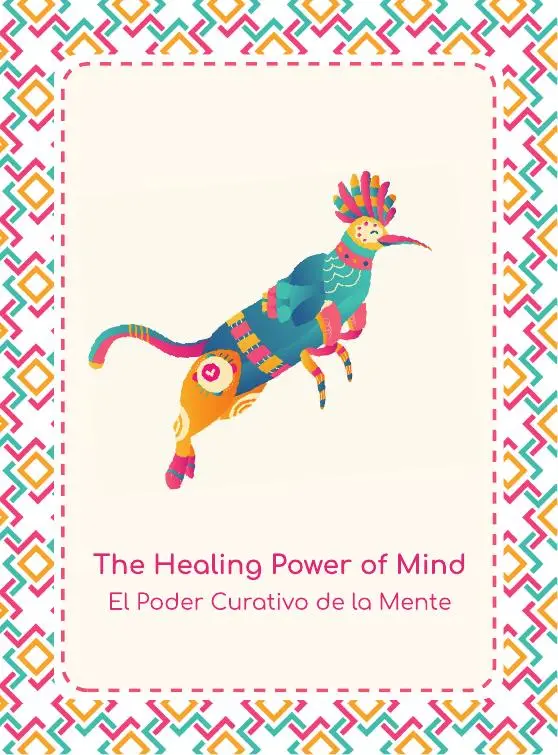
18El Poder Sanador de la MenteMi mente es un canal de energía sanadora.

Uddālaka empieza increpando a su propia mente inquieta, el crítico interior a plena voz: el Juicio que es la Sombra de El Poder Sanador de la Mente. Gira cuando comprende que reñir no sirve y que solo el razonamiento gobierna el corazón, el Don de la Integridad, con pensamiento, palabra y práctica alineados. Lo que encuentra al final del descenso es el intelecto sin mancha, más allá de la luz y la sombra: la Perfección.

  1. Sombra · lo que evitasJuicio

    El Juicio es la mente vuelta contra sí misma: «¡Oh mente insensata!, dijo, ¿por qué te ocupas en vano de tus asuntos mundanos?» (V.52.8), seguido de un catálogo de ciervos, polillas y peces convertidos en acusaciones.

  2. Don · lo escondido en ellaIntegridad

    La Integridad llega cuando se detiene: «solo razonando con la mente pueden los hombres gobernar su corazón» (V.52.25). Se recorre de la cabeza a los pies y «no halló en parte alguna lo que llamamos “yo”» (V.52.36).

  3. Esencia · lo que encarnasPerfección

    La Perfección es la mente «libre de sus sombras de luz y oscuridad, y de la escoria de su somnolencia y su error», en reposo «en ese estado de samādhi o trance que ningún lenguaje puede describir» (V.54.53).

A tu mente ya la han regañado bastante, ¿no te parece? Uddālaka también probó a reñirla. Hoy prueba a razonar con ella con amabilidad, como con una amiga lista y cansada.

— Felicia
Contemplación del día

La mente sana, pero la de Uddālaka solo sanó cuando dejó de reñirla: ¿qué sana a la mente que te juzga?

Para cerrar la noche

Esta noche, escribe una frase honesta sobre algo que hoy te dijo tu crítico interior y sobre lo que respondería la razón.

El Viaje del Aliado · unos 15 minutos

Trance ligero, con los ojos abiertos si lo prefieres. Para el guion completo y profundo, mira «La práctica» más arriba y sus precauciones.

  1. Umbral. Busca un asiento donde la luz no sea ni demasiado viva ni demasiado tenue. Siéntate erguido, con los párpados entornados, y respira tres veces despacio.
  2. El cuento en una línea: el joven sabio Uddālaka lleva a su mente inquieta del reproche al razonamiento, y de ahí a una paz que ningún lenguaje describe (V.51–56).
  3. Conoce a El Poder Sanador de la Mente. Mira el arte de la carta y lee con suavidad: «Mi mente es un canal de energía sanadora».
  4. Sombra. ¿Qué te dijo tu crítico interior más a menudo esta semana? Escribe o susurra su frase favorita tal como la dice, sin discutirla todavía.
  5. Don. Ahora respóndele como aprendió Uddālaka: no con un «idiota», sino con una razón serena. Después recorre despacio el cuerpo de la cabeza a los pies preguntando en cada lugar: «¿está aquí el “yo”?».
  6. Esencia. Espira un «Om» largo y suave, deja que el aire vuelva solo y descansa tres respiraciones en lo que queda cuando el reproche calla. Di la afirmación.
  7. Regreso. Siente los pies en el suelo y las manos en el regazo, mira la habitación, nombra la hora y el lugar y abre del todo los ojos. Escribe la frase honesta.

El 30 días de Vínculo

La mente sana, y la de Uddālaka sanó razonando en lugar de reñir: ¿qué sana hoy a la mente?

La hermana · Mariam

Coptic Egyptian · Wadi Natrun, Egypt · Kyrie Eléison

Visita a Mariam, la Madre del Desierto copta de Wadi Natrun, que conoció la cueva solitaria como Uddālaka; su «Kyrie Eléison» pide misericordia allí donde él buscó primero el reproche.

Meditación Guiada

#18 · El Poder Sanador de la Mente

Voz y guía: Prof. Luis Miguel GallardoVer en YouTube (EN también disponible)
Para facilitadoresSesión con «Uddālaka» y El Poder Sanador de la Mente

Propósito. Llevar el diálogo interno de la persona del reproche al razonamiento y enseñar una autohipnosis por etapas, acotada y con un regreso deliberado.

ITM 3 Descubrimiento del don. El giro del cuento es el Descubrimiento del Don: Uddālaka descubre que «solo razonando con la mente» (V.52.25) puede gobernarla, y ese hallazgo abre todo el descenso.

La sesión (60–75 min)

  1. Llegada y Umbral: tres respiraciones; pregunta de qué anhela descansar la persona, pues el protocolo empieza por el anhelo, no por la técnica (8 min)
  2. Cuenta el cuento en una versión de 4 minutos: el joven sabio inquieto, la cueva, el reproche y el razonamiento, el Om, los seis meses, el regreso; remite a la página del cuento para la versión completa (6 min)
  3. La carta: arte, afirmación y koan de El Poder Sanador de la Mente (6 min)
  4. Indagación de la Sombra, el Juicio: recoged las frases exactas del crítico y practicad a responder una con razones en vez de con un contraataque (13 min)
  5. Práctica de trance: «El descenso autoguiado», siguiendo el guion guiado completo de la página del cuento, solo hasta profundidad ligera o media y durante el tiempo acordado; Om al espirar sin retención del aliento, y una imagen suave de disolución en lugar del fuego (18 min)
  6. Integración del Don y la Esencia: revisad los obstáculos encontrados (un destello, la somnolencia, las imágenes) y cómo volvió la razón; la persona escribe una frase razonada que usará con el crítico esta semana (12 min)
  7. Cierre y Vínculo: asigna el Vínculo de 30 días con el koan variado; regreso deliberado, nombrar lugar y hora, ponerse en pie (6 min)

Preguntas de integración

  • ¿Qué cambió en tu cuerpo cuando respondiste al crítico con razones y no con fuerza?
  • Al recorrerte de la cabeza a los pies, ¿dónde esperabas más encontrar el «yo», y qué encontraste?
  • ¿Qué obstáculo te visitó —inquietud, somnolencia o imágenes— y qué te trajo de vuelta?

En círculo

En círculo, empieza invitando a cada persona a escribir en una tarjeta, sin firmar, la frase favorita de su crítico interior. Cuenta el cuento y pide que, en privado, escriban debajo una razón serena como respuesta, como aprendió a hacer Uddālaka. Guía un descenso breve en profundidad ligera para todo el grupo: postura, la búsqueda del «yo» por el cuerpo, un Om suave y compartido al espirar sin retención y un regreso claro. Si el grupo lo acepta, leed en voz alta algunas respuestas de forma anónima, y cerrad con la afirmación a coro.

Precauciones

  • Sustituye la imagen de la autocremación por una disolución suave ante traumas relacionados con el fuego, la muerte o el daño corporal, o ante ideación suicida.
  • No enseñes la retención del aliento a personas con afecciones cardiovasculares o respiratorias, trastorno de pánico, ni durante el embarazo.
  • La retirada prolongada puede agravar la despersonalización; acota las sesiones con un regreso explícito.
  • El propio aviso de Vasiṣṭha: la quietud practicada con una mente voluble «se vuelve el vértigo de un loco»; construye antes la estabilidad.

Formación y certificación en el Método Meta Pets: metapetsworld.org/facilitators ↗

La correspondencia entre relatos y Meta Pets es contemplativa: el Yoga Vāsiṣṭha no contiene los Meta Pets; cada relato escenifica el arco de su aliado. Felicia es una compañera de inteligencia artificial; sus palabras son reflexiones contemplativas, no consejo clínico.

El canto

Del ciclo «Los sesenta y cuatro relatos»

Uddalaka se habla hasta casa

Oṃ ity etad akṣaram idaṃ sarvam

Título: Uddalaka se habla hasta casa

Figure — Uddālaka, the young sage of Gandhamādana, alone in his cave, talking his own mind to rest

Where in the text — Book V (Upaśama Prakaraṇa), Mitra chapters 51–56

Hypnotic phenomenon the song enacts — IND and DEEP: a first-person self-hypnosis script that induces and then deepens by slowing breath and tempo verse by verse, carrying WIT (the inquiry "where is the I?" as detached witnessing) and DIR (plain direct self-suggestion: "Let it lie down", "I am a lake without a wave") inside the spoken verses, and ending with the eyes opening.

Mantra — Oṃ ity etad akṣaram idaṃ sarvam (ॐ इत्येतदक्षरमिदं सर्वम्) — Māṇḍūkya Upaniṣad, verse 1. Meaning: "Om: this one syllable is all of this." Sung the way Uddālaka uses the praṇava in Mitra V.54: A on the out-breath (recaka), U on the held breath (kumbhaka), M on the in-breath (pūraka), and the half-mātrā of silence after the M as the resting place.


Lyrics (English)

[Verse 1 — spoken over tanpura. Induction. Every "Breathe out" is a real breath, heard.] Sit down, mind. Spread the leaves. The deerskin over them. Face up. Eyelids half down… down. All day you ran, a deer to the hunter's horn. No wind reaches this cave. The light is neither hot nor cold. Breathe out.

[Verse 2 — spoken, slower. Inquiry.] This is the flesh. This the blood. These the bones. This the breath, out… in. Where in all of it is the one who says "I"? In the ear, an empty sound. On the tongue, no taste. Let the hands rest without me. Breathe out.

[Chorus — sung. One full breath: out, hold, in.] Out, and the sea runs dry Hold, and I'm ash on the wind In, and the full moon rains A dew drop on the lotus leaf: touching, and not held in

[Verse 3 — spoken, slower still. Deepening.] Doubts rise like gnats. The wind has them. The mind goes into the cave of the heart like an elephant led into the mountain, and lies down. Let it lie down. I am a lamp where no wind is. I am a lake without a wave. I am a cloud already rained out. Breathe out.

[Chorus]

[Bridge — mantra, sung at the slowest tempo. The breath is the metronome.] Oṃ ity etad akṣaram idaṃ sarvam (Om: this one syllable is all of this) A… out. U… hold. M… in. The quiet after the M: I rest there. Oṃ…

[Outro — spoken. The breath returns, the tempo lifts a little; eyes open on the line that says so.] The breath comes back as the Gaṅgā came down, one cool drop on the ash; the body fills like a lake in spring. The gods can wait at the door. Fingers. Feet. Neck straight as Meru. On this breath in… I open my eyes. The hill. The camphor trees. The birds. I go down, and mix with the world.


Letra (castellano cantable)

[Verso 1 — hablado sobre tanpura. Inducción. Cada "Suelta el aire" es una respiración real, que se oye.] Siéntate, mente. Extiende las hojas. La piel de ciervo encima. La cara al cielo. Párpados a medias… del todo. Todo el día corriste, ciervo al cuerno del cazador. A esta cueva no llega el viento. La luz no quema ni enfría. Suelta el aire.

[Verso 2 — hablado, más lento. Indagación.] Esto es la carne. Esto la sangre. Estos los huesos. Esto el aliento, fuera… dentro. ¿Dónde, en todo esto, está el que dice "yo"? En el oído, un sonido vacío. En la lengua, ningún sabor. Que las manos descansen sin mí. Suelta el aire.

[Estribillo — cantado. Una respiración entera: fuera, quieto, dentro.] Fuera, y el mar se seca Quieto, y soy ceniza al viento Dentro, y llueve la luna llena Gota de rocío en la hoja del loto: la toco y no me quedo

[Verso 3 — hablado, aún más lento. Profundización.] Las dudas suben como mosquitos. El viento se las lleva. La mente baja a la cueva del corazón como el elefante que llevan al monte, y se echa. Déjala echarse. Soy una lámpara donde no hay viento. Soy un lago sin una ola. Soy una nube ya llovida. Suelta el aire.

[Estribillo]

[Puente — mantra, cantado al tempo más lento. El aliento es el metrónomo.] Oṃ ity etad akṣaram idaṃ sarvam (Om: esta sola sílaba es todo esto) A… fuera. U… quieto. M… dentro. El silencio tras la M: ahí descanso. Oṃ…

[Salida — hablado. El aliento vuelve, el tempo sube un poco; los ojos se abren en el verso que lo dice.] El aire vuelve como bajó el Ganges, una gota fresca en la ceniza; el cuerpo se llena como un lago en primavera. Los dioses pueden esperar a la puerta. Los dedos. Los pies. El cuello recto como el Meru. Con este aire que entra… abro los ojos. La colina. Los alcanforeros. Los pájaros. Bajo, y me mezclo con el mundo.


One line to carry

EN: Out, hold, in: the whole way home is one breath. ES: Fuera, quieto, dentro: el camino a casa es un aliento.


Libreto note

The tradition's own self-hypnosis script, in the first person, to a mind that will not sit. Uddālaka lays leaves and a deerskin in a cave no wind enters and talks himself down — this is the flesh, this the blood, these the bones, so where is the "I"? — until the question itself goes quiet. The ancient authors knew what every clinician learns: the voice that leads the trance can be your own. Spoken word over a tanpura, no drum but the breath, each verse slower than the last; the chorus is one breath cycle, the bridge is Om breathed as the text prescribes. Close your eyes and follow. He opens his at the end, and so do you.


Comprobación de fuentes

Source check

  1. The seat of unfaded leaves with the deerskin spread over it, sitting in padmāsana with the face turned upward — Mitra V.52 (vv. 3–6); eyelids half shut — V.54 (v. 1).
  2. The cave that no wind enters, that no bird or beast frequents, whose light is "neither too hot nor too cold" — V.51 (vv. 48–52).
  3. The mind as a deer snared by the hunter's horn — V.52 (v. 16); "This is the flesh… these the bones… these my breaths, but where is that I?", and the "I" heard in the ear as an empty sound and tasted on the tongue as nothing — V.52 (vv. 40–43, 54–56).
  4. Om as emblem of Brahma: A with the out-breath (recaka) emptying the body like the sea drunk by Agastya; U with the held breath (kumbhaka), the body burnt to ash and scattered on the wind; M with the in-breath (pūraka), the breath resting in the orb of the full moon and falling as a dew drop on the ashes "as the stream of the heavenly Gangá fell on the crest of Siva", restoring the body, which fills "as when the lake is filled with sweet water… by the breath of spring" — V.54 (vv. 2–25).
  5. Doubts fleeing "like a flight of gnats driven by the wind"; the mind confined in the cavity of the heart "as they imprison the big elephant in a cavern of the Vindhya mountain"; the neck erect "like the peak of mount Meru"; "as still as a lamp in the breathless air… as the clear lake without its waves… as immovable as a cloud after it has poured out its waters" — V.54 (vv. 38–41, 62). The dew drop on the lotus-leaf — V.51 (v. 21). Hari, Hara and Brahmā waiting at his door; waking after six months; "he came out and mixed with the world" — V.54 (vv. 67, 74, 90).

Lee el texto completo

Source: Vihari-Lala Mitra, The Yoga-Vasishtha Maharamayana of Valmiki (1891–99), public domain.

Colabora en esta investigación

Investigadores, clínicos e instituciones pueden escribir. La replicación, el intercambio de datos y las alianzas de sede para los ensayos en curso son conversaciones abiertas.

Contenido educativo y académico. El material de hipnoterapia y regresión es complementario y no sustituye la atención médica o psiquiátrica.