ICEF

Tale 10 · The Vāsiṣṭha Atlas

The Three Princes Who Never Were

Utpatti · Creation · Mitra III.100–101 · 4,107 words

The world is a nurse's tale we enjoy without understanding.

Bhūmikā 6 · Padārthābhāvanī (melting of objects)MediumYour ally · The Tension of Transcendence

The essence

Vasiṣṭha has just told Rāma that bondage and liberation are both conceits of the ignorant, inventions like 'the story of the boy of old'. Rāma asks for that story. A dull boy asks his nurse for a tale, and she tells, in honeyed tones, of three fine princes in a desolate land: two unbegotten, the third not born of a womb. Scorched and weeping, they travel; they eat from three trees, two that did not grow of themselves and one that bears no seed; bathe in the dry one of three rivers; reach a new-built city; enter the one of three houses that has no foundation; find three pots, two shattering and the third turning to dust, and make a new pot from the dust; cook a hundred measures of rice less one; and feed three brahmins, two bodiless and one mouthless, who eats it all. The boy is delighted without understanding. So, says Vasiṣṭha, is the world: a fabrication of imagination taken as real. Repress the phantoms of fancy and rest in the soul.

What it teaches

  1. 01

    Impossible content can still delight: the boy is glad without understanding (III.101.30), which shows that assent to a story does not depend on its logic, and neither does belief in the world.

  2. 02

    Bondage and liberation are both mental constructions; seeking freedom for what was never bound is itself an error (III.100.37–42).

  3. 03

    Imagination 'represents an unreality as reality, even to men of enlightened understandings' (III.100.41): insight does not abolish appearances, only their authority.

  4. 04

    The remedy is not another story but the withdrawal of fancy: 'repress the thickening phantoms of your fleeting fancy' (III.101.39).

The Vāsiṣṭha Atlas

This tale’s coordinates

The wound and its virtue

The dull boy asks for a story and is soothed by the nurse's honeyed tale of impossible princes, 'glad at what he had heard' without understanding it (III.101.30): assent to a pleasing fiction, the reassuring illusion at the root of Denial, which reaches even the wish to be freed from a bondage that never was (III.100.37). Ease is holding the paradox open, neither solving the riddle nor obeying it, and resting in 'the certainty of the immutable soul' (III.101.39).

What it trains

If the soul is 'always emancipate' (III.100.37), even the self who strives for liberation is a construct to be held lightly, the loosening of self-referential rigidity at its root.

In other yogas

  • Patañjali · Yoga Sūtra · YS 1.9

    Patañjali defines vikalpa as a cognition that follows words but has no object behind it; the nurse's princes, 'unbegotten and increate' (III.101.5), are vikalpa told as a story.

  • Buddhist absorption · MN 22

    In the Alagaddūpama Sutta the Buddha calls his teaching a raft, for crossing over and not for holding on to; Vasiṣṭha goes as far, treating even the ideas of bondage and liberation as fancies to be set down (III.100.37).

  • Vijñāna Bhairava Tantra · VBT

    The Vijñāna Bhairava includes practices of regarding the whole world as a magic show or a painted scene; the nurse's tale applies that regard to the visible world itself (III.101.36).

IEAF: Integrative Emotional Alchemy Framework (Gallardo, Frontiers in Psychology, 2026). FP20: the Fundamental Peace Scale. ITM: the Integrative Transformation Model. Parallels in other yogas are contemplative correspondences, not claims of influence.

The tale

Vasiṣṭha has been teaching that the mind rises from the Supreme as a wave from the sea, the same water in another shape, and that every power of thought is Brahman's own. The soul, the only reality, is never bound, so it is absurd to seek its liberation; bondage and liberation are both conceits of the ignorant, just as imagination makes a rope look like a snake even to the wise. The mind, its bondage and release, and the material world it creates are, he says, fabulous inventions, like the story of the boy of old. Rāma asks to hear that story.

There was once a silly, thick-headed boy who asked his nurse for a pretty story. With a glad face and a voice sweet as honey she began. Once upon a time, in a desolate land, there were three high-minded, fortunate young princes, famous for virtue and valour. They shone in that empty country like stars reflected in water. Two of them were unbegotten and increate, and the third was not born of a mother's womb.

One day the three set out from their dreary home to find a better dwelling, alone and sad, like exiles. The sun scorched their backs, tender as śirīṣa flowers; the burning sand singed their lotus feet; they cried like fawns strayed from the herd, 'O Father, save us.' Blades of grass bruised their soles, and dust covered their fair forms.

By the road they found three trees heavy with fruit and flowers, full of birds and beasts. Two of the trees had not grown of themselves, and the third, easy to climb, bore no seeds. The princes rested in their shade, ate the ambrosial fruit, drank its juice, decked themselves with guluncha chaplets, and went on.

At midday they came to a confluence of three rushing rivers. One was a dry channel, and the other two were shallow, like the blinded eyes of the blind. Sweating, the princes bathed joyfully in the dry one, sported there a long while, and drank its water, sweet as milk.

At sunset they reached a new-built city on a height, its flags fluttering and the songs of its citizens heard from afar. There they saw three beautiful houses with turrets of gold and gems. Two were not the work of art, and the third had no foundation; the princes entered the third and walked about in it happily. Inside they found three pots bright as gold. Two broke to pieces when lifted, and the third crumbled to dust at a touch. The far-sighted princes took the dust and made a new pot, and in it cooked a hundred dronas of rice less one, food for a whole lifetime. They invited three brahmins to the meal. Two had no bodies, and the third had no mouth. The mouthless one ate the hundred dronas, and the princes made their meal of what he left. Refreshed, they rested in the house, then set out again in search of new abodes.

The nurse finished, and the boy was glad, though plainly without understanding. Vasiṣṭha draws the moral: this air-built castle of the world, taken for a reality, is a fabrication like the nurse's tale. Heaven, earth, rivers and mountains are creations of fancy, like the visions of dreams; as the princes, the rivers and the city were creations of the nurse's imagination, so the visible world is a production of the imaginative power. Know the universe to be a network of imagination, repress the thickening phantoms of fancy, and find tranquillity in the immutable soul of souls.

Mitra, in his notes and a closing table, reads the tale as an allegory of triads: soul, mind and living spirit; virtue, wealth and enjoyment; the three guṇas; deep sleep, dream and waking; the sheaths; childhood, youth and age.

The text speaks

Passages from Mitra’s translation (1891–99), cited by book, chapter and verse.

“It is a wrong impression to speak of the bondage of the soul, which is ever free from bonds; and so it is untrue to seek the emancipation of the soul, which is always emancipate.”
III.100.37The doctrine the tale illustrates: both bondage and liberation are imputations.
“Imagination represents an unreality as reality, even to men of enlightened understandings; as a rope presents the appearance of a snake even to the wise.”
III.100.41The rope-and-snake, the classical image of a perception produced by the mind.
“Two of them were unbegotten and increate, and third was not born of the mother’s womb.”
III.101.5The first impossibility, delivered in the confident cadence of a nursery tale.
“After the nurse had finished her relation of the pretty parable, the boy seemed glad at what he had heard (though it is plain without understanding its import).”
III.101.30Delight without understanding: the listener's state the tale names in us.
“Nothing is really existent except the creations of our imagination, and it is our fancy which fashions all the objects in their peculiar fantastic forms.”
III.101.34The moral stated in its strongest form.
“As the princes, the rivers and the future city, were mere creations of the nurse’s imagination, so the existence of the visible world, is but a production of the imaginative power of man.”
III.101.36The explicit mapping of the tale onto the world.
“Know hence, O Ráma! the whole universe to be the net-work of imagination, and your fancy to be the most active power of the mind. Therefore repress the thickening phantoms of your fleeting fancy, and obtain your tranquility by your sole reliance on the certainty of the immutable soul of souls.”
III.101.39The prescription: withdraw from fancy and rest in the soul.

What the trance sees

PARA

Paradox / confusion technique

III.101.5; III.101.12; III.101.16–17; III.101.22; III.101.24; III.101.26–27

In the textPrinces 'unbegotten and increate'; trees that 'did not grow of themselves'; bathing in 'the almost dried up channel'; a house 'without its foundation'; a pot made of dust; brahmins 'bodiless' and one with 'no mouth' who eats a hundred dronas.

In the clinicErickson's confusion technique (1964): a chain of calmly delivered impossibilities overloads the critical mind until it stops arguing and simply receives.

ABS

Absorption

III.101.2–3; III.101.30

In the textThe boy asks for 'some pretty story for his amusement'; the nurse tells it 'with a gladsome countenance, and in accents sweet as honey'; he is glad 'without understanding its import.'

In the clinicNarrative transportation (Green & Brock, 2000) carried by a warm, prosodic voice; children's high hypnotic responsiveness (Morgan & Hilgard, 1973) makes the bedtime story the archetypal induction.

HAL

Positive or negative hallucination

III.100.41; III.101.34–35

In the text'Imagination represents an unreality as reality ... as a rope presents the appearance of a snake even to the wise'; the elements of the world are 'creations of our fancy, like the visions in our dreams.'

In the clinicPositive hallucination, perceiving what is not there under expectation and suggestion; the rope-and-snake is the paradigm of perception shaped by expectancy.

MET

Therapeutic metaphor / reframe

III.100.43; III.101.31–36

In the textThe tale 'will serve to explain to you, the fabrication of the mind of this imaginary being of the world'; 'This air-built castle of the world ... is like the story.'

In the clinicA metaphor that maps onto the client's whole construct of reality, used as in cognitive defusion (Hayes, Strosahl & Wilson, Acceptance and Commitment Therapy, 1999): thoughts recognised as stories being told.

Read upward — stage 1 at the bottom, stage 7 at the top

  1. Integration zone
    Perceptual shift — the boundaries of things soften; consciousness expands past its usual partitions.

A note on what this map claims. The alignment between stages of knowledge and trance depths is a clinical map — a heuristic correspondence proposed for research, not a claim of identity between contemplative attainment and hypnotic depth.

Bhūmikā 6 · Padārthābhāvanī

The teaching it serves is the melting of objects: 'Nothing is really existent except the creations of our imagination' (III.101.34), and bondage and liberation themselves are denied (III.100.37–42); the practice prescribed is the withdrawal of fancy (III.101.39).

Zone · Medium

The induction is a bedtime story told to a willing child: pleasant absorption with eyes open, critical judgement suspended but not abolished (III.101.2–3, 30).

In Mitra’s words

In Calcutta in the 1890s, the translator chose the vocabulary of hypnotism to name these states. More →

  • sushupti-hupnos / hypnotes(The two first were the bodies of men in their states of sleep and deep sleep, called swápa sopor or swapnas-somnus and sushupti-hupnos or hypnotes, which are inborn in the soul; but it is the jágrata or waking body which is the unstable work of art).III.101.22

In the therapy room

Indications

  • Rigid, over-literal or catastrophising thinking that needs loosening through paradox
  • Anxious analytic clients who resist direct induction (the confusion approach)
  • Cognitive defusion: seeing worries and self-narratives as tales being told
  • Existential and spiritual seekers caught in striving for liberation as a further goal

Cautions

  • Teachings that the world is unreal can destabilise clients with derealisation, depersonalisation or psychosis
  • Confusion techniques can feel disrespectful or frightening without rapport; obtain consent and keep the tone playful
  • The 'unreality' frame must not be used to dismiss real suffering, trauma or injustice
From the bookThe full clinical note

Indications. Rigid, over-literal or catastrophising thinking that needs loosening through paradox; anxious, analytic clients who resist direct induction and respond to the confusion approach; cognitive defusion, seeing worries and self-narratives as tales being told; and existential or spiritual seekers who have made liberation into one more goal to strive for (III.100.37–42).

How to use it. Tell the nurse's tale at an even, warm pace, without pausing to explain the impossibilities; let the client's objections rise and pass. Then ask: what tale have you been told, or told yourself, in which the princes were never born and the river was dry, and you bathed in it anyway? The rope-snake image is a gentle frame for intrusive thoughts: the snake appears even to the wise; it only needs to lose its authority.

Cautions. Teachings that the world is unreal can destabilise clients with derealisation, depersonalisation or psychosis; screen first, and with such clients use the tale only as a story about stories, never as a claim about the world. Confusion techniques can feel disrespectful or frightening without rapport; obtain consent and keep the tone playful. And the "unreality" frame must never be used to dismiss real suffering, trauma or injustice. The tale loosens the stories pain tells; it does not deny the pain.


The practice

The Nurse's Tale

  1. Settle as a child settles for a bedtime story; let the voice be warm and slow (III.101.2–3).
  2. Hear, or tell yourself, the tale of the three unborn princes, without trying to make sense of it (III.101.4–28).
  3. Each time the mind objects ('but they were never born'), let the objection pass and keep listening (III.101.5, 12, 22).
  4. Notice the pleasure that comes anyway: enjoyment without understanding (III.101.30).
  5. Turn the same gaze on one heavy worry and notice that it too is being told, with its princes, rivers and city (III.101.32–36).
  6. Let the images thin, repress the thickening phantoms, and rest in what is listening (III.101.39).
  7. Re-alert into the waking body, the third house: name five things in the room, move, and open the eyes.

Practise with a qualified professional if you have a history of dissociation, trauma or psychosis.

From the book · to be read aloudThe full guided script

The Nurse's Tale

Read aloud slowly, in a warm voice, or have someone read it to you; ten to twelve minutes.

Before you begin. This practice uses a story of impossibilities to loosen the grip of thought. It is suitable for most adults. If you have ever had episodes of feeling that the world or you yourself are unreal, or a psychotic illness, practise only with a clinician. Sit comfortably, supported. Never practise while driving or operating anything.

How to return at any moment. Open your eyes, put both feet on the floor, and say aloud the name of the room you are in.


Settle, as a child settles for a story. Let the eyes close if they wish. Let the voice be warm and slow.

Once upon a time, in a desolate land, there were three princes, noble and brave. Two of them were never begotten, and the third was not born of a mother's womb.

If the mind says but that cannot be, let it say so, and keep listening.

They set out to find a better home. The sun was hot on their backs. They cried like fawns who have lost the herd.

By the road were three trees. Two had not grown of themselves, and the third bore no seed. They ate the fruit, and it was sweet.

At noon they came to three rivers. One was dry. They bathed in the dry one, and drank, and it was sweet as milk.

At sunset they came to a new-built city on a hill, with flags, and singing. There were three houses. Two were not made by anyone, and the third had no foundation. They went into the third, and were happy there.

They found three pots. Two broke when lifted, and the third turned to dust. From the dust they made a new pot, and cooked a hundred measures of rice, less one.

They invited three guests. Two had no bodies, and one had no mouth. The one with no mouth ate it all.

Notice: you are glad. You have not understood, and you are glad anyway.

Now let one worry come, one you carry often. Hear it as the nurse would tell it. Once upon a time… Notice it has princes, and rivers, and a city. Notice that it, too, is being told.

Let the images grow thinner. The city, the houses, the worry. Do not push them away. Only stop adding to them. Let them thin like mist.

What is left is the one who was listening. Rest there.

Now come back to the house you live in by day. Feel its walls: the skin, the weight, the breath. I will count from one to five. One: breathe in deeply. Two: move your hands and feet. Three: hear the room. Four: stretch. Five: eyes open, fully alert.

Name five things you can see in the room. Say your name and today's date. If anything still feels unreal, press your feet into the floor, hold something solid, and walk a few steps before you go on.


Meta Pets World · Your ally · Meta Pet 39

The nurse's tale and the never-born princes

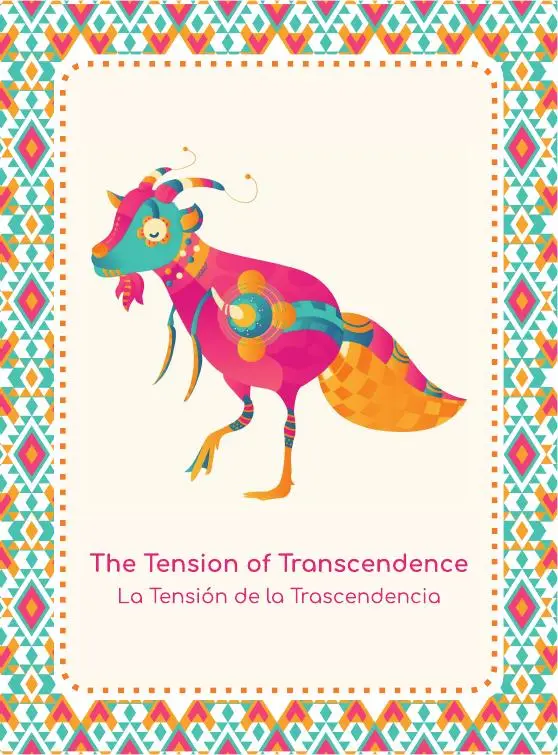
The Tension of Transcendence card
39The Tension of TranscendenceI hold the creative tension of transcendence.

The Tension of Transcendence walks with this tale because it is a deliberate Provocation: a story of princes never born and rivers that are dry, built to snag the reasoning mind at every turn. Its turning is Dynamism, the boy's delight that moves through the impossibilities instead of fighting them, and its arrival is Liberation in the card's own sense: seeing that the soul was never bound, and so letting go even of the need to be freed.

  1. Shadow · what you avoidProvocation

    Provocation: the nurse's riddles prick the reasoning mind at every step, 'Two of them were unbegotten and increate, and third was not born of the mother's womb' (III.101.5), and each 'but that is impossible' is a reaction triggered before anything is understood.

  2. Gift · what is hidden in itDynamism

    Dynamism: when the tale ends 'the boy seemed glad at what he had heard (though it is plain without understanding its import)' (III.101.30); the tension becomes delight and the story moves freely through him.

  3. Essence · what you embodyLiberation

    Liberation: 'it is untrue to seek the emancipation of the soul, which is always emancipate' (III.100.37); Vasiṣṭha asks Rāma to 'repress the thickening phantoms of your fleeting fancy' and rest in the immutable (III.101.39).

The Tension of Transcendence, and a nurse's tale of three princes who were never born. Don't argue with it. Enjoy it. Then notice who was listening all along.

— Felicia
Today’s contemplation

If the soul was never bound, as Vasiṣṭha tells Rāma, which of your efforts to get free is itself one of the nurse's princes, and what remains when you no longer need to transcend?

To close the night

Tonight, write one honest sentence about a story you believed today without asking whether its princes were ever born.

The Ally Journey · about 15 minutes

Light trance, eyes open if you prefer. For the full, deeper script, see “The practice” above and its cautions.

  1. Threshold: settle as a child settles for a bedtime story, eyes soft and open. Take three slow breaths and let your face relax. This is the Umbral.
  2. The tale in one line: a nurse tells a boy of three unborn princes who bathe in a dry river and cook in a pot made of dust, and he is delighted without understanding (III.101.30).
  3. Meet the card: look at The Tension of Transcendence for a few breaths. Notice where the image pulls in two directions. Read the affirmation once: I hold the creative tension of transcendence.
  4. Shadow: what provoked you this week, a remark, a headline, a contradiction you could not leave alone? Name one, and the quick 'but that's wrong' that rose before you understood.
  5. Gift: tell yourself the opening of the tale: three princes, two unbegotten, one not born of a womb. Each time the mind objects, smile, let the objection pass and keep listening.
  6. Essence: let the images thin out and rest in what has been listening. For three breaths say the affirmation, needing nothing to be solved.
  7. Return: name five things in the room, move your shoulders and hands, open your eyes fully and feel your feet. Write tonight's honest line.

The 30-day Bond

To transcend the need to transcend: today, catch one effort to be free and let it rest, like a boy enjoying a story.

The Sister · Drita

Albanian · Krujë, Albania · Hū Allāh Hū

Visit Drita, the Bektashi dervish of Krujë, from a path famous for its playful paradoxes; her Hū Allāh Hū rests on 'Hū', He, a single breath-sound beyond every story that could be told about it.

Guided Meditation

#39 · The Tension of Transcendence

Voice & guidance: Prof. Luis Miguel GallardoWatch on YouTube (ES also available)
For facilitatorsA session with “The Three Princes Who Never Were” and The Tension of Transcendence

Aim. To loosen the person's grip on the stories they take as solid, including the story of their own bondage, through playful absorption rather than argument.

ITM 5 Transcendent Integration. The tale asks one to hold paradox calmly and drop even the striving for liberation, which belongs to Transcendent Integration.

The session (60–75 min)

  1. Arrival and Umbral: three slow breaths together; ask what the person has been striving to get free of (8 min)
  2. Telling the tale: tell the nurse's tale itself in a warm, slow voice, about 4 minutes, then Vasiṣṭha's key in two sentences; point to the tale page for the full text (5 min)
  3. The card: show The Tension of Transcendence, read the affirmation and the koan, and let the person laugh at the koan if it comes (7 min)
  4. Shadow inquiry: where the person provokes or is provoked, which stories they argue with endlessly, and how the project of self-improvement keeps the tension alive (12 min)
  5. Trance practice: The Nurse's Tale, using the full guided script on the tale page at MEDIUM depth, with consent and a playful tone; the confusion should feel like a game, never a trap (15 min)
  6. Gift and Essence integration: turn the same gaze on one heavy worry and notice it too is being told; honour any real suffering in it; rest in what is listening (12 min)
  7. Closing and Bond: name five things in the room, move, open the eyes; set the 30-day Bond with the koan variation (7 min)

Integration questions

  • What happened to your objections when you let them pass and kept listening?
  • Which worry looked different once you saw it as a story being told?
  • What would you stop striving for if you trusted you were never bound?

In a circle

This tale is made for a circle. Dim the light a little, invite everyone to sit as children at bedtime, and tell the nurse's tale aloud, slowly, with the facilitator as nurse. Ask people to raise a finger whenever their mind objects, and to lower it with a smile as they keep listening; soon the whole room sees how often the mind protests and how little it matters to the pleasure. Then give Vasiṣṭha's key in two sentences. In pairs, each person tells a two-minute 'nurse's tale' version of one of their own worries, complete with unborn princes, and notices what happens to its weight. Close with a round of laughter or silence, whichever comes, and name five things in the room together.

Cautions

  • Teachings that the world is unreal can destabilise people with derealisation, depersonalisation or psychosis.
  • Confusion techniques can feel disrespectful or frightening without rapport: obtain consent and keep the tone playful.
  • Never use the 'unreality' frame to dismiss real suffering, trauma or injustice.

Training and certification in the Meta Pets Method: metapetsworld.org/facilitators ↗

The correspondence between tales and Meta Pets is contemplative: the Yoga Vāsiṣṭha does not contain the Meta Pets; each tale enacts its ally’s arc. Felicia is an artificial-intelligence companion; her words are contemplative reflections, not clinical advice.

The song

From the cycle The Sixty-Four Tales

The Nurse's Tale

Vācārambhaṇaṃ vikāro nāmadheyaṃ mṛttikety eva satyam

Figure — The old nurse and the dull boy who asked her for a pretty story, and the three princes she made up for him, as Vasiṣṭha tells it to Rāma.

Where in the text — Book III (Utpatti Prakaraṇa), Mitra chapters 100–101.

Hypnotic phenomenon the song enacts — PARA and ABS: a chain of impossibilities sung in one untroubled lullaby lilt until the critical mind stops objecting and simply listens; then the instruments leave verse by verse, the thickening phantoms thinned to a music box and a bar of silence, before the voice wakes alone in the third house.

Mantra — Vācārambhaṇaṃ vikāro nāmadheyaṃ mṛttikety eva satyam (वाचारम्भणं विकारो नामधेयं मृत्तिकेत्येव सत्यम्). Source: Chāndogya Upaniṣad 6.1.4, the teaching of the lump of clay. Meaning: "The made thing is a hold of speech, a name; the clay alone is true." The nurse's third pot falls to dust and the princes make a new pot of the dust: every form in her tale is speech, and so, says Vasiṣṭha, is the visible world (III.101.36). The bridge breaks off before satyam, where the music box stops.


Lyrics (English)

Performance: it opens full, a warm alto with strings, harp and a soft choir, in a lilting 3/4, and every impossibility is sung in the same untroubled tone. Then, verse by verse, the instruments leave: the choir after verse 2, the strings after the first chorus, the harp after verse 3. By the second chorus only a music box is left, slowing. The bridge is sung over its last turns, and it stops mid-phrase. One bar of silence; then the outro, spoken, voice alone.

Verse 1 "Tell me a pretty story," said the boy, and the nurse's face was glad, her voice like honey: In a land where no one lived, three princes shone like stars in water; two were never begotten, and the third was not born of a mother.

Verse 2 They set out for a better home, the sun on their backs, soft as śirīṣa flowers, crying like fawns, "O Father, save us." Three trees: two had not grown of themselves, and the third, easy to climb, bore no seed.

Chorus Three rivers met at noon, one dry, two shallow as a blind man's eyes; they bathed in the dry one and drank, and it was sweet as milk. Hush. Don't ask how.

Verse 3 At sunset, a new-built city on a hill; three golden houses: two not made by hands, the third with no foundation: in they went. Three golden pots: two broke, one fell to dust; they made a new pot of the dust and cooked a hundred measures of rice, less one.

Chorus Three brahmins came to dine: two had no bodies, one had no mouth; the mouthless one ate everything, and the princes dined on the rest. Hush. Don't ask how.

Bridge (mantra) (over the music box's last turns) vācārambhaṇaṃ vikāro nāmadheyam (the pot is a word; the clay is true) mṛttikety eva… (the music box stops mid-phrase; one bar of silence)

Outro (spoken, voice alone) The boy was glad, and had not understood. The princes, the rivers, the city: she made them; the sky and the hills: so do we. Let the thickening phantoms thin. Call your thoughts home. Then rise in the third house, the waking one, and walk about in it, glad.


Letra (castellano cantable)

Interpretación: empieza lleno, una contralto cálida con cuerdas, arpa y un coro suave, en un 3/4 que mece, y cada imposible se canta con el mismo tono tranquilo. Luego, verso a verso, los instrumentos se van: el coro tras el verso 2, las cuerdas tras el primer estribillo, el arpa tras el verso 3. En el segundo estribillo solo queda una caja de música, cada vez más lenta. El puente se canta sobre sus últimas vueltas, y se detiene a mitad de frase. Un compás de silencio; luego el final, hablado, la voz sola.

Verso 1 "Cuéntame un cuento bonito", dijo el niño, y la nodriza sonrió, con voz de miel: En una tierra donde nadie vivía y tres príncipes brillaban como estrellas en el agua; dos no fueron engendrados nunca, y el tercero no nació de madre alguna.

Verso 2 Salieron a buscar una casa mejor, el sol en la espalda, tiernos como flor de śirīṣa, llorando como cervatillos: "¡Padre, sálvanos!" Tres árboles: dos no habían crecido solos, y el tercero, fácil de trepar, no daba semilla.

Estribillo Tres ríos se juntaban a mediodía, uno seco, dos poco hondos como ojos de ciego; se bañaron en el seco y bebieron, y era dulce como la leche. Calla. No preguntes cómo.

Verso 3 Al ponerse el sol, una ciudad nueva en la colina; tres casas de oro: dos no hechas por mano alguna, la tercera sin cimientos, y allí entraron. Tres ollas de oro: dos se rompieron, una se hizo polvo; con el polvo hicieron una olla nueva y cocieron cien medidas de arroz, menos una.

Estribillo Tres brahmanes vinieron a comer: dos no tenían cuerpo, uno no tenía boca; el que no tenía boca se lo comió todo, y los príncipes comieron el resto. Calla. No preguntes cómo.

Puente (mantra) (sobre las últimas vueltas de la caja de música) vācārambhaṇaṃ vikāro nāmadheyam (la olla es palabra; el barro es verdad) mṛttikety eva… (la caja de música se detiene a mitad de frase; un compás de silencio)

Final (hablado, la voz sola) El niño quedó contento, y no había entendido. Los príncipes, los ríos, la ciudad: ella los hizo; el cielo y los montes: también nosotros. Que se aclaren los fantasmas que se espesan. Llama a casa tus pensamientos. Luego levántate en la tercera casa, la de la vigilia, y paséate por ella, alegre.


One line to carry

EN: Let the tale thin; call your thoughts home; wake glad. ES: Deja que el cuento se aclare; llama a casa tus pensamientos; despierta alegre.


Libreto note

Vasiṣṭha calls bondage and liberation "the story of the boy of old", and Rāma asks for it. A nurse, glad-faced, in a voice like honey, tells of three princes, two never begotten and one not born of a mother, who bathe in the dry river, enter the house without a foundation, cook in a pot made of dust and feed a guest with no mouth. The boy is delighted, understanding nothing. Erickson knew the method: impossibilities, calmly told, until the critic gives up and listens. The song opens full and loses an instrument each verse, down to a music box that stops mid-phrase, because the teaching is to thin the phantoms. Then a voice wakes alone in the third house.


Source check

Source check (Mitra, Book III)

  1. The request and the voice — "a silly and jolt-headed boy, who once asked his nurse, to recite to him some pretty story"; she told it "with a gladsome countenance, and in accents sweet as honey"; the princes "in a desolate country … like stars in the expanse of the waters"; "Two of them were unbegotten and increate, and third was not born of the mother's womb": ch. 101, vv. 2–5.
  2. The road and the trees — bodies "as delicate as Sirísha flowers, … scorched by the powerful sun shining on their backs"; "they cried aloud like some tender fawns … 'O Father save us'"; "The two first of these trees did not grow of themselves … and the third which was easy of ascent, bore no seeds": ch. 101, vv. 8–12.
  3. The rivers — "at the mid-day a confluence of three rivers"; "One of these was a dry channel and the other two were shallow … like the eyes of blind men"; they "bathed joyfully in the almost dried up channel" and drank water "as sweet as milk": ch. 101, vv. 15–18.
  4. The city, the houses, the pots, the meal — "a new-built city, standing afar as on the height of a hill"; "Two of these were not the works of art, and the third was without its foundation"; "The two first broke into pieces … and the third was reduced to dust … took up the dust and made a new pot"; "a hundred dronas minus one"; three Bráhmans, "two of whom … were bodiless; and the third … had no mouth"; "The mouthless Bráhman took a hundred dronas … and the princes took the remainder": ch. 101, vv. 19–27.
  5. The moral and the third house — "the boy seemed glad … (though it is plain without understanding its import)"; "As the princes, the rivers and the future city, were mere creations of the nurse's imagination"; "repress the thickening phantoms of your fleeting fancy", with Mitra's quotation "call thy thoughts home"; the third house read in Mitra's note as "the jágrata or waking body", in which the princes "sat and walked about … with joyous countenances": ch. 101, vv. 22–23, 30, 36, 39.

Read the full text

Source: Vihari-Lala Mitra, The Yoga-Vasishtha Maharamayana of Valmiki (1891–99), public domain.

Collaborate on this research

Researchers, clinicians and institutions are welcome to write. Replication, data-sharing and site partnerships for the trials in progress are all open conversations.

Educational and scholarly content. Hypnotherapy and regression material is complementary and not a substitute for medical or psychiatric care.