ICEF

Tale 13 · The Vāsiṣṭha Atlas

Dāma, Vyāla and Kaṭa

Sthiti · Existence · Mitra IV.25–34 · 15,400 words

Invincible without an I; undone by mine; freed by their story.

Bhūmikā 3 · Tanumānasā (thinning of the mind)MediumYour ally · Being at Ease

The essence

Beaten by the gods, the sorcerer-demon Śambara conjures three generals out of his own mind: Dāma the Snare, Vyāla the Snake and Kaṭa the Mat, beings with no past karma and no desires, mere images of his imagination. Having no 'I', they know no fear and rout the gods. Brahmā tells the defeated gods to stop fighting and let the generals' ambition grow instead. Over forty years of war, success makes the three proud; they begin to identify with their bodies, to wonder how to keep them safe, lose patience and nerve, and flee. Hiding in hell, they marry, live ten thousand years thinking 'this is mine', fail to recognise Yama and are burnt; then they pass through births as hunters, ravens, hogs, rams, reptiles, fish in a Kashmir lake and cranes. Reborn as a sparrow, a gnat and a parrot in the city of Adhiṣṭhāna, they hear a minister recite their own story and are liberated. Self-concern breeds fear; hearing one's own story ends it.

What it teaches

  1. 01

    Fear is born when the self contracts into the body: the generals were fearless while they had no 'I', and became timid exactly when they began to think their persons consisted in their bodies and to plan the body's safety (IV.29.11–17).

  2. 02

    Performance collapses under self-monitoring: continual thought of the body's security cost them their patience, and their former gallantry 'became a dead letter' (IV.29.12–13), the mechanism of choking and performance anxiety.

  3. 03

    Success can seed the ego that undoes it: forty years of victories bred the pride and craving through which Brahmā predicted their fall (IV.27.37–38; IV.29.5–6).

  4. 04

    Hearing one's own story told from outside can release what ages of suffering did not: the parrot, the sparrow and the gnat are freed by a recital of their own war (IV.32.3; IV.32.21–24).

  5. 05

    Not every 'I' is the enemy: Vasiṣṭha keeps the universal Self and the subtle witness-self 'as minute as the hundredth part of a hair' and asks only that the body-identified ego be dropped (IV.33.49–59).

The Vāsiṣṭha Atlas

This tale’s coordinates

The wound and its virtue

Dāma, Vyāla and Kaṭa are fearless while they have no 'I'; forty years of victory breed pride, and they begin 'to think their personalities to consist in their bodies' and to guard them until their nerve fails (IV.29.11–12), a fall from Meru-shakers to gnats. The healing is Humour in the paper's sense: reborn as a sparrow, a gnat and a parrot, they hear their own war recited and Kaṭa 'remembered his past life' and was freed (IV.32.22), seeing himself from outside with compassionate perspective rather than crushing judgement.

What it trains

Their whole fall is the hardening of a self that takes 'the body for the soul or self' (IV.33.53), and their release is that rigid self-reference simply seen through.

In other yogas

  • Buddhist absorption · SN 22.59

    In the Discourse on the Not-self Characteristic the Buddha asks whether what is impermanent is fit to be regarded as 'this is mine, this I am, this is my self' (own translation); the generals' fall follows that very formula (IV.27.21).

  • Bhagavad Gītā · BG 2.71

    The Gītā says peace comes to one who lives without 'mine' and without the ego-sense; the generals lose that peace exactly when they start to think of 'my consort' and 'my daughter' and themselves as 'their lord' (IV.30.7).

  • Patañjali · Yoga Sūtra · YS 2.6

    Patañjali defines asmitā as the seeming identity of the power that sees with the instrument of seeing; Vasiṣṭha calls taking the body for the self the 'last and worst' egoism (IV.33.53).

IEAF: Integrative Emotional Alchemy Framework (Gallardo, Frontiers in Psychology, 2026). FP20: the Fundamental Peace Scale. ITM: the Integrative Transformation Model. Parallels in other yogas are contemplative correspondences, not claims of influence.

The tale

Śambara, lord of the demons and a profound sorcerer, lived in an underground palace lit by artificial suns and moons, and from it waged unending war on the gods. Whenever he slept or left his city, the gods picked off his generals one by one. Enraged, he searched the three worlds, found where the gods were hiding, and by sorcery produced three new commanders: Dāma, Vyāla and Kaṭa, the Snare, the Snake and the Mat, named for how they would trap, coil around and wrap the enemy.

They were unlike any born creature. They had no prior acts behind them and no changing desires; they were 'mere artificial forces and airy forms, as facsimiles of the images in the demon's mind.' Moving 'as free as spiritual beings', they led the demon hosts out of the foaming sea and the caverns of the underworld, darkening the sun. The battle filled the sky with flying mountains, fire-weapons, rivers of blood, and even a weapon of slumber met by its counter-weapon. The demons prevailed; the gods fled bleeding and hid.

The gods went to Brahmā. He told them that Śambara himself would fall to Viṣṇu only after a hundred thousand years, but that these three would soon be caught like birds in a snare. Their strength, he said, came from wanting nothing; the knowledge 'this is I and these are mine' is 'the bane of human life'. So lay down your weapons, he advised, and inflame their ambition instead; no one led blindfold by desire is master of himself.

The gods rested, then beat the drums of war again. The demons rose to meet them, and the war ran on for thirty-five years, then five years, eight months and ten days more. Long success made Dāma, Vyāla and Kaṭa proud and hungry for final victory. Their desires became their selves; they fell into the error of 'mine'; they began to think their persons consisted in their bodies, and to wonder how those bodies could be kept from harm. Thinking of safety, they lost patience; craving comfort, they lost valour; they hesitated, grew timid as deer before elephants, and fled. The demon host was hurled from the sky onto peaks, seas and distant lands.

Afraid of Śambara's anger, the three hid in the seventh underworld. The wardens of hell sheltered them and gave them their three daughters as wives. For ten thousand years they lived thinking, this is my wife, this my daughter, I am their lord. When Yama came to inspect without his insignia, they took him for a servant and did not bow; at a nod of his brow they were cast with their families into the furnace of hell. The cruelty they had absorbed there made them Kirāta hunters; then ravens, vultures and falcons; hogs in Trigarta, rams in Magadha, reptiles in holes; and at last fish in a muddy pool beside a lotus lake in Kashmir, neither dying nor living to their content.

When they had begged for release through Yama's attendants, Yama had said they would be freed once out of their demon bodies and on hearing the account of their own lives. Crushed under the feet of buffaloes, the fish became cranes; feeding on lotus petals and clear water, they were cleansed and their understanding cleared. In the city of Adhiṣṭhāna, Vyāla was born as a sparrow nesting in a mossy hollow at the top of a tower on Pradyumna hill; Dāma as a gnat in the crack of a pillar; Kaṭa as a parrot in a silver cage in the house of the minister Narasiṃha. One day the minister recited the poem of the war of gods and Titans to his household. The parrot heard it and remembered his past life; the sparrow and the gnat heard it too. All three were released.

Vasiṣṭha asks Rāma to picture it: the one who levelled Meru with a frown, living in the chink of a pillar. Then he teaches the three kinds of egoism and tells how Śambara, learning from this failure, made new warriors who had no 'I'.

The text speaks

Passages from Mitra’s translation (1891–99), cited by book, chapter and verse.

“They were preadamite beings and devoid of changing desires; and the want of their prior acts (like those of the human kind), made them move about as free as spiritual beings in one uniform tenor of their course.”
IV.25.37The pre-egoic state: no history, no desire, hence free and fearless action.
“These were not born as men from the seeds of their previous acts, with solid and substantial bodies; but mere artificial forces and airy forms, as facsimiles of the images in the demon’s mind.”
IV.25.38The warriors are mind-made persons, projected parts of their maker.
“The knowledge that, this is I and these are mine (and apart from all others), is the bane of human life; and one with such knowledge of his self and egoism, becomes the receptacle of evils like the sea of briny waters.”
IV.27.21Brahmā's diagnosis, the thesis of the tale.
“You gods, need not bear the burden of your weapons any more, nor toil and moil in the field of war any longer; but try your best to inflame the pernicious avarice of your enemies to the utmost.”
IV.27.35A paradoxical strategy: defeat by amplifying the pattern rather than opposing it.
“Being reduced to the depravity of selfishness, they began to think their personalities to consist in their bodies, and to reflect how their bodies from the head to foot could be safe and secure from harm.”
IV.29.11The precise moment fear is born: identity contracts into the body and attention turns to its safety.
“They lost their patience by continually thinking on the stability of their bodies, and their properties and pleasures of life.”
IV.29.12Rumination on safety erodes composure: a pre-modern account of anxious self-focus.
“Their time passed away in such thoughts as these, that, “this is my consort and this my daughter, and I am their lord:” and they were bound together in the ties of mutual affections as strong as the chain of death.”
IV.30.7Possessive identity ('mine') as bondage, the bridge from defeat to the chain of births.
“That Dáma and others would obtain their liberation, upon their release from their demoniac bodies by death; and upon hearing the account of their lives and actions.”
IV.32.3Yama prescribes the cure in advance: hearing their own story.
“And the parrot Kata, happening to hear it, remembered his past life, whereby he was absolved of his sins, and attained his final liberation.”
IV.32.22Narrative-triggered recall leading directly to liberation.
“The other kind of egoism, which is composed of the knowledge of the body, with all its members as parts of the Ego, is the last and worst kind of it, which takes the body for the soul or self.”
IV.33.53Vasiṣṭha locates the problem precisely in body-identified ego, not in selfhood as such.

What the trance sees

PARTS

Parts / ego states

IV.25.34–38; IV.34.3–6

In the textŚambara produces the three 'by his sorcery' and names them 'according to the demon's wish'; they are 'facsimiles of the images in the demon's mind'. After their fall he reviews why they failed and resolves to produce new ones endowed with reason and spiritual knowledge.

In the clinicEgo-state therapy (Watkins & Watkins): parts created by the self for a protective task, effective until they harden around a self-image; the maker can learn from a failed part and create one with new resources.

PARA

Paradox / confusion technique

IV.27.29; IV.27.35–40; IV.28 (argument)

In the textBrahmā tells Indra to 'foster both the egoistic selfishness, as well as the ambition of Dáma and others' and to stop fighting: 'try your best to inflame the pernicious avarice of your enemies to the utmost'.

In the clinicParadoxical intervention (Haley, Strategies of Psychotherapy, 1963; Frankl's paradoxical intention): amplify the pattern instead of opposing it until it collapses under its own weight, here turned against an enemy.

MET

Therapeutic metaphor / reframe

IV.32.3; IV.32.21–25

In the textYama foretells release 'upon hearing the account of their lives and actions'; the minister recites 'this poetical narrative of the Titan war', and the parrot, the sparrow and the gnat are liberated by hearing it.

In the clinicTherapeutic storytelling in which the client meets their own story in displaced form (Erickson's teaching tales) and narrative re-authoring (White & Epston, Narrative Means to Therapeutic Ends, 1990); the tale prescribes the method it uses on its reader.

AR

Age regression / past-life regression

IV.32.22

In the text'The parrot Kata, happening to hear it, remembered his past life, whereby he was absolved of his sins.'

In the clinicSpontaneous regression triggered by a narrative cue that matches stored experience, close to the affect bridge (Watkins 1971); recall followed at once by release.

WIT

Witness position / dis-identification

IV.33.43; IV.33.46–47; IV.33.50–52

In the text'Whoso thinks himself to be the inward noumena, and distinct from the outward phenomena, and keeps the calm equanimity of his mind, is not ruffled by the feeling of his egoism'; a self 'as minute as the hundredth part of a hair' is kept as a good form of ego.

In the clinicThe observing self (Deikman, The Observing Self, 1982) and dis-identification from body and role; the minute witness is a resource to keep, not to dissolve.

Read upward — stage 1 at the bottom, stage 7 at the top

  1. Integration zone
    Progressive relaxation and deepening — the habitual self loosens enough for new pattern to take.

A note on what this map claims. The alignment between stages of knowledge and trance depths is a clinical map — a heuristic correspondence proposed for research, not a claim of identity between contemplative attainment and hypnotic depth.

Bhūmikā 3 · Tanumānasā

The remedy is the thinning of body-ego: as cranes on lotus food and clear water they are 'becleansed' and gain clear understanding (IV.32.9–10) before release, and Vasiṣṭha's prescription is to 'wipe off from thy heart the sense of thy egoism' (IV.31.7), which is tanumānasā.

Zone · Medium

The operative state is absorbed listening to a recited story that spontaneously triggers recall (IV.32.21–24), without catalepsy, hallucination or loss of surroundings: medium trance.

In Mitra’s words

In Calcutta in the 1890s, the translator chose the vocabulary of hypnotism to name these states. More →

  • sorcererThere lived one Sambara—the chief of demons, and a profound sorcerer in a subterraneous cell, filled with enchanting wonders like a sea of gems.IV.25.7
  • exorcistThe gods also sought every opportunity of harassing the demoniac force, whenever this exorcist demigod, went to sleep or somewhere out of his city.IV.25.22
  • Morphean weapon of slumberthe Morphean weapon of slumber dispelled by that of its counteraction.IV.26.44
  • Máyá or illusionMany big bodies of the gods and demons, rose and fought and fell by turns, as the elemental bodies of earth and the other elements, rise to and disappear from view by the act of Máyá or illusion.IV.28.9
  • death-like sleep / torporNow wake and shake off the dullness of your long, deep and death-like sleep, like the torpor of the old tortoise lying in the bog.IV.32.56
  • false shows of magicA closer investigation into human life, proves it to be a maze full with the false shows of magic.IV.33.44
  • black-art of exorcismthe demons Dáma and others, that I produced by my black-art of exorcism, are all overthrown in battle, by their foolishness and vanity of pride and egotism.IV.34.4

In the therapy room

Indications

  • Performance anxiety, stage fright and choking, where self-monitoring of the body destroys skilled action (IV.29.11–18)
  • Fear and decline after long success; impostor feelings and the fall from high status (from Meru-shaker to gnat, IV.32.28)
  • Health anxiety and constant scanning of the body for danger (IV.29.11)
  • Possessive attachments in families and organisations ('this is my consort and this my daughter', IV.30.7)
  • Third-person retelling of the client's own story as a displaced recital (IV.32.21–24)

Cautions

  • Egolessness language can destabilise clients with low self-worth, depersonalisation or dissociation; use Vasiṣṭha's three egoisms so a healthy self is kept (IV.33.49–52)
  • The descent through ignoble births (gnat, fish) can be heard as shaming; present it as consequence, not verdict
  • Battle imagery may activate combat or violence trauma
  • Paradoxical amplification must never be used against a client; in therapy it is offered openly and in the client's interest
From the bookThe full clinical note

Indications. Performance anxiety, stage fright and choking, where self-monitoring of the body destroys skilled action (IV.29.11–18); fear and decline after long success, impostor feelings and the fall from high status, the Meru-shaker become a gnat (IV.32.28); health anxiety and constant scanning of the body for danger (IV.29.11); possessive attachments in families and organisations (IV.30.7); and third-person retelling of a client's own story as a displaced recital (IV.32.21–24).

How to use it. With performance anxiety, walk the client through IV.29.5–17 as a sequence and let them locate their own point of entry: success, wanting, "mine", the body-scan, impatience, hesitation. With a client stuck in a repeating story, retell their history to them in the third person, calmly, as the minister read the poem, and let recognition come by itself; do not interpret. Use chapter 33 explicitly so that the client keeps a self.

Cautions. Egolessness language can destabilise clients with low self-worth, depersonalisation or dissociation; use the three egoisms so that a healthy, minute witness-self is kept (IV.33.49–52). The descent through ignoble births can be heard as shaming; present it as consequence, not verdict. Battle imagery may activate combat or violence trauma. Paradoxical amplification must never be used covertly against a client. And where recall of "past lives" arises, frame it as meaningful recognition, not verified history, and do not suggest content.


The practice

Before the I

  1. Settle and recall a moment of complete, unselfconscious action, playing, rescuing, performing, when no one inside was watching you (IV.25.37).
  2. Re-enter that moment as one of Śambara's first warriors: no history, nothing to defend, only the movement (IV.26).
  3. Replay, slowly, the shift: the first thought of 'mine', the scan of the body for danger, the hesitation; simply observe each step (IV.29.10–17).
  4. Step back to the witness who notices both the flow and the fear, the inward one 'distinct from the outward phenomena', minute as a hair's tip (IV.33.47; IV.33.51).
  5. Hear your own story told in the third person by a calm voice, as the minister recited the war to the parrot; let recognition come by itself (IV.32.21–22).
  6. Choose which 'I' to carry back: the wide self or the minute witness, not the body-ego (IV.33.50–58).
  7. Re-alert: count up, feel the body as an instrument rather than an identity, open the eyes, and do one small task from that place.

Practise with a qualified professional if you have a history of dissociation, trauma or psychosis.

From the book · to be read aloudThe full guided script

Before the I

Read slowly, aloud or from a recording; twelve to fifteen minutes.

Before you begin. This practice rehearses action without self-monitoring and lets you hear your own story told from outside. It is suitable for most adults. If you have a dissociative disorder, depersonalisation, or a history of trauma linked to combat or violence, practise only with a clinician. Sit upright, feet on the floor. Never practise while driving or operating anything.

How to return at any moment. Open your eyes, press your feet down, and say your name aloud.


Close your eyes and breathe out slowly, three times.

Remember a moment when you acted completely: playing, helping, making something, speaking, when no one inside was watching. Let it come back. Where were you? What were your hands doing?

Step into it. No history to defend. Nothing to keep. Only the movement, one uniform tenor, free.

Stay there for a few breaths.

Now, slowly, as if watching a film at quarter speed, let the change come. The first thought of mine. The first glance down at the body: is it safe? The first hesitation. You do not have to stop any of it. Only watch each step: wanting, mine, the scan, the pause.

Now step back from both. Behind the flow and behind the fear there is one who noticed both. Very small. As fine as the hundredth part of a hair. Rest as that one.

From here, hear a calm voice tell your story, in the third person, as a minister reads a poem to his household. There was once someone who… Let the voice tell it. You are a bird in a cage by the window, listening. You need not do anything. If something is recognised, let it be recognised.

Choose what to carry back: the wide self, or the small witness. Leave the body-ego here, gently, like a coat on a chair.

Now feel the body again, as your instrument: the weight on the chair, the feet on the floor, the hands warm and ready.

I will count from one to five. One: breathe in deeply. Two: move fingers and toes. Three: roll the shoulders. Four: lift the head. Five: eyes open, fully alert.

Say your name, today's date and where you are. Name three things you can see. Then do one small task, pouring water, writing a line, from that place. If you feel distant at all, repeat the count and walk a few steps first.


Meta Pets World · Your ally · Meta Pet 10

Śambara's generals: fearless until they said 'mine'

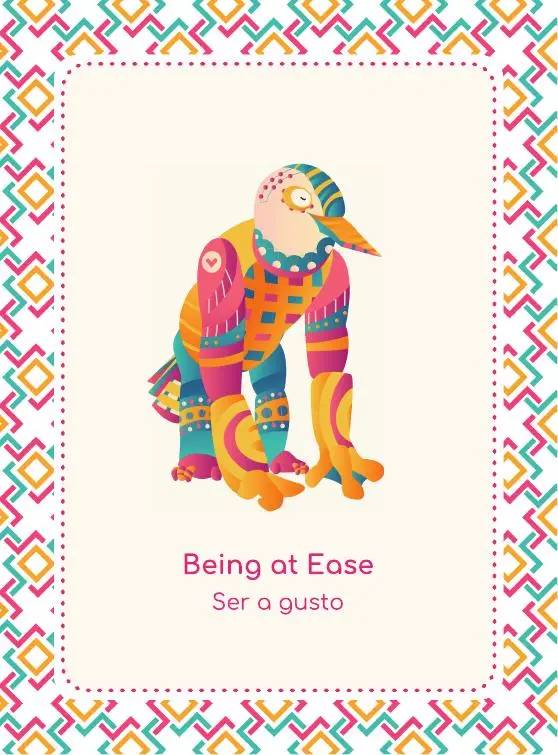
Being at Ease card
10Being at EaseI rest in the ease of my true nature.

Being at Ease walks with Dāma, Vyāla and Kaṭa because their fall is Self-Obsession: fearless while they have no 'I', they begin to think their persons are their bodies and to plan the body's safety, and courage turns to flight. Their Naturalness is the unselfconscious movement they began with, and their arrival is Being, reached after ages of births when they simply hear their own story told.

  1. Shadow · what you avoidSelf-Obsession

    Self-Obsession: after forty years of victory 'they began to think their personalities to consist in their bodies, and to reflect how their bodies from the head to foot could be safe' (IV.29.11), and lost their patience and their nerve (IV.29.12).

  2. Gift · what is hidden in itNaturalness

    Naturalness: at their making they were 'devoid of changing desires' and moved 'as free as spiritual beings in one uniform tenor of their course' (IV.25.37), with no past to defend and so nothing to fear.

  3. Essence · what you embodyBeing

    Being: reborn as a sparrow, a gnat and a parrot, they hear a minister recite their war, and 'the parrot Kata, happening to hear it, remembered his past life… and attained his final liberation' (IV.32.22).

Being at Ease, and three warriors who were fearless until they started guarding their own skins. Notice your inner guard scanning for danger. Thank it, let it rest. Then simply move.

— Felicia
Today’s contemplation

You were already at ease, like Śambara's generals before they thought 'mine'; who, or which success, convinced you otherwise, and what changes when you hear that story told from outside?

To close the night

Tonight, write one honest sentence about a moment today when you stopped flowing because you started watching yourself.

The Ally Journey · about 15 minutes

Light trance, eyes open if you prefer. For the full, deeper script, see “The practice” above and its cautions.

  1. Threshold: sit comfortably, eyes open or softly lowered. Take three slow breaths and let the jaw and shoulders loosen. This is the Umbral.
  2. The tale in one line: three warriors made without an 'I' are invincible, grow fearful once they start guarding their bodies, and are freed ages later by hearing their own story (IV.29.11; IV.32.22).
  3. Meet the card: look at Being at Ease for a few breaths. Notice where your eyes relax. Read the affirmation once: I rest in the ease of my true nature.
  4. Shadow: when this week did you freeze or fumble because you began watching yourself, in a meeting, a game, a conversation? Name the moment the thought 'how am I doing?' arrived.
  5. Gift: recall a time you acted with no one inside watching, playing, helping, dancing. Step back into it for a few breaths. Then tell yourself this week's moment in one calm third-person sentence.
  6. Essence: let both scenes go. For three breaths say the affirmation, and rest as simple being, nothing to defend, nothing to prove.
  7. Return: count up from one to five, feel your body as a good instrument, open your eyes fully, and do one small task from this ease. Then write tonight's honest line.

The 30-day Bond

You are already at ease: today, when the thought 'mine' or 'how am I doing?' appears, ask who convinced you otherwise, and keep moving.

The Sister · Naserian

Maasai · Kajiado, Kenya · Engai Naserian — Engai Narok

Visit Naserian, the Maasai cattle-keeper and birth singer of Kajiado, who sings each newborn into the story of the people; to hear your story sung with love, as the parrot heard his war recited, is a way back to simple being.

Guided Meditation

#10 · Being at Ease

Voice & guidance: Prof. Luis Miguel GallardoWatch on YouTube (ES also available)
For facilitatorsA session with “Dāma, Vyāla and Kaṭa” and Being at Ease

Aim. To help the person observe the moment self-monitoring replaces natural action, and to find ease again by hearing their own story from outside.

ITM 2 Conscious Recognition. The practice replays and observes the shift from flow to 'mine', and the generals are freed by recognising their own story, the very act of Conscious Recognition.

The session (60–75 min)

  1. Arrival and Umbral: three slow breaths together; ask where performance or self-consciousness has been costing the person ease (8 min)
  2. Telling the tale: a 4-minute version of Śambara's three generals, Brahmā's strategy, the fall into 'mine' and the parrot hearing its story; present the animal births as consequence, not verdict; point to the tale page for the full text (5 min)
  3. The card: show Being at Ease, read the affirmation and the koan, and ask who first convinced the person they were not at ease (7 min)
  4. Shadow inquiry: trace one success that bred self-monitoring, the scan of the body for danger, the loss of patience and nerve, step by step (12 min)
  5. Trance practice: Before the I, using the full guided script on the tale page at MEDIUM depth; in the recital step, tell the person's story back in the third person, calmly and kindly (15 min)
  6. Gift and Essence integration: using Vasiṣṭha's three egoisms, choose which 'I' to carry, the wide self or the minute witness, keeping a healthy self intact (12 min)
  7. Closing and Bond: count up, do one small task from ease; set the 30-day Bond with the koan variation (7 min)

Integration questions

  • What did you notice in the body at the exact moment 'mine' arrived?
  • How did your story sound when it was told about you rather than by you?
  • Where this week can you let the body be an instrument rather than an identity?

In a circle

In a circle, invite each person to recall a moment of unselfconscious action and share it in one sentence, so the room fills with ease before the tale is told. Tell the tale, then lead Before the I at medium depth. Afterwards, work in pairs: each person tells a recent moment when self-watching took over, and the partner tells it back in the third person, calmly, as the minister recited the war to the parrot. Swap. Close with a short movement, a walk around the room or a few steps of dance, done without watching yourself, and a round of single words for what remained.

Cautions

  • Language of egolessness can destabilise people with low self-worth, depersonalisation or dissociation; use Vasiṣṭha's three egoisms so a healthy self is kept.
  • The descent through ignoble births can be heard as shaming; present it as consequence, not verdict.
  • Battle imagery may activate combat or violence trauma.
  • Paradoxical amplification, Brahmā's tactic of inflaming the enemy's pride, must never be used against a client; in therapy it is offered openly and in the person's interest.

Training and certification in the Meta Pets Method: metapetsworld.org/facilitators ↗

The correspondence between tales and Meta Pets is contemplative: the Yoga Vāsiṣṭha does not contain the Meta Pets; each tale enacts its ally’s arc. Felicia is an artificial-intelligence companion; her words are contemplative reflections, not clinical advice.

The song

From the cycle The Sixty-Four Tales

The Parrot Remembers

vālāgra-śata-bhāgasya śatadhā kalpitasya ca / bhāgo jīvaḥ sa vijñeyaḥ sa cānantyāya kalpate

Figure — Dāma, Vyāla and Kaṭa, the Snare, the Snake and the Mat, the sorcerer's three generals, who end as a gnat, a sparrow and a parrot in the minister's house.

Where in the text — Book IV (Sthiti Prakaraṇa), Mitra chapters 25–34.

Hypnotic phenomenon the song enacts — MET and AR: a song about a song that frees; three voices sing the war in unison until "mine" breaks them, and when a minister recites the song's own first line, three small creatures recognise their story and sing it back.

Mantra — vālāgra-śata-bhāgasya śatadhā kalpitasya ca / bhāgo jīvaḥ sa vijñeyaḥ sa cānantyāya kalpate (वालाग्रशतभागस्य शतधा कल्पितस्य च । भागो जीवः स विज्ञेयः स चानन्त्याय कल्पते). Source: Śvetāśvatara Upaniṣad 5.9. Meaning: "Know the living self as the tip of a hair split a hundred times, and that part split a hundred more; and it is fit for the infinite." This is the minute self Vasiṣṭha keeps when he asks the body-ego to go, "as minute as the hundredth part of a hair" (IV.33.51): the Meru-shaker made a gnat, and still fit for the infinite.


Lyrics (English)

Performance: three voices and percussion only. Verse 1 and the first chorus are strict unison over a steady drum, the warriors before history. Through verse 2 one voice drifts sharp, another flat, and the beat loosens as patience goes. In verse 3 the unison breaks on the word "mine", and the descent goes a step lower and quieter with each life. Then a fourth voice, the minister's, speaks the song's own first line, and three small sounds answer from the room, a buzz, a chirp, a parrot's phrase, picking up the words until they sing their story back. A single drone enters for the bridge.

Verse 1 — the three, in unison Śambara made three generals out of his own mind: Snare and Snake and Mat, no past behind them, nothing they wanted. They rose from the foaming sea like flying mountains, and hid the sun.

Verse 2 — the three, drifting Forty years of winning. Brahmā told the gods: put down your weapons; feed their wanting. They began to think their bodies were themselves, and how to keep them safe from head to foot; their patience went.

Chorus — the three One brought down Meru with a nod, one would slap the sun and moon, one held Meru like a bunch of flowers: nothing to keep, no one inside to fear.

Verse 3 — the unison breaks Mine. Timid as deer before elephants, they ran; in hell ten thousand years: my wife, my daughter, I their lord; hunters, ravens, hogs, rams, fish in a Kashmir bog, cranes on lotus petals and clear water. (spoken, the minister) In Adhiṣṭhāna, the minister read aloud: "Śambara made three generals…"

Chorus — the gnat, the sparrow, the parrot One brought down Meru with a nod, hums in a pillar's crack; one would slap the sun and moon, chirps in the tower; one held Meru like a bunch of flowers, talks in a silver cage.

Bridge (mantra) (one drone; the three small voices with the three warriors' voices, in unison again) vālāgra-śata-bhāgasya śatadhā kalpitasya ca (a hair's tip, split a hundred times, and again) bhāgo jīvaḥ sa vijñeyaḥ sa cānantyāya kalpate (that is the self; it is fit for the infinite)

Outro The parrot heard its war, remembered, and was free; the sparrow heard; the gnat heard, and had its peace. You who have heard your story: wake, shake off your sleep like the old tortoise in the bog, and go to the day's work like a tree in spring.


Letra (castellano cantable)

Interpretación: tres voces y solo percusión. El verso 1 y el primer estribillo van en unísono estricto sobre un tambor firme, los guerreros antes de la historia. A lo largo del verso 2 una voz se desafina hacia arriba, otra hacia abajo, y el pulso se afloja mientras se va la paciencia. En el verso 3 el unísono se rompe en la palabra "mío", y el descenso baja un peldaño más grave y más quedo con cada vida. Entonces una cuarta voz, la del ministro, dice el primer verso de la propia canción, y tres sonidos pequeños responden desde la sala, un zumbido, un pío, una frase de loro, recogiendo las palabras hasta cantar de vuelta su historia. Para el puente entra un solo bordón.

Verso 1 — los tres, al unísono Śambara sacó tres generales de su propia mente: Lazo, Serpiente y Estera, sin pasado detrás, sin nada que desear. Subieron del mar espumoso como montañas que vuelan, y taparon el sol.

Verso 2 — los tres, desafinándose Cuarenta años de victorias. Brahmā dijo a los dioses: dejad las armas; alimentad su deseo. Empezaron a creer que su cuerpo era ellos mismos, y a pensar cómo guardarlo de la cabeza a los pies; se les fue la paciencia.

Estribillo — los tres Uno derribó el Meru con un gesto, otro abofetearía al sol y la luna, otro sostuvo el Meru como un ramo de flores: nada que guardar, nadie dentro que temiera.

Verso 3 — el unísono se rompe Mío. Tímidos como ciervos ante elefantes, huyeron; en el infierno diez mil años: mi esposa, mi hija, yo su señor; cazadores, cuervos, cerdos, carneros, peces en un fango de Cachemira, grullas entre pétalos de loto y agua clara. (hablado, el ministro) En Adhiṣṭhāna, el ministro leyó en voz alta: "Śambara sacó tres generales…"

Estribillo — el mosquito, el gorrión, el loro Uno derribó el Meru con un gesto, zumba en la grieta de un pilar; otro abofetearía al sol y la luna, pía en la torre; otro sostuvo el Meru como un ramo de flores, habla en una jaula de plata.

Puente (mantra) (un bordón; las tres voces pequeñas con las de los tres guerreros, de nuevo al unísono) vālāgra-śata-bhāgasya śatadhā kalpitasya ca (la punta de un cabello, partida cien veces, y otra vez) bhāgo jīvaḥ sa vijñeyaḥ sa cānantyāya kalpate (eso es el ser; está hecho para lo infinito)

Final El loro oyó su guerra, recordó, y quedó libre; lo oyó el gorrión; lo oyó el mosquito, y tuvo su paz. Tú que has oído tu historia: despierta, sacúdete el sueño como la vieja tortuga en el fango, y ve al trabajo del día como un árbol en primavera.


One line to carry

EN: Hear your own story told, and the war is over. ES: Escucha tu propia historia contada, y la guerra termina.


Libreto note

The sorcerer Śambara dreams three generals out of his own mind, Snare, Snake and Mat, with no past, nothing they want and no one inside them to be afraid; they rout the gods. Brahmā's counsel is paradox: stop fighting, feed their wanting. Forty years of victory later they begin to think "mine", to guard their bodies head to foot, and they run: hell, hunters, ravens, hogs, fish in a Kashmir pool. What frees them is a recital. A minister reads the war aloud, and a parrot, a sparrow and a gnat hear their own story. Any clinician who retells a life in the third person knows it. Three voices in unison, broken on "mine"; three small voices sing it back.


Source check

Source check (Mitra, Book IV)

  1. Made out of the sorcerer's mind — "the names of Dáma—the snare, Vyála—the snake, and Kata—the mat"; "devoid of changing desires; and the want of their prior acts … made them move about as free as spiritual beings"; "facsimiles of the images in the demon's mind"; the army "rose out of the foaming sea … like mountains flying on high", their bodies "hid the disk of the sun": ch. 25, vv. 34–38; ch. 26, vv. 2–3.
  2. Brahmā's paradox and the forty years — "You gods, need not bear the burden of your weapons any more … but try your best to inflame the pernicious avarice of your enemies"; "five and thirty years", then "five years, eight months and ten days": ch. 27, v. 35; ch. 29, vv. 3–4.
  3. "Mine", the body, the flight — "led to the blunder of mei tatem or thinking these things as mine"; "began to think their personalities to consist in their bodies, and to reflect how their bodies from the head to foot could be safe"; "They lost their patience"; "as timid as the timorous deer, to encounter the furious elephants": ch. 29, vv. 10–16.
  4. The descent — the wardens of hell give them "their three maiden daughters"; "ten thousand years"; "this is my consort and this my daughter, and I am their lord"; "Kirátas … ravens … hogs in the land of Trigarta … rams in Magadha … reptiles"; "fishes in the wood-land lakes of Cashmir"; cranes feeding on "tender petals of lotuses" and "the crystal lake": ch. 30, vv. 5–15; ch. 31, v. 10; ch. 32, vv. 6–9.
  5. The recital that frees, and the waking — Yama's word that they would be freed "upon hearing the account of their lives"; the city of Adhisthána; the sparrow's nest in a hollow "overgrown with moss" atop the tower on Pradyumna hill; the gnat "in the crevice of a lofty column"; the parrot "in a silver cage" in the minister Narasinha's house; "the minister recited this poetical narrative of the Titan war … the parrot Kata, happening to hear it, remembered his past life"; the one who "reduced the high Meru and Mandara mountains with a nod of his eyebrows" now a gnat, the one who "threatened to destroy the sun and moon with a slap" a sparrow, the one who "balanced the mount Meru like a flower bouquet" a parrot; "Now wake and shake off the dullness of your long, deep and death-like sleep, like the torpor of the old tortoise lying in the bog"; one who "flourishes like an arbor in the spring"; the self "as minute as the hundredth part of a hair": ch. 32, vv. 3, 11–30, 56, 60; ch. 33, v. 51.

Read the full text

Source: Vihari-Lala Mitra, The Yoga-Vasishtha Maharamayana of Valmiki (1891–99), public domain.

Collaborate on this research

Researchers, clinicians and institutions are welcome to write. Replication, data-sharing and site partnerships for the trials in progress are all open conversations.

Educational and scholarly content. Hypnotherapy and regression material is complementary and not a substitute for medical or psychiatric care.