ICEF

Tale 3 · The Vāsiṣṭha Atlas

Līlā, Padma and the Goddess Sarasvatī

Utpatti · Creation · Mitra III.15–30 · 25,071 words

A whole kingdom lives inside the room where the dead king lies.

Bhūmikā 4 · Sattvāpatti (dawn of being)SomnambulisticYour ally · The Future Human Being

The essence

Queen Līlā, terrified of losing King Padma, wins from Sarasvatī the boon that his spirit will never leave the palace. When he dies she sits in meditation, leaves her body and finds him reigning, as a boy of ten, in a full kingdom that exists in the space of the room where his corpse lies under flowers. The goddess reveals that Padma and Līlā were, eight days earlier, a village brahmin and his wife Arundhatī, whose wish for royalty became their long reign. To teach her that time, space and identity are made by the mind, Sarasvatī leads her into a disciplined stillness (motionless, without outer sensation, until 'an unshaken anesthesia' overtakes her), and the two rise in thought-bodies across the cosmos, visit the brahmin's mourning house, where Līlā lifts her son's grief with a touch, and recall a hundred and eight past lives. Mitra calls the state trance, samādhi and clairvoyance: the fullest hypnotic phenomenology in the Yoga Vāsiṣṭha.

What it teaches

  1. 01

    The fear of loss can build the very world in which loss is undone: Līlā's wish that Padma's spirit stay in the room (III.16.39) produces a kingdom inside that room (III.20.8–11).

  2. 02

    Duration is made by the mind: eight days can hold a reign that seemed eighty years (III.29.34), as Hariścandra lived twelve years in a single night (III.20.51).

  3. 03

    Identity is habit: 'every one is of the form of whatever he thinks himself to be; and it is habit only that makes him to believe himself as such' (III.26.52).

  4. 04

    Contact with what is lost becomes possible when clinging relaxes: Līlā is seen by her son only once she 'became of pure desire' (III.27.11), and only then does her touch lift his grief (III.26.41).

  5. 05

    A deep state is entered by method and left by verification: the text gives the stillness sequence (III.23.4–11), and after her first trance Līlā wakes the household to check the court with open eyes (III.17.42–57).

The Vāsiṣṭha Atlas

This tale’s coordinates

The wound and its virtue

Terrified of losing Padma, Līlā asks that his spirit never leave the palace and, when he dies, is 'about to die of grief' (III.16.39; III.16.49): love gripped as possession. Travelling through the nested worlds she discovers the gift inside that clinging, a love so refined that her hand on her grieving son's head lifts his sorrow (III.26.41), Care freed from the need to keep.

What it trains

Learning that 'every one is of the form of whatever he thinks himself to be' (III.26.52) and seeing her past lives, Līlā loosens her fixed identity as Padma's queen and learns to hold many selves lightly.

In other yogas

  • Patañjali · Yoga Sūtra · YS 3.18

    Patañjali states that direct perception of latent impressions (saṃskāra) yields knowledge of former births; Līlā's recollection of her past lives, as she becomes 'a seer of the three times' (III.29.2), is the narrative form of that saṃyama.

  • Māṇḍūkya Upaniṣad · Māṇḍūkya 3–7

    Sarasvatī's three skies, of the elements, of mind and of Intellect that 'contains the two others' (III.17.10), echo the Māṇḍūkya's waking, dreaming and deep-sleep quarters held within the fourth; Līlā learns to travel through all of them.

  • Yoga nidrā

    Sarasvatī's induction, motionless, 'without any external sensation', every thought shaken off (III.23.4–11), is the sensory withdrawal of yoga nidrā carried to its depth while awareness stays lucid enough to travel.

IEAF: Integrative Emotional Alchemy Framework (Gallardo, Frontiers in Psychology, 2026). FP20: the Fundamental Peace Scale. ITM: the Integrative Transformation Model. Parallels in other yogas are contemplative correspondences, not claims of influence.

The tale

Vasiṣṭha tells this story to show Rāma that the world is a fancy painted on the mind and that whole universes can stand in a small space.

King Padma and Queen Līlā loved one another among gardens, lakes, games and music. Then a thought entered Līlā's heart: how could her husband, dearer than life, be kept from old age and death? The brahmins she consulted told her that austerity can win anything except immortality. So she settled for a second best: if he died first, his spirit must not leave the inner apartment, so that she could still move in his presence. Without telling him, she fasted every third night and worshipped Sarasvatī until, after a hundred such fasts, the goddess appeared and granted two boons: that Padma's soul would not pass beyond the shrine of the inner apartment, and that the goddess would come whenever Līlā called.

In time Padma died. Līlā withered beside his body, pale, mute as a statue, near death from grief. Sarasvatī told her to lay the body in the shrine under flowers, where it would not decay while they stayed fresh, and assured her that his spirit had not departed. At midnight, with the household asleep, Līlā called the goddess, who explained that the spirit now dwelt in the 'sky' of intellect, beyond the sky of the elements and the sky of the mind, and that by grace she could reach it. Līlā sat in steadfast meditation, left her body like a bird freed from its cage, and found Padma enthroned in a crowded court, receiving envoys and reports of war: a boy of ten among the same ministers, pandits and citizens she knew, none of whom could see her.

Recovering from this trance, she woke her servants and had the court convened at midnight, to see whether the courtiers were really alive. They were, in their old places. 'O the wondrous magic!' she said: the same world stood outside her that she had seen within. She invoked Sarasvatī to tell her which was real.

The goddess told her a story. In a hill village lived a brahmin named Vasiṣṭha and his wife Arundhatī. Seeing a royal hunt pass below, he longed to be king; as he lay dying, Arundhatī asked the goddess that his spirit not leave the house. He died, his spirit became a mighty monarch, and she, pining, followed him: they had died eight days before. That brahmin, said Sarasvatī, is your husband, and Arundhatī is you. Līlā protested: how could a sleeping room hold kingdoms, and eight days hold their many years? The goddess answered that every atom of intelligence holds worlds within worlds; that at death one forgets one's former nature and wakes into another life as from a trance, finding that a moment seemed an age, as Hariścandra lived twelve years in one night. She taught that by withdrawing the mind from seer, seen and seeing, until 'an unshaken anesthesia' overtakes it, the body becomes subtle enough to see other worlds.

That night the two sat by the flower-strewn corpse, still as figures carved in marble, shed every thought and sensation, rose a span above the ground and ascended through skies, clouds, siddhas and wandering spirits, over continents and seas to the rim of the world. Then they entered the brahmin's house, where his son Jyeṣṭhaśarmā and the household mourned. Līlā willed that they be seen; the family saw two goddesses and begged for help, and Līlā laid her hand on her son's head, and his grief left him. Sarasvatī explained that Līlā had been seen because she had at last wished purely, and asked which of her three present husbands she wanted. Līlā recalled a hundred and eight births (a vidyādhara's bride, a plant, a prince of Surāṣṭra, a weasel, a bee, an antelope, a crane) and, walking through the village, recognised her calf, her garden, her weeping servant, and the eight days of a reign that had seemed like eighty years. Then the two rose again, beyond sun, stars and the darkness past the sky, and saw the universe as an egg among countless others floating in the ocean of intellect.

The text speaks

Passages from Mitra’s translation (1891–99), cited by book, chapter and verse.

“The goddess replied:—“His spirit is now roving in the sky, of which there are three kinds:—one the firmament or region of the sensible worlds; the other is the region of the mind, the seat of volition and creation; and third is the region of Intellect, which contains the two others.”
III.17.10The three skies (elements, mind, consciousness): the map of the levels Līlā will move through.
“She quitted in a moment the prison house of her body, and her soul broke out of its inner bound of the mind, to fly freely in the air, like a bird freed from its cage”
III.17.16The first out-of-body passage, achieved from steadfast meditation.
“And how is it possible that the small space of the room in which my husband’s body is lying, could contain those spacious lands and hills and the ten sides of the sky: (as I already saw in my trance—_Samádhi_).”
III.20.8Līlā names her own state 'trance' and states the paradox of the nested world.
“Then upon waking from this state of trance, like a fruit from the cell of a flower, it comes to find that a single moment appeared to it as the period of an age. 51. So King Harish Chandra of yore thought one night as a period of twelve years”
III.20.50–51The text's own statement of time distortion, with its classical example.
“Then the impression of the world will be utterly effaced from the mind, and an unshaken _anesthesia_ will overtake you all at once.”
III.21.78Mitra's chosen word for the deep state is the surgical-hypnotic term 'anesthesia'.
“The sleep in which the will and wish are dormant, is called the sound sleep _susupta_, but the dormancy of desires in the waking state, is known as insensibility _moha_ or _múrchhá_. 7. Again the sleep which is wholly devoid of desire, is designated the _turíya_ or the fourth stage of yoga, and which in the waking state is called _samádhi_ or union with Supreme.”
III.22.6–7A typology of states (deep sleep, waking insensibility, turīya, samādhi) with Mitra's glosses.
“They continued in fixed attention without any external sensation, like some lonely creepers shrivelled for want of the moisture of the season. 8. They were fully impressed with the disbelief of their own existence, and that of all other things in the world, and were altogether absorbed in the thought of an absolute privation of every thing at large.”
III.23.7–8The induction itself: fixed attention, sensory withdrawal, total absorption.
“In this manner every one is of the form of whatever he thinks himself to be; and it is habit only that makes him to believe himself as such, though he is not so in reality.”
III.26.52Identity as a habitual self-suggestion, the tale's psychological core.
“I see, O goddess! his royal dignity of eight days, which had seemed to be of so long a duration (as eighty years) before.”
III.29.34Līlā sees the time distortion for herself, from inside the remembered life.

What the trance sees

IND

Induction

III.23.4–11

In the textBeside the corpse the two 'stood motionless ... as if they were sculptures engraven on marble columns', 'shook off all their thoughts and cares', 'continued in fixed attention without any external sensation', were 'altogether absorbed', 'lost the remembrance of the phantom of the phenomenal world' and became 'as quiet as inert nature herself'.

In the clinicA complete classical induction sequence: immobility, release of thought, narrowed attention, loss of peripheral sensation, absorption and disorientation from the surroundings. The bodily stage parallels progressive relaxation (Jacobson 1938); the attentional stage parallels fixation inductions.

ANA

Analgesia / anaesthesia

III.21.76–79; III.23.7

In the textSarasvatī prescribes sitting 'in a state of unalterable insensibility (by forgetting yourself to a stone)', after which 'an unshaken anesthesia will overtake you all at once'; in practice the two remain 'without any external sensation'.

In the clinicHypnotic anaesthesia of the whole sensorium. Mitra, writing in Calcutta, uses the word for which Esdaile's mesmeric surgeries there ('Mesmerism in India', 1846) were the period's best-known demonstration.

OBE

Out-of-body / thought-body travel

III.17.16; III.23.12–15; III.29.39–45

In the textLīlā 'quitted in a moment the prison house of her body ... to fly freely in the air, like a bird freed from its cage'; later the two 'rose as high as one span above the ground, then taking the forms of the empty intellect, they began to mount in the sky', and in III.29 fly beyond sun, stars and the spheres of the dead.

In the clinicOut-of-body imagery in deep hypnosis and its structured use in transpersonal and regression work; clinically a planned separation of the observing perspective from the body schema, with the body left in a safe, known place.

NEST

Nested trance

III.20.8–11; III.20.23–26

In the textLīlā cannot believe that 'the small space of the room in which my husband's body is lying, could contain those spacious lands'; the goddess answers that the brahmin's spirit holds the kingdom in his house 'as the bee abides in the lotus', and that the soul 'contains in every atom of it, unnumbered worlds within worlds'.

In the clinicNested trance and scene-within-scene imagery (dream within dream), and multiple embedded metaphor (Lankton & Lankton 1983): each level contains the next, and moving between levels is itself the deepening.

TD

Time distortion

III.20.27–28; III.20.50–51; III.29.34

In the textThe brahmin pair 'are dead only eight days before, and we have been reigning here for so many years'; 'a single moment appeared to it as the period of an age', as 'King Harish Chandra of yore thought one night as a period of twelve years'; Līlā sees 'his royal dignity of eight days, which had seemed ... (as eighty years)'.

In the clinicTime distortion (Cooper & Erickson 1954): subjective duration decoupled from clock time, both condensation and expansion, here stated explicitly as a property of mind.

AMN

Amnesia

III.20.16; III.20.31–35

In the text'You have lost the remembrance of the states of your former lives after death, as they lose the recollection of waking events in the dreaming state'; at death one 'forgets his former nature and thinks himself as another being'.

In the clinicSpontaneous amnesia across states, comparable to state-dependent memory (Bower 1981): what is learned in one state of consciousness is unavailable in another until that state is re-entered, as Līlā's recall returns at the brahmin's house (III.29.4).

HYP

Hypermnesia

III.27.34–59

In the textLīlā remembers that she 'had undergone a hundred and eight births' and recounts them in detail: vidyādhara's bride, eagle's mate, woodman's wife, gulañcā plant, prince of Surāṣṭra, weasel, bullock, bird, bee, antelope, fish, stork, apsaras, tortoise, goose, crane.

In the clinicHypermnesia in hypnotic regression. Hypnotically enhanced recall raises confidence more than accuracy (Orne 1979; Dywan & Bowers 1983), so in therapy such material is used for its meaning, not as historical evidence.

AR

Age regression / past-life regression

III.29.2–24; III.29.33–37

In the textAt the brahmin's house Līlā 'became a seer of the three times', 'remembered the whole course of her past life' and relives it: milking, churning, 'haste and hasten', her pet calf Karṇikā, her weeping servant, her son, and her husband's 'fond wish of obtaining royal dignity'.

In the clinicPast-life regression anchored to place: the remembered setting acts as the bridge into the earlier life, comparable to the affect bridge (Watkins 1971) with location as the cue; the recall is concrete, sensory and affect-laden.

HAL

Positive or negative hallucination

III.17.31–33; III.26.7–9; III.27.11

In the textIn Padma's court Līlā walks 'unperceived by all' (a negative hallucination for the courtiers); at the brahmin's house she wills that 'the inmates of the house might behold her and the goddess', and they see 'the two ladies as Laxmí and Gaurí'. The goddess explains: 'you ... wished that your son might see you, whereby he was enabled to have your sight.'

In the clinicPositive and negative hallucination, the marks of somnambulistic depth (tested, for example, in the Stanford Hypnotic Susceptibility Scale, Form C; Weitzenhoffer & Hilgard 1962); here produced in others by the intention of the one in trance.

TEST

Trance testing / ratification

III.17.42–57; III.18.6

In the textAfter her first trance Līlā wakes the servants and convenes the full court at midnight, 'to clear her doubt by seeing the courtiers all alive'; finding them all in place, she then invokes the goddess 'to ascertain which of these is illusion, and which the sober and certain reality'.

In the clinicReality testing after emergence and ratification of the trance experience: the subject checks inner content against the waking environment, here an inversion in which the outer world is checked against the inner one.

EMG

Emergence / re-alerting

III.17.42; III.25.35; III.28.8

In the text'Having recovered her sense at the removal of her trance'; 'returned on a sudden to her own land, and found herself in her closet again'; 'Having come out of her vision of the world, she found herself seated in her house, as one finds himself lying in his own bed, after his rambling from one dream to another.'

In the clinicRe-alerting and reorientation to body and room after deep imagery; the dream-to-bed simile describes the discontinuity of emergence that a structured return (counting up, naming the room) is designed to smooth.

GRIEF

Grief and loss work

III.16.45–50; III.17.1–5; III.26.40–42; III.27.2

In the textLīlā fades by the corpse 'about to die of grief' until the goddess consoles her; at the brahmin's house she lays her hand on her son's head and 'the boy was relieved of all his sorrow'; the family, 'forgetting their grief, ... betook themselves to their domestic employments'.

In the clinicGrief work through continuing bonds (Klass, Silverman & Nickman 1996) rather than severance: contact with the dead is granted and then reframed, and the bereaved son receives comfort that carries into ordinary life afterwards.

Read upward — stage 1 at the bottom, stage 7 at the top

  1. Integration zone
    Hypnotic absorption meets direct knowing — identity deconstruction at full depth. This is YVH's primary therapeutic zone, and the model's central testable hypothesis.

A note on what this map claims. The alignment between stages of knowledge and trance depths is a clinical map — a heuristic correspondence proposed for research, not a claim of identity between contemplative attainment and hypnotic depth.

Bhūmikā 4 · Sattvāpatti

Līlā is told she is 'awakened from this day both to your reason and liberation' (III.21.74) and becomes 'a seer of the three times' (III.29.2): sattvāpatti. She has not reached asaṃsakti: she had 'not then lost your sense of duality' (III.27.8) and still asks to be placed by her husband's side (III.27.18).

Zone · Somnambulistic

Līlā moves, sees 'with their playful open eyes' (III.23.14), converses and acts inside a fully hallucinated world, induces hallucinations in others and returns with a discontinuity ('at the removal of her trance', III.17.42): the profile of somnambulism, reached through the deep, sensationless stillness of III.23.4–11.

In Mitra’s words

In Calcutta in the 1890s, the translator chose the vocabulary of hypnotism to name these states. More →

  • steadfast meditationVasishtha said:—so saying, the goddess repaired to her heavenly seat; and Lílá sat gladly in her mood of steadfast meditation. (Platonism).III.17.15
  • tranceThen having recovered her sense at the removal of her trance, she entered into her inner apartment at midnight, and found the inmates fast bound in sleep.III.17.42
  • wondrous magicShe exclaimed:—“O the wondrous magic! that presents these people of my place situated in the same manner without myself, as they were seen to be seated within me.III.18.3
  • reverieThe goddess replied:—So verily was this reproduction of thy husband and all those things which appeared to thy sight in thy reverie; and so, my daughter, is the appearance of all things I see in this world.III.18.27
  • trance—SamádhiAnd how is it possible that the small space of the room in which my husband’s body is lying, could contain those spacious lands and hills and the ten sides of the sky: (as I already saw in my trance—_Samádhi_).III.20.8
  • insensibilityHear now, that no sooner does any one come to feel the insensibility consequent to his death, than he forgets his former nature and thinks himself as another being.III.20.31
  • tranceThen upon waking from this state of trance, like a fruit from the cell of a flower, it comes to find that a single moment appeared to it as the period of an age.III.20.50
  • samádhi / clairvoyanceThe vision of Lílá, called samádhi in Yoga and _clairvoyance_ of spiritualism, was the abstract meditation of her lord in her memory.III.20.55
  • clairvoyanceIf you want to see that sight, you shall have to be immaculate, by forsaking the sense of your personality (_mana_ or _meum_), and betaking yourself to the clairvoyance or clear sightedness of seeing the unintelligible Intellect (_achetya-chit_) within the soul.III.21.28
  • insensibility / reveriesSo your material body becomes spiritual (_átiváhika_), by means of your leaning to spirituality, as in your sleep, in your protracted meditation, insensibility, fancies and reveries.III.21.55
  • unalterable insensibilityWithdraw your mind from its thoughts of the visitor, visibles and vision of this world, and settle it in the idea of the entire negation of all existence, then fix your meditation solely in the supreme Being, and sit in a state of unalterable insensibility (by forgetting yourself to a stone).III.21.76
  • anesthesiaThen the impression of the world will be utterly effaced from the mind, and an unshaken _anesthesia_ will overtake you all at once.III.21.78
  • entrancedRemaining thus entranced in your abstract meditation, you will have in process of time a soul, as luminous as a luminary in the clear firmament of heaven, freed from the concatenation of all causes and their consequences for evermore.III.21.79
  • insensibility (moha / múrchhá)The sleep in which the will and wish are dormant, is called the sound sleep _susupta_, but the dormancy of desires in the waking state, is known as insensibility _moha_ or _múrchhá_.III.22.6
  • turíya / samádhiAgain the sleep which is wholly devoid of desire, is designated the _turíya_ or the fourth stage of yoga, and which in the waking state is called _samádhi_ or union with Supreme.III.22.7
  • drowsiness or lethargyThe spiritualised mind, being awakened (as if it were from its drowsiness or lethargy), mixes with the holy spirits of departed souls in the other world.III.22.10
  • Samádhi (meditative posture)The ponds are as still in their sorrow, as men sitting in their meditative posture (_Samádhi_), notwithstanding the disturbance of the gnats flying incessantly upon them.III.26.37
  • somnambulationA dream presents us the sights of cities and lands, of air and water, where there are no such things in actuality; and it causes the movements of our limbs and bodies (as in somnambulation) for nothing.III.26.48
  • halfwakingAnd thus those that are panic-struck and deranged in their minds, the halfwaking and passengers in vessels, see many appearances like the aforesaid ghosts and forests, as seen by boys and men in the air, and betray these signs in the motions and movements of their bodies.III.26.51
  • dreamers of the same dreamThey then conversed as familiarly with each other, as persons having the same thoughts and desires, agree with one another in their views and acts; and as the dreamers of the same dream hold their mutual correspondence, like _Usha and Aniruddha_ (the Cupid and Psyche of India).III.27.4
  • fast asleepThe management of his very many disordered state affairs, has stultified him to a lubbard, and he is now fast asleep amidst the turmoils of business.III.27.23

In the therapy room

Indications

  • Anticipatory grief and fear of a partner's death; acute grief with longing for continued contact with the deceased
  • Transpersonal and regression work: visiting a remembered or imagined 'other room' and returning with meaning
  • Clients confused after vivid dreams, visions or meditation experiences, who need a frame for which experience is 'real'
  • Rigid identity and role fixation (III.26.52), and time-pressure anxiety (the eight days and eighty years reframe)
  • Training clinicians in a full trance arc: induction, deepening, imagery, testing and emergence

Cautions

  • Not for clients with psychotic disorders, depersonalisation or derealisation disorder: the teaching that waking and dream are equally unreal can destabilise reality testing
  • Līlā is 'about to die of grief' (III.16.49) and Arundhatī dies to follow her husband (III.19.25–27): screen bereaved clients for suicidal ideation and never present reunion through death as a resolution
  • Past-life material may be confabulated; use it as metaphor, not as memory evidence, and avoid leading suggestions
  • Out-of-body and nested imagery require a careful, explicit return; include reality testing after emergence, as Līlā does (III.17.42–44)
From the bookThe full clinical note

Indications. Anticipatory grief and fear of a partner's death: Līlā's bargain (III.16.26–28) is a recognisable presentation, and the tale takes it seriously. Acute grief with longing for continued contact, where the tale offers a continuing bond and a change of role from bereaved to comforter. Transpersonal and regression work: visiting a remembered or imagined "other room" and returning with meaning. Clients unsettled by vivid dreams, visions or meditation experiences, who need Līlā's question, which is real, asked kindly and answered with orientation. Rigid identity and role fixation ("every one is of the form of whatever he thinks himself to be", III.26.52). The carer's exhaustion, for which "haste and hasten" (III.29.9) is often the moment of recognition. And the training of clinicians in a complete arc.

Using the tale. As metaphor, the story can be told nearly whole, the client invited to notice which room they keep someone in. As protocol, the practice below follows the text's sequence. Three moves carry the weight: the wish is honoured before anything is taught (III.16.41); the visit to the other house ends in an act of care, not a reunion; and the return is checked against the real room.

Cautions.

  • Suicide risk. Līlā is "about to die of grief" (III.16.49), and Arundhatī dies in order to follow her husband (III.19.25–27). Screen every bereaved client for suicidal ideation before using this tale, and never present reunion through death as a resolution. If ideation is present, the tale waits.
  • Psychosis, depersonalisation, derealisation. The teaching that waking and dream are alike (III.20.39) can unsettle a fragile reality sense, and out-of-body imagery can trigger depersonalisation. Do not use the flight with clients who have a psychotic disorder, depersonalisation-derealisation disorder or a dissociative disorder. With such clients the tale's useful part is TEST: Līlā checking her experience against the room.
  • Past-life material. It may be confabulated and is easily led (Spanos et al. 1991). Use it as metaphor, not as memory evidence; ask open questions; supply no content. Respect a client's beliefs about rebirth without confirming or disputing them.
  • Contact with the dead. Do not suggest that the imagery is literal contact. The text's own reading is that it was "within the minds" (III.28.2). Imagined conversation with the deceased has a place in structured grief treatment (Shear et al. 2005); it belongs inside such a frame.
  • Timing. That "all creations … are equally false" (III.20.5) is not something to say to someone in the first weeks of loss. The goddess gives flowers first and philosophy later.
  • Return. Out-of-body and nested imagery require an explicit, unhurried emergence and reality testing afterwards, as Līlā tests the court (III.17.42–44).

The practice

Entering the Other Room: stillness, thought-body and return

  1. Name the loss or longing, and the room in which it lives, as Līlā names the inner apartment where Padma's body lies (III.16.39; III.17.5).
  2. At midnight stillness, call on the guide within, in the recess of the understanding, as Līlā calls Sarasvatī (III.17.6–7).
  3. Become still as a carved figure; let thoughts close like a lotus at dusk; keep attention fixed while outer sensation fades (III.23.4–9).
  4. Rise one span above the body in a body of thought, hands clasped with the guide, and let the space open as far as it wishes (III.23.13; III.24.1).
  5. Enter the other house unseen; notice who is grieving there; if you wish, choose to be seen and lay a hand of comfort on one head (III.26.7–9; III.26.40–41).
  6. From above, see how a long reign can fit into a few days, and how each person is 'of the form of whatever he thinks himself to be' (III.29.34; III.26.52).
  7. Return to the room and find yourself seated there, as one finds oneself in one's own bed after a dream (III.25.35; III.28.8).
  8. Re-alert and test the return: open the eyes, name the real objects in the room, stand, and touch something solid, as Līlā woke the household to check the court (III.17.42–44).

Practise with a qualified professional if you have a history of dissociation, trauma or psychosis.

From the book · to be read aloudThe full guided script

Entering the Other Room

Read slowly, aloud, leaving a breath between lines; about twenty-five minutes. It can be read by a clinician to a client, or recorded and played back in your own voice. The text has a guide go in with the seeker; this practice keeps that guide.

Before you begin. This is a guided practice of stillness, imagery and return, built on the sequence of Līlā and the goddess. It is for healthy adults. Do not use it unsupervised if you have, or have had, a psychotic illness, a dissociative disorder, depersonalisation or derealisation, uncontrolled epilepsy, or trauma that still produces flashbacks. If you are grieving and have had any thoughts of ending your life, or of joining the person who has died, do not use this practice alone: speak first to a doctor, a therapist or a crisis line, and use it later, with them. In the first weeks after a death, use only the stillness and the return. Nothing in this practice is contact with the dead; it is a way of visiting what you carry. Sit, do not lie down. Never practise while driving, operating anything, or in or near water.

How to return at any moment. If anything becomes too much, say aloud, "I am in this room," press your feet into the floor, count up from one to five, and open your eyes on five. Nothing requires you to stay.


Sit down.

Before anything else, name the loss or the longing you are bringing. One word is enough. And name the room it lives in. Every grief has a room: a bedroom, a kitchen, a hospital corridor, a chair no one sits in now. You do not have to go there. Only know which room it is.

Now let this room, the real one, be closed and quiet. Doors shut. Nothing will come in. It is late, and everyone else is asleep.

Somewhere in the back of your understanding there is a guide. You do not have to know her name. Call her quietly, the way Līlā called at midnight, and notice that some part of you is already listening.

Breathe out.

Let the body become still, as a carved figure is still. The statue does not hold itself still; it simply is. Let the shoulders be stone. Let the hands be stone, resting. Let the face be smooth.

Breathe out.

Now let the thoughts close, the way a lotus closes at the end of the day. You do not shut it. The light goes, and the petals fold of themselves. Thought after thought, folding.

The limbs are quiet, like a cloud resting on a mountaintop on a calm autumn day. Nothing moves it.

Let attention rest on one point: the breath at the nostrils, or the weight of the hands. Fixed there, without effort. The sounds of the room are further away.

Breathe out.

You are in the middle place now, the doorway between one room and another, neither here nor there. Rest in the doorway.

(Pause.)

Now, if you wish, and only if you wish, let a lighter body of you rise. Not far. One span, the width of a hand. The heavy body stays on the chair, safe, exactly where you left it, waiting for you.

Feel the guide beside you. Her hand takes yours. You are not alone in this.

If rising feels wrong, stay seated, and simply let the inner eye open instead. Either way is right.

Let the space open as far as it wishes, wide and quiet perhaps, like an ocean of air under a full moon. Look around with open, easy eyes. Nothing here needs to be done.

Breathe out.

Now, with the guide's hand in yours, come down towards a house. It is the house where your grief lives, or a house where you once lived, or a house you have never seen but somehow know. Go in. No one sees you yet.

Notice who is there. Notice who is grieving. It may be someone you know. It may be someone who looks a great deal like you, younger perhaps.

You can stay unseen. Or, if you choose, you can let them see you. Choose quietly.

If you choose to be seen, go to the one who is grieving most, and lay your hand gently on their head, the way a plant leans down to its own new shoot. Not to carry them off. Not to hold on. Only to lean.

Let something cool pass from your hand, like the first rain after a hot season.

Let them feel it.

(Pause.)

Now let the house be. Let them go back to their day, to the small tasks of the house. They will be all right.

Rise again with your guide, and look down at everything you have seen from a height. See how a long reign fits into eight days, how a life of hurry, haste and hasten, fits into one breath. See how each person down there is the shape of what they believe themselves to be, and how gently that shape can change.

You might say, silently, I see the worlds within me, as oil is held in a mustard seed.

Rest here.

(Silence: one to three minutes.)


Now it is time to come back.

Feel the guide's hand still in yours, and let her lead you down, gently, towards the room where you began. You can see the chair. You can see your body sitting there, quiet and safe.

Come down into it, the way one finds oneself in one's own bed after a dream.

Let the breath come in through the nostrils, a little fuller.

Let warmth and colour come back into the face and hands.

Let the limbs soften. Let the fingers move. Let the feet press into the floor.

I will count from one to five, and on five the eyes open, clear and rested.

One. The breath is full and ordinary.

Two. The hands and feet are your own, warm and heavy.

Three. The sounds of the room return, near and clear.

Four. Take a deep breath in, and let the shoulders roll once.

Five. Eyes open. Here. Now. Fully alert.

Now test the room, as Līlā tested the court. Look around and name, aloud, five things you can see. Touch something solid: the chair, the table, the wall. Say your name, the day and the place. Stand up slowly and take a few steps. If you feel at all distant or slow, sit and count from one to five again, drink some water, and wait ten minutes before driving or doing anything that needs full attention.

If you laid your hand on someone in that house, you may want to write down what you felt. It belongs to you.


Meta Pets World · Your ally · Meta Pet 19

Līlā and the love that learns to loosen

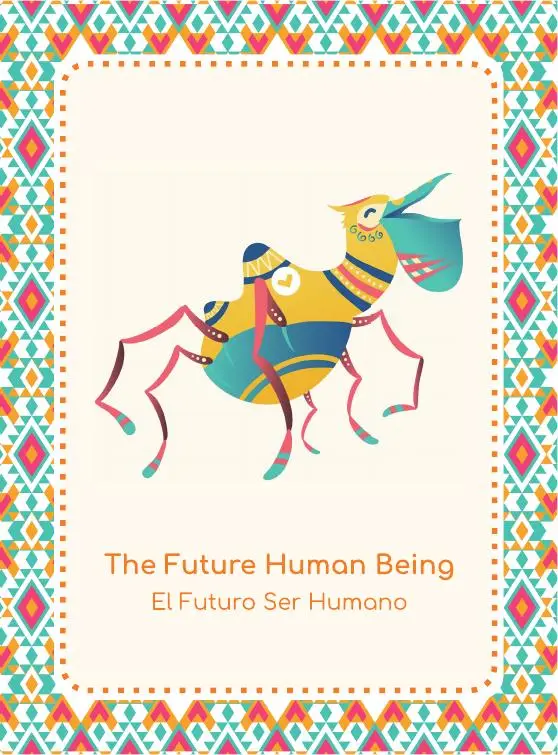
The Future Human Being card
19The Future Human BeingI embody the future human being of compassion.

The Future Human Being walks with Līlā because her predicament is Co-dependence: she cannot bear a world without Padma and asks that his spirit never leave the palace. Her turning is Sensitivity, a love refined enough to comfort a grieving son with one touch, and her arrival is Sacrifice, the possessive claim laid down once she sees how a whole reign fits inside a few days.

  1. Shadow · what you avoidCo-dependence

    Co-dependence: terrified of losing Padma, Līlā wins the boon that his spirit stay in the palace (III.16.39) and, when he dies, is 'about to die of grief' (III.16.49).

  2. Gift · what is hidden in itSensitivity

    Sensitivity: in the brahmin's mourning house her son can see her only once she 'became of pure desire' (III.27.11), and her hand on his head lifts his grief (III.26.41).

  3. Essence · what you embodySacrifice

    Sacrifice: seeing that 'every one is of the form of whatever he thinks himself to be' (III.26.52) and that a reign of eighty years lasted eight days (III.29.34), she gives up the claim to keep what she loves.

The Future Human Being, and a queen who loved so hard she built a kingdom in one room. Loosen your grip a finger's width. Love still reaches; it simply holds less tightly.

— Felicia
Today’s contemplation

If the one who can love without clinging is already here now, as Līlā was the moment her son could see her, what are you waiting for before your touch comforts instead of holds?

To close the night

Tonight, write one honest sentence about someone you hold on to, and what you fear would happen if you held more lightly.

The Ally Journey · about 15 minutes

Light trance, eyes open if you prefer. For the full, deeper script, see “The practice” above and its cautions.

  1. Threshold: sit upright and comfortable, eyes open or softly lowered. Take three slow breaths, letting the shoulders drop a little on each out-breath. This is the Umbral.
  2. The tale in one line: Queen Līlā, unable to lose her husband, finds his whole kingdom inside the room where he lies, and learns to comfort rather than cling (III.20.8; III.26.41).
  3. Meet the card: look at The Future Human Being for a few breaths. Notice the face, the light, what feels near. Read the affirmation once: I embody the future human being of compassion.
  4. Shadow: where this week did you hold on too tightly to someone, checking, waiting, needing a reply? Name the moment and the small fear underneath it.
  5. Gift: picture that person resting somewhere safe. Instead of reaching to keep them, let your hand rest lightly on their shoulder, offering comfort and asking nothing back. Notice what changes in your chest.
  6. Essence: let the image go. For three breaths, say the affirmation, and feel the love remain while the grip has gone.
  7. Return: feel your feet and the chair beneath you. Look around the room and name three real things you can see. Open your eyes fully and write tonight's honest line.

The 30-day Bond

The future human being who loves without holding on is here now: whom are you waiting to love that way?

The Sister · Lola

Romani · Granada, Spain · Devleha, Devleha

Visit Lola, the Romani Phuri Dai of Granada, a wise woman who sits with families in their grief; her mantra, Devleha, Devleha, 'with God', is a way of loving someone and letting them go in the same breath.

Guided Meditation

#19 · The Future Human Being

Voice & guidance: Prof. Luis Miguel GallardoWatch on YouTube (ES also available)
For facilitatorsA session with “Līlā, Padma and the Goddess Sarasvatī” and The Future Human Being

Aim. To help the person find, inside an anxious attachment, the sensitivity that can comfort others, and to let the possessive claim soften without denying the love.

ITM 3 Gift Discovery. Līlā's clinging already carries her gift; the work is to discover the sensitivity hidden inside the fear, which is Gift Discovery.

The session (60–75 min)

  1. Arrival and Umbral: three slow breaths together; ask whom the person is most afraid of losing, and listen (8 min)
  2. Telling the tale: a 5-minute version of Līlā's boon, the kingdom in the room, the brahmin's house and the touch that lifts the son's grief; point to the tale page for the full text (5 min)
  3. The card: show The Future Human Being, read the affirmation and the koan, and ask what the future self would do differently with this love (7 min)
  4. Shadow inquiry: trace the boon Līlā asked for, what the person has asked of life, of a partner or of a child, to keep loss away, and what that asking has cost (12 min)
  5. Trance practice: Entering the Other Room, using the full guided script on the tale page at LIGHT to MEDIUM depth only; never the deep somnambulistic stillness of the tale; keep the comforting touch and the explicit return with reality testing (18 min)
  6. Gift and Essence integration: name one person this sensitivity could comfort this week, and one claim the person is ready to lay down (10 min)
  7. Closing and Bond: open eyes, name objects in the room, stand; set the 30-day Bond with the koan variation (7 min)

Integration questions

  • What did your hand feel like when it comforted instead of held?
  • Which part of your attachment is fear, and which part is a gift of sensitivity you want to keep?
  • What would one small act of letting go look like this week, without abandoning anyone?

In a circle

In a circle, tell the tale with special care for anyone recently bereaved, and say plainly that the practice is about loving more freely, not about contacting the dead. Lead a shortened Entering the Other Room at light depth, keeping only the stillness, the visit to a grieving house and the comforting touch, and leave out the rising above the body. Bring everyone back with eyes open, naming objects in the room and standing. In threes, each person shares one claim they are ready to soften and one person their sensitivity could comfort this week. Close with Lola's Devleha spoken softly together, and keep a co-facilitator available for anyone whose grief is raw.

Cautions

  • Not for people with psychotic disorders, depersonalisation or derealisation: the teaching that waking and dream are equally unreal can unsettle reality testing.
  • Līlā nearly dies of grief and Arundhatī dies to follow her husband: screen bereaved people for suicidal ideation and never present reunion through death as a resolution.
  • Past-life material may be confabulated; treat it as metaphor, not memory, and avoid leading suggestions.
  • Out-of-body and nested imagery need a careful, explicit return with reality testing afterwards.

Training and certification in the Meta Pets Method: metapetsworld.org/facilitators ↗

The correspondence between tales and Meta Pets is contemplative: the Yoga Vāsiṣṭha does not contain the Meta Pets; each tale enacts its ally’s arc. Felicia is an artificial-intelligence companion; her words are contemplative reflections, not clinical advice.

The song

Read the full text

Source: Vihari-Lala Mitra, The Yoga-Vasishtha Maharamayana of Valmiki (1891–99), public domain.

Collaborate on this research

Researchers, clinicians and institutions are welcome to write. Replication, data-sharing and site partnerships for the trials in progress are all open conversations.

Educational and scholarly content. Hypnotherapy and regression material is complementary and not a substitute for medical or psychiatric care.