Core model · 2026
The Integrative Transformation Model
How temporary states of consciousness become permanent developmental stages: five stages, seven mechanisms, and one engine — Shadow → Gift → Essence.
Prof. Luis Miguel Gallardo · World Happiness Foundation & Shoolini University — Yogananda School of Spirituality and Happiness · ORCID 0009-0005-3222-6092
The problem
Transpersonal psychology has described states beautifully: the retreat, the session, the flight. What it has not explained is why most of those states change nothing durably. ITM answers with an uncomfortable thesis: shadow integration is not the psychological housekeeping you do before the transpersonal work — it is the pathway by which the transpersonal becomes permanent.
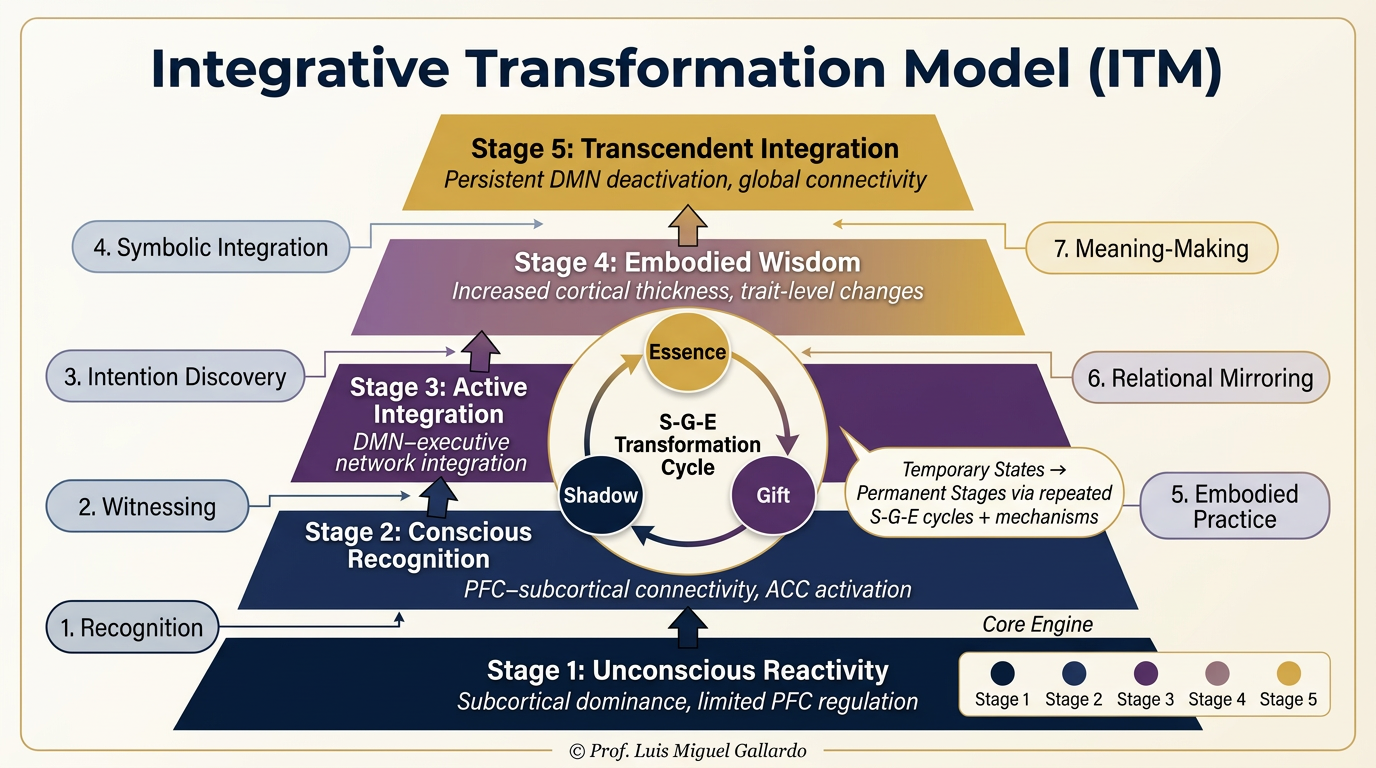
The engine · Shadow → Gift → Essence
Unconscious patterns, defences and projections operating below awareness. Every defence once served a protection.
The adaptive capacity hidden inside the pattern. Integrated consciously, the defence returns as a strength.
The quality of being that emerges when the gift is embodied — the deepest dimension of the same pattern.
Clinical example: a client's anger (shadow) → assertiveness and boundary-setting (gift) → authentic power and sovereignty (essence).
Five developmental stages
Stages are expanding capacities, not fixed achievements. You can visit a higher stage in a peak experience and still live from an earlier one. No stage is worth more than another.
Unconscious Reactivity
Automatic defences and extensive projection of shadow material; life is experienced as something that happens to you.
- Neurobiology
- Subcortical dominance, limited prefrontal regulation
- Interventions
- Psychoeducation, MBSR, grounding, body scans, structured journaling
- Mechanisms
- Recognition · initial Witnessing
Conscious Recognition
Metacognitive awareness emerges — the pattern can be observed while it is happening.
- Neurobiology
- PFC–subcortical connectivity, ACC activation
- Interventions
- Vipassana, reflective dialogue, shadow journaling, Gestalt exercises
- Mechanisms
- Recognition · Witnessing (strengthening)
Active Integration
Deliberate engagement with shadow through the S–G–E process; tolerance for psychological discomfort.
- Neurobiology
- DMN–executive network integration
- Interventions
- IFS parts work, active imagination, dreamwork, breathwork, Immunity to Change
- Mechanisms
- All seven mechanisms actively engaged
Embodied Wisdom
Insight becomes trait: compassion, equanimity and wisdom hold across contexts; shadow becomes information.
- Neurobiology
- Increased cortical thickness, trait-level change
- Interventions
- Somatic experiencing, advanced retreats, integral daily practice, group work
- Mechanisms
- Embodied Practice · Relational Mirroring · Meaning-Making
Transcendent Integration
Stable nondual awareness; shadow and light, self and other, form and emptiness recognised as one field.
- Neurobiology
- Persistent DMN deactivation, global connectivity
- Interventions
- Nondual meditation (Dzogchen, Advaita), contemplative retreat, service and legacy work
- Mechanisms
- Meaning-Making · ongoing integration
Seven transformation mechanisms
| # | Mechanism | Operational definition | Neuro correlate | Practice |
|---|---|---|---|---|
| 1 | Recognition | Conscious awareness of a previously unconscious pattern. | ACC, insula | Mindfulness · interpretation · honest feedback |
| 2 | Witnessing | Observing inner experience without identifying with it. | DMN deactivation, PFC–subcortical connectivity | Meditation · self-observation · body awareness |
| 3 | Intention Discovery | Uncovering the protective purpose the defence once served. | vmPFC, compassion networks | IFS · compassion-focused therapy |
| 4 | Symbolic Integration | Meeting the material where it speaks — image, dream, archetype. | Right hemisphere, DMN | Active imagination · dreamwork · expressive art |
| 5 | Embodied Practice | Grounding insight in the nervous system, not only in thought. | Interoceptive networks, vagal regulation | Breathwork · yoga · somatic therapy |
| 6 | Relational Mirroring | Using the relationship as the place where shadow becomes visible. | Social brain networks | Therapeutic relationship · group process · projection work |
| 7 | Meaning-Making | Composing a coherent story that holds shadow, gift and essence. | PFC, autobiographical memory | Narrative therapy · life review · legacy work |
Clinical protocol
ITMSA stage assessment (50 items), ITMMI mechanism inventory (70 items, 7 subscales), structured interview, HRV and cortisol baseline.
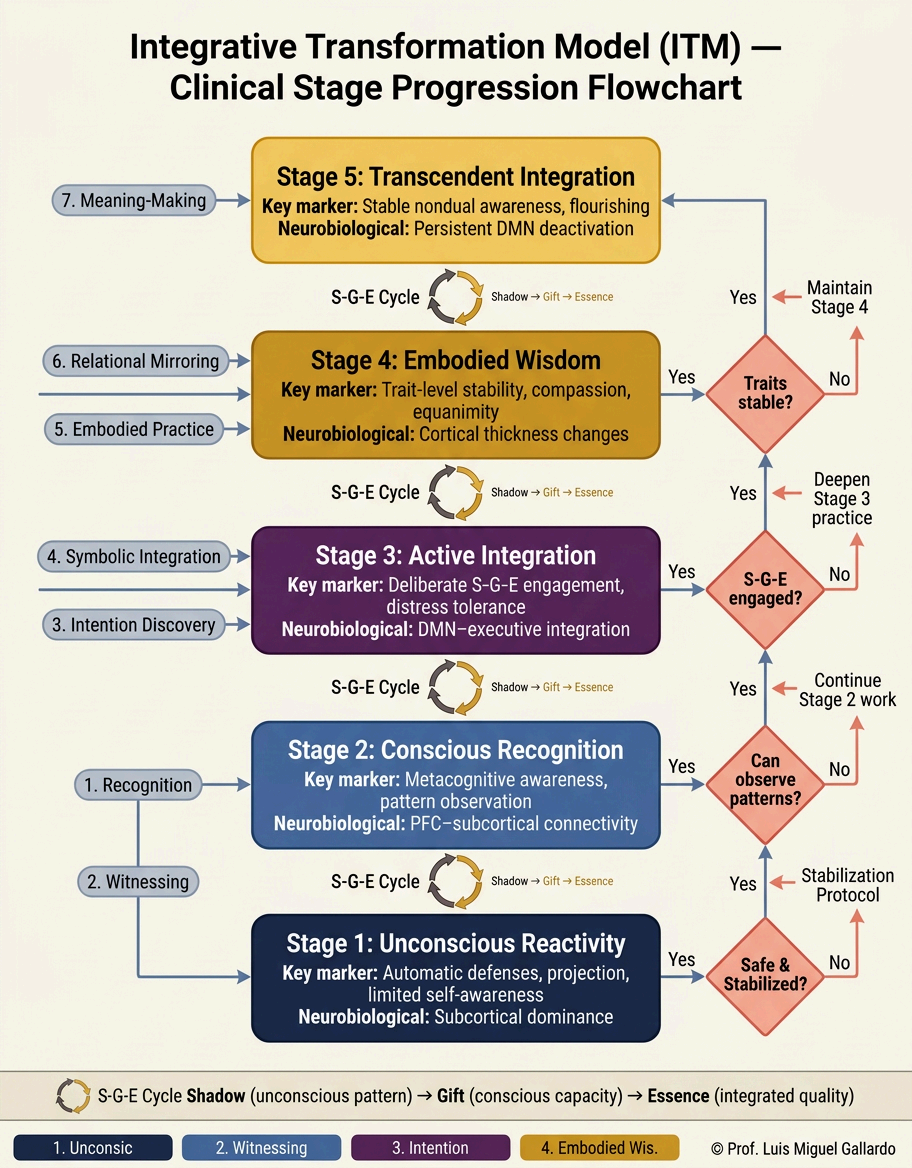
Stage 1–2: build recognition and witnessing. Stage 3: full S–G–E with all seven mechanisms. Stage 4–5: stabilise traits through embodiment, relationship and meaning.
Graduated complexity: foundational mechanisms before deep ones. Pair every session with daily integral practice and a support system.
ITMMI every 8 sessions, ITMSA every 6 months, physiological markers quarterly, clinical interview monthly. Mechanism engagement rises before stage change.
Safety and contraindications
Do not proceed with deep shadow work when there is:
- ·Active psychosis or severe dissociative symptoms
- ·Severe unprocessed trauma without adequate stabilisation
- ·Ruptures in the working alliance — repair the relationship first
- ·Active spiritual crisis or spiritual emergency
- ·Emotional dysregulation without coping resources
- ·Existential crisis or acute suicidality
- ·Practitioner burnout — keep your own shadow work current
ITM prevents spiritual bypassing by design: no stage consolidates without conscious confrontation of the psychological material beneath it.
Where this model lives