Essay · Core model
The State Is Not the Stage
Why most transformative experiences transform nothing — and what the Integrative Transformation Model does about it.
Prof. Luis Miguel Gallardo · 2 September 2026
Almost everyone I meet in this field has had the experience. A retreat that cracked something open. A session where the room changed shape. A breath that went further than breath. And then, three months later, the same argument with the same person about the same thing.
This is the oldest embarrassment of transpersonal psychology, and we have been polite about it for fifty years. We are excellent at producing states. We are poor at explaining why states so rarely become stages.
The claim
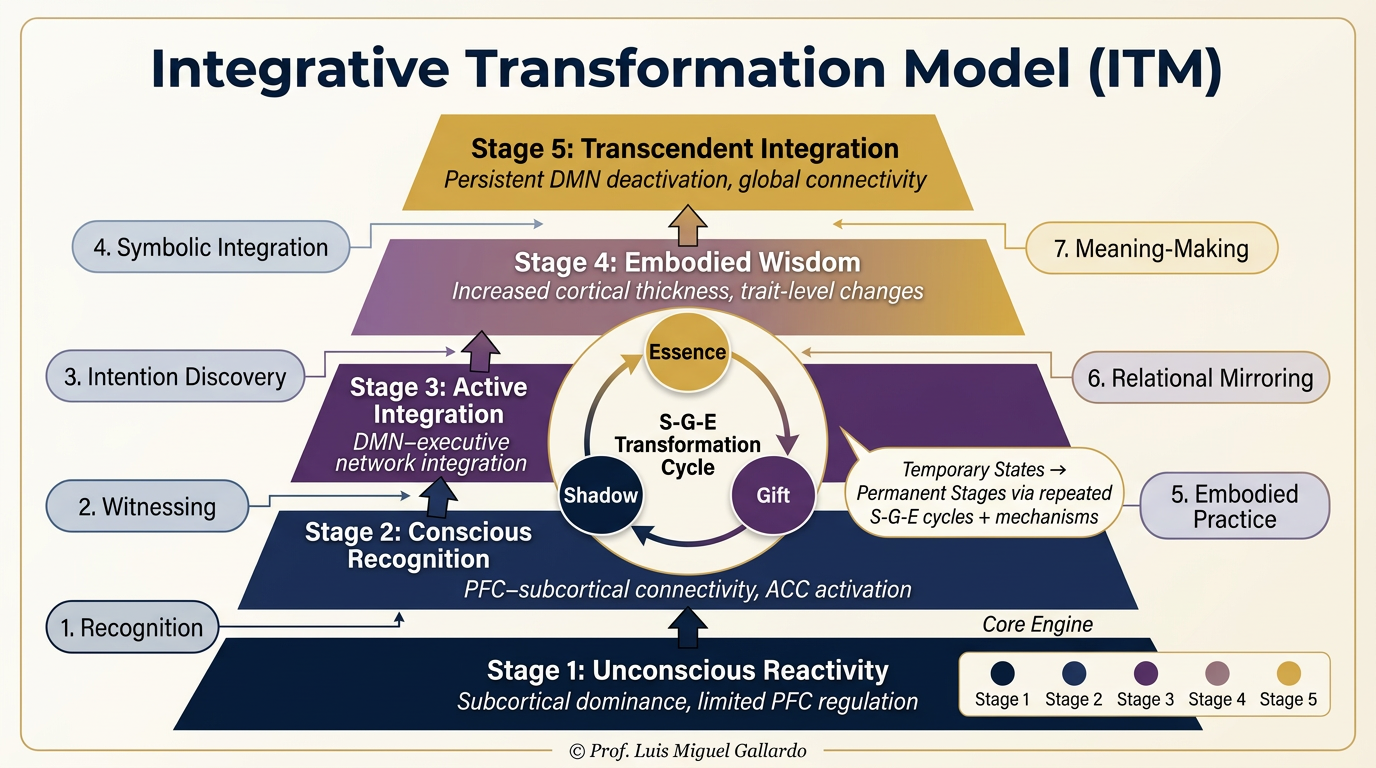
The Integrative Transformation Model (ITM) makes one claim, and everything else in it follows from that claim: shadow integration is the mechanism by which temporary transpersonal states become permanent developmental capacities.
Not shadow work as preparation. Not shadow work as the psychological hygiene you complete before the real spiritual curriculum begins. Shadow work as the road itself. The luminous state you had on the mountain becomes a trait in your ordinary Tuesday only to the degree that it is metabolised through material you would rather not look at.
The engine: Shadow → Gift → Essence
Jung named the shadow and described it with extraordinary richness, but he never specified how it transforms. ITM does, in three phases. In the Shadow phase, a defensive pattern becomes visible — usually through conflict, contemplative practice, or a therapist's well-timed sentence. In the Gift phase, we discover that the defence was carrying a capacity: the anger was holding the boundary, the shame was holding the discernment, the fear was holding the caution. In the Essence phase, that capacity resolves into a quality of being that no longer needs a pattern to protect it.
This is why the model is not a pathology map. Every symptom in it is a strength in the wrong costume, and the clinical task is not removal but return.
Five stages, honestly held
ITM maps five stages — Unconscious Reactivity, Conscious Recognition, Active Integration, Embodied Wisdom, Transcendent Integration — and cross-references them with Kegan, Loevinger, Cook-Greuter and Wilber so nobody has to take my word for the architecture. But stages are dangerous when they become a ladder people climb for status. So the model insists on two disciplines. First, stages are expanding capacities, not achievements: you can visit Stage 5 on a Sunday and live from Stage 2 on Monday. Second, no stage is worth more than another. A person in Stage 1 is not behind. They are at the beginning of a particular piece of honesty.
Seven mechanisms, so the work is teachable
Most models tell you that people change through "integration" and leave it there. ITM names seven distinct mechanisms — recognition, witnessing, intention discovery, symbolic integration, embodied practice, relational mirroring, meaning-making — each with an operational definition, a neurobiological correlate and a clinical technique. That specificity is what makes the model trainable: a supervisor can say which mechanism a session was missing, and a practitioner can practise it.
It also makes the model testable. Two instruments accompany it — the ITM Stage Assessment (50 items) and the ITM Mechanism Inventory (70 items across seven subscales) — with physiological correlates in heart rate variability and cortisol. A theory that cannot be wrong is not a theory. This one can be wrong, and I would rather find out.
Why this matters for coaches
Conventional coaching runs out of road at the exact moment the real subject arrives. The client's goal was never the goal; the pattern under the goal was. ITM gives an accompanying practitioner three things at that moment: a way to tell which stage the person is actually working from, a menu of mechanisms matched to that stage, and a set of contraindications that say plainly when not to go deeper.
That last part is not decoration. Active psychosis, unstabilised trauma, acute crisis, a ruptured alliance, a burnt-out practitioner: each is a reason to stop and stabilise. Depth without safety is not depth. It is damage with good lighting.
Against bypassing
The model was built partly as an antidote. Spiritual bypassing is not a character flaw; it is a structural temptation in any tradition that offers relief before it offers contact. ITM removes the temptation by making shadow integration the condition of stage consolidation. You cannot skip the room you are afraid of and still arrive in the house.
Read the whole model