New book · 2026 · World Happiness Press
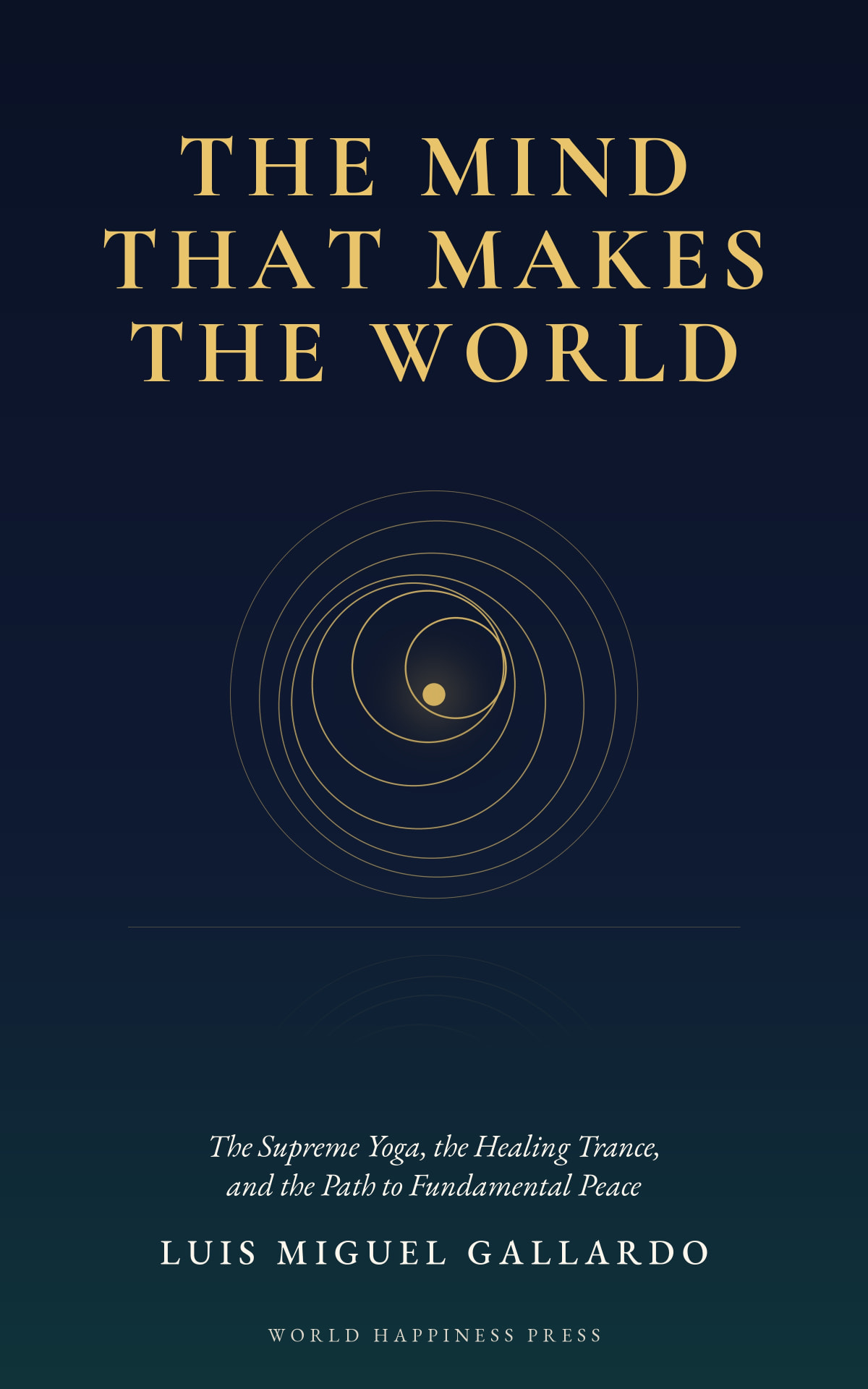
The Mind That Makes the World
The Supreme Yoga, the Healing Trance, and the Path to Fundamental Peace
Prof. Luis Miguel Gallardo · 2026-09-10
Two thousand years ago a sage sat with a prince who had everything and could not rest, and told him stories until the prince's world loosened. Two hundred years ago a priest from Goa stood in a Paris hall and showed that a sentence, well said, could change what a body does. This book puts them in the same room — and then hands you the practice.
Why the Yoga Vāsiṣṭha
The Yoga Vāsiṣṭha — the Supreme Yoga — is the boldest claim in Indian contemplative literature: the world you experience is the shape your mind is currently holding. It argues by story rather than doctrine. Līlā walks between worlds. Lavaṇa lives a lifetime in an hour. Bhuśuṇḍa, the crow, outlasts the gods on the strength of his breath. Cūḍālā, the queen, wakes her husband from a spirituality that had become a costume. Part One retells five of these and lets them do what stories do — loosen the grip before argument arrives.
Why hypnotherapy
Abbé José Custódio de Faria, born in Candolim, taught that the power was never in the operator: it was in the concentration and the consent of the person in the chair. Modern trance research says the same thing in different vocabulary — absorption, expectancy, dissociation, focused attention. Part Two describes carefully what a trance is and is not, what the body actually does, and what the rhythms of the brain can and cannot yet tell us. It refuses the three myths — sleep, control, weakness — and it never over-claims.
Twelve doors, one room
The heart of the bridge is a set of thirteen construct concordances between the two traditions, presented in the book as twelve doors into one room: saṅkalpa and suggestion, bhāvanā and absorption, vāsanā and the conditioned pattern, sākṣī and the observing self. These are concordances, not equivalences. The book is explicit about that boundary: a Sanskrit term carries a metaphysics that a clinical construct does not, and flattening one into the other would betray both.
The cool mind
Chapter 11 names what the whole book is walking toward. Fundamental Peace is not the absence of conflict and not the presence of justice; it is the inner ground from which a person responds instead of reacts. It is trainable, and it is measurable — the FP20 scale, twenty statements and four components, is open free on this site. The seven stairs of the Yoga Vāsiṣṭha appear here as a heuristic map of that terrain, offered with a warning about treating any ladder as a scoreboard.
A path you can actually walk
Part Three is the practice: the wish, spoken; settling; the trained imagination; old rivers; the queen's dialogues; the witness; living free. Seven chapters, each with a story, a reason, a script you can use tonight, and a note for practitioners who work with clients. There is a forty-day arc for anyone who wants the sequence rather than the sampler.
The scholarship behind it
The book is the narrative door into a peer-reviewed research programme — Yoga Vāsiṣṭha Hypnotherapy (YVH) — with a published paper, a DOI, five testable hypotheses, an integrative model figure and an explicit set of cultural-integrity caveats. Read the book for the stories; read the programme if you want the evidence and the limits.
A note of care: nothing here is diagnosis or treatment. Trance work with trauma, psychosis or dissociation belongs with a trained clinician.