
New peer publication
The Supreme Yoga meets the science of suggestion
A summary of the first systematic integration of the Yoga Vāsiṣṭha and modern hypnotherapy — now published with its own DOI.
Prof. Luis Miguel Gallardo · 2026-09-09
The paper is live at the World Happiness Foundation Research Lab under DOI 10.68220/whf.2026.001, licensed CC BY 4.0. It introduces Yoga Vāsiṣṭha Hypnotherapy (YVH): an integrative clinical model that reads one of the most psychologically sophisticated works of Indian philosophy alongside a modern therapeutic method — without collapsing either into the other.
The Yoga Vāsiṣṭha (Mokṣopāya) teaches that experienced worlds are mind-made, that latent impressions (vāsanā) sustain suffering, that disciplined imagination (bhāvanā) and self-effort can dissolve them, and that liberation is available in this life (jīvanmukti).
Modern hypnotherapy arrived at the operative core of those claims by a different road — and, remarkably, a road that runs through India. Its founding doctrine of suggestion entered Europe through the Goa-born Abbé Faria; its largest early clinical corpus was produced in Bengal; and its first theorist, James Braid, analysed reports of yogic samādhi.
The article maps thirteen construct concordances, aligns the seven jñāna-bhūmikās with graded trance depths as a heuristic clinical map, and identifies the text's jīvanmukta with Fundamental Peace — the measured endpoint of the whole programme.
The model, in one image
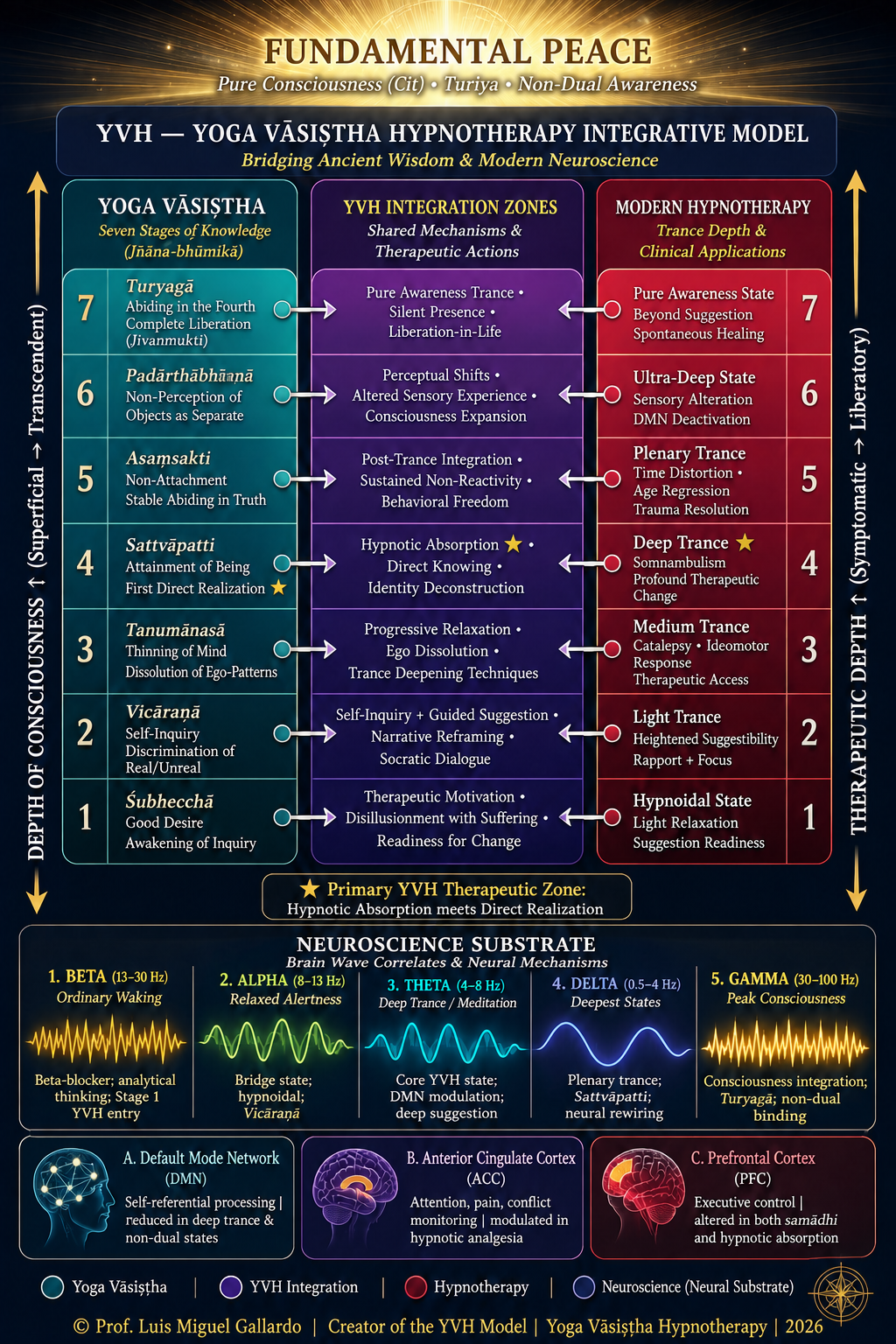
Figure 1 — The Yoga Vāsiṣṭha Hypnotherapy (YVH) Integrative Model, v2. © 2026 Luis Miguel Gallardo.
What maps onto what
The method is complementarity without collapse: each tradition keeps its own epistemology, and only the operative claims are compared. Six of the thirteen concordances, in brief:
| Yoga Vāsiṣṭha | Clinical hypnotherapy |
|---|---|
| Vāsanā — latent impressions | Conditioned schemas and implicit learning |
| Bhāvanā — disciplined imagination | Therapeutic suggestion and mental rehearsal |
| Saṃkalpa — resolve | Intention setting and post-hypnotic suggestion |
| Jñāna-bhūmikās — seven stages | Graded depth of absorption (heuristic map) |
| Dṛṣṭi-sṛṣṭi — world as mind-made | Cognitive construction of experience |
| Jīvanmukti — liberation in life | Fundamental Peace, measured by the FP20 |
A measurable endpoint
The paper's decisive move is to give contemplative clinical practice something it usually lacks: a validated outcome. Fundamental Peace is defined as an integrated regulatory capacity — flexible attentional control without effortful suppression, emotional coherence across self-states, reduced self-referential rigidity, and compassionate self-awareness.
That definition is not a mood. It is operationalised by the FP20 scale, and it is the primary outcome measure across the programme's trials, including the doctoral cluster-randomised study in Rajasthan and the Life Between Lives regression study submitted to the CEICA ethics committee in Spain.
Returning the science of suggestion to its deepest source, while giving contemplative practice a validated endpoint.
Five testable hypotheses
- 1Absorption capacity predicts movement through the seven bhūmikās as a clinical progression.
- 2Bhāvanā-based suggestion reduces vāsanā-driven reactivity more than relaxation alone.
- 3YVH protocols raise FP20 scores beyond attention-only comparators.
- 4Gains track reduced self-referential rigidity (default-mode reconfiguration), not sedation.
- 5Cultural-integrity framing improves adherence rather than diluting clinical effect.
What the paper does not claim
The seven-rung alignment is offered as a heuristic clinical map, not an identity claim: a bhūmikā is a soteriological stage, a trance depth is a psychophysiological state, and the paper states the disanalogies openly.
Nothing here replaces medical or psychiatric care. The model is a research programme with hypotheses awaiting trials, and it is labelled as such throughout.