Transpersonal Leadership · Essay
The Compass and the Shadow Map: A Beyond-GDP Analysis Through Fundamental Peace and Transpersonal Leadership
The UN High-Level Expert Group has finally built a compass beyond GDP. Read side by side with the Global Pain & Trauma Map and the Fundamental Peace Index, it also reveals what only transpersonal leadership can walk — the practice that moves a society from diagnosis to healing.
In May 2026 the United Nations High-Level Expert Group on Beyond GDP delivered a report whose title alone marks a civilisational turn: Counting What Counts. I read it in one sitting and I want to say plainly what I felt — first gratitude, then recognition, then a familiar ache.
This essay is my working analysis of that report, written from the two frames I have spent twenty years building: Fundamental Peace as the state we are actually measuring, and Transpersonal Leadership as the practice that moves a society there. The full, footnoted version lives at the World Happiness Foundation.
The gratitude
For the first time in history, the world's governments — through the Pact for the Future — asked the UN for a definition of progress beyond economic output. The Group answered with a dashboard of 31 indicators, five forms of capital, and three foundational principles: peace, human rights, respect for the planet. Peace is defined positively, in Mandela's words, as the creation of an environment where all can flourish. When I read that sentence inside a UN document destined for the General Assembly, I felt the ground shift a few degrees toward the light.
Life satisfaction, loneliness, trust, confidence in institutions — interiority has finally entered official statistics. Half the indicators come from the SDGs so countries can start tomorrow. And the Group had the humility to say what most economists never will: a civilisation cannot be reduced to a single headline number.
The recognition
The report and our own Global Pain & Trauma Map (GPTM) — seven domains of human suffering across 196 countries and 321 communities — were built independently, and yet they rhyme. Both were built listening to the same human cry that GDP has never been able to hear. The Fundamental Peace Index (FPI = 100 − GPTM) is simply the distance any community sits from suffering to flourishing. The UN built a compass; we had been drawing its shadow map.
The ache — what the dashboard cannot yet see
Of the seven GPTM domains, the dashboard covers one strongly, three thinly, and two barely at all.
| GPTM domain | Dashboard coverage | What is missing |
|---|---|---|
| D1 · Individual / Psychological | Thin (2 partial) | Negative affect, mental disorder prevalence, trauma symptomatology |
| D2 · Relational / Social | Thin (3 partial) | Belonging, social support, relationship quality |
| D3 · Collective / Cultural | Proxy only | Intergenerational trauma, cultural erasure, collective grief |
| D4 · Structural / Systemic | Strong (16+) | The dashboard's centre of gravity |
| D5 · Existential / Spiritual | Absent | Meaning, purpose, spiritual well-being |
| D6 · Somatic / Biological | Proxy only | Chronic pain (1.5B people), addiction, burnout, dysregulation |
| D7 · Environmental / Planetary | Strong objective / Absent subjective | Climate anxiety, eco-grief, nature connection |
Two of those gaps are not details.
Existential suffering is invisible. No indicator measures meaning, purpose or spiritual well-being. Our data explains why this matters: the Nordic countries, perennial champions of the happiness rankings, still carry existential suffering scores near 58 and ecological grief near 72. You can top every league table and still not know why you are alive. I call this the Nordic Paradox, and no life-evaluation question can detect it.
Trauma is invisible. Conflict deaths measure violence in the present tense; they say nothing about how war moves through generations, through nervous systems, through the stories a people tells its children. When conflict struck Iran in early 2026, our collective-trauma domain rose sixteen points in weeks — faster than any other form of suffering. A compass with peace as its foundation but no instrument for trauma is missing its most important bearing.
And the dashboard is state-centric. Yet the places on Earth with the least suffering are not nations — Plum Village, the Blue Zones, the ecovillages average GPTM composites of 26–33 against a global average of 65. Plum Village, whose monks own nothing, outperforms Luxembourg. The difference is not wealth, climate or genetics. It is consciousness, practiced daily, together.
Where transpersonal leadership walks in
The report itself opens the door. Paragraph 78 explicitly asks civil society and academia to develop complementary analyses. Paragraph 74(e) proposes a scientific committee on headline aggregates. Paragraphs 63–64 call for operational tools that turn metrics into action.
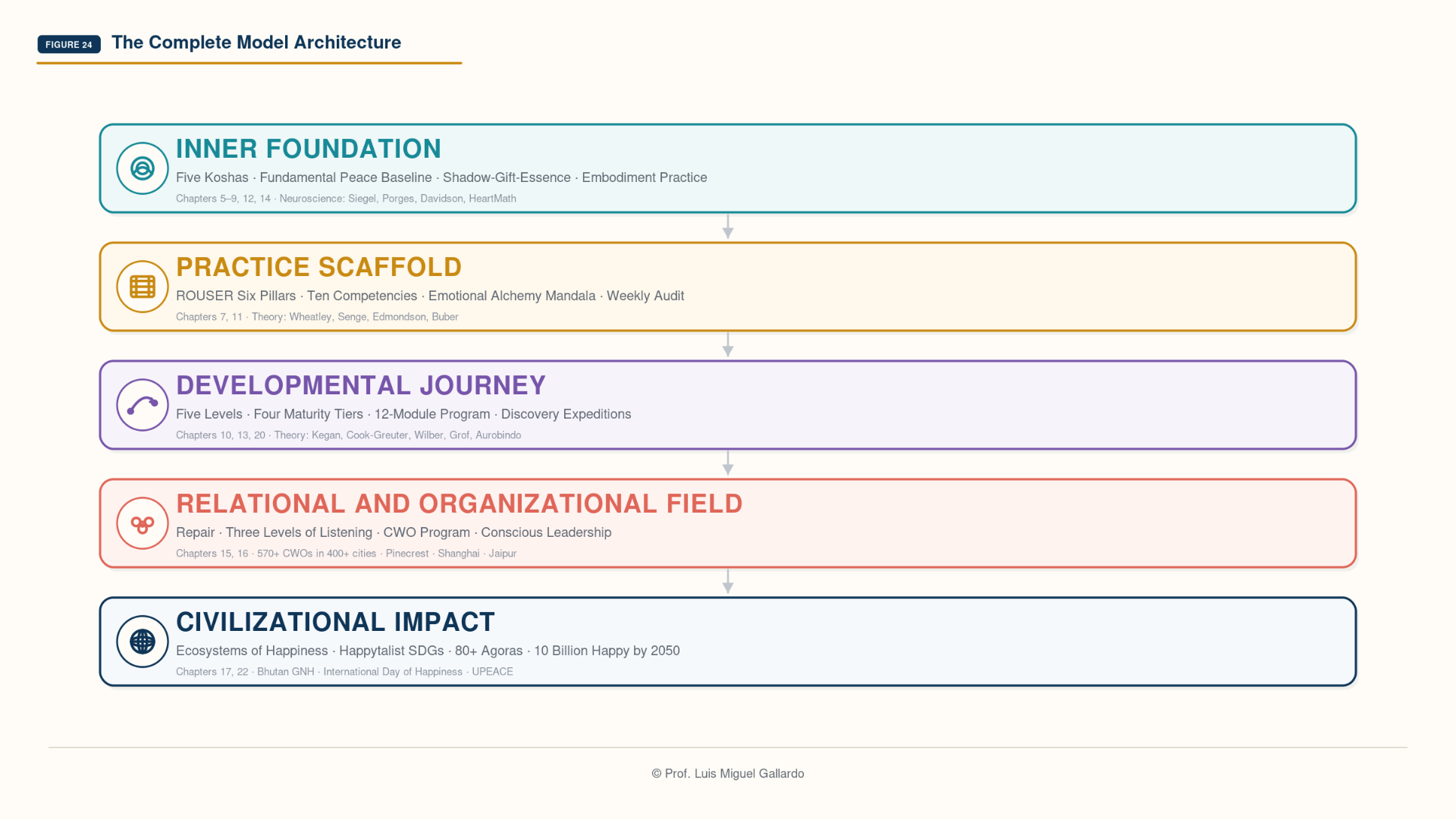
A dashboard can reveal that a society suffers. Only practice — sustained daily, together — moves it toward peace. That is the layer transpersonal leadership is built for. Where the compass points at a wound, the ICEF path — Individual, Community, Essence, Fundamental Peace — is how a person, a team or a city actually walks from wound through gift into essence. Where the report tracks life satisfaction, FP20 tracks the twenty concrete conditions of Fundamental Peace inside a human system. Where governments will report averages, the ROUSER pillars give leaders the daily practice to become the environment their people can flourish in.
This is the completion the report cannot make on its own. The compass tells you north. Only the traveler, in Otto Scharmer's sense — leading from the future as it emerges — actually goes there.
Three movements the World Happiness Foundation now takes
One, celebrate publicly. This is the most consequential institutional validation of Happytalism in a generation, and it deserves a generous, specific welcome under our ECOSOC consultative status.
Two, offer the GPTM and the FPI as the shadow map the compass needs — D5 (existential) and D3 (collective trauma) methodologies as Tier III candidate indicators under paragraph 53, and the FPI as a non-monetary headline architecture for the scientific committee of paragraph 74(e). Money should no longer be the numeraire of human progress.
Three, offer what no dashboard contains — the therapeutic layer. Schools of Happiness. Cities of Happiness. Chief Well-Being Officer certification. The Five Levels of Transpersonal Leadership and the Shadow → Gift → Essence pathway as the practice stack that moves communities from diagnosis to healing.
The compass and the traveler
The report closes with a sentence I would be proud to have written: "What we measure shapes what we value." Happytalism completes it: what we practice shapes what we become.
The United Nations has built the compass. Let us become the travelers. Ten billion free, conscious and happy human beings by 2050 — that is the destination. And for the first time in my lifetime, the map and the territory are beginning to agree.
"Fundamental Peace is not the absence of pain… it is the transmutation of its energy into love and compassion."
Where to walk next
- Read the full analysis on the World Happiness Foundation blog.
- Measure your own baseline with FP20 — the twenty items of Fundamental Peace.
- Explore the ICEF framework and the essays on Transpersonal Leadership.
With an embrace,
Luis Miguel.