
Transpersonal Leadership · Essay
Beyond Charisma and Competency: The Soul and System of Transpersonal Leadership
Discover "transpersonal leadership" as a journey beyond the ego, integrating neuroscience with ancient wisdom for profound impact. Lead from the soul, transform systems.
To lead is to awaken consciousness within ourselves and in those we serve.
The Journey Beyond the Persona
Leadership, in its most common understanding, often conjures images of powerful individuals—charismatic figures who inspire through their presence, or highly competent experts who navigate complexity with precision. While these traits are valuable, they represent only the visible tip of a much deeper iceberg. As someone who has spent decades exploring the frontiers of human potential and organizational flourishing, I've come to understand that true, enduring impact—what I call transpersonal leadership—emerges from a far more profound wellspring: the soul, integrated with a sophisticated understanding of systems. It is a leadership that transcends the personal ego and ventures into the collective, the universal, the transpersonal.
From the ancient wisdom traditions of Sri Aurobindo to the developmental psychology of Robert Kegan and Susanne Cook-Greuter, we continuously encounter the idea that human consciousness is not static but evolves through successive stages. Similarly, neuroscience, through the work of Daniel Siegel, Stephen Porges, and Richard Davidson, illuminates the intricate dance between our inner states and our capacity for connection, regulation, and flourishing. It is at the intersection of these two powerful currents—contemplative wisdom and cutting-edge science—that transpersonal leadership finds its footing.
In essence, transpersonal leadership is about leading from a state of expanded awareness, moving beyond personal preferences and desires to serve a greater purpose. It's not about being 'new agey'; it's about being fundamentally human, in the fullest sense. It calls us to integrate our emotional intelligence with our spiritual intelligence, our intellectual prowess with our intuitive knowing. As Otto Scharmer eloquently puts it, we must learn to 'lead from the future as it emerges.'
The Five Levels of Transpersonal Leadership
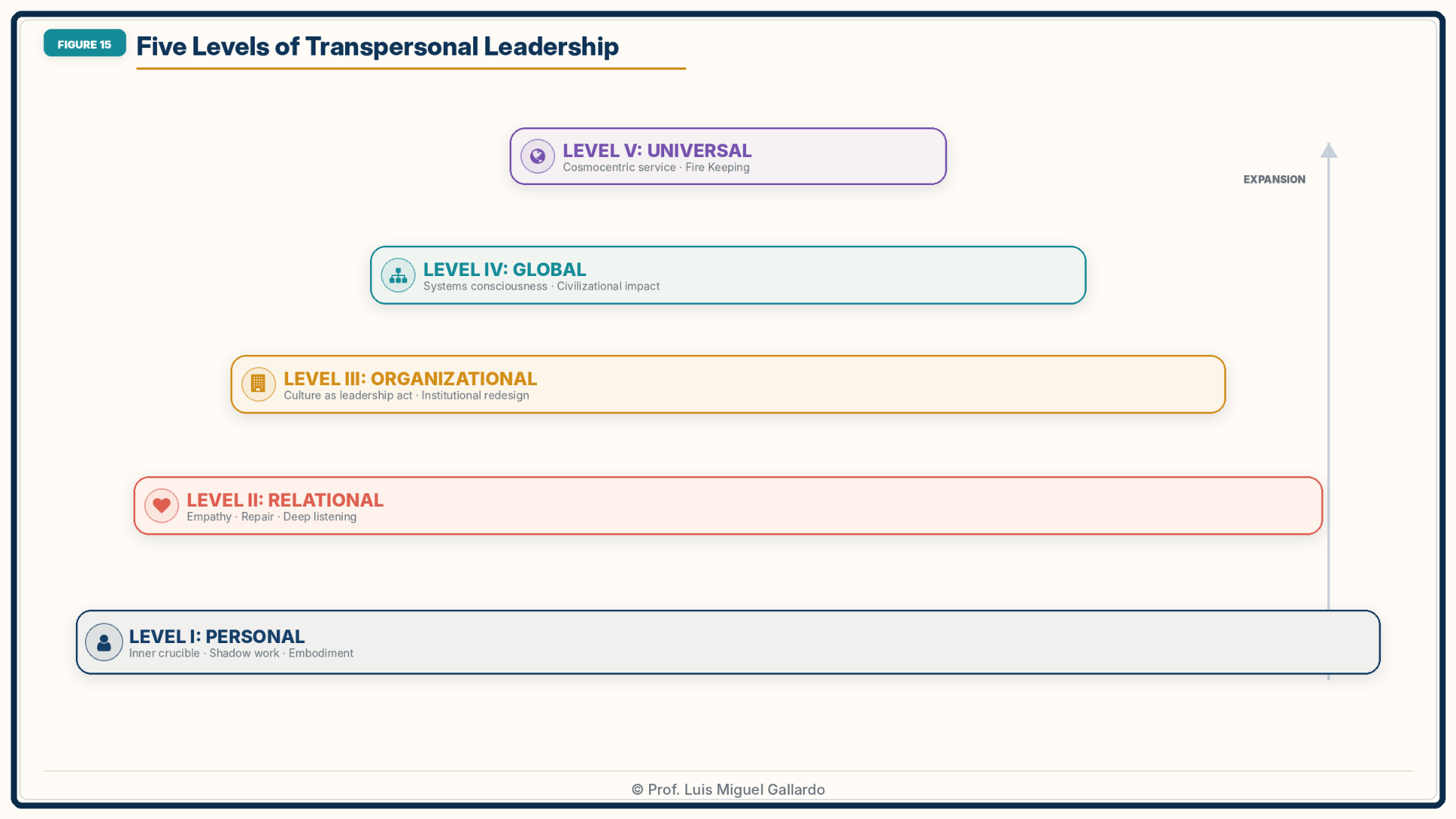
To effectively cultivate this form of leadership, we need a framework—a map, if you will—to guide our development. We propose Five Levels of Transpersonal Leadership, which correspond to ascending stages of consciousness and capacity:
- Individual Awareness: Deep self-knowledge, emotional regulation, and inner coherence (grounded in practices like those taught by HeartMath).
- Relational Presence: The ability to create psychological safety, foster genuine connection, and engage in empathic communication (as highlighted by Siegel's work on interpersonal neurobiology).
- Systemic Understanding: Comprehending the interconnectedness of organizational, social, and ecological systems, and recognizing leverage points for change.
- Generative Purpose: Anchoring one's actions in a sense of higher purpose that transcends individual or organizational gain, consciously contributing to the collective good.
- Integral Wisdom: The embodiment of all previous levels, coupled with the capacity for paradoxical thinking, deep compassion, and visionary foresight—a leadership truly anchored in the 'Self' as described by Carl Jung and the integral philosophy of Ken Wilber.
These levels are not linear checkboxes; rather, they are permeable states of being that deepen over time with conscious practice and reflection. They invite us to continually expand our 'window of tolerance' (Porges' Polyvagal theory) for complexity and uncertainty, allowing us to lead with greater equanimity and wisdom.
The Ten Competencies of Impact
Alongside these levels of being, specific competencies enable us to translate our expanded awareness into tangible impact. These Ten Competencies are skillsets that, when cultivated, empower the transpersonal leader to act effectively in complex environments:
- Self-Mastery: Mindfulness, emotional intelligence, resilience.
- Empathic Resonance: Active listening, compassionate communication, diverse perspective-taking.
- Visionary Foresight: Strategic thinking, future-sensing, purpose articulation.
- Systems Thinking: Pattern recognition, causal loop analysis, interdependencies mapping.
- Co-Creative Collaboration: Facilitation, conflict resolution, collective intelligence harnessing.
- Authentic Influence: Integrity, trustworthiness, ethical decision-making.
- Adaptive Agility: Learning mindset, innovation, change management.
- Courageous Action: Risk-taking, challenging the status quo, perseverance.
- Integral Development: Continuous learning, self-reflection, growth mindset.
- Spiritual Intelligence: Meaning-making, ethical compass, service orientation.
These competencies, when seen through the lens of a developing transpersonal leader, are not merely skills but expressions of an evolving consciousness. They challenge us to move beyond what Otto Scharmer calls "downloading" past patterns and instead to "presencing" new possibilities.
Cultivating Transpersonal Leadership
Cultivating transpersonal leadership is a transformative journey, not a destination. It demands:
- Inner Work: Meditation, self-inquiry, shadow work (Grof's transpersonal psychology).
- Learning & Development: Engaging with developmental models, neuroscience, and integral theory.
- Conscious Practice: Applying these principles in daily leadership challenges, reflecting on outcomes, and learning from experience.
It is about understanding that true external change begins with radical internal transformation. As leaders, we are not just managing people or processes; we are stewards of human potential and catalysts for systemic evolution. Our capacity to lead from a place of soul-guided wisdom, while understanding the intricate dynamics of the systems we inhabit, is the greatest leverage point for creating a world that truly works for all.
"The most important work we will ever do is the work we do on ourselves, for that is the work that changes the world."
This is the essence of transpersonal leadership: a call to embrace our full humanity, to lead with our hearts and minds intertwined, and to serve a future that is not just successful, but deeply meaningful and profoundly harmonious.
With an embrace, Luis Miguel.