
Transpersonal Leadership · Essay
From Shadow to Essence: The Inner Alchemy of Transpersonal Leadership
Transpersonal Leadership isn't just about strategy; it's an inner journey. Discover the Shadow-Gift-Essence pathway for profound transformation.
For too long, leadership has been viewed as an external pursuit, a mastery of skills and strategies. But true leadership, especially Transpersonal Leadership, is fundamentally an inner journey, a profound exploration into the depths of our being.
The Unseen Architects of Our Reality
My work, particularly in The Transpersonal Leader and Happytalism, emphasizes that our external world is, in many ways, a projection of our internal one. Our patterns of leadership, our reactions, our innovations—they all emerge from the complex tapestry of our inner landscape. Chapters 5 through 9 of The Transpersonal Leader delve deeply into this phenomenon, revealing how our developmental stages, our relational matrices, and our very consciousness shape our capacity to lead effectively and compassionately.
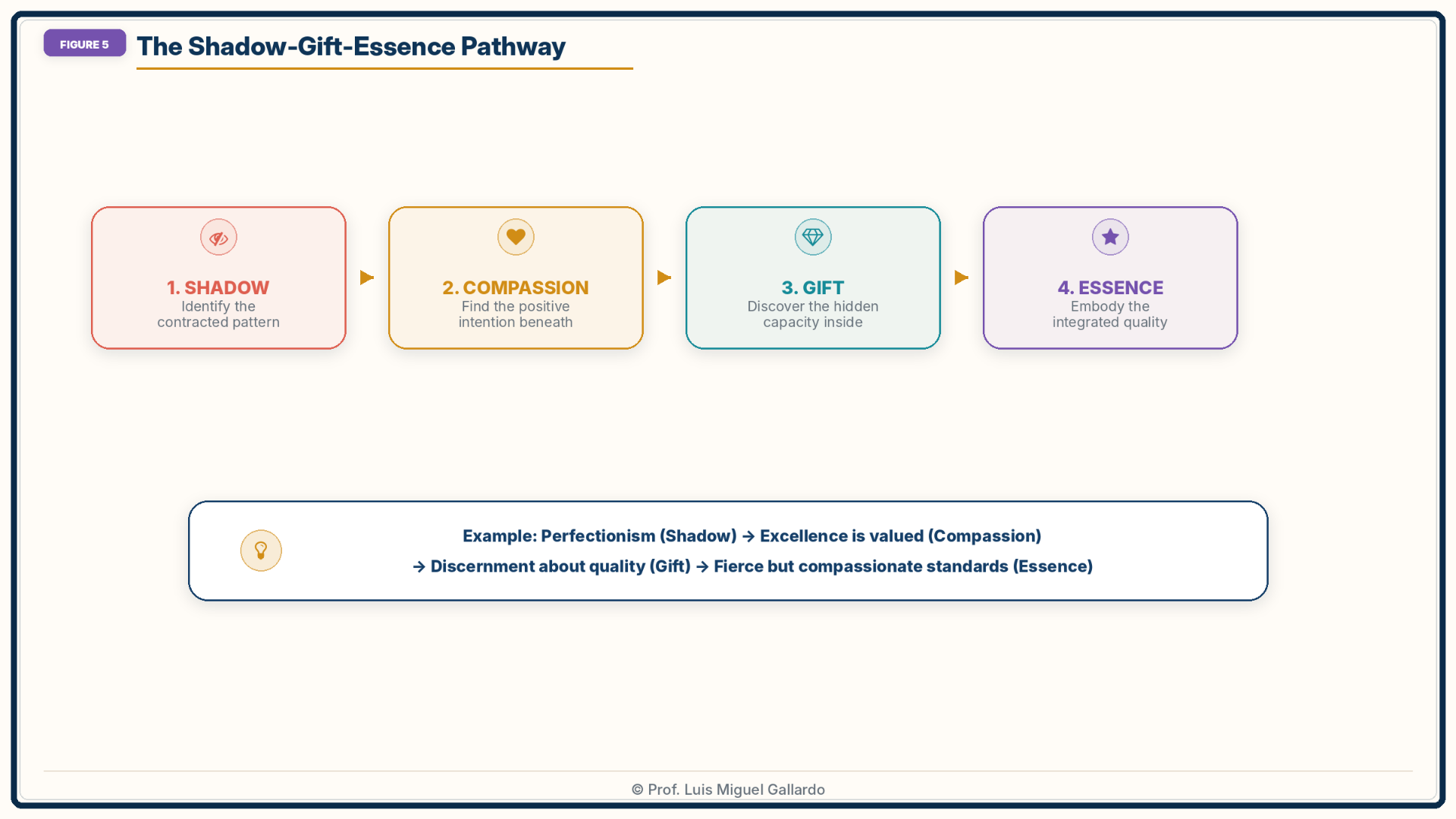
Neuroscience, with the illuminating works of Daniel Siegel, Stephen Porges, and Richard Davidson, provides a scientific lexicon for what ancient wisdom traditions have always known: our internal states, our nervous system regulation, our brain's circuitry directly impact our perception, our empathy, and our capacity for coherent action. When our internal world is fragmented, so too is our leadership. Peter Levine's work on trauma, too, underscores how unresolved experiences can keep us tethered to past reactions, limiting our present effectiveness. This is where the profound path of the Shadow-Gift-Essence (S-G-E) pathway becomes not just helpful, but essential.
Unveiling the Shadow: The First Step Towards Wholeness
Every one of us carries a shadow—those disowned parts of ourselves that we deem unacceptable, unworthy, or frightening. These are not inherently 'bad' but are often aspects of our authentic self that were suppressed or denied due to early conditioning, societal pressures, or painful experiences. Carl Jung famously articulated the shadow, and its dynamic presence in our psyche. Ken Wilber, drawing from various wisdom traditions and developmental psychology, further elucidates how these unintegrated fragments of consciousness can distort our perception and limit our evolutionary potential.
Think of the leader who struggles with micromanagement, a manifestation that might stem from an unacknowledged fear of losing control, a shadow of deep insecurity. Or the leader who avoids conflict, perhaps harboring a shadow of unworthiness or fear of rejection. These shadows, while hidden, exert immense influence on our behaviors and decisions, often creating the very problems we desperately try to solve externally. Genuine shadow work for leaders is not about castigating these parts, but about gently illuminating them.
"The unexamined life is not worth living," declared Socrates. In leadership, the unexamined shadow is an unseen hand, steering us away from our highest potential, and often away from the collective good we aspire to serve.
Transforming Shadow into Gift: The Heart of Integration
Once we bravely encounter our shadow, the next phase of the S-G-E pathway involves discerning its embedded gift. This is where the lyrical beauty of inner work truly unfolds. Behind every shadow lies a core essence, a positive intention, or a latent strength waiting to be reclaimed. The micromanaging leader? Perhaps their shadow of control is, at its heart, a profound gift of meticulousness, a desire for excellence, or a deep sense of responsibility. The conflict-avoidant leader? Their shadow might conceal a gift of empathy, a desire for harmony, or a capacity for nuanced understanding.
This is not a superficial reframing; it is an act of deep psychological and spiritual alchemy. It requires slowing down, listening to the subtle whispers of our internal world, and truly feeling into the energetic imprints these shadows leave. Contemplative practices, such as mindfulness and meditation, are invaluable here, helping to cultivate the inner spaciousness necessary for this discernment. Stan Grof's work on holotropic states and Otto Sharmer's Theory U also offer pathways for accessing deeper levels of awareness where these transformations can occur.
Embodying Essence: The Flowering of Transpersonal Leadership
The final stage of the S-G-E pathway is the embodiment of our essence. This is where the integrated gift, once liberated from the shadow's grip, becomes a natural, flowing expression of our authentic self. When the leader embraces their gift of meticulousness, it transforms into an empowering attention to detail, fostering precision and innovation without stifling others. When the gift of empathy is fully embraced, it leads to profound relational intelligence, strong teams, and genuinely human-centered decision-making.
This embodiment aligns us with our highest purpose, drawing from the wisdom traditions of Sri Aurobindo and the developmental frameworks of Robert Kegan and Susanne Cook-Greuter. It's about leading from a place of wholeness, coherence, and profound inner peace. The HeartMath Institute's research on heart-brain coherence shows us the physiological benefits of operating from this integrated state—a state that fosters resilience, clarity, and genuine connection. It's not about being perfect, but about being progressively more whole, more aligned, and more available to serve.
A Micro-Practice for Daily Integration:
- Pause and Notice: When you experience a strong, usually negative, emotional reaction (e.g., frustration, anger, insecurity) in a leadership situation, pause. Don't immediately act.
- Name the Shadow: Ask yourself: "What unacknowledged part of me is feeling threatened or triggered right now? What belief or fear is active?" (This is your shadow).
- Seek the Gift: Gently ask: "If this shadow had a positive intention, what would it be? What strength or essence might be hidden beneath this reaction?" (This is your gift).
- Embrace and Choose: Acknowledge both the shadow's protection and the gift's potential. Then, consciously choose to lead from the embodied gift rather than the reactive shadow. For example, if the shadow was fear of failure leading to micromanagement, the gift might be 'desire for excellence.' You then choose to lead with an empowering pursuit of excellence, delegating effectively, and trusting your team.
This continuous process of moving from shadow to gift to essence is the very heart of the inner work required for Transpersonal Leadership. It's a journey of self-discovery, integration, and ultimately, of becoming the leader our world so desperately needs—a leader rooted in their authentic essence, resonant with compassion, and capable of fostering genuine flourishing.
With an embrace, Luis Miguel.