WE ARE
The Ecology of the Integrative Alchemy Model — Community, Nature, the Three Worlds, and the Honoring of Ancestral and Indigenous Wisdom
Prof. Luis Miguel Gallardo
World Happiness Foundation · Yogananda School of Spirituality and Happiness, Shoolini University · Chair in Contemplative Sciences, University of Zaragoza · Institute of Interpersonal Hypnotherapy · Michael Newton Institute (LBL®)
Paper IV: the ecological completion of the trilogy — «From Wound to Essence», «The Physics of the Soul», and «I AM»
Abstract
The Integrative Alchemy Model (IAM), completed in the third paper of this series, remains — for all its multidimensionality — a model that could still be read through the individualist lens of the cultures that dominate psychological science: one person, healing, accompanied. This fourth paper corrects that reading and completes the model ecologically. Its keystone is given by the Nguni Bantu philosophy of Ubuntu — umuntu ngumuntu ngabantu, a person is a person through other persons — which reveals the model's own name as half a sentence: I AM completes only in WE ARE. Four extensions follow. First, the communal self: the six wounds and six virtues are operationalized at all four of their canonical scales — personal, collective, racial-ancestral, and planetary — and the community itself (council, circle, ceremony, cooperative) is architected as a transmutation vessel, with the Rajasthan village deployment as field precedent and traditions of communal healing — Ubuntu jurisprudence, Andean Buen Vivir, council practice — as elder lineages. Second, Nature as first scripture: the Twelve Universal Laws are recognized as having been read from the living world before they were written in any text — Vibration in wave and resonance, Rhythm in tide, season, and breath, Polarity in day and night, Gender in seed and soil — and nature is wired into the model operationally: entrainment science (heart-rate-variability coherence, brainwave entrainment, drum-induced theta at four to seven beats per second) grounds practice, and a Wheel of Cycles paces sessions, programs, and lifetimes on nested natural rhythms from the breath to the generation. Third, the vertical cosmology: the shamanic three-world map — underworld, middle world, upper world — is shown to be isomorphic with the model's own frequency architecture (Shadow-subconscious, Gift-conscious, Essence-superconscious), placing the roadmap's descent in the oldest human lineage of katabasis, from Inanna's descent onward, and locating supraconsciousness and the ancestral underworld on one axis mundi. Fourth, the ancestors honored: the ancestral band of the imprint axis becomes bidirectional — wounds are healed down the line and gifts are received up the line — through practices of honoring drawn, with permission and attribution, from living traditions. A dedicated section establishes the ethics of indigenous integration through the Mi'kmaw framework of Etuaptmumk, Two-Eyed Seeing, and principles of reciprocity, consent, and benefit-sharing. The model's movements are completed at both ends: Movement 0 — arrival on the land and in the lineage — now precedes the roadmap, and Movement 8's offering explicitly includes the more-than-human world. I am because we are; we are because Earth is.
Keywords: Ubuntu, communal self, Buen Vivir, nature-based practice, entrainment, cycles, three worlds, katabasis, supraconsciousness, ancestral healing, Two-Eyed Seeing, indigenous knowledge, ecological self, Pachamama, Happytalism
1. The Keystone: I Am Because We Are
The third paper closed on the statement I am — the unconditioned residue of being once the wounds' qualifications dissolve. That closure was true and incomplete, and the incompleteness has a name older than psychology. In the Nguni Bantu languages of southern Africa: umuntu ngumuntu ngabantu — a person is a person through other persons. Ubuntu is not a sentiment appended to an individualist ontology; it is a different ontology, in which the self is constituted by relationship rather than merely enriched by it. Archbishop Tutu's rendering made it a healing principle for an entire nation's collective wound-work: my humanity is caught up, inextricably bound, in yours. Read against IAM, Ubuntu performs a precise correction: the model's name is half a sentence, and the half it omits is the half most of the world's cultures would have said first. I AM completes only in WE ARE.
The correction is not rhetorical; it is structural, and this paper installs it in four places. The wound stratum, which the Six Wounds framework always declared to operate at four scales, is finally operationalized beyond the personal. The relational vessel, which Paper III architected as dyad and circle, is extended to community and to the more-than-human world. The Laws, which Paper II presented through texts, are returned to their first teacher — the living Earth, whose waves, frequencies, and cycles taught every tradition that ever named them. And the vertical of the model — from supraconsciousness to the underworld of the ancestors — is mapped onto the oldest cosmology humans possess, held today most faithfully by the indigenous traditions this paper engages with explicit ethics. The WEIRD critique that opened the author's Rajasthan work applies to models as much as to measures: a model of transformation that heals persons while leaving their webs — communal, ancestral, ecological — untouched has imported the very separation it treats.
2. The Communal Self: Healing in the We
2.1. The Wounds at Four Scales
The Six Wounds framework has always specified four scales — personal, collective, racial-ancestral, planetary — and the trilogy worked almost entirely at the first. Table 1 completes the operationalization: each wound named at each scale, with its collective virtue-practice. The table reads as a diagnostic instrument for communities exactly as the Compass reads for persons: a team, a village, an institution, a nation can locate its dominant wound and find, in the same row, the practice-form of its virtue. The GPTM's seven domains already measure this field at population scale; Table 1 supplies the intervention grammar.
| Wound | Collective Form | Racial-Ancestral / Planetary Form | The Virtue as Communal Practice |
|---|---|---|---|
| Repression | Cultures where feeling is unprofessional; institutions that manage emotion instead of metabolizing it | Silenced histories; the unspeakable events a people carries in its body; extraction that silences the land's signals | Honesty as truth-telling structures: councils where the unsaid is speakable; truth commissions; histories told whole |
| Denial | Organizations publishing wellbeing reports while burning people out; communal «everything is fine» | Historical amnesia by design; climate denial as civilizational refusal of the mirror | Ease as collective facing: reality named together without collapse; grief rituals for what is true |
| Shame | Honor-shame economies; institutions hungry for validation; communal worth confused with rank | Peoples taught their cultures were lesser; internalized colonial verdicts | Humour and celebration as restoration: cultural pride, festival, the community laughing together as one body |
| Rejection | Us-versus-them as governance; exclusion as policy; the unwelcomed at every border and table | Caste, racism, and every architecture of exclusion; species treated as expendable | Gentleness as radical hospitality: the extended table; restorative justice; belonging as infrastructure |
| Guilt | Debt economies of obligation; communities run on ledgers of who owes whom | Intergenerational debt narratives; extractive relations with the Earth kept off the books | Forgiveness as jubilee: ledger-closing rituals; reparative action freely given; Ho'oponopono as civic practice |
| Separation | Loneliness epidemics; communities of proximity without communion | Peoples severed from land and lineage; humanity's severance from the living world — the planetary wound itself | Care as communion: ceremony, shared meals, land connection; the community re-membered as one body among the Earth's bodies |
Table 1. The six wounds and virtues operationalized at collective, racial-ancestral, and planetary scales — the intervention grammar for the field the GPTM measures.
2.2. The Community as Vessel
Paper III established the gradient dyad-circle-community and its law: the vessel seals in proportion to depth. This paper adds the community's own technologies of sealing and transmutation, each with living lineage. Council practice — the talking piece, the listening circle — creates witnessed speech, the communal form of Movement 2. Ceremony marks the Turn collectively: transitions ritualized so that a whole group crosses together. Restorative circles run the roadmap on relational rupture: harm named (descent), the community's need spoken (the wound), repair agreed (virtue), reintegration enacted (ascent) — Ubuntu jurisprudence in the form the Truth and Reconciliation process carried to national scale. And the cooperative — the Rajasthan precedent — shows the everyday form: the Mandala on the workshop wall became a shared language, artisans became one another's Emotion Alchemy Guides, and the village itself functioned as the vessel. The Andean Buen Vivir / Sumak Kawsay tradition names the horizon these practices serve: the good life defined not as individual attainment but as right relation — with community, with ancestors, with the land — which is, in one phrase, this entire paper.
3. Nature as First Scripture: Waves, Frequency, Cycles
Paper II presented the Twelve Laws through the texts that codified them. This section restores their source. Before any Hermeticist wrote «as above, so below», the tide had been teaching Rhythm, the resonance of one struck string with another had been teaching Vibration, day and night had been teaching Polarity, and seed and soil had been teaching Gender. Indigenous epistemologies never lost this order of authority: the land is the first teacher, and texts are commentary. IAM adopts the same order operationally — nature is not a metaphor bank for the model but its longest-running empirical demonstration, and contact with the living world is a first-class modality.
3.1. Frequency and Entrainment: The Science of the Wave
The bridge from the Law of Vibration to clinical practice is entrainment — the tendency of coupled oscillators to synchronize, from Huygens' pendulum clocks to fireflies flashing in unison. Three entrainment channels carry IAM practice. Cardiac: slow breathing at resonance frequency (around five to six breaths per minute) entrains heart-rate-variability coherence, the physiological signature of the regulated state every session opens with — pranayama is applied wave mechanics. Neural: rhythmic auditory driving entrains cortical oscillation, and here the model meets its oldest colleague: the shamanic drum, struck at four to seven beats per second, drives the brain toward theta — the same band the Fundamental Peace model identifies as the plasticity window, the same band the 128 seat-meditations occupy. The journey drum and the theta meditation are one technology, separated by vocabulary; IAM says so plainly and credits the elder. Relational: nervous systems entrain to one another — the co-regulation of Paper III's dyad and the field-resonance of the circle are the Law of Vibration operating between bodies. And beneath all three, the chronobiological substrate: circadian and ultradian rhythms are entrainment to the planet itself, which is why the session template's ninety-minute arc is not arbitrary — it is one ultradian wave, ridden rather than fought.
3.2. The Wheel of Cycles: Nature Paces the Work
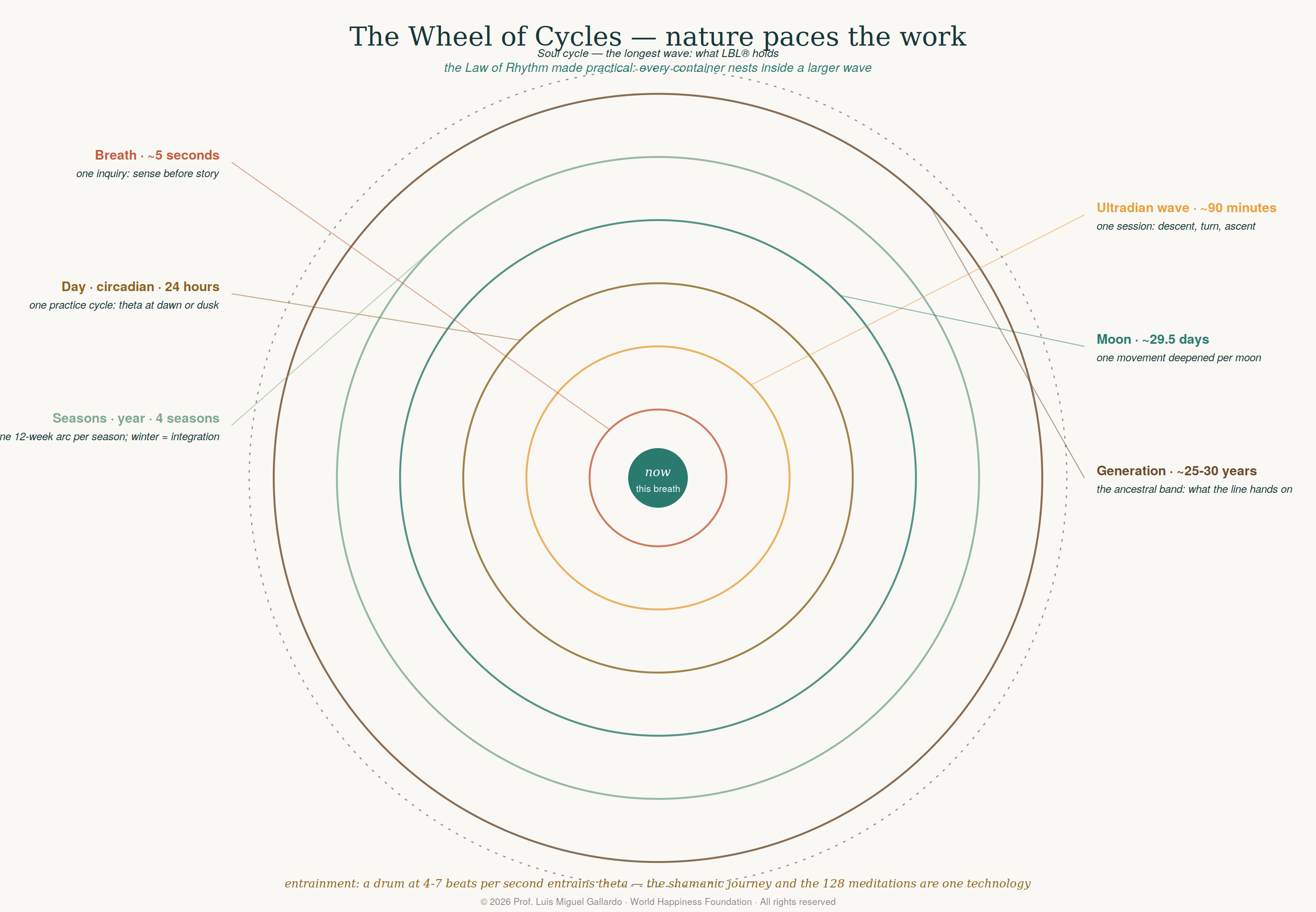
The Law of Rhythm, made practical, becomes a pacing architecture: every container of the work nests inside a larger natural wave. The breath paces the inquiry; the ultradian wave paces the session; the day paces practice (theta most accessible at the thresholds of dawn and dusk); the moon paces the deepening of a single movement; the year paces the twelve-week arcs — one per season, with winter honored as the integration season rather than pathologized as slowdown; the generation paces the ancestral band; and beyond it, the soul cycle names the longest wave, the one LBL® work holds. Relapse re-reads, one more time, as tide. Figure 2 assembles the wheel.
Figure 2. The Wheel of Cycles: nested natural rhythms — breath, ultradian wave, day, moon, season, generation, soul — as the pacing architecture of sessions, programs, and lifetimes.
3.3. Nature Contact as Modality
Beyond pacing, direct contact: attention restoration and stress-reduction findings on natural environments, the shinrin-yoku literature, and the simple clinical fact that anandamaya opens more easily under a sky. IAM adds nature immersion to the Modality Matrix (Section 7) with specific assignments: Repression met by walking until the body thaws; Denial met by sitting still in a living place until what was outrun arrives; Separation met — most directly of all — by the practiced remembering that one is inside the living world, not beside it. The ecological self of deep ecology names the endpoint: an identity whose boundary has widened until the Earth's flourishing is experienced as one's own.
4. The Three Worlds: From Supraconsciousness to the Underworld
Across an astonishing range of traditions — Siberian and Amazonian shamanisms, Norse cosmology's Yggdrasil, the Maya ceiba, the Vedic lokas — the vertical of reality is mapped as three worlds joined by one axis: an upper world of spirit and vision, a middle world of ordinary life, and a lower world of ancestors, roots, and the dead. IAM does not borrow this map as decoration; it recognizes it as isomorphic with the model's own frequency architecture, stated in the author's canon from the beginning: the Shadow is the subconscious pattern, the Gift its conscious activation, the Essence its superconscious realization. Underworld, middle world, upper world; subconscious, conscious, superconscious; Shadow, Gift, Essence — three vocabularies, one vertical. The roadmap's descent (Movements 1–4) is therefore katabasis, the underworld journey, and it stands in the oldest recorded lineage of human literature: Inanna's descent through the seven gates, stripped of every regalia — every I-am-this — until she hangs in the dark, and returns transformed. Orpheus, Persephone, the shaman's lower-world journey on the drum, the dark night of the mystics: the model's clients walk a path with four thousand years of maps, and telling them so is itself therapeutic — the descent stops being pathology and becomes pilgrimage.
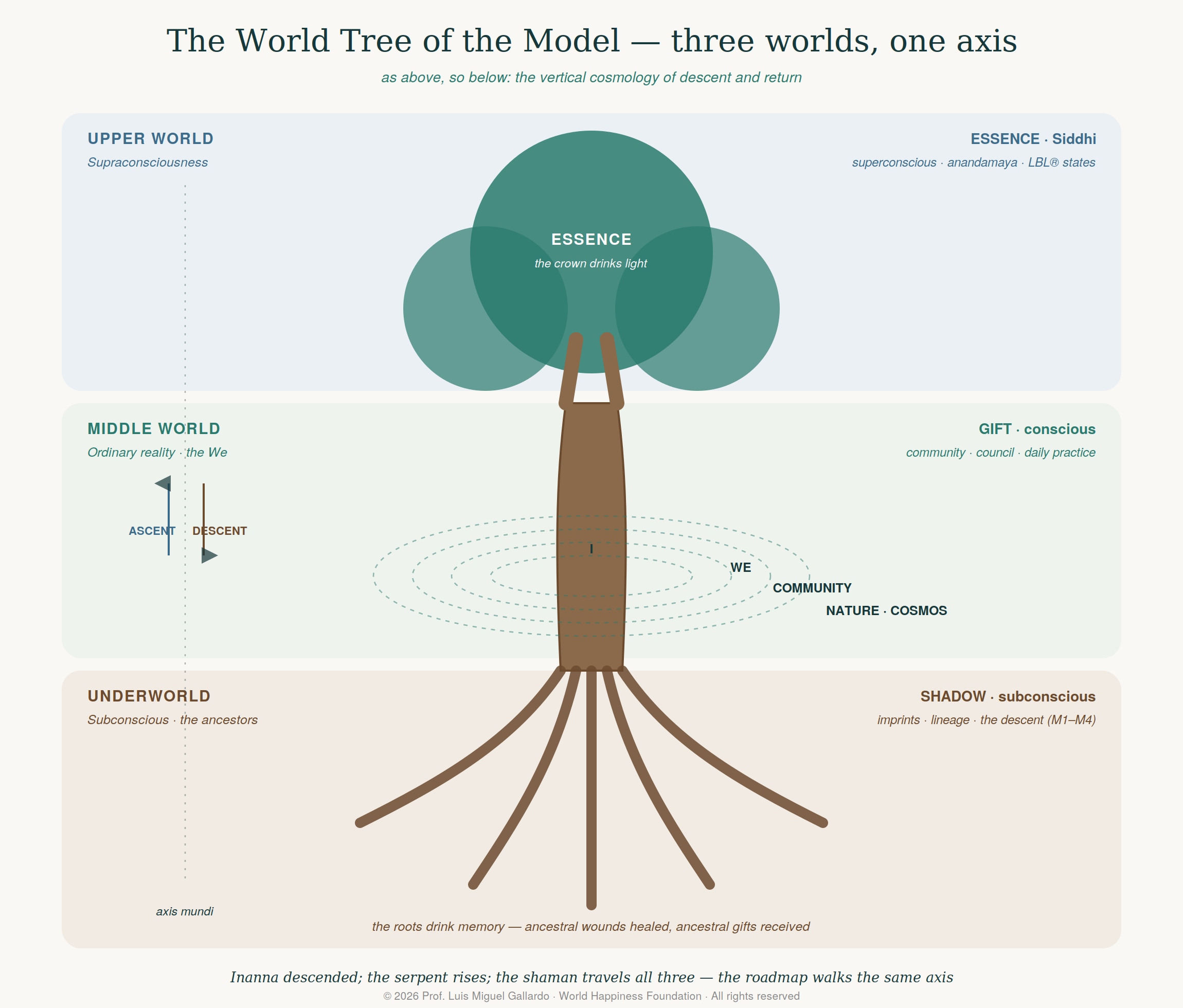
The upper reach completes the axis. Supraconsciousness — the superconscious band the Essence names — is accessed in the model through deep theta, through the Essence phase of every traversal, and, at the gated depth, through LBL® states, whose reports across thousands of documented sessions are structurally upper-world reports: guidance, life-purpose context, the perspective from above the incarnation. And the serpent, keeper of the author's wider canon, is the axis animal itself: kundalinī rising from the root, the plumed serpent Quetzalcóatl joining earth and sky, the Norse Níðhöggr at the root and the eagle at the crown of the same tree. The World Tree gathers the whole vertical in one image, and the We-rings of Section 2 circle its trunk: the middle world is where the community lives. And the Tree carries one more teaching, the most intimate of all: its trunk passes through every human heart. The Tree is not outside us, nor is it ours — it is the living bridge between Heaven, Earth, and Humanity, and every heart is a doorway through which the Source can be remembered.
Figure 1. The World Tree of the Model: underworld (Shadow, subconscious, ancestors) at the roots; middle world (Gift, conscious, the We) at the trunk; upper world (Essence, superconscious, supraconsciousness) at the crown — one axis, walked in both directions by the roadmap.
5. The Ancestors: Healing the Line, Receiving the Line
Paper III's imprint axis reached the ancestral band as a depth of pathology: transgenerational wounds requiring Level 3 work. That framing, this paper must say plainly, is half a relationship — and the poorer half alone. In the traditions that never severed the tie — the ancestor veneration of East Asia, the libations of West Africa, the ofrendas of Día de los Muertos, the Māori whakapapa in which a person introduces themselves by mountain, river, and lineage before their own name — the ancestors are not primarily a wound-source. They are a living presence: the root system of the tree, holders of accumulated gifts, allies of the descendants. IAM therefore makes the ancestral band bidirectional. Downward, the healing of the line proceeds as architected: transgenerational patterns met in trance, inherited affect returned to its origin with compassion, epigenetic findings on the biological inheritance of stress held as the scientific echo of what the traditions always taught — carefully framed, as ever, at the level of pattern rather than fate. Upward, the receiving of the line becomes practice: the ancestor honored by name; the altar or the photograph as anchor; the question asked in trance not only «what wound do I carry for you?» but «what strength do you hand me?»; the gifts of the lineage — its survivals, its crafts, its humor, its faith — claimed as inheritance. Movement 0 (Section 7) installs this at the threshold of every traversal, and Ho'oponopono, already in the Matrix, reveals its fuller identity here: in its Hawaiian origin it is family and ancestral reconciliation practice — making-right across the line — and the model credits it as such.
6. Two-Eyed Seeing: The Ethics of Integration
This paper draws on Nguni, Andean, Hawaiian, Mi'kmaw, Māori, Mesoamerican, and shamanic lineages, and a model that gathers such wealth owes more than citation; it owes an ethic. IAM adopts as its epistemic frame Etuaptmumk — Two-Eyed Seeing — offered by Mi'kmaw Elders Albert and Murdena Marshall: to see with one eye the strengths of indigenous knowledges, with the other the strengths of Western science, and to use both eyes together for the benefit of all. Two-Eyed Seeing is not synthesis-by-absorption; it insists the indigenous eye remains sovereign, whole, and uncollapsed into the scientific one. For IAM this yields five binding principles. Attribution: every practice and frame is named to its lineage — the drum to the shamanic traditions, Ho'oponopono to Hawai'i, Ubuntu to the Nguni Bantu, Buen Vivir to the Andes — in teaching, in publication, in the digital ecosystem. Consent and relationship: living ceremonial forms are not extracted into the Modality Matrix; what enters the model are either practices their traditions have explicitly offered outward, or structural parallels honored as parallels — and deeper engagement proceeds only in relationship with knowledge-keepers, as the Serpent Library's respectful-use protocol already models. Reciprocity and benefit-sharing: where indigenous frameworks inform programs, benefit flows back — partnership, co-authorship, revenue-sharing, and support for the communities' own priorities, in the spirit of the UN Declaration on the Rights of Indigenous Peoples. Non-costume: practitioners use the model's own forms (the roadmap, the Mandala, the theta meditations) rather than performing ceremonies of traditions not their own. And humility of frame: the model's mappings — three worlds to three frequencies, drum to theta — are offered as resonances honored, never as explanations that reduce the elder knowledge to the younger science. The distortion test of Paper II extends naturally: any use of indigenous wisdom that deepens a collective wound — extraction re-enacted as appropriation — is a distortion of the very Oneness it claims.
7. The Model Completed at Both Ends
7.1. Movement 0 — Arrival on the Land and in the Lineage
The roadmap now opens before it opens. Movement 0 precedes Movement 1 in every session and program: arrival in place — the land acknowledged, the body's contact with ground sensed, one breath entrained to the room and the world it sits in — and arrival in lineage — the silent naming of those whose lives made this life possible. In communal settings Movement 0 takes its traditional forms: the circle opened, the ancestors greeted, the land thanked. The movement costs two minutes and changes the ontology of everything after it: the work begins already in the We, already on the Earth, already accompanied. The full sequence thus runs 0 through 8 — from arrival to offering — and both ends now face outward.
7.2. Movement 8, Widened
Essence into Offering, Paper III's telos, widens its recipient. The offering completes not only toward other persons but toward the more-than-human world: the liberated energy of a healed Separation wound owes some of itself to the separation it mirrors at planetary scale. Service assignments in the twelve-week arc now include ecological forms — restoration work, land care, advocacy — and the Happytalist horizon states its full sentence: ten billion free, conscious, and happy people on a flourishing Earth, the FPI and the GPTM's planetary domain (D7) measuring both clauses.
7.3. Additions to the Modality Matrix and the States Table
| New Modality | Movements | Primary Wounds / Scale | Kosha / State | Lineage Credited |
|---|---|---|---|---|
| Nature immersion & sit practice | M0, M2, M5 | Separation, Denial, Repression | All koshas / alpha | Deep ecology; shinrin-yoku; universal land-based traditions |
| Drum & sound journey (4–7 Hz) | M3-M5 | All six | Anandamaya / theta | Shamanic traditions worldwide; credited as elder of the theta meditations |
| Ancestor honoring practice | M0, M5 | Ancestral band; Guilt, Separation | Vijñanamaya / alpha | East Asian veneration, West African libation, Día de los Muertos, whakapapa |
| Council & talking circle | M1-M2, M6 (communal) | Collective scale, all wounds | Manomaya / waking-alpha | Indigenous council forms; restorative circle practice |
| Communal ceremony & ritual | M5, M8 (communal) | Collective Turn; Separation | All koshas / alpha-theta | The community's own tradition — never a borrowed costume |
Table 2. Ecological and communal additions to the IAM Modality Matrix, each with its lineage credited — the attribution principle in table form.
The states table gains one row in kind: drum-entrained theta joins hypnotic induction and the seat-meditations as a third road into the plasticity window — the oldest of the three. And the relational vessel's gradient extends to its full length: dyad, circle, community, lineage, land.
8. The Cosmology of Remembering: The Ontology of the Whole
One thread has run beneath every paper of this series without yet being named as what it is: the entire model is a cosmology of remembering. The second paper's central thesis — each wound is a Law forgotten, each virtue that Law restored — was already the claim in miniature; this section states it whole, and in doing so joins the model to the oldest account the West possesses of why transformation is possible at all. In Plato's telling, the soul knows; incarnation veils; and all true learning is anamnesis — un-forgetting. The soldier Er, returning from the threshold of death at the close of the Republic, reports what souls do between lives: they review the life lived, choose the life to come, and drink from the river Lethe before birth — forgetting everything. The Orphic initiates were buried with gold tablets instructing the soul, at that same threshold, to refuse the waters of forgetfulness and drink instead from the pool of Mnemosyne: Memory. The choice between the two rivers is the oldest statement of this model's work.
8.1. Forgetting as the Price of Incarnation
Why is there anything to remember? Because forgetting is the price — and, the traditions insist, the agreed condition — of incarnation. The density of physical existence is a limit; the veil that accompanies birth is a limit; the conditioning of family, culture, trauma, and belief is a limit: all of them constraints the soul works within and, ultimately, transcends. Sri Aurobindo described the soul as a divine spark maturing through the experiences of many lifetimes into the psychic being — an entity growing more conscious and capable with each incarnation of carrying light into the dense material plane. Read through this cosmology, the model's strata reorganize themselves: the wounds are not damage but the architecture of the forgetting — six characteristic ways the veil thickens into I am not — and the conditioned field of scarcity, hierarchy, and separation is the forgetting operating at civilizational scale. Soul work, as the author has defined it elsewhere, is the conscious process of recognising, meeting, and dissolving the barriers between the incarnated self and its deeper essence: which is to say, every traversal of the roadmap is soul work, and every virtue is an act of anamnesis.
8.2. LBL® as Clinical Anamnesis
The lineage has a contemporary clinical form. Life Between Lives regression — the deep-hypnosis modality this series gates at its furthest depth — guides clients into territory strikingly continuous with Er's report: the interlife, where the purpose of an incarnation, the architecture of soul relationships — soul groups, learning agreements, purpose themes — and the intention behind a life can be consciously remembered, with remarkable consistency across thousands of documented sessions worldwide. The model holds this material exactly as its EUROTAS formulation states: as a contemporary mystery practice, a clinical anamnesis, with ontology bracketed and phenomenology honored — myth gives the work its map; research gives it its accountability, from the 241-study regression evidence base to the University of Zaragoza LBL protocol comparing believers and sceptics under identical conditions. And the author's own documented session — the encounter recorded as «Dancing with Stardust», in which the categories of self and other, inner and outer, personal and cosmic became transparent and a life's thread showed itself held within a larger intelligence — stands in the series as what first-person evidence honestly can be: not proof, but the reason the maturity pathway stopped being theory and became cellular.
8.3. The Field of Remembering
Remembering is not private. The series' fourth dimension of relation — dyad, circle, community, lineage, land — carries a field claim the collective-consciousness research tradition has begun to instrument: consciousness behaves as a field phenomenon, and the quality of consciousness present in a system shapes what that system can perceive, create, and sustain. This is the deep mechanism of the circle's power in Section 2, of the Guides' collective sessions — whose harvested themes independently converged on the very teaching this section names: people are already whole, and remembering this makes them less reactive — and of the arts as remembering technologies. Story, mantra, music, and ceremony are not decorations of the model but among its oldest instruments: the author's literary and musical cycle names itself explicitly a field for remembering, its books «books that remember you to yourself» — and every culture's ceremony has done the same work, entraining a community into the state where what was always true becomes, briefly and then more durably, felt.
8.4. Maturity as Depth of Remembering
The cosmology also re-reads development. The maturity pathway of the author's leadership canon — Ambassador, Catalyst, Fire Keeper, Wisdom Elder — is, in its own words, a scale of remembering: the Ambassador is at the beginning of remembering; the Catalyst has remembered enough to practice; the Fire Keeper's remembering has become steady enough to hold others; and the Wisdom Elder's remembering is so stable that they can afford to forget themselves — the ego resting in the background while purpose moves through without obstruction. The correspondence with this series is exact: the ITM's five stages are depths of remembering, the practitioner pathway's three levels are licenses to accompany others only as deep as one's own remembering reliably reaches, and the Elder's self-forgetting names the paradoxical summit at which I AM has been remembered so completely that it no longer needs asserting — the point where I AM and WE ARE stop being two statements.
8.5. Therapy and Coaching as the Remembering Arts
The cosmology finally renames the practice itself. If wholeness is inherent and forgetting is the condition, then nothing in this model fixes anyone: therapy and coaching are the remembering arts, and the roadmap is guided anamnesis. Each movement re-reads accordingly. Movement 0 remembers land and lineage; Movements 1–3 remember what was felt and concluded and buried; Movement 4 remembers what was never actually severed; the Turn is Mnemosyne's pool — the moment the soul refuses Lethe; Movements 6–7 remember the Gift and Essence that predated the wound; and Movement 8 remembers forward — the purpose an incarnation intended, recalled and enacted as offering. The remembering is the work. The remembering is the medicine.
8.6. The Source, the Field, and the Practice Worn Smooth
The cosmology completes with three namings, drawn from the author's foundational invitation «The Remembering», that give the model its plainest language — the language a village can use. The first is the Source: before there were methods, religions, or nations, there was Life — a living intelligence moving through rivers, trees, animals, stars, and human hearts. Every tradition has tried to describe it — Love, Spirit, God, Great Mystery, Consciousness, Nature — and the model deliberately keeps the trans-traditional name, because names matter less than the experience, and because the claim beneath all four papers can now be said in one line: the Source has never disappeared; only our awareness of it has. This is the cosmology's final restatement of the wound stratum — awareness lapsed, not connection severed — and of the work: our task is not to produce light, for we are already light; our task is to keep the path clear.
The second naming is the Field: the invisible web of relationship connecting every living being — the phenomenon Section 8.3 approached through research, here named directly as the object of tending. The invitation specifies its nourishments, and the model receives them as the Field's own modality list, complete alongside the clinical one: presence, truth, beauty, compassion, song, silence, movement, laughter, grief, shared meals, service, remembering. Every loving act strengthens the Field; every conscious breath nourishes it; every awakened heart expands it. And the Field carries the model's deepest teaching about how transformation scales: remembering is contagious. Presence awakens presence; peace awakens peace; courage awakens courage; love awakens love. Transformation does not spread by convincing — it spreads through coherence; the Field teaches what words cannot. This is the Law of Vibration in its final, communal form, and it re-grounds the entire telos: healing is not the destination. We tend our wounds not to become perfect but to become available — available for the work that is larger than any individual, which is the tending of the Field itself. And it names why the circle exists at all: we gather not because the world is broken, but because remembering is easier together — and we do not gather to escape the world, but to return to it more fully alive, more awake, more loving, more rooted, more free.
The third naming is the practice itself, and it is deliberately simple — the form the entire nine-movement roadmap takes when it has been walked so many times that the scaffolding dissolves and only the arc remains: Shadow into Gift, Gift into Essence. In the Mandala's own five gestures, walkable by anyone, daily, like breath: name the Shadow; feel it before the story; find the Gift inside it; touch the Essence beneath it; act with love. Nothing to fix — everything to transmute; from suffering to flourishing, one heart at a time. With this comes the governance ethic the whole model now adopts as constitutional: no one owns the Flame, no one owns the Tree, no one owns the Source. This work follows no person; it orients toward the Living Source, and those who have walked longer become not authorities but caretakers — not above others, simply closer to the fire, responsible for keeping it alive so that anyone who arrives may find warmth. The Fire Keeper of the maturity pathway is revealed as exactly this office, and the practitioner levels of the whole series are re-read accordingly: gates of responsibility, never ranks of ownership. What is being built, finally, is not an organization but a living ecosystem of consciousness — a place where people remember who they are, where love becomes visible, and where the Field remains alive. The three duties of everyone who tends it: tend the Tree, protect the Flame, nourish the Field.
9. Limitations and the Partnership Research Program
The claims of this paper divide, as ever, by register. The entrainment and chronobiology findings, the nature-contact literature, and the transgenerational-stress research are empirical terrain with active scientific debate, engaged here at the level of established effect rather than mechanism-certainty. The three-worlds isomorphism and the Laws-in-nature reading are contemplative framings — resonances honored, per Section 6, not reductions. The research program this paper adds is distinctive in method as much as topic: community-scale trials of the collective wound-virtue grammar (the Rajasthan design extended to council- and ceremony-based arms); nature-dose studies within the twelve-week arc; and — under Two-Eyed Seeing — partnership research with indigenous communities in which questions, methods, ownership, and authorship are shared from design onward, evaluated by the communities' own measures of right relation alongside the FP20 and FPI. The digital expansion follows the same ethic: the Lovable build of this paper's layer — the We-scale Compass for teams and communities, the Wheel of Cycles as a pacing engine, the ancestor and land practices in the practitioner portal — ships with lineage attributions rendered on every screen.
10. Conclusion
Four papers now, and the arc they draw is itself the teaching — and its true name, visible at last, is the one the canon carried all along: a cosmology of remembering. The first mapped the wounds of the one; the second found the laws that move them; the third gathered everything a practitioner needs to walk one person home to I am. This fourth paper lets the sentence finish the way most of humanity, for most of history, would have finished it. The person is a person through other persons. The Laws were the Earth's before they were anyone's text. The descent every client makes was first made through seven gates in Sumer, and the drum that carries it was tuned to theta millennia before theta had a name. The ancestors are not only where the wounds come from; they are where half the gifts come from. And the crown of the tree drinks light only because the roots drink memory. I am because we are. We are because Earth is. The alchemy was never individual; it only ever began there. And it was never repair: the wounds were the forgetting, the virtues are the remembering, and the model’s whole apparatus — laws and koshas, states and cycles, councils and drums, ancestors and trees — exists so that a soul who drank from Lethe may find its way, accompanied, to the other pool. The remembering is the work. The remembering is the medicine.
Hear this, keepers of the small flame: the Tree does not need your tending — it needs your listening. The Flame does not ask to be protected — it asks to be recognised. The Field does not wait for your care — it waits for your return. Remember, and you are already home; and where one soul remembers, a thousand wake beside it.
«Fundamental Peace is not the absence of pain... it is the transmutation of its energy into love and compassion.» — Luis Miguel Gallardo
References
Aurobindo, S. (1939/2005). The life divine. Sri Aurobindo Ashram Press.
Bartlett, C., Marshall, M., & Marshall, A. (2012). Two-Eyed Seeing and other lessons learned within a co-learning journey of bringing together indigenous and mainstream knowledges. Journal of Environmental Studies and Sciences, 2, 331–340.
Berry, T. (1999). The great work: Our way into the future. Bell Tower.
Eliade, M. (1964). Shamanism: Archaic techniques of ecstasy. Princeton University Press.
Gallardo, L. M. (2026). From Wound to Essence; The Physics of the Soul; I AM: The Integrative Alchemy Model. World Happiness Foundation. [Papers I–III of this series]
Gallardo, L. M. (in press). Emotional alchemy in rural India: The Meta Pets Method as a community-based pathway to emotion regulation and Fundamental Peace.
Gallardo, L. M., & Chetri, S. (2026). Fundamental Peace. Behavioral Sciences, 16(3), 395.
Gudynas, E. (2011). Buen Vivir: Today's tomorrow. Development, 54(4), 441–447.
Kaplan, R., & Kaplan, S. (1989). The experience of nature: A psychological perspective. Cambridge University Press.
Kimmerer, R. W. (2013). Braiding sweetgrass: Indigenous wisdom, scientific knowledge, and the teachings of plants. Milkweed Editions.
Kramer, S. N., & Wolkstein, D. (1983). Inanna, queen of heaven and earth: Her stories and hymns from Sumer. Harper & Row.
Lehrer, P. M., & Gevirtz, R. (2014). Heart rate variability biofeedback: How and why does it work? Frontiers in Psychology, 5, 756.
Li, Q. (2018). Shinrin-yoku: The art and science of forest bathing. Penguin.
McCraty, R., & Zayas, M. A. (2014). Cardiac coherence, self-regulation, autonomic stability, and psychosocial well-being. Frontiers in Psychology, 5, 1090.
Naess, A. (1973). The shallow and the deep, long-range ecology movement. Inquiry, 16(1), 95–100.
Neher, A. (1962). A physiological explanation of unusual behavior in ceremonies involving drums. Human Biology, 34(2), 151–160.
Newton, M. (1994). Journey of souls: Case studies of life between lives. Llewellyn Publications.
Plato. (ca. 375 BCE/1992). Republic (G. M. A. Grube, Trans.; Book X, the Myth of Er). Hackett.
Tutu, D. (1999). No future without forgiveness. Doubleday.
United Nations. (2007). United Nations Declaration on the Rights of Indigenous Peoples.
Yehuda, R., & Lehrner, A. (2018). Intergenerational transmission of trauma effects: Putative role of epigenetic mechanisms. World Psychiatry, 17(3), 243–257.