I AM
The Integrative Alchemy Model — The Complete Architecture for Transpersonal Therapy and Coaching
Prof. Luis Miguel Gallardo
World Happiness Foundation · Yogananda School of Spirituality and Happiness, Shoolini University · Chair in Contemplative Sciences, University of Zaragoza · Institute of Interpersonal Hypnotherapy · Michael Newton Institute (LBL®)
Paper III of the trilogy, completing «From Wound to Essence» (anatomy) and «The Physics of the Soul» (dynamics)
Abstract
Two companion papers established, respectively, the anatomy of transformational work — six wounds, eleven emotion families, and sixty-four archetypal shadows, traversed by a seven-movement inquiry roadmap — and its physics, the Twelve Universal Laws as the dynamics by which wounds form, persist, and transmute. This third and final paper completes the system into the Integrative Alchemy Model (IAM): a whole architecture for transpersonal therapy and coaching. Seven additions close the gaps a complete model requires. First, a somatic stratum: the five koshas of Vedic psychology are mapped to the six wounds, locating each wound in its sheath of residence and specifying its bodily door of entry. Second, a states-of-consciousness dimension: each movement of the roadmap is assigned its vehicle state, from waking attention through alpha mindfulness and alpha-theta trance to deep theta — where the Fundamental Peace neurocognitive model locates the experiential plasticity window that makes the Turn possible — and, at the deepest gate, soul-level states accessed through Life Between Lives® regression. Third, a temporal imprint axis: wounds are located on a depth-of-contraction timeline from adult life through childhood, pre- and perinatal experience, ancestral transmission, and soul-level patterning, each depth indicating its regression modality and practitioner gate. Fourth, the Modality Matrix — the model's clinical centerpiece — cross-referencing fourteen modalities against movements, wounds, koshas, states, and setting, answering the practitioner's perennial question of which tool, when. Fifth, the relational field: the dyad and the circle are architected as transmutation vessels, with practitioner reflexivity and collective alchemy as structural requirements rather than adjuncts. Sixth, a measurement loop closing the system on itself through the Wound-to-Essence Compass, the FP20, and the GPTM/FPI. Seventh, a telos: an eighth movement — Essence into Offering — completes the wounded-healer arc, maps the six healing virtues one-to-one onto the six ROUSER pillars, and connects individual integration to the civilizational project of Happytalism. Program architecture (session template, twelve-week arc, three-level practitioner pathway), ethics, and a research program are specified. The model's name is its thesis: what remains when the alchemy completes is the unconditioned statement of being — I am.
Keywords: Integrative Alchemy Model, transpersonal therapy, coaching, koshas, states of consciousness, hypnotic regression, Life Between Lives, modality matrix, relational field, wounded healer, ROUSER, Fundamental Peace, Happytalism
1. Introduction: Completing the Trilogy
The first paper of this trilogy answered the question of structure: what is the architecture of human contraction and liberation? The second answered the question of dynamics: by what laws does that architecture move? The present paper answers the final question, which is the practitioner's: what is everything I need — and nothing I do not — to accompany a human being through this territory, in a coaching room or a therapy room, in one session or across a year, alone or in a circle, from the first complaint to the moment their healing becomes someone else's medicine?
Reviewed against that standard, the two-paper system showed seven precise gaps. It had no somatic stratum, though wounds live in bodies before they live in stories. It had no dimension of consciousness states, though the difference between an insight in waking conversation and the same insight in deep theta is the difference between information and transformation. It had no temporal axis, though where a wound was contracted — this decade, this childhood, this womb, this lineage, or deeper — determines how far down the work must reach. It had no modality matrix, though the mature practitioner's art is precisely the matching of tool to moment. Its relational field was implicit, though nothing in this territory transmutes outside of relationship. It had instruments but no measurement loop. And its arc ended at Essence, as if the point of becoming whole were to stop there. The Integrative Alchemy Model closes all seven gaps, and in doing so earns a name. IAM abbreviates Integrative Alchemy Model; it also states the model's destination. Every wound examined in this trilogy is, finally, a qualification appended to being — I am not safe, I am not seen, I am not enough, I am not wanted, I am indebted, I am alone. What remains when the alchemy completes is the statement without qualification.
1.1. The Seven Dimensions at a Glance
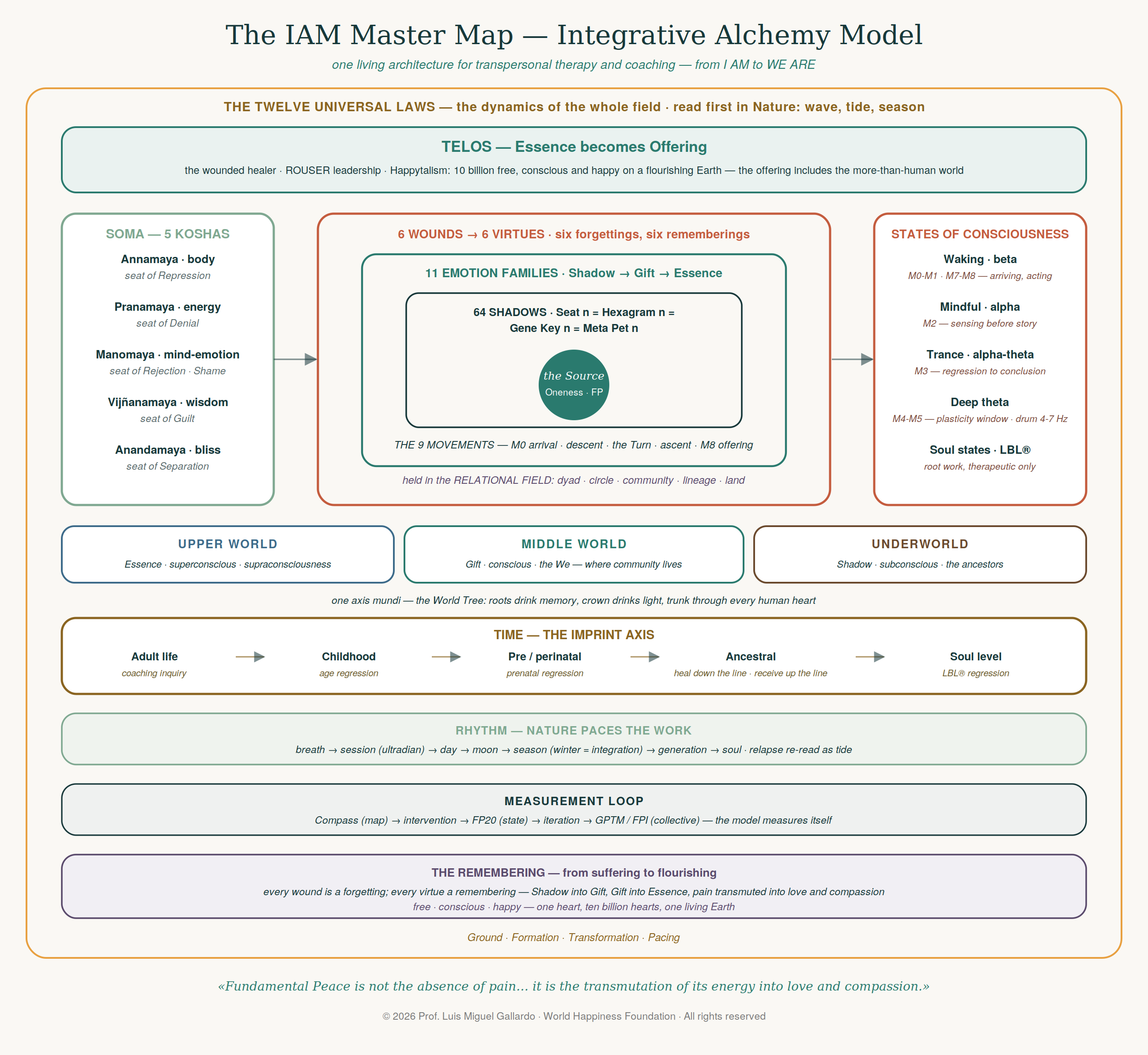
IAM organizes everything the trilogy has built, plus this paper's additions, into seven dimensions of one architecture. Depth: the three strata — wounds, families, shadows — with the seven-movement roadmap as their traversal. Dynamics: the Twelve Universal Laws in their four functions. Soma: the five koshas as the wounds' sheaths of residence. States: the consciousness vehicle of each movement. Time: the imprint axis from adult life to soul level. Relation: the dyadic and collective vessels in which all of it occurs. Telos: the eighth movement, from Essence into Offering. A measurement loop closes the system on itself. Figure 1 assembles the whole.
Figure 1. The IAM Master Map (shown in its completed series form): the dimensions of one architecture — Telos (top), Soma and States flanking the three strata and roadmap, the imprint axis of Time, the measurement loop, all within the field of the Twelve Laws.
2. Soma: The Kosha Stratum
Vedic psychology's pañcha-kośa model describes the human being as five nested sheaths: annamaya (the physical body of food), pranamaya (the energy body of breath), manomaya (the mental-emotional body), vijñanamaya (the wisdom body of discernment), and anandamaya (the bliss body, nearest the Self). IAM's somatic thesis is that each wound has a sheath of primary residence — the layer of the person where its contraction is actually held and where, therefore, the work must physically land. The mapping exhibits the same quiet elegance the trilogy has met before: five sheaths receive six wounds, with manomaya housing two — Rejection and Shame, the two verdict-wounds — just as the Shame/Guilt emotion family straddles two wounds in the first paper's architecture.
| Kosha (Sheath) | Wound in Residence | How the Contraction Is Held | Somatic Door of Entry |
|---|---|---|---|
| Annamaya — physical body | Repression | Frozen affect stored in tissue: chronic bracing of jaw, shoulders, diaphragm, gut; numbness as muscular event | Somatic anchoring, body scan, movement, breath directed into sensation; the feeling is found in the body before it is named |
| Pranamaya — energy body | Denial | Vital energy displaced into stimulation, craving, and busyness; breath shallow, scattered, or held | Pranayama — nadi shodhana, bhramari, coherent breathing; when breath steadies, what was outrun arrives |
| Manomaya — mental-emotional body | Rejection · Shame | Verdicts, judgments, and self-attack running as thought-emotion loops; the inner critic and the inner exile | Parts and Gestalt dialogue, narrative externalization, the Mandala micro-protocol; the verdict is met as a voice, not a truth |
| Vijñanamaya — wisdom body | Guilt | The ledger held as belief-structure at the level of discernment itself: a distorted law installed where wisdom should preside | Contemplative inquiry, discernment practice, structured forgiveness work (including Ho'oponopono); the law is corrected where it is written |
| Anandamaya — bliss body | Separation | The veil: bliss and belonging present but unperceived; the sheath nearest the Self experienced as empty | Deep trance, theta meditation, LBL® states, Oneness contemplation; not repair but remembrance |
Table 1. The kosha stratum: each wound's sheath of residence, the form its contraction takes there, and its somatic door of entry.
The clinical consequence is directional: enter through the sheath where the wound lives. A Repression pattern approached through conversation alone produces articulate clients with unchanged bodies; it must be met at annamaya first. A Separation wound approached through cognitive reframing produces understanding without belonging; anandamaya opens only in depth states. The kosha stratum thus does for the vertical of embodiment what the wound stratum did for the vertical of psyche — it tells the practitioner where to knock.
3. States: Consciousness as Vehicle
The same inquiry lands differently in different states of consciousness, and the difference is not stylistic but neurological. The Fundamental Peace neurocognitive model describes the mechanism: in ordinary waking cognition the default mode network's self-referential loops defend the very patterns under examination; in hypnotic and contemplative states, DMN activation quiets, executive-salience coupling strengthens, and an experiential plasticity window opens in which habitual self-patterns become less binding and new regulatory pathways accessible. IAM operationalizes this by assigning each movement of the roadmap its vehicle state — the state in which that movement's work actually takes.
| State (Band) | Movements Carried | Neural Signature | Practices That Induce It |
|---|---|---|---|
| Waking attention (beta) | M1 (naming the pattern) · M7-M8 (action, offering) | Ordinary task-positive cognition; DMN and narrative self online | Structured conversation, Meta Pets card selection, commitment rituals |
| Mindful presence (alpha) | M2 (sensing before story) | Early DMN quieting; interoceptive attention rising | Five-breath grounding, body scan, the Mandala's «sense before story» step |
| Light-to-medium trance (alpha-theta) | M3 (descent to the conclusion) | Deepening DMN release; heightened absorption and memory access | Hypnotic induction, guided regression to the imprint, parts dialogue in trance |
| Deep trance (theta) | M4 (the root) · M5 (the Turn) | The plasticity window: DMN minimal, ECN-SaN coupled; suggestion and re-decision land at depth | Deep hypnosis, the 128 theta meditations, transmutation and Essence anchoring at the Turn |
| Soul-level states | M4 at the Separation floor, when indicated | Profound absorption states of the LBL® protocol; therapeutic container only | Life Between Lives® regression by certified facilitators |
Table 2. States as vehicles: each roadmap movement's consciousness band, its neural signature per the Fundamental Peace model, and its induction practices.
Two rules govern the dimension. Depth of state follows depth of movement: the descent deepens the state as it deepens the inquiry, and the ascent returns the client, movement by movement, to waking agency — a session that opens theta must close beta, with the micro-action as the re-entry vehicle. And state is gated by training: every practitioner may work the waking and alpha bands; the trance bands belong to hypnotherapeutic training; the soul band to certified LBL® facilitation within therapeutic containers — the gates formalized in the practitioner pathway of Section 9.
4. Time: The Imprint Axis
Wounds are contracted at moments, and the moment determines the depth of the work. IAM's temporal dimension locates every presenting pattern on an imprint axis running from adult life backward through childhood, pre- and perinatal experience, ancestral transmission, and soul-level patterning. The axis is not speculative ornament: hypnotic age regression rests on a substantial clinical evidence base — the author's synthesis of 241 studies in the American Journal of Clinical Hypnosis — and each deeper reach corresponds to an established modality with its own training gate. The practitioner's diagnostic question is simple: when the client touches the wound in Movement 3, how old are they? The answer — spoken, or visible in posture and voice — indicates the depth.
| Imprint Depth | Indication Markers | Modality of Reach | Practitioner Gate |
|---|---|---|---|
| Adult life | The conclusion dates to a nameable adult event; affect proportionate; narrative access intact | Coaching inquiry; the roadmap in waking and alpha bands | Level 1 — Alchemy Coach |
| Childhood / adolescence | Age-shift in voice or posture at M3; the conclusion is a child's logic; «I've always been this way» | Hypnotic age regression to the imprint scene; re-decision and resource installation | Level 2 — Integrative Practitioner |
| Pre / perinatal | Pre-verbal, somatic-global patterns; themes of welcome, safety of existence, separation at the threshold of life | Prenatal and birth regression within clinical hypnotherapy | Level 3 — Transpersonal Therapist |
| Ancestral / transgenerational | The pattern precedes the person: family repetitions, inherited affect, loyalty to unlived lives | Transgenerational and systemic work; ancestral healing within trance | Level 3 — Transpersonal Therapist |
| Soul level | The Separation floor itself; existential patterns without biographical anchor; readiness and explicit request | Life Between Lives® regression | Level 3 + LBL® certification |
Table 3. The imprint axis: depth of contraction, its clinical markers, the modality that reaches it, and the training gate that governs access.
The axis integrates with the Laws: Cause and Effect operates across all five depths — including, in the ancestral band, across generations — and the Law of Rhythm cautions that depth is approached in spirals, not plunges: a client may need three passes at the childhood band before the perinatal layer is ready to be met. The deepest bands remain, as everywhere in this trilogy, invitation-only territory: the practitioner proposes nothing the client has not moved toward.
5. The Modality Matrix: Which Tool, When
The mature practitioner's art is matching. IAM's clinical centerpiece is therefore a single cross-reference answering the question every training eventually confronts: given this client, this movement, this wound, this sheath, and this state — which instrument? Fourteen modalities, all present in the author's practice canon, are matrixed below. The matrix is read diagnostically in either direction: from the modality (what is this tool actually for?) or from the moment (what does this moment actually need?). Settings are marked C (coaching), T (therapy), or C/T.
| Modality | Movements | Primary Wounds | Kosha / State | Best For | Setting |
|---|---|---|---|---|---|
| Meta Pets card work | M1, M6 | All six | Manomaya / waking-alpha | Naming without defense; imaginal entry | C/T |
| Mandala micro-protocol (5 steps) | M1-M2, M5-M7 | All six | Manomaya-annamaya / alpha | Self-guided and session alchemy | C/T |
| Pranayama (nadi shodhana, bhramari) | Arrival, M2 | Denial, Repression | Pranamaya / alpha | State-shifting; energy retrieval | C/T |
| Somatic anchoring | M2, M6-M7 | Repression | Annamaya / alpha | Finding frozen affect; landing Essence in body | C/T |
| Hypnotherapy (suggestion, anchoring) | M5-M6 | All six | All koshas / theta | The Turn; Essence installation at depth | T |
| Age regression | M3 | Shame, Rejection, Guilt | Manomaya / alpha-theta | Reaching the childhood imprint; re-decision | T |
| Pre/perinatal regression | M3-M4 | Separation, Repression | Annamaya-anandamaya / theta | Pre-verbal, existence-level imprints | T |
| Life Between Lives® | M4 | Separation | Anandamaya / soul states | The Separation floor; soul-level context | T |
| Parts & Gestalt dialogue | M2-M3, M6 | Shame, Rejection | Manomaya / alpha-theta | Verdict voices; Shadow-Gift-Essence trialogue | C/T |
| Narrative externalization | M1, M3 | Shame, Guilt | Manomaya / waking | «The worry that follows me»; re-authoring | C/T |
| Creative arts & craft practice | M6-M7 | Repression, Denial | Annamaya-pranamaya / alpha | Embodying Essence in made things | C/T |
| Theta meditations (128, per seat) | M5-M6, between sessions | All six | Anandamaya / theta | Deepening the seat-specific arc at home | C/T |
| Ho'oponopono / forgiveness protocols | M5 | Guilt, Rejection | Vijñanamaya / alpha | Closing ledgers; relational transmutation | C/T |
| Service assignment (karma yoga) | M8 | Separation, Guilt | All koshas / waking | Essence into Offering; the wounded-healer completion | C/T |
Table 4. The IAM Modality Matrix: fourteen modalities cross-referenced by movement, wound, kosha and state, indication, and setting.
6. The Relational Field: Dyad and Circle as Vessels
Nothing in this territory transmutes outside relationship. The alchemists knew that transformation requires a sealed vessel; in IAM the vessel is relational, and it takes two canonical forms. The dyad — practitioner and client — is the first vessel, and its operative mechanisms are already named in the Integrative Transformation Model as Compassionate Witnessing and Relational Mirroring: the practitioner's regulated nervous system lends the client a temporary second regulatory circuit (co-regulation), and the practitioner's undefended presence models the very relationship to experience the client is learning to extend to themselves. This carries a structural obligation the model states without softening: the practitioner must have walked their own descents. A practitioner who has not met their own Rejection wound will unconsciously steer clients away from anger; one who has not closed their own ledgers will collude with a client's guilt. Reflexive practice — the practitioner's own Compass, their own traversals, and supervision within a community of practice — is therefore not professional development but load-bearing architecture. The transference field is read through the same map: what the client constellates in the practitioner, and the practitioner in the client, is Correspondence operating inside the vessel, and it is diagnostic material of the first order.
The circle is the second vessel, and it is more than a scaled dyad. Group work adds dynamics the dyad cannot: witnessing before many (the direct antidote to Shame, whose wound is the fear of being seen), belonging in practice (the lived refutation of Rejection and Separation), and resonance — the Law of Vibration operating collectively, in which one member's Turn perceptibly shifts the field for all. The author's Guides' Collective Wisdom Sessions, in which trained facilitators enter deep states together and harvest shared themes, stand as the developed form of collective alchemy, and the community-scale deployments of the Mandala in Rajasthan demonstrate the circle's furthest extension: the village itself as vessel. IAM formalizes the gradient — dyad, circle, community — as the Relation dimension, and notes its law: the vessel must be sealed (confidentiality, consent, container) in proportion to the depth of the work it holds.
7. The Measurement Loop: The Model That Measures Itself
A complete model closes its own feedback loop. IAM wires its instruments into a cycle in which every intervention generates the data that refines the next. The Wound-to-Essence Compass supplies the map at intake — wound profile with polarity, primary family, chosen seat — and its retake at program's end renders change visible in the client's own architecture. The FP20 measures the state outcome — Fundamental Peace itself, on the four pillars — at intake, mid-arc, and completion. Session-level markers track process: the somatic settling that confirms a wound named truly, the kind laugh that marks Humour's arrival, the completed micro-action that certifies each ascent. And at the collective scale, the GPTM and the FPI (100 − GPTM) locate every individual traversal within the population-level field, connecting the coaching room to the Observatory. The loop is also the model's research engine: anonymized, consented Compass-FP20 pairs across programs constitute exactly the convergence dataset the trilogy's validation agenda requires.
| Instrument | What It Measures | Stratum / Scale | Cadence |
|---|---|---|---|
| Wound-to-Essence Compass | Wound profile + polarity, primary family, primary seat | All three strata / individual | Intake and completion |
| FP20 | Fundamental Peace state across the four pillars | Outcome / individual | Intake, mid-arc, completion |
| Session markers | Settling, resonance, the Turn, micro-action completion | Process / session | Every session |
| GPTM / FPI | Pain-trauma load and Fundamental Peace Index | Collective / population | Program cohorts; Observatory |
Table 5. The measurement loop: instruments, targets, scales, and cadence.
8. Telos: The Eighth Movement — Essence into Offering
The trilogy's roadmap ended, until now, at Movement 7: Essence touched, micro-action committed. IAM completes the arc with an eighth movement, and thereby corrects the subtle self-enclosure that haunts all healing work: the assumption that wholeness is for the one becoming whole. Movement 8 — Essence into Offering — asks the completing question: now that this energy is liberated, whom does it serve? The archetype is ancient: the wounded healer, Chiron's lineage and Jung's, in which the healed wound becomes the precise medicine one can offer others — the formerly shame-bound practitioner who can sit with anyone's humiliation unflinching, the survivor of the Separation floor who can accompany the dying. In IAM this is not sentiment but mechanism: by the Law of Compensation, Essence given returns multiplied; by Correspondence, one person's integration propagates through every system they touch; and by Oneness, the distinction between healing oneself and healing the field was provisional from the start.
The movement has an exact leadership expression. The six healing virtues map one-to-one onto the six ROUSER pillars — the moment, discovered in composing this paper, at which the trilogy's clinical architecture and the author's leadership architecture are revealed as one system: Gentleness, the healed Rejection wound, becomes Relations; Honesty, the healed Repression, becomes Openness; Forgiveness, the healed Guilt, becomes Understanding; Humour, the healed Shame, becomes Self-Awareness; Care, the healed Separation, becomes Empowerment — the lifting of others as love's organizational form; and Ease, the healed Denial, becomes Reflection — the capacity to look at what is without flinching. A leader is, in IAM's definition, a person whose virtues have become pillars. Scaled fully, Movement 8 is Happytalism itself: ten billion traversals of the same arc, with Fundamental Peace as the attractor and the FPI as the compass.
| Healing Virtue (Wound) | ROUSER Pillar | The Virtue as Leadership Capacity |
|---|---|---|
| Gentleness (Rejection) | Relations | Firm boundaries in a soft voice; no one excluded from the table one now hosts |
| Honesty (Repression) | Openness | Transparency that begins with one's own interior; cultures where truth is speakable |
| Forgiveness (Guilt) | Understanding | Ledgers closed; others met in their context rather than judged from one's debt |
| Humour (Shame) | Self-Awareness | The lightness to see oneself accurately; feedback received without collapse or armor |
| Care / Love (Separation) | Empowerment | Others lifted as the natural act of connection; power held with, never over |
| Ease (Denial) | Reflection | Reality faced without resistance; the pause that lets what is teach what's next |
Table 6. The telic mapping: six healing virtues become the six ROUSER pillars — the clinical and leadership architectures revealed as one.
9. Program Architecture
9.1. The Session Template (75–90 minutes)
A standard IAM session runs the roadmap inside the Meta Pets Method's five-phase container, with states deepening and returning symmetrically: arrival and attunement with breath (10 minutes, alpha); Movements 1–2, naming and locating (15, alpha); Movement 3 and, where contracted and gated, 4 — the descent (20–25, alpha-theta to theta); Movement 5, the Turn, with Essence anchoring (10–15, theta); Movements 6–7, ascent, Gift articulation, micro-action (15, returning to beta); closing seal — the vessel named closed, the micro-action spoken aloud (5, beta). Movement 8 enters the template from mid-program onward as the standing final question: whom did this week's liberated energy serve?
9.2. The Twelve-Week Arc
The program form mirrors the field-tested Happiness Ritual's four-phase, twelve-week structure, now carried by the complete model:
| Phase (Weeks) | Focus | Primary Movements & Modalities | Measurement |
|---|---|---|---|
| Foundation (1–3) | Soma and states: breath literacy, Mandala literacy, the map of one's own architecture | Arrival practices; pranayama; Compass intake; Meta Pets introduction | Compass + FP20 intake |
| Descent (4–6) | The pattern met: shadow named, family located, wound approached at its indicated depth | M1–M3; regression as gated; parts dialogue; narrative work | Session markers |
| Turn & Ascent (7–9) | Virtue meets wound; Gift and Essence embodied in body and craft | M4 (where indicated), M5–M7; hypnotherapeutic anchoring; creative practice; theta meditations | FP20 mid-arc |
| Offering (10–12) | Essence into service; peer transmission; the vessel opened outward | M8; service assignment; circle practice; closing rituals | Compass + FP20 completion; cohort GPTM |
Table 7. The IAM twelve-week arc, mirroring the four-phase structure validated in the Rajasthan field program.
9.3. The Practitioner Pathway
Three levels, each gating states, depths, and modalities to training — the formalization of every gate named in this paper. Level 1, Alchemy Coach: the full waking and alpha repertoire — Movements 1–2 and 5–8 in their coaching register, Meta Pets, Mandala, breath, narrative — with the wound stratum held lightly and adult-life imprints only; prerequisite, a completed personal traversal and the Level 1 curriculum. Level 2, Integrative Practitioner: adds Movement 3 in trance, hypnotherapeutic method, and age regression to childhood imprints; prerequisite, certified hypnotherapy training and supervised cases. Level 3, Transpersonal Therapist: adds Movement 4, deep theta work, pre/perinatal and ancestral regression, and — with Michael Newton Institute certification — LBL®; prerequisite, clinical licensure or its jurisdictional equivalent, Level 2 standing, and ongoing supervision. At every level, the reflexivity requirement of Section 6 stands: no practitioner guides a descent they have not made.
10. The Complete Model, and Its Ethics Restated
IAM can now be stated whole in a single paragraph. A human being presents with a pattern. The pattern is one of sixty-four shadows, made of one of eleven emotional energies, contracted around one of six wounds, whose floor is Separation and whose ceiling is a virtue; it is held in one of five sheaths, was imprinted at one of five depths, and is maintained — and transmutable — by twelve constant Laws. The work traverses eight movements in the appropriate states of consciousness, inside a sealed relational vessel, at the pace the system can hold, measured as it goes; and it completes not when the person is healed but when their healing becomes offering. Every element of that sentence has now been specified, tabled, and gated. The trilogy's ethical provisions travel with the whole undiminished — the invitation-only depths, the distortion test for the Laws, the prohibition on wound-diagnosis at persons, the scope-of-practice gates, the trauma contraindications — and this paper adds the reflexivity requirement and the vessel-sealing law as structural, not aspirational, elements. A model this complete could tempt its practitioners toward totalism; its own physics is the antidote. By the Law of Relativity the map remains one frame among frames; by Rhythm it will be revised; by Oneness it was never separate from the traditions it gathers, to which it remains in debt.
11. Limitations and the Research Program
The additions of this paper inherit the trilogy's epistemic posture. The kosha mapping and the state assignments are theory-grounded clinical syntheses awaiting the same validation pathway as the wound-law correspondences: expert consensus, then convergence and process studies. The regression bands rest on an evidence base of differing maturity — substantial for hypnotic age regression, emerging and contested for pre/perinatal and past-life-adjacent work — and the model deliberately gates the latter to therapeutic containers and frames its material phenomenologically: what matters clinically is the imprint's resolution, not its ontology. The measurement loop is itself the research program: consented Compass-FP20 pairs across twelve-week cohorts, session-marker coding at the Turn, practitioner-pathway outcome comparisons across the three levels, and — through the GPTM — the model's population-scale hypothesis, that communities practicing collective alchemy shift their FPI. The Rajasthan cluster-randomized findings stand as the first field evidence for the program form; multi-site replication with the complete model is the next study. A bilingual practitioner manual and the Lovable expansion of the digital ecosystem — the Compass acquiring the kosha, state, and imprint layers; the practitioner portal carrying the pathway — are the implementation frontier.
12. Conclusion
Three papers, one model. The first gave the territory a map; the second gave the map its physics; this one gives the physics a practice, a vessel, a measure, and a destination. What began as an inquiry roadmap for linking wounds, emotions, and shadows completes as an architecture in which a breath taken in a coaching room and a civilization learning to count what counts are the same alchemy at different magnitudes. The model's name was chosen because it is where every traversal ends. Beneath I am not safe, the fear transmuted; beneath I am not enough, the shame turned to lightness; beneath I am alone, the oldest error corrected — there remains the statement that needs no predicate, the one the bliss sheath has been keeping all along. I am. Everything else was weather.
«Fundamental Peace is not the absence of pain... it is the transmutation of its energy into love and compassion.» — Luis Miguel Gallardo
References
Gallardo, L. M. (2025). Understanding the 12 Universal Laws and their role in ROUSER leadership. World Happiness Foundation.
Gallardo, L. M. (2026). From Wound to Essence: An integrated inquiry architecture linking the Six Wounds of Humanity, the eleven emotion families of the Emotional Alchemy Mandala, and the sixty-four Shadows. World Happiness Foundation.
Gallardo, L. M. (2026). The Physics of the Soul: The Twelve Universal Laws as the dynamics of wound, emotion, and shadow. World Happiness Foundation.
Gallardo, L. M. (2026). Fundamental Peace: A neuro-experiential framework for emotion regulation and human flourishing. World Happiness Press.
Gallardo, L. M. (2026). Hypnotic age regression: A synthesis of 241 studies. American Journal of Clinical Hypnosis (in press).
Gallardo, L. M. (in press). Emotional alchemy in rural India: The Meta Pets Method as a community-based pathway to emotion regulation and Fundamental Peace.
Gallardo, L. M., & Chetri, S. (2026). Fundamental Peace. Behavioral Sciences, 16(3), 395.
Gallardo, L. M., & Ibáñez, P. (2025). The Meta Pets Method: Sixty-four cosmic animal allies for shadow integration. World Happiness Foundation / TEOH Lab.
Grof, S. (1985). Beyond the brain: Birth, death and transcendence in psychotherapy. SUNY Press.
Jung, C. G. (1951). Fundamental questions of psychotherapy (Collected Works, Vol. 16). Princeton University Press.
Levine, P. A. (2010). In an unspoken voice: How the body releases trauma and restores goodness. North Atlantic Books.
Newton, M. (1994). Journey of souls: Case studies of life between lives. Llewellyn Publications.
Porges, S. W. (2011). The polyvagal theory: Neurophysiological foundations of emotions, attachment, communication, and self-regulation. Norton.
Rudd, R. (2013). The Gene Keys: Embracing your higher purpose. Watkins Publishing.
Saraswati, S. S. (1969). Asana pranayama mudra bandha. Bihar School of Yoga.
Schwartz, R. C. (2021). No bad parts: Healing trauma and restoring wholeness with the Internal Family Systems model. Sounds True.
Simeona, M., as developed in Hew Len, I., & Vitale, J. (2007). Zero limits: The secret Hawaiian system. Wiley.
Verny, T., & Kelly, J. (1981). The secret life of the unborn child. Summit Books.
Yalom, I. D., & Leszcz, M. (2020). The theory and practice of group psychotherapy (6th ed.). Basic Books.