THE BRIDGE
From «I Am Not» to I AM: The Complete Integrative Alchemy Model, Its Belief Stratum, and the Living Laboratory That Embodies It
Prof. Luis Miguel Gallardo
World Happiness Foundation · Yogananda School of Spirituality and Happiness, Shoolini University · Chair in Contemplative Sciences, University of Zaragoza · Institute of Interpersonal Hypnotherapy · Michael Newton Institute (LBL®)
Paper V of the Alchemy Papers — the synthesis: «From Wound to Essence» (anatomy) · «The Physics of the Soul» (dynamics) · «I AM» (practice) · «WE ARE» (ecology) · and now the instrument
Abstract
Four papers built a complete architecture for transpersonal therapy and coaching: an anatomy (six wounds, eleven emotion families, sixty-four archetypal Shadows, traversed by a movement roadmap), a physics (the Twelve Universal Laws, with the thesis that each wound is a Law forgotten and each virtue that Law restored), a practice (the Integrative Alchemy Model — koshas, states of consciousness, the imprint axis, the Modality Matrix, the relational vessel, the measurement loop, and the telos of Essence-into-Offering), and an ecology (Ubuntu's completion of I AM in WE ARE; Nature as the first scripture of the Laws; the three worlds; the ancestors honored bidirectionally; the ethics of Two-Eyed Seeing; and the whole revealed as a cosmology of remembering). This fifth paper does two things. First, it names a stratum the entire series had been circling without formalizing: the belief stratum. Wounds do not remain raw events; they crystallize into identity-level beliefs — «I am not safe», «I am not enough», «I am alone» — which then organize emotion and behavior. The model's own name had been pointing at this layer from the beginning: every wound is a qualification appended to being, and the work replaces the sentence. The paper specifies the belief canon per wound, the elicitation technology (the Identity–Emotion Bridge question — «when this feeling is here, who do you believe you are?» — refined by at most one NLP Meta-Model probe, offered with dignity), the belief metrics (conviction, age, charge), and the belief's full clinical arc: excavated in Movement 3, transmuted at the Turn, replaced by the future-self statement installed across Movements 5–8. Second, the paper presents the model's embodiment as a living system: a five-stream unified intake (behaviors, emotions with polarity, beliefs, felt sense, and the Vector from present to future self); a computational engine that renders the canon as a weighted graph and performs transparent, path-explainable diagnosis, forecast, and prescription; a longitudinal architecture of immutable snapshots yielding an Integration Index, a belief-shift curve, and a felt-shift record — three convergent evidence lines alongside the FP20; and a three-tier laboratory (client journey, practitioner cockpit, research lab) in which every forecast is checkable, every inference shows its path, consent is granular and revocable, and the person's verbatim words are sacred. The system's ethics are stated as engineering requirements, its research program is specified with the belief-shift-as-mediator study as flagship, and its horizon remains the series' own: from suffering to flourishing — from «I am not» to I AM — one heart, ten billion hearts, one living Earth.
Keywords: Integrative Alchemy Model, belief systems, identity beliefs, NLP Meta-Model, felt sense, unified intake, computational psychotherapy, explainable inference, longitudinal measurement, Integration Index, Fundamental Peace, living laboratory, Happytalism
1. Introduction: Four Papers, One Missing Sentence
A series that set out to connect everything must eventually answer for itself as a whole. The first paper mapped the territory: six wounds beneath eleven emotion families beneath sixty-four Shadows, with a roadmap of movements for walking a presenting pattern down to its root and back up to its gift. The second supplied the territory's physics: twelve constant Laws, with the discovery that each wound is a Law forgotten and each healing virtue that Law restored. The third gathered everything a practitioner needs — the koshas that locate each wound in the body, the states of consciousness that carry each movement, the imprint axis of time, the Modality Matrix, the relational vessel, the measurement loop, and an eighth movement completing healing in offering — under a name that was also a thesis: I AM. The fourth corrected the last individualism: I AM completes only in WE ARE; the Laws were Nature's before they were anyone's text; the descent is katabasis on an axis the shamans mapped first; the ancestors give as well as wound; and the whole architecture, read honestly, is a cosmology of remembering.
And yet, teaching and practicing the model, one question kept arriving in the same grammatical form. Clients do not present wounds; they present sentences. «I'm the kind of person who ruins things.» «I'm fine — I don't need anything.» «I'm too much.» The practitioner's fastest route beneath any pattern proved to be a single question the author has asked in session for years: when this feeling is here — who do you believe you are? The answer is always an identity statement, and the identity statement is always the wound speaking in the first person. The series had built the wound's anatomy, physics, practice, and ecology; what it had never formalized was the wound's voice. This paper names that layer — the belief stratum — and then presents what the naming made possible: the model's embodiment as a living system in which the whole architecture becomes an instrument — an intake that captures the person in five streams, an engine that reasons over the canon transparently, a longitudinal record in which healing becomes visible as moving lines and migrating maps, and a laboratory in which the model measures, corrects, and validates itself. The paper is therefore both a synthesis of the series and its fifth movement: the bridge between the map and the walking.
2. The Model in One View
For readers arriving here first, the complete architecture in a single statement — each clause specified, tabled, and gated in the earlier papers. A human being presents with a pattern. The pattern is one of sixty-four Shadows, made of one of eleven emotional energies, contracted around one of six wounds, whose floor is Separation and whose ceiling is a virtue. It is held in one of five koshas, was imprinted at one of five depths on the axis of time, and is maintained — and transmutable — by twelve constant Laws that Nature taught before any text recorded them. The work traverses nine movements (arrival through offering) in the appropriate states of consciousness, inside a sealed relational vessel that extends from dyad through circle and community to lineage and land, at the pace the living world's own rhythms set, measured as it goes; it completes not when the person is healed but when their healing becomes offering — and, by the ecology of the fourth paper, the offering includes the more-than-human world. Beneath all of it runs one ontology: nothing is fixed, because nothing was broken; every wound is a forgetting and every virtue a remembering; the practice, worn smooth, is Shadow into Gift, Gift into Essence — pain transmuted into love and compassion.
Figure 1. The complete architecture (Master Map, completed series form): the Twelve Laws framing Telos, Soma, the strata, States, the Three Worlds, the imprint axis of Time, Rhythm, the measurement loop, and the Remembering.
3. The Belief Stratum: The Wound's Voice
3.1. Crystallization
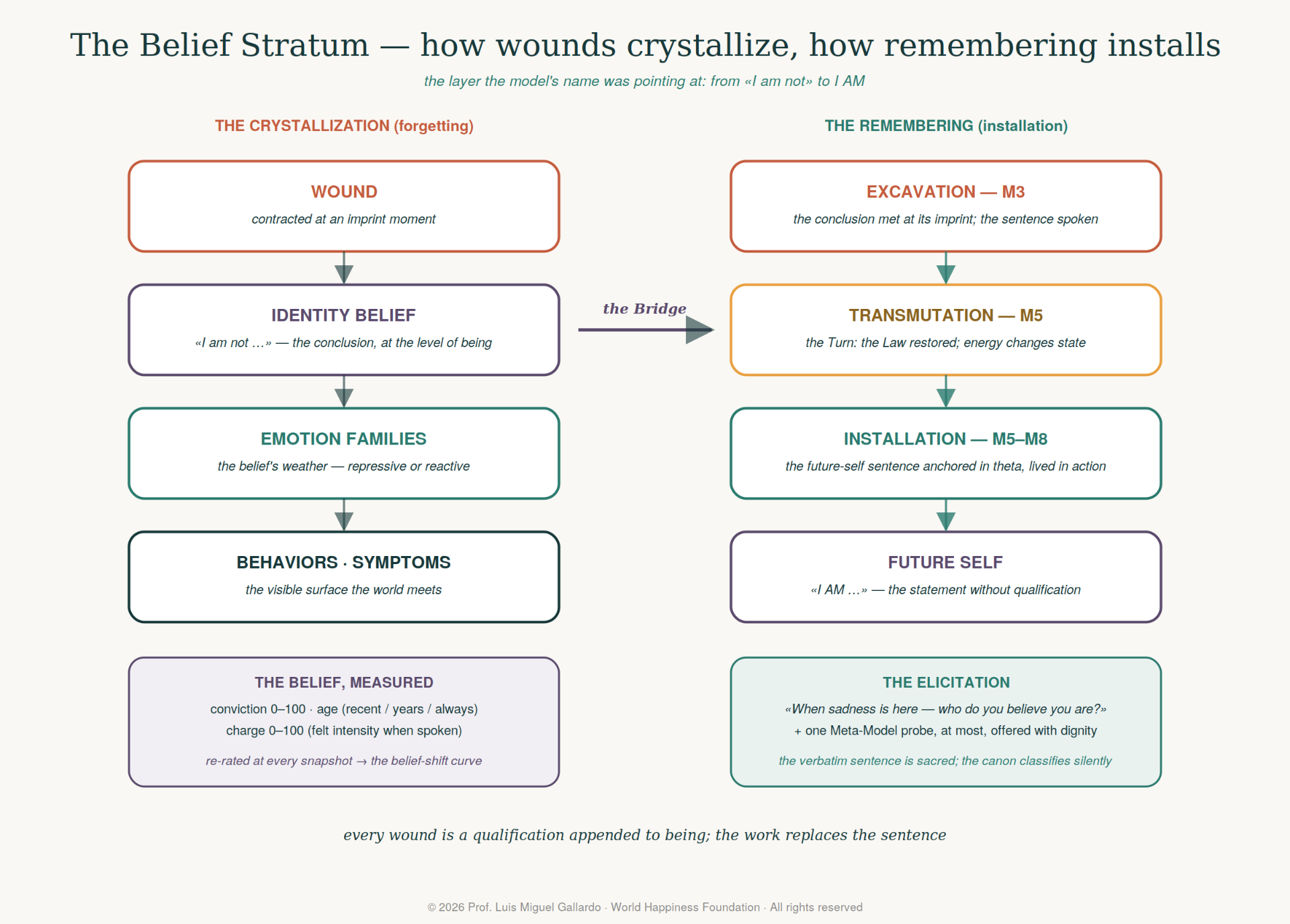
A wound is contracted at a moment — the imprint — but it does not persist as a moment. It persists as a conclusion: a sentence drawn about the self, at the level of identity, in the first person, present tense. «I am not safe.» «I am not wanted.» «I am the cause of the harm.» The third paper's roadmap had already located this event without naming its product: Movement 3's central question — what conclusion set this loop in motion? — was always the belief question. The belief stratum makes the product explicit and gives it a place in the vertical: the wound crystallizes into an identity belief; the belief organizes the emotional weather (which families fire, and on which polarity — the repressive or the reactive face); and the weather expresses as the behaviors and symptoms the world meets. In the language of NLP's logical levels, the series had long specified environment and behavior (the signal surface), capability (the practices), and identity-spirit (Essence, I AM); beliefs complete the ladder, exactly where Dilts placed them — between what a person does and who a person is. The clinical consequence is a re-reading of the whole arc: Movement 3 is the belief's excavation; the Turn is its transmutation; and the future-self statement — the paper returns to it in Section 5 — is its replacement, installed where the work is gated for it: spoken in waking commitment, anchored in theta, lived in the micro-action and the offering.
Figure 2. The belief stratum: the crystallization ladder (wound → identity belief → emotional weather → behavior) and the remembering path (excavation → transmutation → installation → future self), joined by the Bridge.
3.2. The Canon of «I Am Not»
Each wound speaks in a characteristic cluster of sentences — a canon the practitioner learns to hear, and which the system of Section 6 uses for silent classification, never for overwriting: the client's verbatim sentence always outranks the canon. Table 1 gives one exemplar sentence per wound with its repressive and reactive faces and, in the final column, the sentence's replacement — the virtue speaking in the first person. The full canon (forty-three sentences, bilingual) ships with the platform; what matters theoretically is the structure: the beliefs are not random negative cognitions but the six wounds conjugated as identity, which is why belief work inside this model is never generic «cognitive restructuring» — it is wound work at the level where the wound talks.
| Wound | Exemplar Identity Belief | Its Two Faces (repressive / reactive) | The Replacement (virtue, first person) |
|---|---|---|---|
| Repression | «My truth is dangerous.» | «I am the one who holds — I cannot fall» / «If I let it out, I will destroy something» | «I am allowed my truth — one honest sentence at a time.» (Honesty) |
| Denial | «I am fine — nothing is happening to me.» | «I am safer not knowing» / «I am the positive one; I keep moving» | «I am able to look at what is, without drowning.» (Ease) |
| Shame | «I am not enough.» | «If they truly saw me, they would leave» / «I am a fraud — it is only a matter of time» | «I am human — and the verdict was never the whole of me.» (Humour) |
| Rejection | «I do not belong.» | «I am a burden; if I show need, I will be left» / «I am only accepted when I perform» | «I am welcome — the boundary stays, the wall dissolves.» (Gentleness) |
| Guilt | «I am in debt.» | «I do not deserve good things until the debt is paid» / «Only punishment can make me clean» | «I am free — the ledger is closed.» (Forgiveness) |
| Separation | «I am alone.» | «I cannot be reached; the world happens without me» / «It is all on me — I am on my own» | «I am held — nothing was ever cut.» (Care / Love) |
Table 1. The belief canon in miniature: each wound conjugated as identity, its two polarity faces, and the virtue as replacement sentence.
3.3. Elicitation: The Identity–Emotion Bridge and the Meta-Model
The stratum's elicitation technology is deliberately minimal, because beliefs surface most truly when least interrogated. The primary instrument is the Identity–Emotion Bridge — the author's session question, formalized per family: when fear is here — who do you believe you are? When anger rises — who do you believe you are? And, because the upper register is diagnostic too: and when joy is here — who do you believe you are then? The answer is captured verbatim and treated as sacred text: it is what every subsequent screen, report, and session displays. The secondary instrument is the NLP Meta-Model, applied with a strict economy of one: when the stated belief carries a recognizable pattern — a universal quantifier («always», «no one»), a modal operator of necessity («I must», «I cannot»), a comparative with the ruler deleted («not enough» — for what, for whom, by whose measure?), a vanished referent, a mind-reading, a cause-effect weld, a nominalization, a lost performative, a complex equivalence — the practitioner or the system offers at most one gentle probe, in the model's own register, with a dignified refusal always available: the sentence stays as it is. The probe's purpose is not to defeat the belief but to loosen its grammar; if the person restates it softer, both versions are kept, because the distance between them is itself data. Finally, the belief is measured on three dials that make the stratum longitudinal: conviction (how true does this feel right now, 0–100), age (recently / for years / as long as I can remember — the last answer pointing the imprint axis toward childhood or deeper), and charge (how strongly the body responds when the sentence is spoken aloud). Conviction and charge are re-rated at every subsequent snapshot; their decline over time is the belief-shift curve, one of the three evidence lines of Section 7.
4. The Unified Intake: Five Streams, One Person
With the belief stratum in place, a complete phenomenological intake becomes specifiable: five streams, each keyed to a canonical layer, ordered by a clinical logic that opens at the least threatening surface and closes facing forward. First, behaviors and symptoms — what is observably happening — captured through the signal surface of the sixty-four Shadows, in the platform's poetic register («trust feels naive right now»), because people recognize themselves in poetry before they will in categories. Second, emotions — which of the eleven families have been visiting, each with its polarity slider: does this energy pull inward and go quiet, or push outward and get loud? Third, beliefs — the Bridge of Section 3, one question per active family, verbatim answers, three dials, at most one probe. Fourth, the felt sense — Gendlin's construct given a sixty-second structure: where it lives in the body (a tap on a silhouette), its size (a point, a region, half of me, everywhere), its qualities (heavy, tight, hot, hollow…), its movement (still, pulsing, spreading, retreating), and — often the session's key — its name, if it had one. The capture quietly hints the kosha of residence and, re-taken over time, records the felt shift: the thing getting smaller, softer, warmer, beginning to move, which Gendlin identified as the body's own signature of change. Fifth, the desired state — and here the intake performs its most important reversal.
4.1. The Vector: Present Self to Future Self
Most assessment ends in a description of what is wrong. This intake ends in a vector. The person selects how they want to feel — from the Essence poles of the eleven families themselves (trust and presence; fierce compassion; love and oneness; awe; bliss; wholeness; worthiness; peace and spaciousness…), so that desire is expressed in the canon's own upper register — and then completes one sentence whose prefix cannot be deleted: I AM … . This future-self statement is the exact anti-sentence to the beliefs of stream three: where the belief says «I am not enough», the future self might say «I am whole as I learn». The system then holds both poles and renders the Vector — the strongest present-tense belief on one side, the future-self statement on the other, and between them the work: which wound, which movements, which practices, which states. Every later view shows the same Vector with the distance closing. The intake thus enacts, structurally, the paper's title: the person arrives carrying «I am not», leaves having spoken «I AM», and everything the system subsequently does is the bridge between the two sentences.
5. The Computational Model: The Canon as a Graph
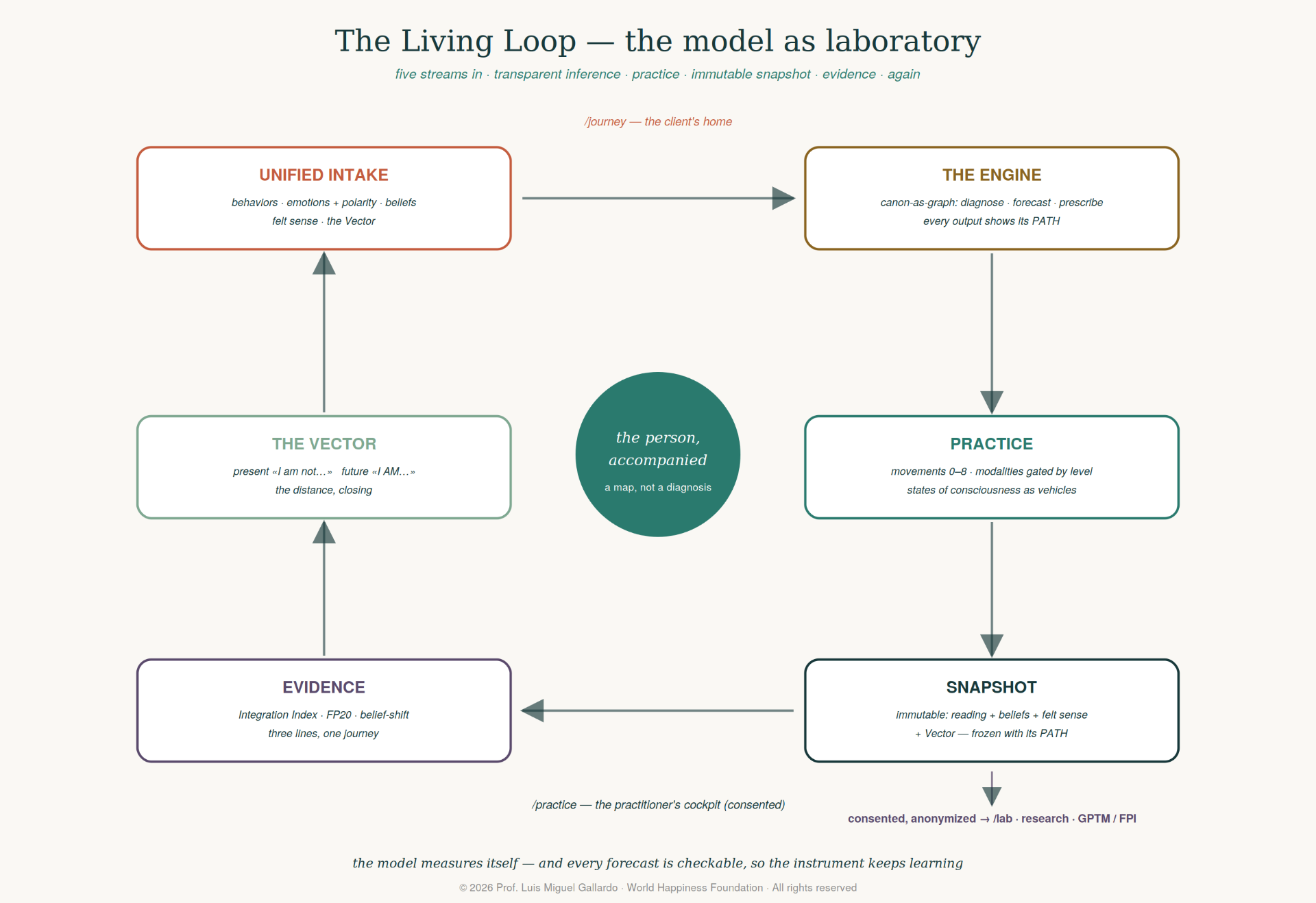
The architecture of the first four papers has a property that only became fully visible when the attempt was made to build it: it is already a graph. Behaviors express Shadows; Shadows belong to families; families root in wounds; wounds are seated in koshas, imprinted at depths, maintained and transformed by Laws, restored by virtues, served by movements, worked by modalities. Render each of these as nodes and typed, weighted edges, and the entire canon becomes computable without a single black box. On this graph the system performs four functions. Diagnose propagates upward from what is present: entered signals activate their Shadow edges; Shadows sum into families; families into wounds; the result is a ranked reading with a confidence band, a polarity (which face of the wound is presenting), a kosha of residence, and — decisively, since the belief stratum — a second, independent evidence stream: each captured belief contributes its classified wound at a weight scaled by classification confidence, so that diagnosis triangulates from behavior and belief together, catching the cases where conduct masks the wound but the sentence betrays it. Forecast reads the dynamics edges forward: which Laws are currently maintaining the pattern (the self-reinforcing loop the person is likely inside), where the pattern tends to deepen if unmet — down the imprint axis, across scale, or into its opposite polarity face — and what the Turn will require: which Law must be restored, in which state, looking like what. Prescribe filters the movement and modality edges by wound, kosha, state, depth, and setting, gated by the practitioner-level system. Explore renders the living map itself, with the fourth paper's overlays — rhythm, three worlds, scale, the Field.
Two properties are load-bearing. First, transparency: every output carries its PATH — the exact traversal of signals, edges, and weights that produced it — behind a «why this?» control on every card. The system can always show its work, which is both its intellectual honesty and, as Section 8 argues, its clinical safety: the person always sees that they are looking at the model's logic, never at a pronouncement about their fate. Second, humility as design: forecasts are rendered as tendency, not destiny — explicitly probabilistic, framed as agency-restoring information — and every forecast is checkable (Section 7), so the instrument is falsifiable by construction. The distortion test of the second paper thereby acquires its engineering form: any output that deepens a wound is a bug of the first order.
Figure 3. The living loop: five streams in; transparent inference; practice; immutable snapshot; three-line evidence; the Vector — with the person, accompanied, at the center, and consented aggregates flowing outward to research and the GPTM/FPI.
6. The Longitudinal Architecture: Healing Made Visible
A single reading is a mirror; the model's real claim is about movement, and movement requires memory with integrity. The longitudinal layer therefore rests on one uncompromising rule: snapshots are immutable. Every saved reading freezes its full input, output, and PATH; history is compared, never recomputed; at the database level, mutation of a snapshot is blocked outright. On this record, three derived measures make progress legible. The Integration Index locates the active pattern on its own Shadow–Gift–Essence arc: each active seat is scored by which pole of its arc the person's signals indicate, weighted and summed to a 0–100 scalar with four interpretive bands — in the Shadow (0–30), meeting it (31–55), finding the Gift (56–75), embodying the Essence (76–100). The Index is deliberately a companion to the FP20, not a replacement: the FP20 measures the state (Fundamental Peace across its four pillars); the Index measures the pattern's position on its arc; their convergence over time is itself the validation signal. The belief-shift curve tracks the decline of conviction and charge across the person's stored sentences, re-rated in twenty seconds at each snapshot. And the felt-shift record tracks the somatic capture — size, quality, movement — across time. Together with the FP20 these yield the system's signature evidence view: three lines on one chart, and beside them the visual forms of the same story — the Migration Map, in which the active seats visibly travel along the Shadow-to-Essence rail across a timeline; the body map softening; the Vector's distance closing. What an intake form could never give a therapist, the longitudinal layer gives the client themself: a picture of their own healing that they can feel to be theirs, because every line in it can show its path.
| Measure | What it tracks | Source | Reads with |
|---|---|---|---|
| FP20 | The state: Fundamental Peace across four pillars | 20-item scale, repeated | Integration Index (convergence = validation) |
| Integration Index (0–100) | The pattern's position on its Shadow–Gift–Essence arc | Signal poles per active seat, weighted | The Migration Map; the four bands |
| Belief-shift | Conviction and charge of the person's own sentences, over time | Twenty-second re-rating per snapshot | The Vector; Movement 3 and the Turn |
| Felt shift | Size, quality, and movement of the felt sense | Somatic capture per snapshot | Kosha work; Gendlin's change signature |
Table 2. The four convergent evidence lines of the longitudinal architecture.
7. The Living Laboratory: Three Tiers, One Spine
The system lives as three concentric surfaces over one data spine. The journey is the client's home: their map and its movement, their sentences and the dials softening, their practices, their Vector — always in the second person, always in the register of invitation. The practice is the practitioner's cockpit: a consented roster; the five streams and the longitudinal record per client; prescriptions gated to certified level; session notes; supervision sharing — with the client's consent explicit, logged, and revocable, and revocation taking effect immediately. The lab is the research surface: consented, anonymized aggregates; cohort comparisons across programs; the model console where diagnostic weights are tuned against outcomes; and the collective rollup, by which every consented journey becomes a pixel in the Global Pain and Trauma Map and its inverse, the Fundamental Peace Index — the fourth paper's scales, instrumented. Three design decisions distinguish the laboratory from a dashboard. Certification is enforced in the interface: the practitioner pathway's three levels gate not only teaching but capability — no one operates a depth they are not certified to hold, which is simultaneously a safety property and the pathway's incentive structure. The forecast is falsifiable: every forecast can be answered — was this your experience? — and the answers accumulate into calibration data, so the instrument's boldest function is also its most accountable. And the artificial-intelligence layer is a reader, never an oracle: one grounded intelligence in three roles — companion to the client (conducting the conversational intake in the model's own questions, explaining the map in Self-mode language), copilot to the practitioner (pre-session briefs of what moved, indicated movement and modality per gating), analyst to the researcher (natural-language queries over consented cohorts) — always citing its sources, whether a paper's section, a canon table, or the person's own snapshot, and never speaking beyond them.
| Level | The loop at that level | Instrument |
|---|---|---|
| Session | Felt shift; conviction delta on the sentence worked; the Turn's markers; micro-action set | Session card |
| Journey | Three evidence lines converging; seats migrating; the Vector closing | Journey view; Migration Map |
| Practice | Caseload outcomes; which movements and modalities move which wounds, for this practitioner | Practice dashboard |
| Program | Pre/post across twelve-week arcs; level comparisons across the certification pathway | Cohort views |
| Collective | Consented, anonymized contribution to GPTM / FPI; We-scale maps for teams and communities | The Observatory |
Table 3. The measurement loop closed at five levels — the model measuring itself from the breath to the planet.
8. The Ethics of a Computational Contemplative System
A model this complete, made this operational, must state its ethics as engineering requirements rather than aspirations, and the series' provisions translate into build law. A map, not a diagnosis: the system names patterns, never verdicts; the wound is never named to a person during intake, only in the result, in the register of invitation; the footer that says so is permanent. The verbatim is sacred: the person's own sentences are stored exactly as spoken, displayed wherever beliefs are shown, and never overwritten by the canon, which classifies silently and abstains below its confidence threshold. No black box: explainability is not a feature but a safety property — an inference that cannot show its path has no place in a room where a psyche is open. Crisis first: crisis-sensitive signals intercept before any diagnosis, route to human support, and never assert confidentiality the system cannot guarantee. Consent is granular, purposeful, and revocable, and revocation is immediate; research participation defaults to off; free text — the sentences, the felt-sense names, the future-self statements — is never exported, at any aggregation, for any purpose. Depth is gated: the certification levels are enforced in software, and the imprint bands beyond a practitioner's gate are not merely discouraged but absent from their interface. The distortion test governs the machine as it governed the Laws: any output that deepens a wound — a forecast that frightens without restoring agency, a classification that hardens a verdict, a nudge that fosters dependence on the tool — is a bug of the first order, to be treated with the severity that phrase implies. And Two-Eyed Seeing extends into the code: every practice the system prescribes renders its lineage credit on the card itself, so that attribution is not a bibliography but a pixel-level habit; the drum is credited to the shamanic traditions on the very screen that recommends it. The fourth paper argued that any use of indigenous wisdom that deepens a collective wound is a distortion of the Oneness it claims; a platform is a use, and the same test applies.
9. The Research Program and Its Limits
The laboratory's purpose is to make the model accountable, and its research program is specified rather than gestured. Four pre-registered studies lead. First, convergence: does the Integration Index move with the FP20 across twelve-week arcs, as the architecture predicts? Second — the flagship, and the belief stratum's decisive test — mediation: do changes in belief conviction mediate gains in Fundamental Peace? The model's claim is precise: the wound speaks as a sentence, the work replaces the sentence, and the state follows; if belief-shift does not carry a substantial share of FP20 change, the stratum's centrality is falsified as stated. Third, calibration: the forecast's checkable predictions accumulate hit-rates by wound, polarity, and depth — the instrument publishing its own error. Fourth, the felt shift as early responder: does somatic softening precede belief and state change, as Gendlin's tradition suggests? Around these, the community trials of the fourth paper proceed under Two-Eyed Seeing — questions, methods, ownership, and authorship shared with the communities from design onward. The limits are stated with equal care. The system's metaphysical framings — the Laws, the three worlds, the cosmology of remembering — remain contemplative registers, engaged as such; the empirical claims live in the measures. The Integration Index is theory-laden by construction and is validated against, never substituted for, the FP20 and external instruments. Everything downstream of self-report inherits self-report's limits; the poetic signal register, a strength for recognition, must be tested for cultural portability as the Mandala was in Rajasthan; and a digital laboratory must answer for the digital divide — which is why the paper's final commitment is that the system's paper forms, card decks, and village-wall Mandalas remain first-class citizens: the Lab is a bridge, and bridges are judged by who can cross.
10. Conclusion
Five papers now, and the arc closes where it always pointed. The first mapped the wounds; the second found their laws; the third gathered the practice under the name I AM; the fourth finished the sentence — I am because we are; we are because Earth is — and named the whole a cosmology of remembering. This fifth paper found the wound's voice and built the wound's mirror. The voice: every wound speaks in the first person, present tense — I am not safe, I am not enough, I am alone — and the deepest work of the model was always the replacement of a sentence. The mirror: a living system in which a person's five streams become a transparent reading, the reading becomes practice, the practice becomes an immutable record, and the record becomes three lines rising together — with the person, accompanied, at the center, and every inference able to show its path. The model is now what it described: a bridge. On one side, the sentence a life concluded in pain; on the other, the sentence that needs no predicate; between them, movements, laws, states, vessels, rhythms, ancestors, communities — and now an instrument that walks beside the walker, keeps honest count, and hands the evidence back to the one it belongs to. From «I am not» to I AM. From suffering to flourishing. One heart, ten billion hearts, one living Earth.
«Fundamental Peace is not the absence of pain… it is the transmutation of its energy into love and compassion.» — Luis Miguel Gallardo
References
Bandler, R., & Grinder, J. (1975). The structure of magic I: A book about language and therapy. Science and Behavior Books.
Dilts, R. (1990). Changing belief systems with NLP. Meta Publications.
Gallardo, L. M. (2026). From Wound to Essence: An integrated inquiry architecture. World Happiness Foundation. [Paper I]
Gallardo, L. M. (2026). The Physics of the Soul: The Twelve Universal Laws as the dynamics of wound, emotion, and shadow. World Happiness Foundation. [Paper II]
Gallardo, L. M. (2026). I AM: The Integrative Alchemy Model. World Happiness Foundation. [Paper III]
Gallardo, L. M. (2026). WE ARE: The ecology of the Integrative Alchemy Model. World Happiness Foundation. [Paper IV]
Gallardo, L. M., & Chetri, S. (2026). Fundamental Peace. Behavioral Sciences, 16(3), 395.
Gallardo, L. M. (in press). Emotional alchemy in rural India: The Meta Pets Method as a community-based pathway to emotion regulation and Fundamental Peace.
Gallardo, L. M., & Ibáñez, P. (2025). The Meta Pets Method: Sixty-four cosmic animal allies for shadow integration. World Happiness Foundation / TEOH Lab.
Gendlin, E. T. (1978). Focusing. Everest House.
Gendlin, E. T. (1996). Focusing-oriented psychotherapy: A manual of the experiential method. Guilford Press.
Hawkins, D. R. (2002). Power vs. force: The hidden determinants of human behavior. Hay House.
Jung, C. G. (1959). The archetypes and the collective unconscious (Collected Works, Vol. 9i). Princeton University Press.
Newton, M. (1994). Journey of souls: Case studies of life between lives. Llewellyn Publications.
Rudd, R. (2013). The Gene Keys: Embracing your higher purpose. Watkins Publishing.
Rudin, C. (2019). Stop explaining black box machine learning models for high stakes decisions and use interpretable models instead. Nature Machine Intelligence, 1, 206–215.
Three Initiates. (1908). The Kybalion: A study of the Hermetic philosophy of ancient Egypt and Greece. Yogi Publication Society.
Wilhelm, R., & Baynes, C. F. (Trans.). (1967). The I Ching or Book of Changes (3rd ed.). Princeton University Press.