The Physics of the Soul
The Twelve Universal Laws as the Dynamics of Wound, Emotion, and Shadow — A Complete Architecture for Multidimensional Evolution
Prof. Luis Miguel Gallardo
World Happiness Foundation · Yogananda School of Spirituality and Happiness, Shoolini University · Chair in Contemplative Sciences, University of Zaragoza · Institute of Interpersonal Hypnotherapy
Companion to «From Wound to Essence: An Integrated Inquiry Architecture» (Gallardo, 2026)
Abstract
The companion paper «From Wound to Essence» established the anatomy of transformational work: a vertical architecture nesting the Six Wounds of Humanity, the eleven emotion families of the Emotional Alchemy Mandala, and the sixty-four archetypal Shadows into a single map with a seven-movement inquiry roadmap. Anatomy, however, is not physiology. A map of structures does not yet explain why wounds persist across decades, why shadows recruit their own confirming evidence, why transformation is possible at all, or why healing moves in spirals rather than lines. This paper supplies the missing dynamics by introducing the Twelve Universal Laws — Divine Oneness, Vibration, Correspondence, Attraction, Inspired Action, Perpetual Transmutation of Energy, Cause and Effect, Compensation, Relativity, Polarity, Rhythm, and Gender — as the operating physics of the entire architecture. The paper's central thesis is structural and precise: each of the Six Wounds is the experiential residue of a Universal Law forgotten or distorted, and each healing virtue is that same Law remembered and embodied. Separation is the forgetting of Oneness; Repression the refusal of Vibration and Transmutation; Denial the refusal of Correspondence; Shame a misreading of Polarity and Relativity; Rejection the fracturing of Oneness at the relational scale; Guilt a distortion of Compensation into a private ledger. The Laws are then classified into four functions — Ground, Formation, Transformation, and Pacing — and mapped onto the eleven families, the sixty-four Shadows (via an inheritance principle), and the seven movements of the inquiry roadmap, each of which acquires an explicit law lens and law question. The result is a complete and whole model of multidimensional evolution: a spiral traversing the five developmental stages of the Integrative Transformation Model across four scales — personal, collective, ancestral, and planetary — under twelve constant dynamics, with Fundamental Peace as the attractor state. Five original figures accompany the text. A dedicated section addresses the ethics of the Laws, including the prevention of spiritual bypassing and law-based blame, which the model itself diagnoses as re-enactments of the wounds of Denial, Guilt, and Shame.
Keywords: Universal Laws, Hermetic principles, Six Wounds of Humanity, Emotional Alchemy Mandala, Shadow–Gift–Essence, multidimensional evolution, Fundamental Peace, transmutation, spiritual bypassing, ROUSER, Happytalism
1. Introduction: From Anatomy to Physics
Every mature science passes through the same threshold. First come the maps — the taxonomies, the atlases, the catalogues of structure. Then comes the question the maps cannot answer: what makes it move? Anatomy required physiology; chemistry required thermodynamics; the map of the heavens required the laws of motion. Transformational practice stands at the same threshold. The companion paper gave the field a unified anatomy — six wounds beneath eleven families beneath sixty-four shadows, with a roadmap for traversing them — and immediately the deeper question surfaces: by what dynamics does a wound sustain itself for forty years? By what mechanism does a shadow recruit, with uncanny precision, exactly the experiences that confirm it? And by what right do we promise clients that transformation is possible — that the energy locked in a shadow can genuinely become gift and essence, rather than merely being managed?
The wisdom traditions have long held an answer: the Universal Laws. From the Hermetic teachings of ancient Egypt to the Hawaiian practice of Ho'oponopono, contemplative cultures described a small set of intrinsic, unchanging principles governing how energy and consciousness operate — principles this author has previously presented in full and aligned with the ROUSER leadership model. The present paper takes the decisive further step: it wires the Twelve Laws directly into the wound–family–shadow architecture, so that structure and dynamics become one system. The claim is not decorative. It is that the Laws explain the architecture — why there are wounds at all, why they cluster as they do, why the Shadow–Gift–Essence arc works, and why the healing virtues are not arbitrary consolations but precise restorations. When the anatomy and the physics are held together, transformational practice acquires what it has lacked: a complete and whole account of multidimensional evolution, in which a single session with one human being and the civilizational project of ten billion free, conscious, and happy people by 2050 are recognizably the same process at different scales.
A note on epistemic register. The Universal Laws are metaphysical principles, not empirical findings; where they touch scientific terrain — vibration and physics, cause and effect and karma — the resonances are analogical, offered as contemplative framings rather than physical claims. The paper's testable content lies elsewhere: in whether the law-based reframes, question banks, and pacing principles improve clinical and coaching outcomes when added to the roadmap, a question Section 10 hands to future research. What the Laws contribute meanwhile is coherence, orientation, and — as Section 9 argues — a built-in ethics.
2. The Twelve Universal Laws: A Systematic Presentation
The Twelve Laws are presented here in compressed, operational form; the author's extended treatment with real-life applications is available in the source essay. What matters for this paper is each Law's function within the wound–family–shadow system, so the presentation moves quickly to a functional classification.
| Law | Operating Statement | Function |
|---|---|---|
| 1. Divine Oneness | Everything is connected to everything else; separation is an illusion of perception. One field, one source, flowing through all. | Ground |
| 2. Vibration | Everything moves; everything carries frequency. Thoughts, emotions, and states emit and entrain vibration. | Formation |
| 3. Correspondence | As within, so without. Patterns repeat across levels; the outer mirrors the inner. | Formation |
| 4. Attraction | Like attracts like; focus and belief draw matching experience. | Formation |
| 5. Inspired Action | Creation requires action aligned with inner guidance — the step that «feels right» and lands the vision in the world. | Transformation |
| 6. Perpetual Transmutation | Energy is never destroyed, only transformed; higher frequency consciously applied transmutes lower. | Transformation |
| 7. Cause and Effect | Every action has consequence; nothing is by chance, though effects may ripen slowly. | Formation |
| 8. Compensation | What is given returns in kind, often multiplied; no true effort is lost. | Transformation |
| 9. Relativity | Nothing has meaning except in comparison; the frame of reference creates the experience. | Pacing |
| 10. Polarity | Everything contains its opposite; extremes are poles of one continuum. | Transformation |
| 11. Rhythm | Everything moves in cycles — ebb and flow, season and tide; nothing is permanent. | Pacing |
| 12. Gender | All creation requires two complementary energies: the receptive (yin, being) and the active (yang, doing), in balance. | Pacing |
Table 1. The Twelve Universal Laws in operational form, with their primary function within the wound–family–shadow system. Gallardo (2025) provides the extended treatment.
2.1. Four Functions
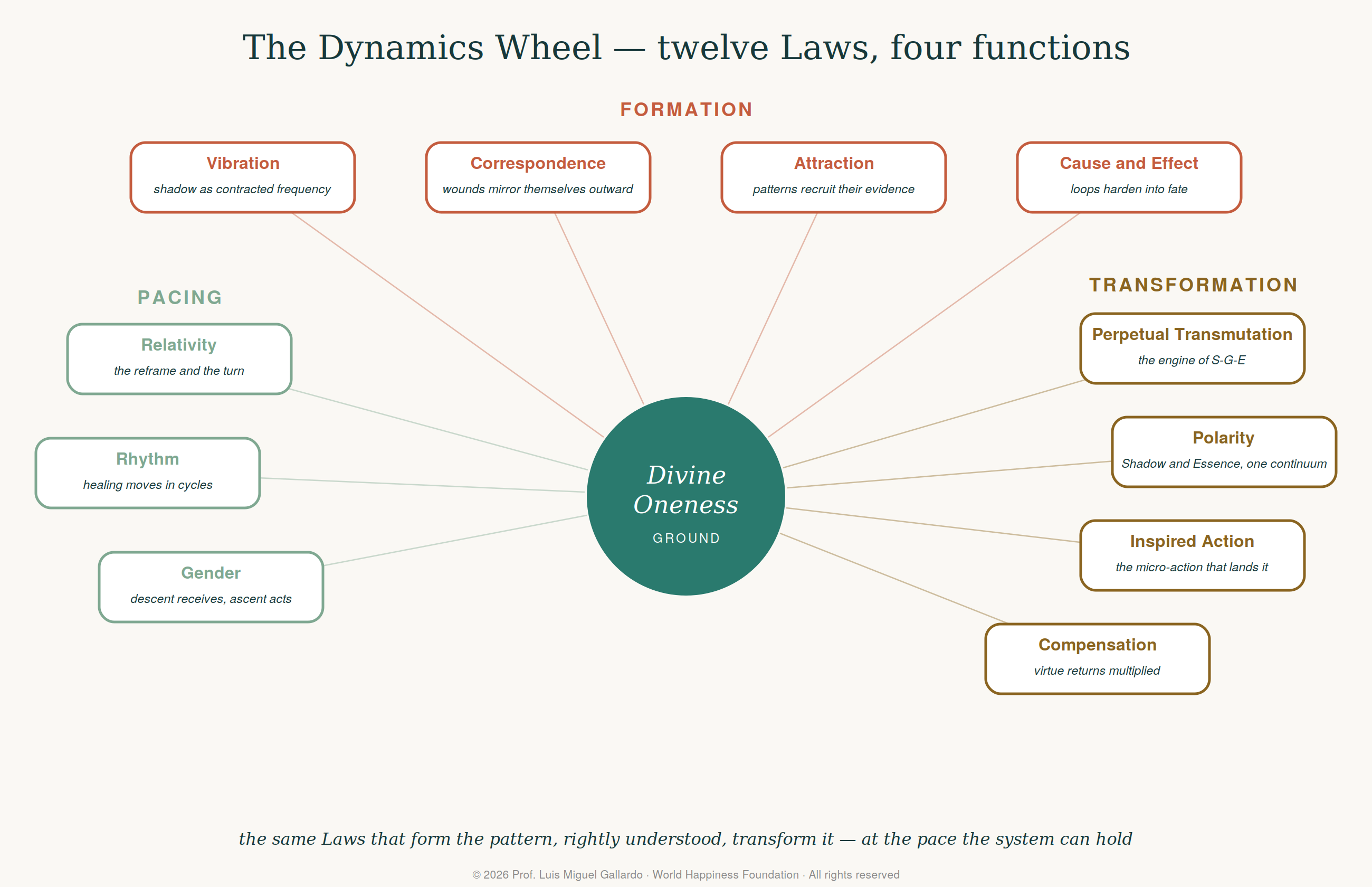
Read against the architecture, the twelve Laws organize themselves into four functions. One Law is Ground: Divine Oneness is not a dynamic among others but the field in which all the others operate — and, as Section 3 shows, its forgetting is the deepest wound. Four Laws are Formation: Vibration, Correspondence, Attraction, and Cause and Effect describe how wounds crystallize into shadows and how shadows perpetuate themselves; they are, so to speak, the physics of stuckness. Four Laws are Transformation: Perpetual Transmutation, Polarity, Inspired Action, and Compensation describe why and how the Shadow–Gift–Essence arc is possible; they are the physics of alchemy. And three Laws are Pacing: Rhythm, Relativity, and Gender govern how transformation must be timed, framed, and balanced if it is to hold. The same Laws that imprison, rightly understood, liberate — a point the tradition has always made and the clinical sections below operationalize.
Figure 1. The Dynamics Wheel: the Twelve Laws in four functions — Ground (center), Formation, Transformation, and Pacing — around the field of Divine Oneness.
3. The Ground Law: Oneness and the Wound of Separation
The companion paper established that Separation is the wound beneath the wounds — that every other wound can be read as a strategy the psyche adopted after concluding it was alone. The Law of Divine Oneness now explains why this is so, and why the architecture has a floor at all. If Oneness is the fundamental condition — one field, one source, connection as fact rather than achievement — then Separation is not a wound like a cut is a wound. It is a perceptual error with experiential consequences: the forgetting of what is the case. This is why the companion paper could observe that Separation «rarely presents as itself; it presents as everything else»: an error at the level of the ground does not appear as one pattern among others but as the distorting medium through which all patterns form.
The pairing of Oneness and Separation is therefore the master polarity of the whole system, and it dictates the direction of every healing arc. The virtue of Separation is Care — love in motion — and the Law explains the prescription's precision: care is what connection does; to act with care is to behave, bodily, as if Oneness were true, which is the fastest route to remembering that it is. Every descent in the inquiry roadmap ultimately approaches this floor, and every ascent draws its energy from it. In the language of the Fundamental Peace framework, Oneness names what the fourth pillar's compassionate self-awareness opens onto: not merely a kinder relationship with oneself, but the felt dissolution of the boundary that made harshness possible.
4. The Laws and the Six Wounds: Forgetting and Restoration
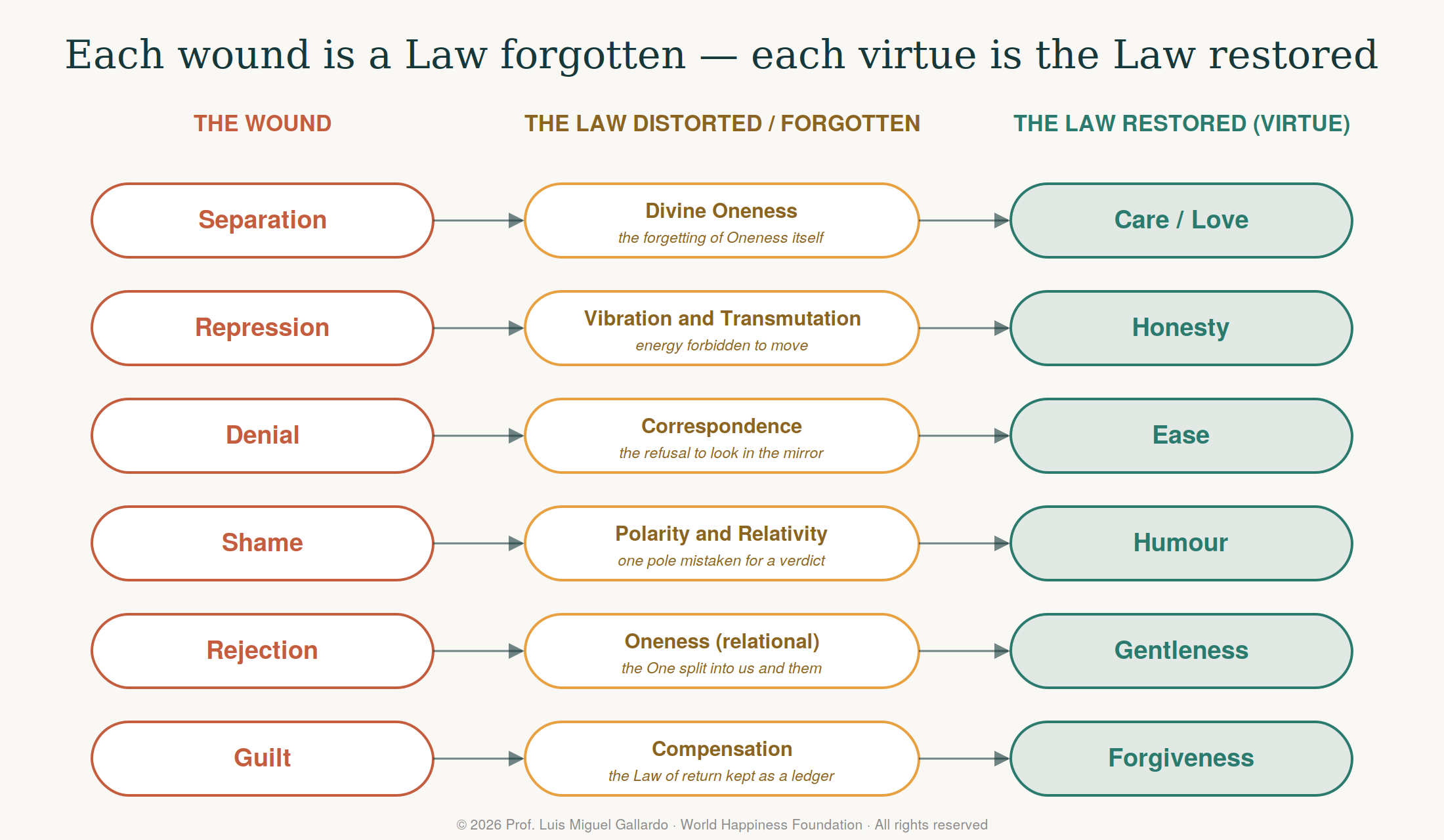
The paper's central thesis can now be stated in full: each of the Six Wounds is the experiential residue of a Universal Law forgotten or distorted, and each healing virtue is that same Law remembered and embodied. The correspondence is exact enough to be tabulated, and precise enough to change practice — because it means the virtues are not moral advice but reparative physics: each one restores the specific dynamic whose distortion constitutes the wound.
Figure 2. Each wound is a Law forgotten; each virtue is the Law restored. The six correspondences with their distortion glosses.
| Wound | Law Forgotten / Distorted | Virtue (Law Restored) | The Restoration in Practice |
|---|---|---|---|
| Separation | Divine Oneness — the ground itself is forgotten | Care / Love | Acting with care enacts connection until connection is again perceived; belonging is remembered, not earned. |
| Repression | Vibration & Perpetual Transmutation — energy is forbidden to move, so it freezes in the body | Honesty | Honest naming sets frozen energy back in motion; one true sentence is a vibrational event. |
| Denial | Correspondence — the mirror is refused; inner and outer are kept strangers | Ease | Ease is what remains when reality no longer has to be argued with; the mirror, faced, stops shouting. |
| Shame | Polarity & Relativity — one pole of the self is mistaken for a verdict; one comparison for a truth | Humour | Humour is applied Relativity: the frame widens, the verdict becomes one perspective among many, and lightness returns. |
| Rejection | Divine Oneness at the relational scale — the One is split into us and them | Gentleness | Gentleness treats the other — and the self — as not-other; the boundary stays, the wall dissolves. |
| Guilt | Compensation — the Law of generous return is distorted into a private ledger of debt | Forgiveness | Forgiveness closes the ledger and lets the Law operate as written: what is given returns, freely, without accounting. |
Table 2. The six wound–law–virtue correspondences with their reparative logic.
Reading the correspondences clinically
Two of the six deserve expansion because they reorganize familiar clinical territory. First, Guilt as distorted Compensation: the guilt-wounded client is not lawless but over-lawful — they have taken a true principle (what is given returns) and privatized it into an unpayable debt, complete with interest. This explains a phenomenon every practitioner knows: exhortations to «let it go» fail, because the client experiences release as breaking a law. The reparative move is not to abolish their sense of cosmic accounting but to correct it — the Law of Compensation, as written, contains no clause requiring self-punishment, and forgiveness is its proper administration. Second, Shame as misread Polarity: the shame-wounded client has encountered a real pole of themselves — a genuine limitation, failure, or excess — and, forgetting that every pole implies its counterpart on one continuum, has taken the pole for the whole. Humour heals not by minimizing the pole but by restoring the continuum: the moment a person can laugh kindly at their own verdict, they are standing, by definition, outside it — at the vantage the Law of Relativity names. The other four correspondences reward the same treatment, and the wound-specific question banks of the companion paper can now each be re-read as law-restoration protocols.
5. The Laws and the Eleven Families: The Dynamics of the S-G-E Arc
At the middle stratum, the Laws explain both halves of every family's story: how its Shadow maintains itself, and by which dynamics its transformation proceeds. The maintenance side is dominated by the four Formation laws in family-specific configurations — fear held in place by Attraction (a threat-focused mind recruits threats), guilt-family patterns by Cause and Effect run as endless ledgers, envy by Relativity distorted into compulsive comparison. The transformation side draws on the four Transformation laws, with the Pacing laws setting tempo. Table 3 gives the complete mapping; a practitioner who knows a client's primary family can read from it, at a glance, both the physics that keeps the pattern in place and the physics that will move it.
| Emotion Family | Laws Maintaining the Shadow | Laws Powering the Transformation |
|---|---|---|
| Fear | Attraction (threat-focus recruits threat) · Correspondence (inner alarm mirrored as outer danger) | Transmutation (fear's energy becomes courage) · Inspired Action (one aligned step dissolves what analysis cannot) |
| Anger | Cause & Effect (retaliation loops harden) · Vibration (rage entrains rage) | Polarity (fierce compassion at the far pole) · Vibration (a settled nervous system de-escalates the field) |
| Grief / Sadness | Correspondence (loss mirrored everywhere) · Rhythm resisted (waves fought instead of ridden) | Oneness (nothing loved is ever outside the field) · Rhythm (grief honored as tide, not verdict) |
| Disgust / Aversion | Polarity misread (the rejected pole is exiled, not integrated) | Relativity (the frame widens) · Oneness (what is rejected out there is met in here) |
| Shame / Guilt | Correspondence (self-verdict re-staged as the world's verdict) · Cause & Effect (the ledger) | Relativity (humour restores perspective) · Compensation (forgiveness administers the true Law) |
| Envy / Jealousy | Relativity distorted (comparison as reflex) · Attraction (scarcity focus recruits scarcity) | Compensation (abundance returns to the giver) · Attraction rightly used (aspiration instead of bitterness) |
| Surprise / Uncertainty | Rhythm resisted (change fought as threat) · Correspondence (inner disorientation mirrored as chaos) | Rhythm (cycles trusted) · Inspired Action (curiosity acts before certainty arrives) |
| Joy / Pleasure | Attraction inverted (craving the next high) · Rhythm resisted (clinging to the peak) | Rhythm (impermanence turns pleasure into gratitude) · Vibration (joy as sustainable frequency, not spike) |
| Love / Bonding | Oneness sought outside (merger as substitute for the field) | Oneness (connection as ground, not acquisition) · Gender (giving and receiving rebalanced) |
| Pride / Recognition | Relativity distorted (superiority as safety) · Correspondence (image maintenance) | Polarity (worth beyond the win–lose continuum) · Oneness (radiance needs no audience) |
| Calm / Apathy | Vibration suppressed (frequency flattened into numbness) | Transmutation (stillness re-animated into serenity) · Gender (being restored so right doing can follow) |
Table 3. The eleven emotion families with the Laws that maintain their Shadow and the Laws that power their Shadow–Gift–Essence transformation.
6. The Laws and the Sixty-Four: The Inheritance Principle
The finest stratum requires no third table, because the architecture already supplies the answer through inheritance: each of the sixty-four Shadows inherits the maintaining and transforming laws of its emotion family, and beneath those, the forgotten law of its core wound. The full derivation for any seat is therefore mechanical — and worth performing explicitly with clients, because it converts a diffuse pattern into a precise physics. Three worked examples demonstrate the method.
Seat 21 — Control (Fear · Repression)
Control inherits Fear's maintenance physics: Attraction (the controlling mind scans for what could slip, and finds it) and Correspondence (inner alarm materializes as an environment that «needs managing»). Beneath these, Repression's forgotten laws: Vibration and Transmutation — the fear was never allowed to move, so it hardened into grip. The transformation runs on the inherited pair: Transmutation (the gripping energy is the raw material of authority in its liberated sense) and Inspired Action (one deliberately un-managed outcome, chosen and survived, teaches the nervous system what no reassurance can). The restoring virtue is Honesty: the controller's first free act is the true sentence «I am afraid.»
Seat 48 — Inadequacy (Shame/Guilt · Shame)
Inadequacy inherits the shame family's maintenance physics: Correspondence (the inner verdict of not-enough is re-staged in every arena as evidence) and Cause and Effect (each avoidance «confirms» the verdict and deepens the loop). Beneath them, Shame's forgotten laws: Polarity and Relativity — a real limitation was mistaken for the whole self, one comparison for the truth. Transformation runs on Relativity (the widened frame in which the same person is inadequate to one standard and abundant to another) and Compensation (contribution offered despite the verdict returns as unforeseen capability). The virtue is Humour, and the clinical marker of its arrival is unmistakable: the first kind laugh at the cosmic seriousness of «not enough.»
Seat 55 — Victimization (Grief · Separation)
Victimization inherits Grief's maintenance physics: Correspondence (a world that keeps «happening against me») with Rhythm resisted (each new wave read as proof rather than tide). Beneath them lies the ground wound itself — Separation, the forgetting of Oneness. This placement, from the companion paper's mapping, now reveals its full weight: the victim story is separation narrated. Its transformation therefore cannot be argued; it must be remembered — Oneness (the felt discovery of not-aloneness, often through being accurately accompanied in the grief) and Rhythm (the waves survived until they demonstrate their own passing). The virtue is Care, received before it can be given; in the Gene Keys tradition this key's arc famously opens toward Freedom, and the Laws explain why: freedom is what victimhood becomes when the illusion of the cut dissolves.
7. The Roadmap Revisited: Law Lenses on the Seven Movements
The seven-movement Deconstructive Inquiry Roadmap of the companion paper now acquires its dynamics. Each movement operates under identifiable laws, and each therefore gains a law question — an inquiry that invokes the operative dynamic directly. The descent as a whole is receptive (the yin arc of the Law of Gender: sensing, allowing, witnessing); the ascent is active (the yang arc: choosing, acting, embodying); and the Turn between them is the Law of Perpetual Transmutation in its purest clinical form — the moment the wound's energy, fully met, changes state. The author's canonical formulation of Fundamental Peace has always been, precisely, a transmutation statement, and it stands as the Turn's epigraph.
Figure 3. The seven movements under law lenses: the receptive descent, the Turn, and the active ascent.
| Movement | Traversal | Operating Laws | Law Question |
|---|---|---|---|
| M1 | Behavior → Shadow | Vibration · Correspondence | «What frequency is this pattern broadcasting — and what is the world mirroring back?» |
| M2 | Shadow → Family | Vibration · Polarity | «Before the story — what is the raw frequency in the body, and what might live at its opposite pole?» |
| M3 | Family → Wound | Cause & Effect · Correspondence | «What conclusion set this loop in motion — and what has been confirming it ever since?» |
| M4 | Wound → Root | Divine Oneness | «If separation is the illusion the Law says it is — what has never actually left you?» |
| M5 | The Turn | Transmutation · Relativity | «This energy cannot be destroyed, only transformed. Met fully, into what does it want to move?» |
| M6 | Virtue → Gift | Polarity · Compensation | «What gift lives at the other pole of this — and what returns when you give from it?» |
| M7 | Gift → Essence + Micro-Action | Inspired Action · Rhythm · Gender | «What one step feels inspired rather than forced — and is this its season?» |
Table 4. Law lenses and law questions for the seven movements of the Deconstructive Inquiry Roadmap.
Two pacing consequences deserve emphasis. The Law of Rhythm converts the most demoralizing clinical phenomenon — relapse — into expected physics: healing is tidal, and the return of a pattern after progress is a cycle, not a verdict; practitioners who teach this law explicitly inoculate clients against the meta-shame of «failing at healing». And the Law of Gender governs the repressive/reactive polarity established in the companion paper: the repressive presentation is a yin-excess (energy collapsed into being without doing) whose first move is activation, while the reactive presentation is a yang-excess (discharge without reception) whose first move is settling. The same wound, the same roadmap, opposite first moves — now with the Law that explains why.
8. Multidimensional Evolution: The Whole System in Motion
With dynamics wired into anatomy, the complete model can finally be stated. It has five dimensions. Depth: the three strata — wounds, families, shadows — traversed by the roadmap. Time: the Law of Rhythm's cycles, through which traversals repeat and deepen rather than conclude. Polarity: the repressive/reactive axis on which every wound presents, governed by the Law of Gender. Frequency: the vibrational gradient running from contracted Shadow states toward Essence, along which the Law of Transmutation operates — the same gradient the Global Pain and Trauma Map renders at population scale and the FP20 renders at personal scale. And scale: the four levels at which the Six Wounds framework has always located its wounds — personal, collective, racial-ancestral, and planetary — connected by the Laws of Oneness and Correspondence, which guarantee that patterns repeat across levels: as within, so without; as the person, so the people.
Figure 4. The Spiral of Multidimensional Evolution: repeated traversals of the roadmap turn the spiral through the ITM's five developmental stages and outward across four scales, from the wound of Separation at center toward Fundamental Peace as attractor.
Evolution through this space is a spiral, not a ladder. Each traversal of the seven movements carries the practitioner or client through one turn; repeated turns move the person through the five developmental stages of the Integrative Transformation Model — from Unconscious Reactivity through Conscious Recognition, Gift Discovery, and Essence Embodiment toward Transcendent Integration — while the Laws of Correspondence and Oneness propagate each personal integration outward. This propagation is not mystical hand-waving but the model's account of social change: a leader who transmutes their own rejection wound stops re-staging exclusion in their organization (Correspondence at the collective scale); a community that metabolizes ancestral grief stops transmitting it (Cause and Effect across generations); and the civilizational project of Happytalism — ten billion free, conscious, and happy people by 2050 — is the planetary scale of the identical arc, with the Fundamental Peace Index as its instrument and Fundamental Peace itself as the attractor state toward which the whole spiral tends. The mandala below assembles the entire system in a single image: the Laws as the outermost ring of dynamics, the strata nested within, and Oneness — Fundamental Peace — at the still center.
Figure 5. The Whole System Mandala: twelve Laws (outer ring), sixty-four Shadows, eleven emotion families, six wounds with their virtues, and the still center of Oneness / Fundamental Peace.
9. The Ethics of the Laws: Against Bypassing and Blame
A framework this totalizing carries a specific danger, and the model would be incomplete — and unsafe — without naming it. The Laws of Attraction and Correspondence, carelessly taught, curdle into blame: «you attracted your illness», «your abuse mirrors your vibration». The architecture itself diagnoses this move: law-based blame is the wound of Guilt weaponized — a cosmic ledger imposed from outside — compounded by Shame's verdict-making, and it re-wounds precisely where it claims to heal. Likewise, «high-vibes-only» spirituality — the refusal to feel or acknowledge pain in the name of Vibration — is the wound of Denial dressed in the vocabulary of the Laws, and chronic manifestation-striving that cannot rest is a Gender imbalance masquerading as diligence. The model therefore supplies its own ethical test, and practitioners should apply it without exception: any use of a Universal Law that deepens a wound is a distortion of that Law. The Laws describe dynamics; they never assign fault. Correspondence is an invitation to inquiry, not an indictment; Attraction is a practice of orientation, not a theory of blame for suffering — much of which arises from structural injustice, biology, and circumstance that no individual vibration authored. On this the model is deliberately conservative: the Laws are offered to clients as lenses that restore agency and coherence, never as explanations imposed on their pain. Where the companion paper's scope-of-practice provisions apply — crisis, trauma, psychosis, depth work beyond one's training — they apply here doubled, because metaphysical framing amplifies both healing and harm.
10. Limitations and Future Directions
The Twelve Laws are received metaphysical principles, and this paper makes no empirical claim for them as physics; its claims are architectural (the wound–law–virtue correspondences are internally coherent and exact) and pragmatic (law lenses should improve practice). Both invite research. The correspondences of Table 2 can be examined through expert consensus methods; the law questions of Table 4 can be tested in the same session-process research proposed for the roadmap, asking whether law-framed turns produce measurably different affective shifts than standard reframes; and the ethics of Section 9 suggests a safeguarding study — whether practitioners trained with the distortion test show lower rates of client-reported blame and bypassing than those trained in manifestation frameworks alone. Culturally, the Laws' cross-traditional pedigree (Hermetic, Vedic, Taoist, Hawaiian) is an asset for the adaptation studies already proposed for the architecture, but the specific twelve-fold enumeration is a modern synthesis and should be held with corresponding humility. A bilingual practitioner module — the Laws integrated into the Wound-to-Essence Compass as a fourth results layer, and into the Meta Pets facilitation pathway — is in preparation.
11. Conclusion
The companion paper closed by observing that a map connecting everything is, in the end, a work of care. This paper has tried to show why such a map was possible at all: because beneath the six wounds, the eleven families, and the sixty-four shadows run twelve constant dynamics, and because the deepest of them — Oneness — guarantees that nothing in the system is finally separate from anything else, including the wound from its virtue, the shadow from its essence, and the person from the whole. Each wound is a Law forgotten; each virtue is the Law restored; each traversal of the roadmap is a turn of a spiral that does not end in the individual, because by the Laws' own logic it cannot. Anatomy told us where to walk. The physics tells us why walking works — and why one person's transmutation is already, in a connected universe, everyone's.
«Fundamental Peace is not the absence of pain... it is the transmutation of its energy into love and compassion.» — Luis Miguel Gallardo
References
Gallardo, L. M. (2025). Understanding the 12 Universal Laws and their role in ROUSER leadership. World Happiness Foundation.
Gallardo, L. M. (2025). Beyond scarcity: Embracing Happytalism for a world of abundance. World Happiness Foundation.
Gallardo, L. M. (2026). From Wound to Essence: An integrated inquiry architecture linking the Six Wounds of Humanity, the eleven emotion families of the Emotional Alchemy Mandala, and the sixty-four Shadows. World Happiness Foundation.
Gallardo, L. M. (2026). Fundamental Peace: A neuro-experiential framework for emotion regulation and human flourishing. World Happiness Press.
Gallardo, L. M. (2026). The Emotional Alchemy Mandala: Eleven emotion families on the Shadow–Gift–Essence continuum. World Happiness Foundation.
Gallardo, L. M. (2026). Healing the Six Wounds of Humanity through love, virtue, and conscious leadership. World Happiness Foundation.
Gallardo, L. M. (2026). From Shadow to Essence: The Integrative Transformation Model (ITM) for leaders and changemakers. World Happiness Foundation.
Gallardo, L. M. (in press). Emotional alchemy in rural India: The Meta Pets Method as a community-based pathway to emotion regulation and Fundamental Peace.
Gallardo, L. M., & Ibáñez, P. (2025). The Meta Pets Method: Sixty-four cosmic animal allies for shadow integration. World Happiness Foundation / TEOH Lab.
Hawkins, D. R. (2002). Power vs. force: The hidden determinants of human behavior. Hay House.
Jung, C. G. (1959). The archetypes and the collective unconscious (Collected Works, Vol. 9i). Princeton University Press.
Rudd, R. (2013). The Gene Keys: Embracing your higher purpose. Watkins Publishing.
Three Initiates. (1908). The Kybalion: A study of the Hermetic philosophy of ancient Egypt and Greece. Yogi Publication Society.
Welwood, J. (1984). Principles of inner work: Psychological and spiritual. Journal of Transpersonal Psychology, 16(1), 63–73.
Wilber, K. (2000). Integral psychology: Consciousness, spirit, psychology, therapy. Shambhala.
Wilhelm, R., & Baynes, C. F. (Trans.). (1967). The I Ching or Book of Changes (3rd ed.). Princeton University Press.