

Shoolini University · Yogananda School of Spirituality & Happiness
Six Faces, One Invitation
Teaching Fundamental Peace at Shoolini University
Prof. Luis Miguel Gallardo · 2026-09-08
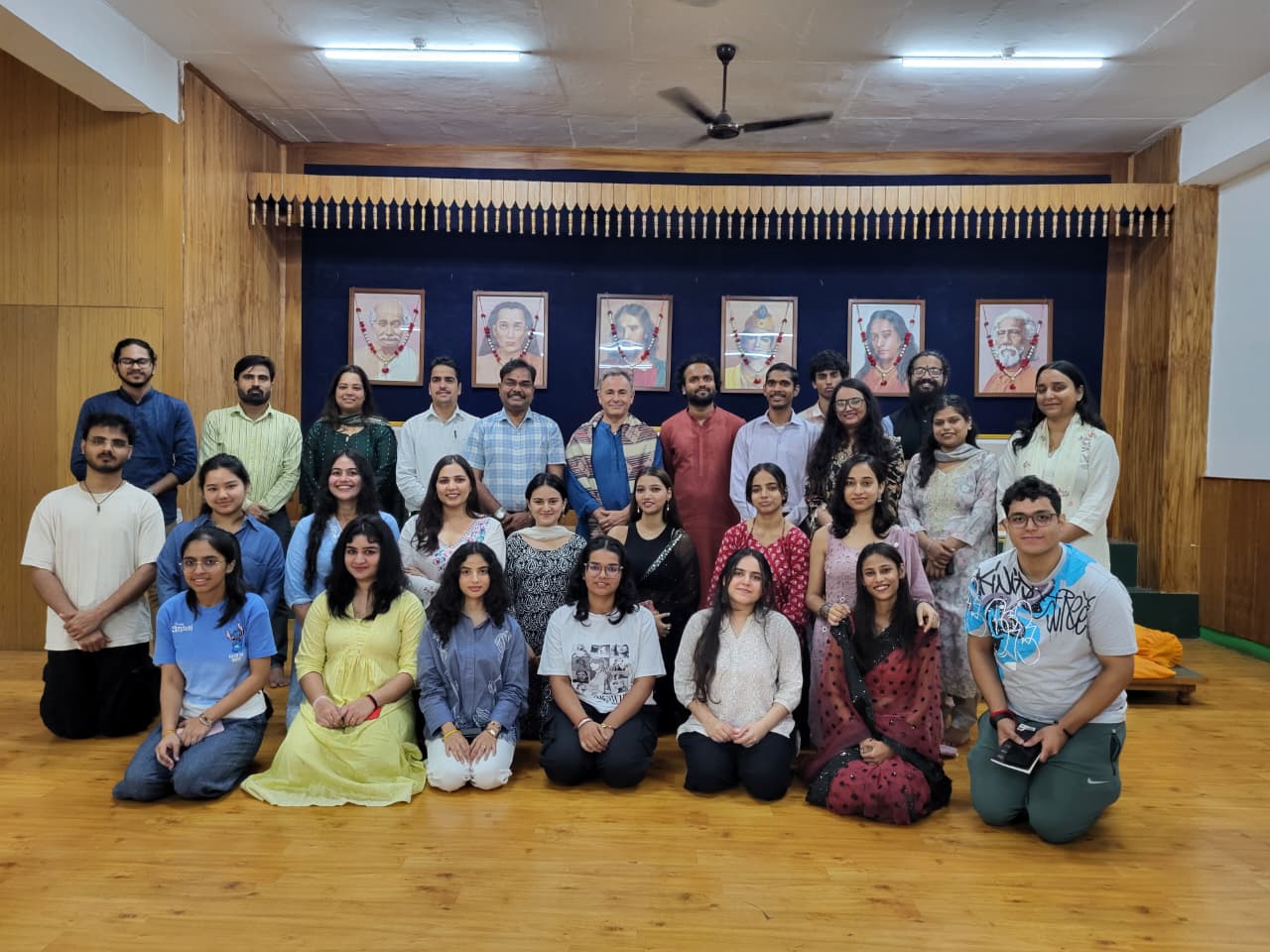
Standing before Lahiri Mahasaya, Mahavatar Babaji, Jesus Christ, Bhagavan Krishna, Paramahansa Yogananda and Swami Sri Yukteswar, I am reminded that authentic education must create a meeting place for tradition, experience, science and service.
The photograph captures two kinds of movement.
Across the foreground, people pass through the room. Some are sharply visible; others are blurred by motion. Behind them, small lamps burn steadily. Above the lamps are six faces, repeated in two rows.
Life moves beneath them. The witnesses remain still.
For me, this is more than a photograph of a contemplative space at Shoolini University. It expresses the question at the heart of my work: how can ancient spiritual wisdom, lived human experience and contemporary scientific inquiry meet without diminishing one another?
I do not see six interchangeable teachers or six versions of one doctrine. Their histories, roles and sacred meanings are distinct. I see a constellation — a conversation across centuries about consciousness, disciplined practice, love, wisdom and the possibility of inner freedom.
Within the Yogoda Satsanga Society / Self-Realization Fellowship tradition, Krishna and Jesus are honoured as great divine exemplars, while Mahavatar Babaji, Lahiri Mahasaya, Swami Sri Yukteswar and Paramahansa Yogananda form its modern Kriya Yoga guru-parampara. The photograph is better understood as a sacred conversation than as a historical flowchart.
Each face offers me a different invitation
Lahiri Mahasaya
Bringing realization into ordinary life
Remembered as a great householder yogi, he represents profound practice amid employment, family and responsibility. Peace must be available while answering messages, teaching students and confronting uncertainty. The measure of a practice is not what happens when the eyes are closed, but what becomes possible when they open again.
Mahavatar Babaji
Humility before the mystery
Revered as the master who renewed the transmission of Kriya Yoga for the modern age, he evokes continuity — practices travelling across generations with a living centre. Science can study attention, breathing and emotion regulation; an instrument does not exhaust the meaning of an experience. Research should clarify experience without pretending to own it.
Jesus Christ
Peace becoming relationship
Attention turns from inner stillness toward love, forgiveness and the transformation of relationship. Can I remain present without immediately defending myself? Can pain be met without transmitting it to somebody else? Fundamental Peace is not numbness; it is enough interior space for love to become a possible response.
Bhagavan Krishna
Remaining centred in action
The Gita does not unfold in a secluded sanctuary but at the threshold of conflict and moral choice. Its question is not how to become calm, but how to act without being imprisoned by fear or attachment. Peace is the inner ground from which clearer action emerges.
Paramahansa Yogananda
Building bridges without erasing difference
He carried yoga from India to the West while emphasising direct experience and disciplined meditation. Building a bridge does not mean declaring two shores identical; it means creating a responsible way to travel between them.
Swami Sri Yukteswar
Rigor, discernment and clarity
Disciplined wisdom: precision, discernment and the refusal to separate spiritual aspiration from intellectual rigor. Rigor does not weaken inquiry — at its best it protects inquiry from exaggeration and lets us speak across cultures and disciplines.
Bringing the conversation into the classroom
My work as a professor and researcher at Shoolini University takes place within this meeting of worlds. Shoolini’s Yoga Research Centre was established to bring ancient Indian philosophy and spirituality into dialogue with modern academic programmes, while strengthening inner awareness and social responsibility among young people.
In my teaching of hypnotherapy and in my research on Fundamental Peace, I ask students to explore a practical question: what human capacities become available when the body is deeply settled, attention is stable, and awareness remains free to respond?
My role is not to claim membership in this spiritual lineage, nor to present Fundamental Peace as an official YSS/SRF teaching. I approach the lineage with respect while working from an academic, experiential and therapeutic perspective. The portraits provide spiritual and historical context; contemporary scholarship asks what aspects of inner experience can be observed, articulated and taught responsibly.
Fundamental Peace as a contemporary bridge
Fundamental Peace is a proposed neuro-experiential state of bounded interior settling. It describes a condition in which the body becomes deeply restful, habitual self-referential thought softens, present-centred awareness grows clearer, and agency remains intact.
The word bounded matters. Fundamental Peace is not sleep, sedation, dissociation or the disappearance of the self. It is restful yet alert. Thoughts still arise, but they no longer command automatic obedience. Emotions remain present, but we gain more freedom in how we meet them.
The model considers Fundamental Peace through four research windows: neural coordination; brain rhythms associated with relaxed attention and absorption; autonomic and bodily regulation; and the lived experience of clarity, settledness, compassion and agency. These are research lenses, not spiritual attainment scores. No brain scan can determine the total meaning of peace.
Research should clarify experience without pretending to own it.
Yoga and hypnotherapy: complementarity without collapse
Yoga often begins through embodiment: posture, breath, sensory withdrawal, concentration, meditation and witnessing. Hypnotherapy often begins through consent, relationship and language — focused attention, relaxation, imagery, suggestion and deliberate reorientation.
Their convergence can be explored through several shared functions: settling physiological arousal, turning attention inward, stabilising concentration, deepening absorption, orienting intention, and preserving witnessing and choice.
Yoga Nidra offers a particularly useful bridge. Its combination of stillness, body awareness, guided attention, imagery, sankalpa, witnessing and deliberate return creates meaningful functional parallels with hypnotic practice while remaining firmly rooted in its yogic context. The value lies in complementarity, not appropriation.
From Fundamental Peace to world happiness
The people moving through the photograph are as important as the figures on the wall. Spiritual wisdom does not exist only in portraits, texts or meditation halls. It must enter moving human lives.
Inner peace does not replace justice, dignity, belonging or social transformation. But it may strengthen the capacities those transformations require: listening, discernment, emotional regulation, courage, compassion and freedom from automatic reaction.
This is where my work at Shoolini University meets my work with the World Happiness Foundation. Education, research, contemplative practice and social transformation can become parts of one movement: from inner awareness to wiser action, and from personal regulation to collective flourishing.
The responsibility of standing before these faces
When I look again at the photograph, I do not receive a simple answer about where spirituality ends and science begins. I receive a responsibility.
My task is not to make their voices identical. It is to help create a classroom quiet enough to hear their differences — and rigorous enough to explore the shared human possibility toward which they point: a peace that is deeply restful, fully conscious, and capable of entering the world through the choices we make.
The portraits remain still. Life continues to move beneath them. Perhaps Fundamental Peace is precisely this: not the end of movement, but the discovery of a centre from which we can move with greater awareness, love and freedom.
Settle. Focus. Intend. Witness. Choose.
What I ask students to practise
- 1SettleFeel the support beneath the body and let the breath become easier.
- 2FocusRest attention on the breath, a sensation, a sound or a guiding voice.
- 3IntendChoose a simple and compassionate inner direction.
- 4WitnessNotice thoughts and emotions without suppressing or following them.
- 5ChooseCarry one conscious response into the next moment of life.
Students may keep their eyes open, change posture, disregard an instruction or stop at any time. Peace is not measured by compliance — agency must remain present throughout.