

Essays · Fundamental Peace
The Gold in the Crack
Kintsugi, shame and the art of Fundamental Peace
Luis Miguel Gallardo · 21 October 2026
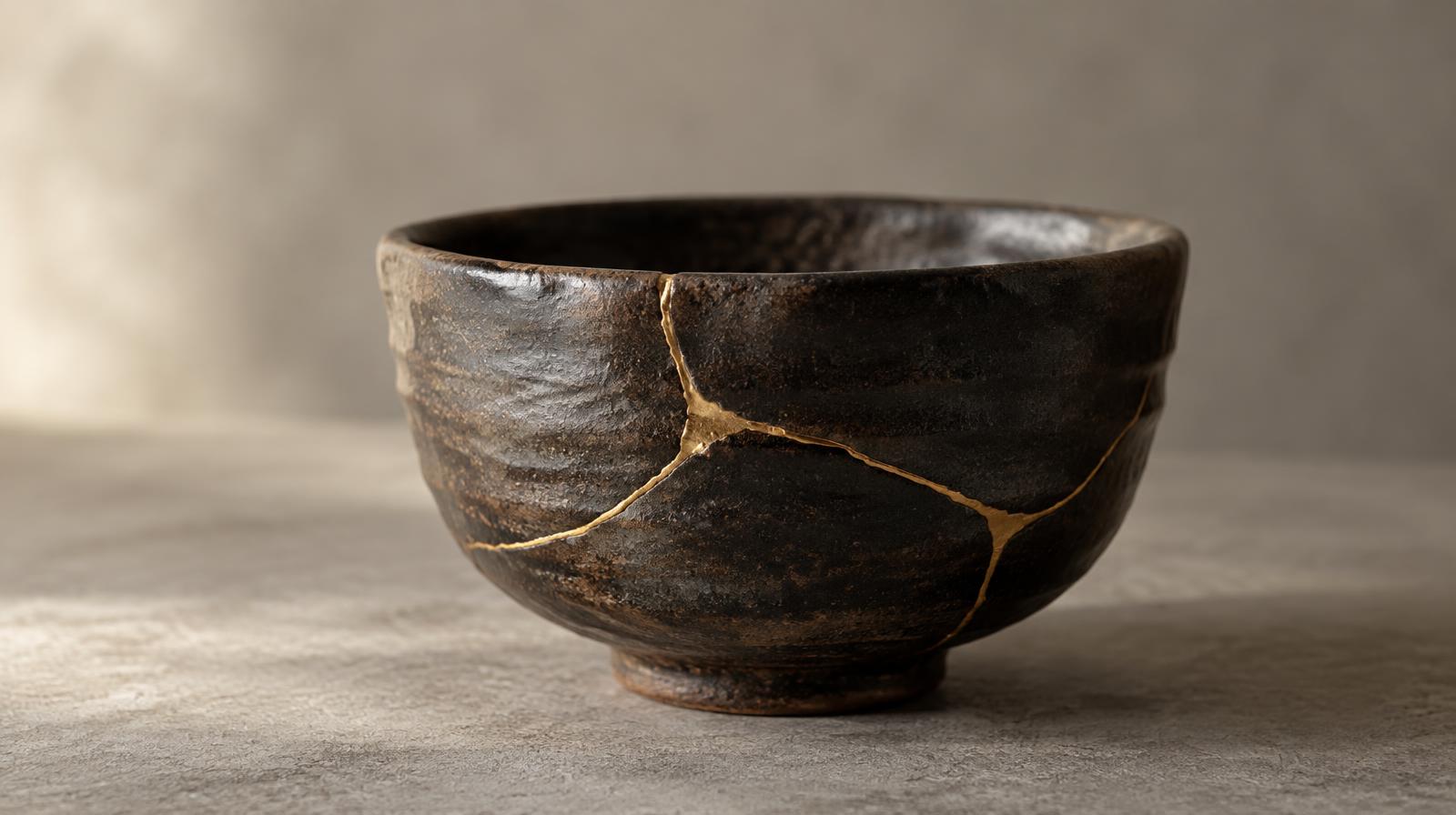
A bowl falls. It happens in every kitchen on Earth, and in every kitchen the same small decision follows: throw it away, glue it so the break hides, or do something else entirely.
In Japan, for several centuries, there has been a something else. It is called kintsugi (金継ぎ), "golden joinery." The broken pieces are rejoined with urushi, the lacquer drawn from the sap of the lacquer tree, and the seams are dusted with powdered gold. The bowl does not return to what it was. It becomes something it could never have been without the fall: a vessel whose history is written across its body in light.
I want to write about kintsugi because I think it is one of the most precise images humanity has ever made of what I call Fundamental Peace, and because it speaks directly to the wound that, in my experience, sits beneath so much of our private suffering and our public violence: shame.
A craft before it is a metaphor
The story usually told is that in the late fifteenth century the shogun Ashikaga Yoshimasa sent a cherished Chinese tea bowl back to China for repair, and it returned held together with crude metal staples. Displeased, Japanese craftsmen looked for a repair worthy of the bowl. Whether or not it happened exactly that way, kintsugi grew up inside the culture of the tea ceremony, alongside wabi-sabi (the beauty of what is imperfect, impermanent and incomplete) and mottainai, the sorrow of waste.
Before kintsugi becomes a metaphor, it is a craft, and the craft is the teaching. Urushi is not a quick glue. Raw, it irritates the skin. It cures slowly, layer upon layer, in a warm, humid cabinet, and a single serious repair can take weeks or months. Most of the work is invisible: cleaning the edges, filling, sanding, waiting, applying again. The gold arrives last, and it is the thinnest layer of all.
That order matters. We are shown the gold. We are rarely shown the lacquer.
Craftspeople describe three ways of mending. In the first, a crack (hibi) is simply traced in gold. In the second, a missing piece is rebuilt in lacquer and covered in gold. In the third, yobitsugi, literally a "calling together," fragments from a different broken vessel are fitted into the gap, so that two histories become one bowl.
Keep that third way in mind. We will return to it.
Two cultures of breakage
There are, broadly, two ways to meet a break.
The first is concealment. Hide the crack, glue it invisibly, put the bowl at the back of the cupboard, and hope no one turns it over. This is the way of shame. Shame does not say "something broke." Shame says "I am broken, and if you saw it, you would turn away." Guilt is about what we did; shame is about what we are. That is why it is so hard to heal: the whole self feels like the crack.
The second is honouring. Gather every piece, take time, and let the break become the most visible line on the bowl. Not to celebrate the damage (no one drops a bowl on purpose) but to refuse the lie that it never happened.
In my work on the Six Wounds of Humanity, shame is the third wound, alongside repression, denial, rejection, guilt and separation. Each wound has a virtue that heals it, and the virtue of shame is humour. People are sometimes surprised by that. But I do not mean the humour that mocks. I mean the humour that is a form of love: the warm, forgiving laughter of someone who sees your crack and is not frightened by it, and, in time, the same laughter turned toward yourself. Humour is compassion that has stopped being solemn. It is forgiveness that can breathe.
A kintsugi bowl has that quality. It is neither ashamed nor boastful. It simply shows, gently and with a certain lightness, the place where it fell, and keeps holding tea.
Shadow, Gift, Essence, in gold
In the Integrative Transformation Model I use with clients and students, every pattern moves through three registers: Shadow, Gift and Essence. Kintsugi maps onto them almost exactly.
The Shadow is the break, and our reflex to hide it. The Gift is the slow work of the lacquer: gathering, cleaning, holding, waiting, the honest and unglamorous labour of turning toward what hurts. The Essence is the golden line: not the wound erased, but the wound made luminous, the place where the bowl is now most itself.
Notice that you cannot skip the lacquer and go straight to the gold. Gold without urushi falls off. Spiritual bypassing is exactly that: golden words painted over a crack that was never cleaned. The transformation is real only when the joining is real.
What Fundamental Peace has to do with a bowl
I have defined Fundamental Peace as integrated regulatory capacity under changing conditions, and in our research we describe four components. Each one is visible in a mended bowl.
- Flexible attentional control without effortful suppression. The concealed crack demands constant management: don't turn it over, don't let them look. The golden seam needs no guarding. Attention is free again.
- Emotional coherence across self-states. The bowl before and the bowl after are not two bowls. The pieces, the fall and the repair are held in one form.
- Reduced self-referential rigidity. The mended bowl no longer needs its original shape to be worthy. It has let go of the story of how it should have been.
- Compassionate self-awareness. Behind every kintsugi repair are patient hands. In inner work, those hands are your own attention, turned toward your fragments with care rather than contempt.
This is why I insist that peace is not a sealed, untouched surface. As I have said many times: "Fundamental Peace is not the absence of pain… it is the transmutation of its energy into love and compassion." Kintsugi is that sentence made in clay and gold.
And then, and this is the part we forget, the bowl goes back to the table. It is used. It holds hot tea again. Fundamental Peace is not a display case. It is the capacity to be broken, to be mended, and to keep serving under changing conditions.
Yobitsugi: mending together
Now the third way. In yobitsugi, the gap in one bowl is filled with a shard from another. It is, to me, the most beautiful image of collective healing I know.
Families, communities, institutions and nations break too. And when they do, the reflex of shame operates at scale: hide the crack, blame someone, rewrite the history. In "The Shamed World" I wrote about how shame that cannot be faced turns outward as the need for revenge: the impulse to break the other's bowl so that ours does not look so broken. My years in peace studies, and as an international observer in the former Yugoslavia, taught me how far hidden cracks can travel, through generations, waiting.
Yobitsugi suggests another path. My missing piece may be completed by your fragment. Your history may hold what mine lacks. Peace between people is rarely the restoration of two perfect, separate vessels. More often it is a single mended form that carries both stories visibly, and is stronger, stranger and more beautiful for it.
This is what I hope for the institutions I work with: that they become, in a sense, shameless. Not without conscience, but without the need to hide. Organisations that can show their seams stop spending their energy on concealment and can spend it on care instead.
A small practice: one crack, five movements
You do not need lacquer and gold to practise kintsugi. You need one crack and a few quiet minutes. I invite you to use the five movements I teach as the daily engine of Fundamental Peace.
- Settle. Sit, feel the ground beneath you, and let the breath lengthen. Nothing needs fixing yet.
- Focus. Bring to mind one place where you feel broken, something you hide. Choose something small enough to hold.
- Intend. Silently state your intention: not to erase this, but to join it.
- Witness. Notice where it lives in the body. Notice the old story: "I am the crack." Now picture a thin line of gold slowly tracing the edge, not covering it, honouring it. If a soft, kind smile comes, let it come; that is humour beginning to heal.
- Choose. Choose one small act this week that you would take if you were no longer hiding this crack. Then take it.
Repeat as often as needed. Lacquer is applied in many thin layers.
The bowl that keeps holding tea
You are not the crack. You are not the gold either. You are the bowl: the whole, changing, mended form that, after everything, can still hold something warm for someone else.
If you would like to know where you stand today, you can take the FP20, the scale we developed to measure Fundamental Peace. And if you are carrying a crack you have never shown anyone, perhaps this is the moment to begin gathering the pieces.
Gently. Slowly. With gold at the end.
— Luis Miguel Gallardo
Further reading: Gallardo, L. M., & Chetri, S. (2026). Hypnosis as a Mechanism of Emotion Regulation and Self-Integration: An Integrative Review of Neural, Cognitive, and Experiential Pathways to Fundamental Peace. Behavioral Sciences, 16(3), 395. https://doi.org/10.3390/bs16030395