International Day of Peace · 21 September 2026
Want Peace? Begin Within
Fundamental Peace: The Source Book and the everyday architecture of peace
Prof. Luis Miguel Gallardo · 2026-09-21
Some days commemorate an ideal. Others ask us to become it.
On 21 September, the world observes the International Day of Peace. The United Nations theme for 2026 — “Invest in Peace: For Everyone, Everywhere, Every Day” — could hardly be more urgent. It honours the everyday architects of peace: people whose local actions create trust, restore dignity and quietly lay the foundations for a less violent world. The United Nations invites each of us to take one small step for peace every day.
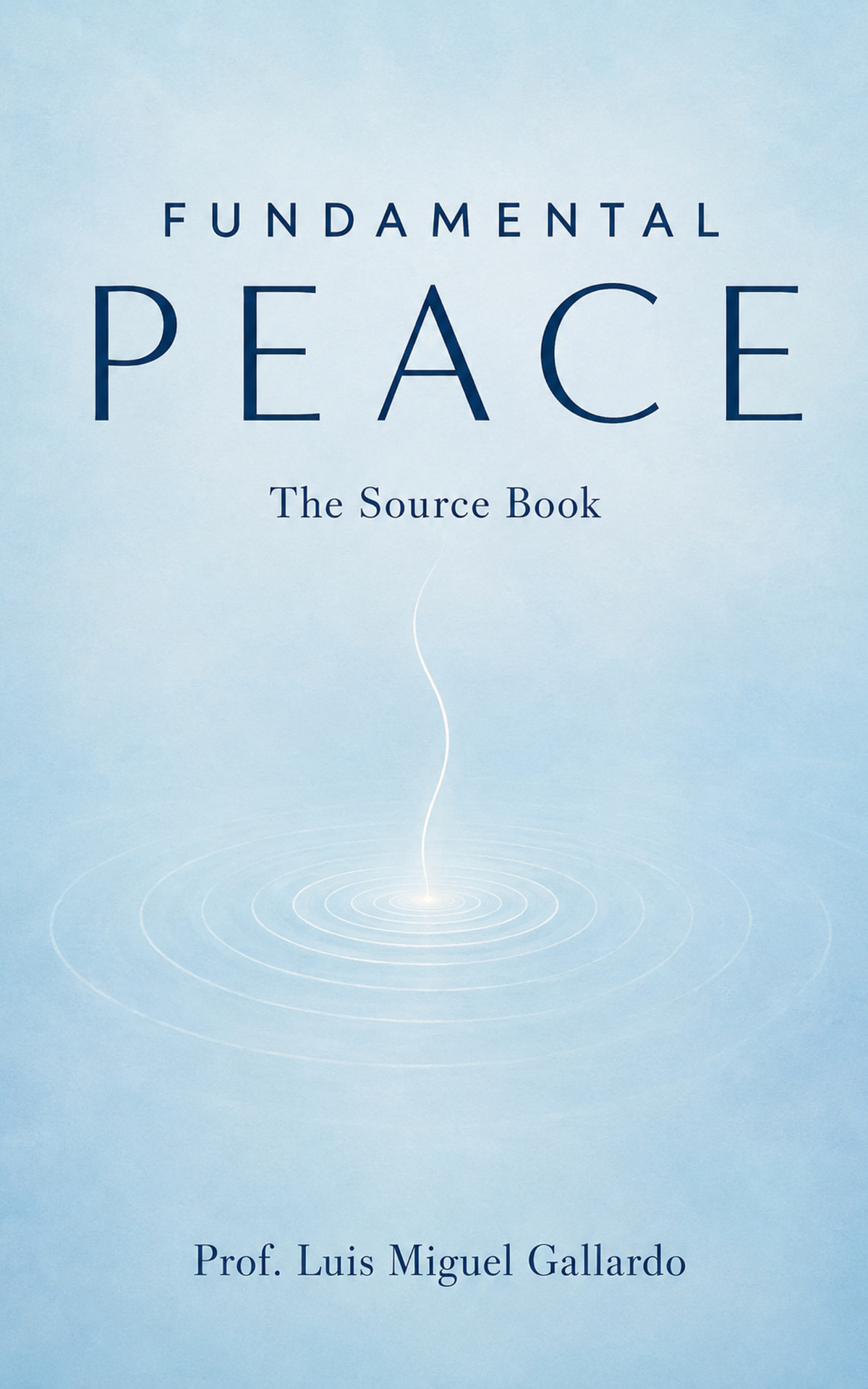
This is also the moment in which Fundamental Peace: The Source Book, by Prof. Luis Miguel Gallardo, enters the world.
Published by World Happiness Press for the International Day of Peace, the book asks a question that reaches beneath treaties, institutions and declarations:
What kind of peace can remain when circumstances take everything else away?
When the sky closes
Gallardo traces the beginning of the book to a journey through the Himalayan foothills in May 2025.
Escalating tensions between India and Pakistan had closed airports across northern India. He had been preparing to fly to Dharamshala, where he was due to meet His Holiness the Dalai Lama. With the sky closed at both ends of the journey, he travelled by road instead.
War closes the sky; peace goes by land.
Peace often takes the slower route. It travels close to the ground, through ordinary lives, patient conversations and acts of compassion that may never make the news.
When Gallardo finally met the Dalai Lama, he encountered someone who had lived through occupation, displacement and decades of exile without surrendering to bitterness. That encounter sharpened the question at the heart of the book: if peace depends entirely on favourable circumstances, what happens when those circumstances disappear?
Fundamental Peace is Gallardo’s answer. Peace, in this account, does not require a painless life. It is the capacity to meet pain fully and transform its energy into compassion, understanding and purposeful action. It is not withdrawal from the world. It is the inner ground from which we can respond to the world without reproducing its fear.
The ground beneath the other peaces
Peace studies has traditionally distinguished between two essential dimensions. Negative peace is the absence of direct violence — the ceasefire, the silence of weapons, the ending of immediate harm. Positive peace is the presence of justice — the social, political and economic conditions that allow people to live with dignity.
Both remain indispensable. But Fundamental Peace proposes a third dimension: the interior capacity required to sustain them.
Agreements are written by human beings. Institutions are led by human beings. Classrooms, governments, companies and communities all inherit the fears, identities and unresolved wounds of the people within them.
When those inner systems remain dominated by threat, humiliation or rigid ideas of “us” and “them,” even carefully constructed peace can become fragile. When people develop greater emotional coherence, compassionate awareness and freedom from rigid identity, the conditions for dialogue and repair become stronger.
Fundamental Peace does not replace justice, diplomacy or accountable institutions. Inner calm alone cannot dismantle oppressive structures or end a war. But structural peace without people capable of sustaining it is equally incomplete. The inner and outer dimensions belong to the same architecture.
From a beautiful idea to a human capacity
One of the book’s most important contributions is its insistence that peace should not remain an inspiring but undefined aspiration.
A 2026 peer-reviewed integrative review by Luis Miguel Gallardo and Saamdu Chetri describes Fundamental Peace as a dynamic neuro-experiential state composed of four capacities:
Flexible attentional control
the ability to direct, hold and release attention without being continually captured by fear or rumination.
Emotional coherence
the capacity to experience emotions as meaningful information without becoming fragmented or overwhelmed by them.
Reduced self-referential rigidity
the ability to hold our personal and collective identities more lightly, allowing the self to become a window rather than a wall.
Compassionate self-awareness
the ability to meet our own experience with honesty and kindness rather than punishment.
These capacities do not remove disagreement. They change the quality of the person entering the disagreement.
The book also introduces the FP20, a twenty-item self-report scale designed to support reflection across these four dimensions. It is not presented as a clinical or diagnostic instrument. Instead, it offers readers a way to connect the idea of peace with observation and practice — to notice where peace is already present and where it may need attention.
Everyone
The word everyone changes the scale of peace. Peace cannot remain the specialist territory of diplomats, negotiators or international institutions. Their work is essential, but the culture surrounding them is formed much earlier: in homes, schools, workplaces and communities.
In one of the book’s most moving recollections, Gallardo remembers Vligna, an 85-year-old woman he encountered while serving as an international observer in post-war Bosnia and Herzegovina. She had lost her children, her home and even her animals. Yet at four in the morning, she was already waiting outside a school that would become a polling station.
She was waiting to vote because she still carried hope — the hope of living peacefully and being happy again.
Vligna was not standing at a negotiating table. She was performing an ordinary civic act. Yet in that moment, she embodied precisely what the United Nations means by an everyday architect of peace. Peace lives wherever a person refuses to pass suffering forward.
Everywhere
If peace begins within, it must not remain there. It must enter the household as the practice of reliable repair. It must enter education as emotional literacy, cooperation and the ability to disagree without dehumanising. It must enter organisations as psychological safety, dignity and shared purpose.
It must enter cities as belonging. It must enter economics as an honest concern for human flourishing. And it must enter international relations as the capacity to meet difference without turning identity into a weapon.
The United Nations’ 2026 campaign reminds us that peace is shaped in classrooms, neighbourhoods and every place where people meet one another with open minds and open hearts. Its suggested actions are deliberately practical: give time, use your voice, convene a Peace Circle or share a story of hope.
These are small acts only if we misunderstand how culture is built. Every culture is the accumulated result of what people repeatedly practise.
Every day
An international observance gives humanity a shared date — a point on the calendar that belongs to no single nation, religion or ideology. It allows us to form an inclusive “we” without inventing a “them.”
But a day becomes transformative only when it changes what happens on all the days that follow it.
Peace is not a performance reserved for 21 September. It is a daily discipline of attention, regulation, compassion and repair. It is the pause before reacting. The willingness to listen before judging. The courage to interrupt humiliating language. The decision to repair a relationship instead of protecting one’s pride.
It is also the patient work of changing the conditions that generate suffering: inequality, exclusion, discrimination, violence and the denial of human dignity. To invest in peace every day is to invest simultaneously in people and systems — in the nervous system and the social system, the kitchen table and the parliament, the classroom and the international assembly.
A Peace Day invitation
This International Day of Peace, begin with one honest question: Where is peace asking to be built through me?
Perhaps it is asking for five quiet minutes in which you stop fighting your own experience. Perhaps it is asking for a conversation you have postponed, an apology you need to offer or a boundary you need to establish without hatred.
Perhaps it is asking you to help another person, host a circle, challenge injustice or use your platform to tell a story that restores hope.
You can explore Fundamental Peace: The Source Book, reflect on its four capacities and take the FP20. Then choose one tangible investment in peace. Not all of humanity at once. One person. One relationship. One community. One act.
The International Day of Peace gives us a shared moment. Fundamental Peace offers us a ground route: from pain to compassion, from inner coherence to collective responsibility, and from the peace we imagine to the peace we practise.
When enough of us take that route, peace stops being a distant destination. It becomes the way we travel.