Transpersonal Leadership · Essay
Transpersonal Leadership vs. Traditional Leadership: An Evolutionary Comparison
Traditional leadership optimises the ego and the org chart. Transpersonal leadership works one layer deeper — with wounds, families, shadows and essence — so results become a by-product of consciousness. A side-by-side comparison, and the ICEF path from one to the other.
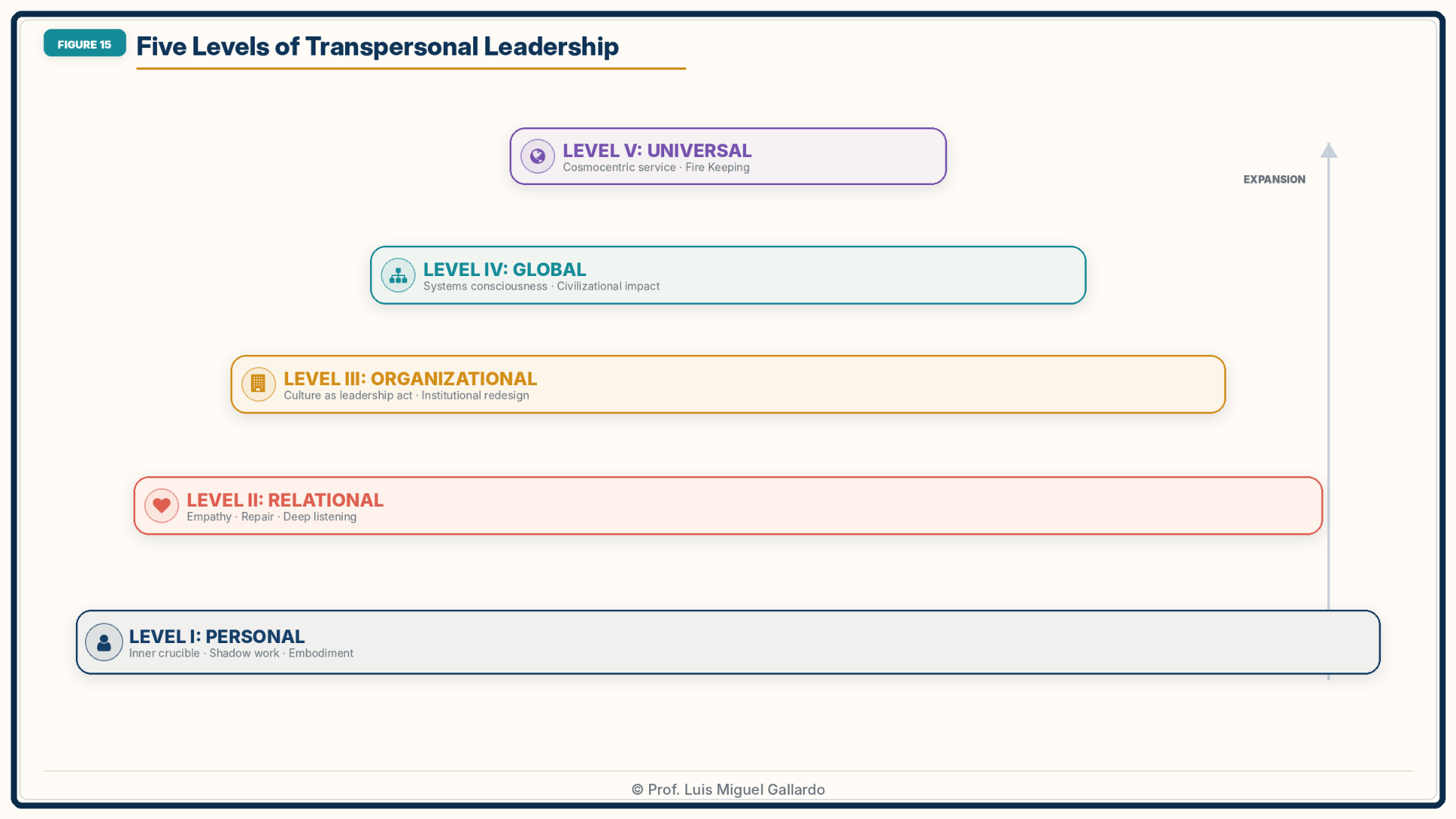
Most leadership models train the surface of the person. Transpersonal leadership trains the depth from which the surface arises.
After three decades coaching founders, Olympians and boards, I keep meeting the same ceiling: a technically excellent leader whose team still cannot breathe around them. The gap is never on the résumé. It is one layer below competency — in what my book The Transpersonal Leader calls the ICEF layers of the human system: wounds, families of origin, shadows, and essence.
This essay is a plain comparison of the two models, and the evolutionary path from one to the other.
What "traditional leadership" actually means
By traditional leadership I mean the mainstream post-industrial model still taught in most MBA programmes and management books:
- The leader's job is to set direction, allocate resources, and hold people accountable.
- Performance is a function of clarity, incentives, and execution.
- Emotions are managed so they do not interfere with delivery.
- Development means new frameworks (OKRs, Lean, Agile, SBI feedback, DiSC) layered onto the same operator.
- The organisation is a machine to be optimised; the human is a role in that machine.
This model is not wrong — it built the modern economy. But it has a hard ceiling. Once a team is technically competent, adding more frameworks yields less and less. What blocks the next octave of performance is no longer skill. It is the leader's unexamined inner architecture leaking into the room.
What transpersonal leadership means
Transpersonal leadership does not replace competency; it goes one level deeper and then returns. It treats the leader as a full human system — body, emotion, story, shadow, purpose, and something beyond the personal — and works with all of it, on purpose, as part of the craft.
The operating assumption flips:
- Direction, resources and accountability are still required, but they are downstream of the leader's state.
- Performance is a by-product of consciousness — of how coherent, regulated and integrated the leader is when the team meets them.
- Emotions are not managed; they are metabolised. Fear becomes prudence, anger becomes justice, shame becomes humility, grief becomes compassion. (See the Emotional Alchemy Mandala.)
- Development means the ICEF path: Inner wounds → Community/family patterns → Shadow work → Essence and purpose.
- The organisation is a living system inside a larger living system. The human is not a role; the role is a chapter in a human.
Side by side
| Dimension | Traditional Leadership | Transpersonal Leadership |
|---|---|---|
| Unit of change | Behaviour, process, KPI | Consciousness, then behaviour |
| Source of authority | Position, expertise, results | Presence, integrity, embodied wisdom |
| Handling of emotion | Manage, contain, "leave at the door" | Metabolise; treat as information and fuel |
| Handling of shadow | Ignored, HR-managed, or "coached out" | Named, worked with, transmuted into gift |
| Time horizon | Quarterly, annual | Seven generations, lifetime, legacy |
| Development path | New frameworks, more training | Inner work + frameworks (ICEF, FP20, ROUSER) |
| Failure mode | Burnout, cynicism, quiet quitting | Slower start; needs patience and practice |
| Success signal | Hit the number | Hit the number and the team is more human at the end |
| Measurement | Engagement surveys, 360s | 360s plus FP20 (Fundamental Peace) and ROUSER pillars |
The distinction is not that one is soft and the other is hard. Transpersonal leaders are often the most demanding people in the room. They ask for reality, not performance.
Why the traditional model plateaus
Every unresolved wound, every family-of-origin pattern, every disowned shadow shows up somewhere — in the meeting the leader dominates without noticing, in the feedback they cannot receive, in the strategist who cannot say no, in the founder who confuses urgency with truth. Traditional leadership has no vocabulary for any of this. So the same pattern keeps producing the same crisis under new names.
Daniel Siegel, Stephen Porges, Susanne Cook-Greuter, Robert Kegan and Otto Scharmer all point at the same thing from different angles: adult development is real, it is stageable, and organisations rise to the level of consciousness of the person holding the room.
Traditional leadership optimises within a stage. Transpersonal leadership grows the stage.
The bridge: ICEF and the Five Levels
A leader does not need to abandon the traditional model to move. They need one layer added underneath it. The ICEF framework and the Five Levels of Transpersonal Leadership provide that layer:
- Individual Awareness — self-knowledge, emotional regulation, inner coherence.
- Relational Presence — psychological safety, empathic contact.
- Systemic Understanding — the org as a living system.
- Generative Purpose — action anchored in a purpose larger than the self.
- Integral Wisdom — paradox, compassion, foresight held together.
Run in parallel with any traditional playbook (OKRs, agile, Lean, whatever the team already uses), these levels compound.
How to tell which one you are running
A quick diagnostic. When something breaks on your team this week, which sentence comes first, before you can stop it?
- "Who dropped this?" — traditional.
- "What is this pattern trying to show me?" — transpersonal.
Both questions are valid. Only the second one changes the leader.
Where to start
If this essay lands, three concrete next steps:
- Take the FP20 — a twenty-item measure of your current Fundamental Peace baseline.
- Take the ROUSER — the six pillars of the transpersonal leader.
- Read the ICEF framework and pick the one layer — wound, family, shadow, essence — that your body already knows is next.
The traditional leader asks what should I do? The transpersonal leader also asks who am I being, and from where? Everything else — culture, results, retention, legacy — follows from the answer.
With an embrace,
Luis Miguel.