
Essays · The Six Wounds
With No Men in the World
What a student's answer at Shoolini University taught me about fear, shame and the happiness we still owe half of humanity
By Prof. Luis Miguel Gallardo · 15 October 2026
- Fundamental Peace
- Shame
- Six Wounds
- Gender & Safety
- Happytalism
- India
- Global Happiness Forum Jaipur 2026
A torn page
I asked my students at Shoolini University a simple question: How do we create a world without fear — without judging, without expecting?
One of them, a young woman, answered on a page torn from her notebook. Her handwriting changes halfway down. The first lines are careful, cursive, almost polite. Then the letters become capitals:
WITH NO MEN in the WORLD. If there won't be no men we need to fear no one.
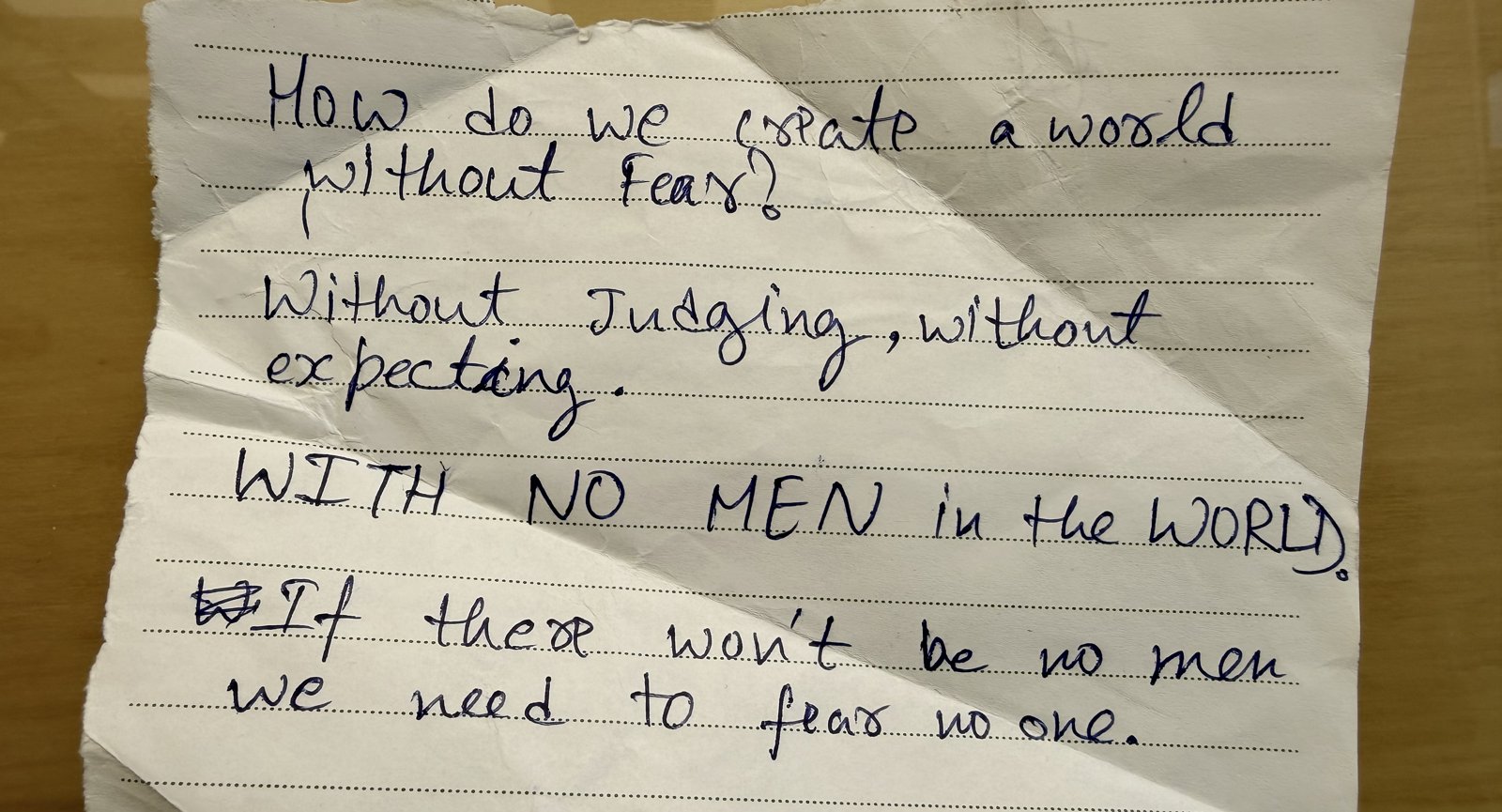
I have kept that page. I have read it many times since, before and after Jaipur. I want to write about it honestly, because I think it is one of the most important answers I have received in thirty years of asking people about peace and happiness.
I am a man. I am her professor. And her answer was, in part, addressed to me.
Not an insult, a map
The easy response is to defend. Not all men. That is unfair. Exclusion is not peace. All of that is true, and all of it misses the point.
She did not write a manifesto against men. She answered the question I asked: where does fear come from? Her answer is a map of her lived world. In that map, the source of fear has a face, and the face is male.
Notice what she did not say. She did not say "with no strangers," "with no poverty," or "with no bad people." She went straight past every abstraction to the one variable her body already knows. That is not hatred. That is data — collected every day, on streets, in buses, in homes, in the silence after certain jokes.
Notice also the grammar of the last line: we need to fear no one. Not "we would be happy" or "we would be free." Her horizon is not joy. Her horizon is the mere absence of fear. When a gifted young woman at a university of spirituality and happiness imagines her ideal world, she does not reach for flourishing. She reaches for safety. That gap is the measure of what we still owe her.
The numbers behind one sentence
Her sentence is not an exaggeration. It is a summary.
In November 2025 the World Health Organization estimated that about 840 million women — nearly one in three — have experienced partner or sexual violence in their lifetime, a share that has barely moved since 2000. In the past twelve months alone, 316 million women suffered physical or sexual violence from a partner. In Southern Asia that past-year figure is 19%, well above the global 11% (WHO).
In India, the National Crime Records Bureau registered 448,211 crimes against women in 2023, a rate of 66.2 per 100,000 women. The largest single category — 133,676 cases — was cruelty by husbands or their relatives (NCRB 2023, via PTI). And these are only the cases that reached a police station.
Read that last category again. The place where a woman is most likely to be harmed is not the dark street. It is the home. Her fear is not of an exceptional monster. It is of the ordinary.
Numbers like these do not stay in statistics. They become a curfew a girl sets for herself. A route home chosen for its streetlights. A smile held a little too long to avoid trouble. A self that grows smaller to stay safe. This is what fear does to happiness: it does not attack it directly. It shrinks the space where it could grow.
The root beneath the fear: shame
If we stop at fear, we stop too early. Her fear has a source, and so does the violence she fears. For several years my work has followed that source to one place: shame.
In the framework I call the Six Wounds of Humanity — Repression, Denial, Shame, Rejection, Guilt and Separation — shame is the wound that tells a human being I am not enough, and if they see me, I will be destroyed. It operates at the personal, collective, racial and planetary levels at the same time.
The psychiatrist James Gilligan, after decades working with the most violent men in American prisons, reached a conclusion I have seen confirmed across cultures: behind almost every act of violence is a man trying to wipe out a feeling of shame and humiliation. Violence is the counterfeit cure for shame. Domination is what a frightened ego does to never feel small again.
Shame moves through the world in a cruel asymmetry:
- In men, shame is converted into control. Boys learn early that tears, tenderness and need are shameful. The feeling does not disappear; it goes underground and returns as anger, possession, the need to win, the need to be obeyed.
- In women, shame is converted into silence. In many societies — India included, with its heavy grammar of izzat, honour — a family's honour is placed on the bodies of its women. When a woman is harmed, it is often she who is made to carry the shame. So she does not speak, and the harm continues.
- In nations, shame is converted into revenge. Humiliated peoples remember. Humiliation becomes story, story becomes identity, identity becomes the justification for the next war. I studied this in my first years as a peace researcher, from the Balkans to the Middle East: at the root of most conflicts lie domination and wounded dignity, and the cycle continues as long as nobody is wise enough to stop it.
The man my student fears and the nation that seeks revenge are expressions of the same wound at different scales. A shamed world is a frightened world. And a frightened world cannot be a happy one.
From Jaipur: happiness that includes safety
A few days ago, on 10 and 11 October, we celebrated the third Global Happiness Forum & Festival at the Birla Auditorium in Jaipur. The Governor of Rajasthan lit the lamp. The Mayor released our books. More than 35 speakers, six thematic sessions and four panels explored what it means for Jaipur to become a City of Happiness.
It was a joyful gathering. And her page was in my mind the whole time.
Because here is the honest question for every forum on happiness, including ours: happy for whom? A city is not a City of Happiness if half its population plans its evening around fear. A school is not a School of Happiness if its girls learn, together with mathematics, to make themselves invisible. An enterprise is not an engine of wellbeing if the women who create its beauty return at night to homes where they are not safe.
One of the threads of this year's forum was Artisans of Happiness. Much of my work in rural India is with women — weavers, mothers, grandmothers — whose hands carry generations of skill. Every circle we hold with them is, before anything else, an attempt to create for half an hour a space where nobody needs to be feared. My student wrote in one sentence why such spaces are still so rare.
This is why Happytalism cannot be only about measuring life satisfaction. The Global Pain & Trauma Map exists to name what our indicators prefer not to see. Safety is not a side-topic of happiness. It is its floor.
Answering her back
So what do I answer her?
Not that she is wrong. Her fear is earned. But I want to offer her a different ending to the same sentence: a world without fear does not need no men. It needs men without shame.
By shameless I do not mean men without conscience. I mean men who no longer have to defend a wounded self at someone else's expense — men whose sense of worth does not depend on control. In the language of Fundamental Peace, this is a measurable state: reduced self-referential rigidity, emotional coherence, flexible attention and compassionate self-awareness. A man in Fundamental Peace has nothing to prove. And a man with nothing to prove is not dangerous.
Every wound has its virtue. The virtue that heals shame is humour — but not the humour that mocks or humiliates, which only spreads shame further. I mean the gentle humour that is always joined to love, compassion and forgiveness. It is the lightness of a heart that can see its own ego and smile at it, without being destroyed by being seen as small. Love gives that humour its warmth; compassion keeps it from ever laughing at another; forgiveness — of others and of ourselves — is what finally lets the weight of shame be put down. A man who can laugh at himself with love, forgive himself with compassion, and offer the same to others does not need to make anyone afraid.
What would this look like in practice, in India and everywhere?
- Raise boys who are allowed to feel. Every tear a boy is forbidden becomes a debt that someone else may pay later. Schools of Happiness must teach emotional literacy to boys as seriously as mathematics.
- Move shame from the victim to the silence. A family's honour must never again rest on a woman's body. The only thing that should be shameful is to stay silent when harm happens.
- Create circles for men. Women have built circles of mutual support for centuries. Men rarely have a space where their vulnerability is safe. Without one, it leaks out as violence.
- Build shameless institutions. Companies, universities, governments and families can either amplify shame through humiliation, ranking and fear, or dissolve it through dignity, listening and care. Institutions are called to choose.
- Measure what she measured. If a City of Happiness does not track whether its women feel safe walking home, it is measuring the wrong thing. Her fear is an indicator. We must put it on the dashboard.
And to the men reading this — starting with myself — her page is not an accusation to defend against. It is an invitation to be part of the evidence that she was wrong. Not by arguing with her, but by becoming, one by one, men around whom no one needs to be afraid.
What the page means, and why
It means that half of humanity still begins its dream of the future with the word without. Without fear. Without judgment. Without expectation. Before we can speak to her of flourishing, we must first earn the right to be trusted.
It means that the work of happiness is not decoration. It is not a festival separate from the wound. Our joy in Jaipur is real, and it becomes complete only when it reaches the young woman who wrote, in capital letters, the most radical solution she could imagine to stop being afraid.
And it means — why this matters to me so much — that the mission I have given my life to, 10 Billion Free, Conscious & Happy by 2050, cannot be measured only in smiles. It must be measured in the number of girls who, asked how to create a world without fear, no longer think of removing anyone.
The day a student answers my question with "with men who are at peace," we will know the work has begun to work.
Until then, I keep her page. Not as an indictment. As a compass.
Fundamental Peace is not the absence of pain… it is the transmutation of its energy into love and compassion. — Luis Miguel Gallardo
— Prof. Luis Miguel Gallardo
Founder and President, World Happiness Foundation · Professor of Practice, Yogananda School of Spirituality and Happiness, Shoolini University
Sources
- World Health Organization, Lifetime toll: 840 million women faced partner or sexual violence (19 Nov 2025)
- NCRB Crime in India 2023, reported by PTI: crimes against women (30 Sep 2025)
- World Happiness Foundation, Global Happiness Forum & Festival, Jaipur 2026
- James Gilligan, Violence: Reflections on a National Epidemic (1996)