

World Happiness Foundation Research Lab · Journal of Happytalism and Fundamental Peace
Measuring What Matters? A New Paper Reads Fourteen Years of the World Happiness Report — with Special Reference to India
Prof. Luis Miguel Gallardo · 2026-09-14
The second publication of the World Happiness Foundation Research Lab reviews every edition of the World Happiness Report from 2012 to 2026 and asks how much of a country's rank reflects lived welfare — and how much reflects the instrument doing the measuring. Open access, CC BY 4.0.
A personal note: I'm honoured to co-author this paper with three colleagues I deeply admire — Saamdu Chetri, Renita Sinha, and Satish. It asks a question at the heart of my work: are we measuring what matters?
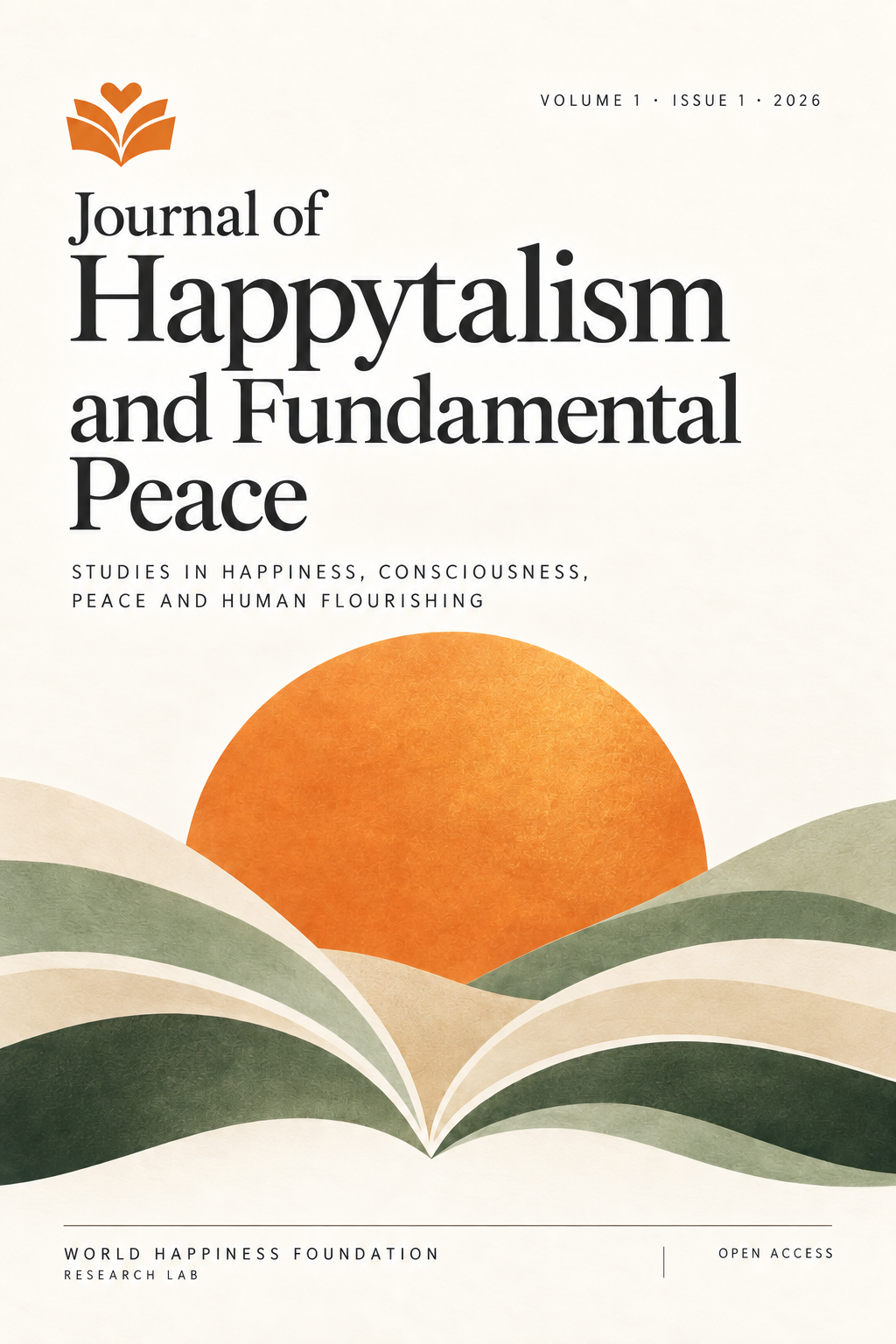
The World Happiness Foundation Research Lab has published the second article in the Journal of Happytalism and Fundamental Peace — an international, peer-reviewed, open-access journal of the World Happiness Foundation Research Lab —: “Measuring What Matters? A Critical Review of the World Happiness Report Framework (2012–2026), with Special Reference to India” (DOI 10.68220/whf.2026.002). The paper is authored by Saamdu Chetri (Rekhi Foundation for Happiness; Rekhi Centres of Excellence for the Science of Happiness in India), Luis Miguel Gallardo (Yogananda School of Spirituality and Happiness, Shoolini University; World Happiness Foundation), Renita Sinha (Shoolini University), and Satish (Department of Education in Social Science, New Delhi). It appears open access, under a CC BY 4.0 licence, in Vol. 1, No. 1 (2026).
What the paper does
Since 2012, fourteen editions of the World Happiness Report (WHR) have ranked between roughly 137 and 158 countries each year using a single survey question — the Cantril Ladder — and six explanatory variables: GDP per capita, social support, healthy life expectancy, freedom, generosity, and perceived corruption. The report has done real work in making well-being a serious complement to GDP in global policy conversations. This new review honours that contribution while asking a harder question: what exactly is being measured, and for whom does the instrument work well?
The authors synthesise the full 2012–2026 run in three moves. First, they compare the top 30 and bottom 30 ranked countries across the whole period, finding that the gap at the extremes has widened rather than narrowed: Finland has now topped the table for nine consecutive editions, while Afghanistan's score has collapsed to roughly one-fifth of Finland's — with Afghan women recording the lowest average life satisfaction of any subgroup measured anywhere in the 2026 edition. Second, they set out seven methodological concerns with the WHR framework — from the ladder metaphor's tendency to prime thoughts of status and wealth, to its individualistic framing in collectivist cultures, to a rarely discussed problem the paper calls the “moving denominator”: the number of countries ranked has itself swung by more than twenty places across the period, so raw year-on-year rank comparisons mix genuine change with mechanical change in the size of the field.
India's fifteen-year arc, read in percentiles
The heart of the paper is India. Its rank fell from 111th in 2012–13 to a pandemic-era low of 144th in 2020, then recovered over five consecutive editions to 116th in 2026. The paper's distinctive contribution is to re-read this trajectory in percentile terms — rank divided by the number of countries ranked that year — a correction largely absent from existing commentary. On that basis, India's position worsened almost continuously from the 71st percentile in 2012 to the 94th in 2020, then improved to the 79th by 2026, a level last seen in 2017.
The authors argue that both halves of the arc are real: rising inequality, institutional friction, informal safety nets under strain, and pandemic disruption on the way down; resumed growth, unwinding pandemic effects, and remarkable prosocial strength on the way up. In the 2025 edition's benevolence data, India ranked 10th in the world on volunteering — far above its overall rank of 118th that year — a pattern the paper reads as a genuinely high-benevolence society whose ladder-based score continues to understate it.
Not a dismissal — an invitation to measure better
The review is careful on both fronts: methodological concerns are not grounds for dismissing India's performance, and India's low scores are not simply artefacts. Its closing recommendations are constructive: build state- and district-level well-being surveys with real statistical depth; pair life evaluation with measures of day-to-day mood, stress, and worry; track informal support and benevolence explicitly; treat governance friction as an actionable policy lever; report percentile positions alongside raw ranks; and flag cultural and framing confounds honestly in cross-country comparison.
How we measure flourishing shapes what we build for it. This review is an invitation — to researchers, to policymakers, and to India especially — to build measurement worthy of the societies it describes.
Suggested citation
Chetri, S., Gallardo, L. M., Sinha, R., & Satish (2026). Measuring What Matters? A Critical Review of the World Happiness Report Framework (2012–2026), with Special Reference to India. World Happiness Foundation Research Lab. https://doi.org/10.68220/whf.2026.002