Transpersonal Leadership · Essay
Your Leadership Development Blueprint: A Transpersonal Journey
Discover the three phases of transpersonal leadership development—Awakening, Integration, and Catalyzing—and how this blueprint fosters deep personal and collective transformation.
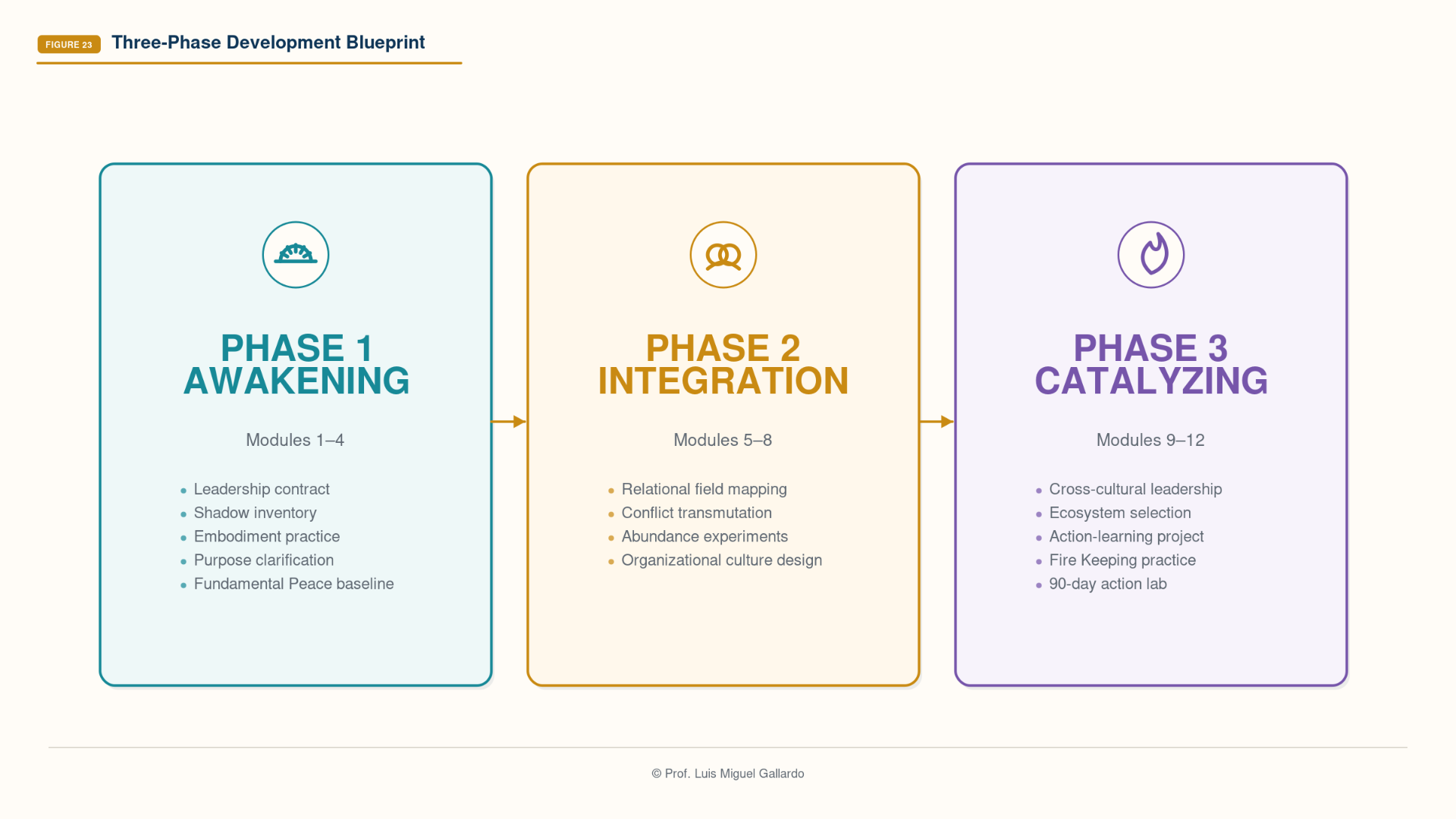
In my work, captured within "The Transpersonal Leader," I often speak of a profound journey, not merely a skills upgrade. Leadership, at its heart, is a transformative act, moving us beyond conventional boundaries into a space of expanded awareness and deeper connection. This journey necessitates a structured yet fluid path, which I have distilled into what I call the Three-Phase Development Blueprint. This blueprint, detailed as Figure 23 in my book, serves as the very architecture for cultivating transpersonal leadership.
Phase 1: Awakening – The Call to Deeper Self-Awareness
The initial phase, 'Awakening,' is a profound invitation to look inward, to truly see oneself with fresh eyes. It’s about becoming acutely aware of the inner workings that shape our perceptions, decisions, and interactions. We begin by exploring our personal history, the narratives that have defined us, and the unconscious patterns that often dictate our responses. This isn’t a superficial examination; it’s a deep dive into the wellsprings of our being, echoing Carl Jung's profound explorations of the shadow and the collective unconscious. By illuminating these aspects, we start to dismantle limiting beliefs and connect with our intrinsic motivations. This phase asks: What are the core drivers within me, and how do they serve or hinder my authentic expression?
Module 1, for instance, focuses on "The Transpersonal Leader as an Integral Human Being," setting the stage for self-inquiry rather than merely skill acquisition. It's here that we begin to sense the subtle shifts required to move from an ego-centric view to an eco-centric one, a journey Otto Scharmer eloquently describes in his concept of 'presencing'—sensing into the emerging future from the deepest source of self. This foundational self-awareness is the bedrock upon which all subsequent leadership development blueprint phases are built. Without this awakening, any attempts at external leadership are akin to building a house on sand.
Phase 2: Integration – Embodying the Expanded Self
Once the seeds of awareness are sown, the next crucial phase is 'Integration.' This is where the insights gained during Awakening are woven into the fabric of our daily lives and leadership practice. It’s no longer just about understanding; it's about embodying. Here, we delve into practices that cultivate emotional intelligence, resilience, and coherence—themes extensively explored by organizations like HeartMath Institute. Learning to regulate our internal states, to respond rather than react, becomes paramount. We develop the capacity for deep listening, both to ourselves and to others, moving beyond cognitive comprehension to an empathic attunement.
Modules within this phase might include "Cultivating Emotional Resilience and Intuition" or "Mastering Authentic Communication." This phase asks: How do I live and lead from this expanded sense of self consistently, especially under pressure? It acknowledges that true leadership isn't just about strategy; it's also about presence and emotional intelligence. Daniel Siegel's work on 'interpersonal neurobiology' offers powerful insights into how our internal integration directly impacts our ability to connect meaningfully with others. This period of assimilation ensures that the principles of transpersonal leadership are not simply intellectual concepts but lived realities, making the leadership development blueprint not just a plan, but a felt experience.
Phase 3: Catalyzing – Impacting the World with Purpose
The final phase, 'Catalyzing,' is where the integrated leader steps fully into their role as a force for positive change. Having cultivated deep self-awareness and integrated these insights into their being, the transpersonal leader is now uniquely positioned to inspire and guide collective transformation. This phase is less about individual achievement and more about collective flourishing. It involves leading with purpose, fostering collaborative environments, and addressing complex challenges with courage and compassion.
"The ultimate purpose of leadership is not to serve oneself, but to serve the greater whole – to catalyze a future that benefits all sentient beings." (L.M. Gallardo, The Transpersonal Leader, 2024)
Modules here might explore topics such as "Designing for Systemic Change with Transpersonal Principles" or "Leading with a Global Conscience." This phase asks: How can I leverage my integrated self to create meaningful, sustainable impact in my organization and the world? It’s about consciously shaping culture, empowering others, and contributing to the emergence of a more conscious future. This culmination of the leadership development blueprint is where individual transformation translates into collective evolution, manifesting the profound potential of transpersonal leadership.
These three phases are not linear steps to be completed and checked off. Rather, they represent an ongoing spiral of growth, where deeper insights continually emerge, requiring renewed integration and subsequent catalytic action. It’s a dynamic, lifelong process of becoming, calling us to always strive for our highest potential in service of a greater good.
With an embrace, Luis Miguel.