

Transpersonal Leadership · Essay
The Uncharted Depths of Leadership: Mastering the Three Levels of Listening
Deep listening leadership is the bedrock of presence, connection, and wisdom. Explore its three levels & their profound link to our Koshas.
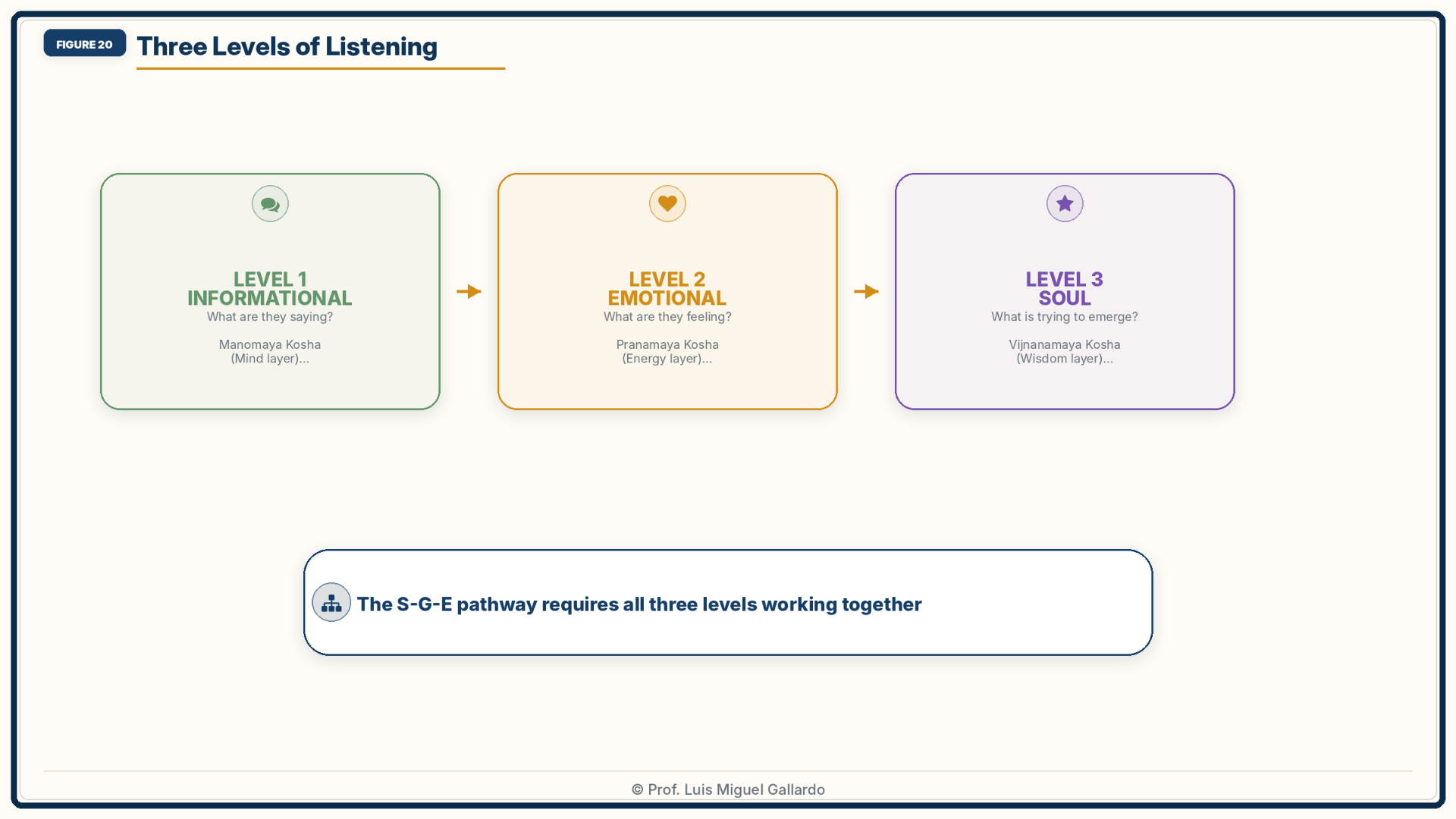
In a world clamoring for attention, the most profound act of leadership may well be the capacity to truly listen.
The Crisis of Inattention in Modern Leadership
We often speak of vision, strategy, and execution as the pillars of effective leadership. And while these are undoubtedly vital, I’ve come to believe, through my work with leaders across the globe and my own journey with the World Happiness Foundation, that the single most undertrained — and consequently, underdeveloped — skill is the nuanced art of listening. Think of the modern leader: perpetually barraged by data, meeting requests, and urgent notifications. The default mode becomes one of reaction, of processing information as quickly as possible to move on to the next task. This environment cultivates a superficiality of attention, a kind of constant skimming that barely scratches the surface of human interaction. The impact is profound: miscommunications proliferate, mistrust takes root, and the soulful essence of leadership, which depends on genuine connection, withers.
Many of us operate within what I call the Informational Level of Listening. This is where we process words, facts, figures, and logical arguments. It’s essential for understanding reports, project statuses, and operational directives. Is the data accurate? What are the key takeaways? What’s the next step? This level primarily engages our cognitive functions, mapping directly to what the ancient wisdom traditions of India call the Manomaya Kosha, the mental body, and the Vijnanamaya Kosha, the wisdom or intellectual body. Neuroscientifically, we're engaging executive functions, processing in the prefrontal cortex, sorting and categorizing. And yes, it is absolutely necessary. But it is far from sufficient for deep listening leadership.
Beyond the Words: The Emotional Landscape
To move beyond the purely informational, we must descend into the Emotional Level of Listening. Here, we're not just hearing the words, but sensing the feeling behind them. We're picking up on tone, pace, body language, and the unspoken subtext. Is there frustration, excitement, anxiety, or hope? This level requires us to engage our own emotional intelligence, to sense resonance in our own limbic system, to attune to the subtle cues that reveal the speaker's inner state. Leaders who cultivate this level can detect brewing conflicts before they erupt, understand underlying motivations, and build genuine rapport. Stephen Porges’ Polyvagal Theory offers a powerful lens here, as we unconsciously scan for safety and connection, interpreting subtle neuroception in the other’s prosody and facial expressions. When we engage at this level, we are touching upon the Pranamaya Kosha, the energy or vital body, sensing the life force and emotional currents flowing through the speaker. We're bringing Daniel Siegel's concept of 'mindsight' to bear, perceiving the internal world of others and ourselves, fostering a deeper sense of intersubjectivity.
The Profound Resonance: Soul Listening
But there is a third, even deeper level, one that is truly transformative: Soul Listening. This is where we move beyond the immediate emotional content to sense the underlying spirit, the deepest intentions, the emerging truth, or the core essence of the speaker's being. It's listening for what wants to emerge, for the higher purpose, for the essential humanity. It’s not about analyzing or problem-solving, but about creating a space for profound presence, a stillness that allows wisdom to surface. This is the realm where we listen not just with our minds or hearts, but with our entire being. It touches upon what Ken Wilber calls the 'aperspectival mind' and Michael Cook-Greuter's mature stages of ego development, where our capacity for self-transcendence allows us to hold multiple perspectives and listen from a place of profound spaciousness. HeartMath Institute's research on heart coherence provides a physiological underpinning, demonstrating how a coherent heart field can facilitate deeper attunement and intuitive understanding.
This level aligns with the Annamaya Kosha, the physical body, as we root ourselves in presence, and most profoundly, the Anandamaya Kosha, the bliss or causal body, which represents our deepest connection to joy, truth, and our essential self. Aurobindo speaks of this integration, the manifestation of spirit in matter. When we listen at this level:
- We create safety and trust.
- We facilitate genuine insight, both for the speaker and ourselves.
- We access collective intelligence and emergent wisdom.
- We foster transformation rather than mere transaction.
"The deepest forms of leadership arise not from commanding but from aligning. And alignment can only happen when the leader has the capacity to truly see, truly feel, and truly resonate with the soul of the collective they serve."
In our hurried world, to practice Soul Listening is an act of courage and radical presence. It means slowing down, silencing our inner monologue, suspending judgment, and offering our full, undivided attention. It requires us to cultivate self-awareness — understanding our own filters, biases, and emotional triggers — and developing a robust capacity for empathy. It is the core of deep listening leadership, a path to not just managing people, but to awakening their full potential and fostering truly thriving communities and organizations.
This isn't about being 'new agey' or ethereal. It's about grounded, scientifically-informed human connection. It's about understanding the full spectrum of human experience and bringing that understanding into our leadership. It recognizes that beneath all the data and emotions, there is a fundamental human longing to be seen, heard, and understood at the deepest possible level. Embracing these three levels of listening is not just a skill; it's a profound journey into what it means to be a truly human leader.
With an embrace, Luis Miguel.