Transpersonal Leadership · Essay
Conscious Leadership Theory of Change: 25 Million Catalysts for Global Impact
Discover how a conscious leadership theory of change, leveraging just 25 million catalysts, can profoundly transform global consciousness and ignite systemic shifts across 10 billion lives by 2050.
Friends,
In our increasingly interconnected world, the quest for meaningful change often feels daunting, almost Sisyphean. We see systemic challenges, global anxieties, and a pervasive sense that individual efforts are but a drop in a vast ocean. Yet, what if the dynamics of transformation operated through a different calculus? What if a relatively small number of deeply committed individuals could spark a wave of awakening so profound that it reaches every corner of our planet?
This is precisely the premise underpinning the conscious leadership theory of change I explore in The Transpersonal Leader (2024). It's a vision rooted not in naive optimism, but in a deep understanding of resonance, relationship, and the potent leverage points within complex human systems.
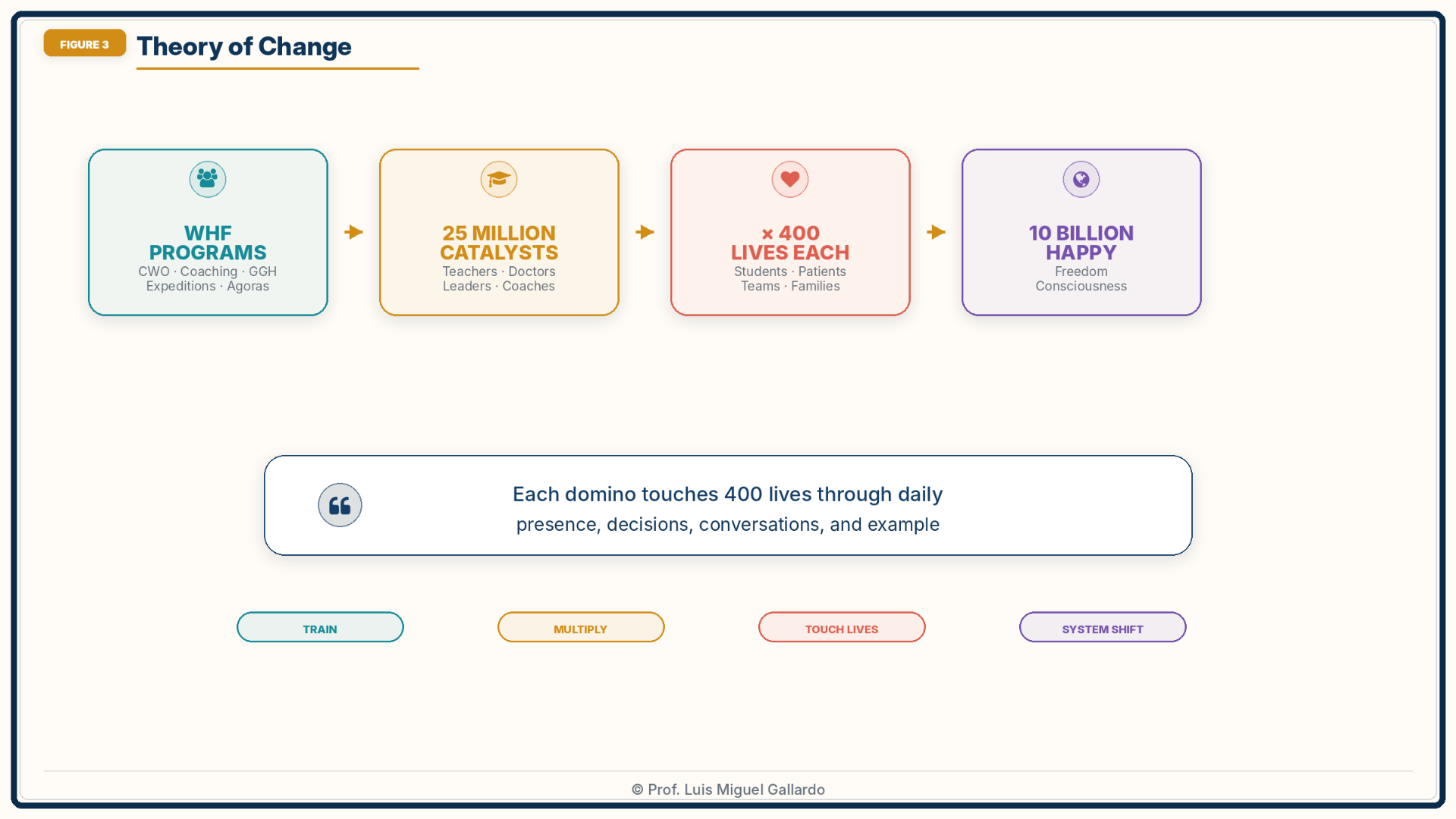
Let us consider the compelling mathematics of impact. If we aspire to reach 10 billion people by the year 2050, the magnitude seems overwhelming. However, imagine if we didn't need to reach each person directly. What if we focus on cultivating transpersonal leaders who act as catalysts, each capable of influencing a significant sphere of people around them? This model suggests that if just 25 million such leaders emerge globally, and each of them consciously influences approximately 400 individuals—their teams, their families, their communities, their networks—we arrive at the extraordinary figure of 10 billion.
This isn't merely a numbers game; it's a testament to the power of authentic presence, radical compassion, and the ability to operate from a place of deep interiority, which are hallmarks of the transpersonal leader. This influence extends beyond mere instruction; it inspires, activates, and elevates.
This idea is visually represented in Figure 3 — Theory of Change from my book. This figure illustrates a fractal model of influence, where individual transformation radiates outwards, creating ripple effects. It posits that a change in the internal condition of a leader—a shift from ego-centricity to eco-systemic awareness, from reactive decision-making to generative presence—does not remain confined to their personal sphere. It permeates their organizational culture, their community, and eventually, society at large. This is the essence of a conscious leadership theory of change.
Think about the implications. 25 million leaders in a world of 8 billion-plus sounds achievable, given focused effort and the right cultivation environment. These aren't necessarily CEOs or heads of state, although they could be. They are teachers, entrepreneurs, parents, community organizers, artists, and innovators—leaders at every level, in every domain. What unites them is their commitment to leading from a place of wholeness, guided by purpose and a recognition of our shared interdependence.
Such a conscious leadership theory of change draws inspiration from profound insights into human consciousness and systemic change. Otto Scharmer's concept of “presencing” from Theory U, for example, highlights the power of shifting from ego-system to eco-system awareness. When leaders tap into deeper sources of knowing, they don't just react to the current reality; they co-sense and co-create an emerging future. Similarly, Daniel Siegel's work on interpersonal neurobiology underscores how empathetic attunement and mindful presence can shape the neural pathways of those we interact with, fostering resilience and connection.
This is not a top-down mandate but an organic, bottom-up unfolding. It’s about creating fertile ground for these catalysts to emerge naturally, supporting their development, and connecting them in a network of shared purpose. The HeartMath Institute's research on heart coherence demonstrates how individual physiological states can entrain others, suggesting a scientific basis for this energetic transmission of conscious influence.
Our task, then, is not to fix the world, but to cultivate these 25 million catalysts. It’s a call to invest in inner development, to foster contexts where transpersonal qualities can flourish, and to recognize that true power resides not in control, but in connection and inspired action. This conscious leadership theory of change offers a hopeful, tangible path forward, demonstrating that we are, in fact, not too few.
With an embrace, Luis Miguel.