Transpersonal Leadership · Essay
The Unified System: FP20, ROUSER, the 12 Universal Laws, the Emotional Alchemy Mandala, the 111 Soul Dialogues, the 64 Meta Pets, the 6 Wounds — and the ITM with its 5 Stages and 7 Mechanisms
A deep map of the entire transpersonal architecture I have been refining for two decades — how Fundamental Peace, ROUSER, the laws, the Emotional Alchemy Mandala, the 64 Meta Pets, the soul dialogues, the wounds, and the Integrative Transformation Model weave into one coherent practice for the conscious leader.
Every working system I have ever loved — in physics, in music, in contemplative traditions, in leadership — has the same quiet property: its parts are not parts. They are facets of one living whole that reveals itself differently depending on the question you bring. This essay is my attempt to set down, in one place, the architecture of the system I have been refining for over two decades alongside leaders, founders, ministries and communities across more than fifty countries. It is the system that underwrites the World Happiness Foundation, The Transpersonal Leader, and the assessments and practices on this site: FP20, ROUSER, the 12 Universal Laws, the Emotional Alchemy Mandala (the 11 families of emotions read through Shadow → Gift → Essence), the 111 Soul Dialogues, the 64 Meta Pets (the S-G-E cards), the 6 Wounds, and the Integrative Transformation Model (ITM) with its 5 developmental stages and 7 mechanisms.
I want you to read what follows not as theory but as a map for daily practice. Each layer answers a different question of the soul, and each layer needs the others to stay honest.
1. The whole, in one breath
The simplest way to hold the system in your mind is this: FP20 measures the ground, ROUSER cultivates the practice, the 12 Laws describe the field, the Emotional Alchemy Mandala names what is moving through you and how to alchemise it, the 111 Soul Dialogues are the questions that unlock it, the 64 Meta Pets are the Shadow → Gift → Essence cards that personalise the inner work, the 6 Wounds are the original aches the shadows defend, and the ITM is the path — five stages and seven mechanisms — by which all of this becomes lived.
You can enter from any door. A founder in crisis usually enters through Wounds. A meditator usually enters through Soul Dialogues. A team usually enters through ROUSER. A child or a parent often enters through the Meta Pets. An analyst usually enters through FP20. The system is designed so that whichever door you choose, the same rooms open.
2. FP20 — the ground state
FP20 is the Fundamental Peace Scale, a twenty-item, four-component instrument I developed to measure what I call Fundamental Peace — not the absence of conflict, but the baseline coherence of a human being. Its four components are inner stillness, relational ease, meaning-coherence and embodied trust. Scored on a 1–7 Likert across twenty items, FP20 produces a total between 20 and 140 and a vector across the four components.
FP20 is the ground state. Everything else in the system is a way to move the FP20 vector. When inner stillness is low, the 12 Laws of Vibration and Rhythm become the leverage. When meaning-coherence is low, the Soul Dialogues become the leverage. When relational ease is low, ROUSER's Relations pillar becomes the leverage. FP20 tells you where to apply the rest of the system.
3. ROUSER — the practice layer
If FP20 is the diagnostic, ROUSER is the prescription. Its six pillars — Relations, Openness, Understanding, Self-Awareness, Empowerment, Reflection — are the daily ground on which a transpersonal leader trains. Each pillar is rated 1–10 and paired with reflective practice. ROUSER answers the question "how do I live this in the next twenty-four hours?" The pillars are not personality traits; they are habits of consciousness.
ROUSER's relationship with FP20 is recursive: a higher ROUSER average lifts FP20 over time, and a higher FP20 makes ROUSER easier to embody. The two are designed to be repeated quarterly and read together.
4. The 12 Universal Laws — the field
The 12 Universal Laws (Divine Oneness, Vibration, Correspondence, Attraction, Inspired Action, Perpetual Transmutation, Cause and Effect, Compensation, Relativity, Polarity, Rhythm, Gender) are the physics of the inner world. I treat them not as metaphysics to believe in, but as operational principles intuited by every major wisdom tradition and corroborated, in different language, by systems theory, polyvagal science, and quantum field models.
Their role in the system is to tell us what kind of move is available at any given moment. If a leader is stuck in repetition, the Law of Rhythm is asking for a fallow season. If a leader keeps attracting the same conflict, the Law of Correspondence is asking for an internal audit. If a culture feels frozen, the Law of Perpetual Transmutation reminds us that nothing is fixed. The laws are the grammar. ROUSER is the sentence.
5. The Emotional Alchemy Mandala — Shadow → Gift → Essence across 11 families
Beneath cognition, emotion is the water that moves through the body. The Emotional Alchemy Mandala is the map I use — and which I describe in detail in Emotional Alchemy Mandala — to organise eleven emotional families along a single trajectory: Shadow → Gift → Essence (S-G-E).
Every emotion carries intelligence. The question is never how do I get rid of it; it is how do I liberate the energy inside it. The Mandala teaches us to name the contraction (Shadow), activate its healthy function (Gift), and touch the deeper truth beneath it (Essence).
The eleven families and their S-G-E arc:
- Fear — Shadow: anxiety, dread → Gift: awareness, vigilance, courage → Essence: trust, presence.
- Anger — Shadow: irritation, rage, contempt → Gift: clarity, boundaries → Essence: fierce compassion, strength.
- Sadness — Shadow: grief, despair → Gift: empathy, depth → Essence: love, oneness.
- Disgust / Aversion — Shadow: contempt, loathing → Gift: discernment, integrity → Essence: truth, alignment.
- Shame — Shadow: embarrassment, self-disgust → Gift: humility, accountability → Essence: innocence, self-acceptance.
- Guilt — Shadow: remorse, moral injury → Gift: repair, responsibility → Essence: freedom, integrity.
- Envy / Jealousy — Shadow: envy, possessiveness → Gift: aspiration, appreciation → Essence: inspiration, abundance.
- Surprise / Uncertainty — Shadow: shock, confusion → Gift: curiosity, openness → Essence: awe, reverence.
- Joy / Pleasure — Shadow: clinging excitement, hubris → Gift: playfulness, gratitude → Essence: bliss, unconditional love.
- Love / Bonding — Shadow: clinging, obsession → Gift: affection, care, intimacy → Essence: wholeness, divine love.
- Peace / Calm — Shadow: numbness, apathy → Gift: serenity, equanimity → Essence: peace, spaciousness.
Naming the family — and then the pole within it — is the first act of alchemy. A leader who can say "this is the Shame family, in its self-disgust form" is already halfway home, because the un-named emotion is the one that runs the meeting from underneath. The Mandala connects upward into the Laws (every family is a vibration), inward into the Wounds (every family is a doorway to one of the six original aches), and outward into ROUSER (every family is regulated through a pillar).
6. The 111 Soul Dialogues — the unlocking questions
The 111 Soul Dialogues are the questions that open the soul without forcing it. They are organised into eleven sets of eleven, one set per family of the Emotional Alchemy Mandala. Within each set, the eleven questions move from surface (situational) through middle (relational) to depth (existential).
A sample of the architecture:
- Fear set, question 1: "What is the smallest version of this fear that I can name out loud?"
- Fear set, question 6: "Whose fear, that came before mine, am I still carrying?"
- Fear set, question 11: "If this fear were a teacher, what is the one thing it has been trying to say my whole life?"
The Soul Dialogues are the engine of insight. They make the Wounds visible, the Shadows nameable, the Laws applicable. They are designed to be lived slowly — one per day, or one per session — and journalled. On this site, the Daily Pulse and the Peace Journal are partly an interface for the Soul Dialogues. The number 111 is not arbitrary: it is the eleven families multiplied by the eleven depths, a deliberate matrix that lets you locate exactly where a soul has gone quiet.
7. The 64 Meta Pets — the Shadow → Gift → Essence cards
The 64 Meta Pets are the heart of the Meta Pets Method I have been developing for the last decade. They are not archetypes from the I Ching or Gene Keys. They are sixty-four original beings, each one a tender, embodied portrait of a single human pattern, and each one rendered as a complete Shadow → Gift → Essence (S-G-E) card.
For every Meta Pet, the card shows three faces of the same energy:
- Shadow — the contracted form of the pattern (e.g., the Performer in burnout, the Pleaser in self-erasure, the Tyrant in fear-driven control).
- Gift — the conscious function inside the same energy (e.g., the Performer's dedication, the Pleaser's attunement, the Tyrant's protective clarity).
- Essence — the core quality that emerges when the pattern is integrated (e.g., devotion, intimacy, fierce love).
The sixty-four are not random. They are organised as eight constellations of eight, each constellation anchored to a developmental phase of a human life — womb, infancy, early childhood, latency, adolescence, early adulthood, mid-life, elderhood — and each one anchored to one of the 6 Wounds.
The Meta Pets are the bridge between abstraction and intimacy. A leader can read about "the inner critic" for years without changing; the same leader, when she meets the specific Meta Pet that carries her critic — its face, its name, its quote, its S-G-E triptych — finds that the pattern softens in a single sitting. This is why we render the system as cards, not as a list. The Meta Pets are designed to be drawn, flipped, contemplated, shared with children, used in family sessions, in coaching, in classrooms, and in therapeutic settings.
You can explore all sixty-four on this site at /meta-pets and draw one for today's reflection. Each draw and each thirty-day practice plugs directly into the larger ITM arc described below.
8. The 6 Wounds — the original aches and their healing virtues
At the deepest layer of the personal architecture lie the 6 Wounds of Humanity — the original aches that every human carries in some proportion, and around which the 64 Meta Pets cluster. I follow here the framing articulated by Richard Rudd in the Gene Keys tradition, which I describe in detail in Healing the Six Wounds of Humanity Through Love, Virtue, and Conscious Leadership. Each wound carries within it its own medicine — a healing virtue that is love meeting that specific form of suffering:
- Repression — the fear of expressing our true feelings and truths. Healing virtue: Honesty.
- Denial — the refusal to face reality or acknowledge pain. Healing virtue: Ease.
- Shame — a deep sense of unworthiness and humiliation. Healing virtue: Humour.
- Rejection — the feeling of being unwanted or excluded. Healing virtue: Gentleness.
- Guilt — the burden of inner wrongdoing or of having caused harm. Healing virtue: Forgiveness.
- Separation — the sense of disconnection from others, from purpose, from the divine. Healing virtue: Care / Love.
These six wounds do not just sit inside individuals; they echo across every level of our experience — personal, collective, racial, planetary. Repression scales into terror, denial into rage and violence, shame into panic and greed, rejection into hatred and colonisation, guilt into delusion and war, separation into annihilation and self-destruction. The six healing virtues are the antidotes at every scale.
Every leader I have worked with carries one primary wound and one secondary wound. The primary wound shapes the leader's defensive style; the secondary wound shapes the leader's blind spot. The work of the transpersonal leader is not to "heal" the wound in a cosmetic sense, but to let the wound become a window — a place where light passes through, where the leader's compassion becomes inexhaustible because it knows the ache from inside, and where the matching virtue (Honesty, Ease, Humour, Gentleness, Forgiveness, Care) becomes the daily medicine.
I have written the deep-study of exactly this layer — the six wounds together with the eleven emotion families and the sixty-four shadows — as a stand-alone paper, From Wound to Essence — an integrated inquiry architecture. The Wound-to-Essence Compass is the seven-minute self-assessment that operationalises the paper: it maps your primary wound, your dominant emotion family and the specific shadow you are wearing today, and hands you back a personal cartography that plugs directly into FP20 (as the pillars it touches) and ROUSER (as the daily practice it asks of you).
9. The Integrative Transformation Model (ITM) — the path
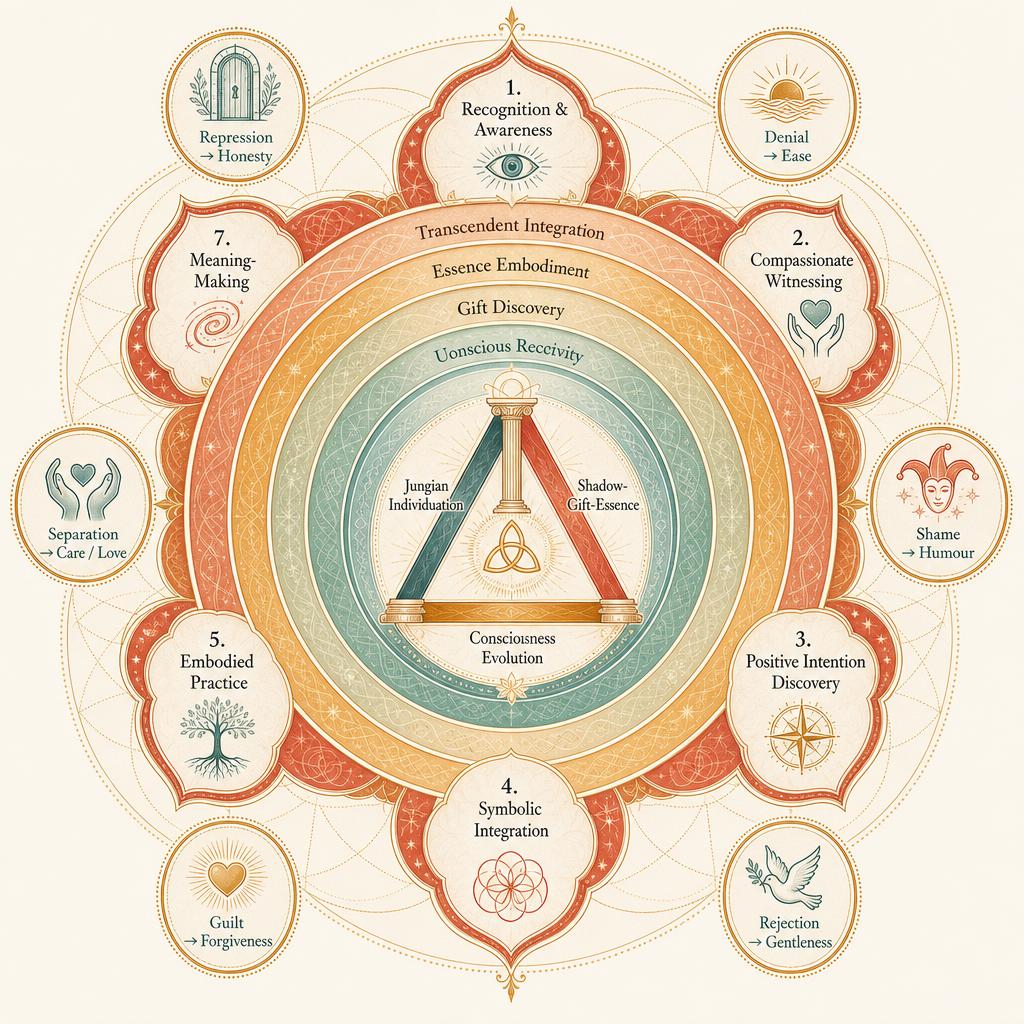
The Integrative Transformation Model (ITM) is the integrative path that operationalises everything above. I have described it in full in From Shadow to Essence: The Integrative Transformation Model (ITM) for Leaders and Changemakers. It rests on three pillars and unfolds through five stages powered by seven mechanisms.
The three pillars of the ITM
- Jungian Individuation. The lifelong process of becoming who we truly are. We cannot become whole by rejecting parts of ourselves; we must integrate the shadow to access the Self. The qualities a leader most resists in herself or in others usually hold the very capacities her leadership needs to evolve.
- The Shadow → Gift → Essence (S-G-E) Framework. The emotion-centred, practice-ready engine of the ITM. Shadow is the contracted pattern; Gift is the adaptive intelligence inside it; Essence is the authentic quality that emerges when Shadow and Gift are integrated. This is the same S-G-E carried by the Emotional Alchemy Mandala and by every Meta Pet card.
- Consciousness Evolution & Human Flourishing. The empirical layer, drawing on integral theory, positive psychology, and self-determination theory. Human consciousness evolves through predictable developmental stages; psychological well-being requires autonomy, competence and relatedness; shadow integration accelerates both personal growth and collective evolution.
The 5 ITM Stages
Transformation is not random; it follows a developmental arc. The ITM maps this arc as five stages:
- Unconscious Reactivity. Driven by unexamined patterns. A critical comment triggers defensiveness. A setback spirals into self-doubt. You react before you realise what is happening. FP20 is typically 60–80; ROUSER averages below 5.
- Conscious Recognition. You begin to notice the patterns. You catch yourself mid-reaction and think, "there I go again". Awareness emerges even if you cannot yet change the behaviour. The dominant Meta Pet starts to come into focus.
- Gift Discovery. You look beneath the reactive pattern and discover its positive intention. That defensiveness is protecting your integrity. That self-doubt is ensuring you maintain high standards. The Gift face of the Meta Pet reveals itself.
- Essence Embodiment. You integrate the gift consciously. You can now access healthy assertiveness without defensiveness, or maintain standards without self-attack. You embody a new quality. FP20 rises into the 90–110 range; ROUSER stabilises above 7.
- Transcendent Integration. The transformation becomes second nature. You move fluidly between perspectives, hold paradox with ease, and access wisdom that transcends your individual psychology. The leader becomes a channel for collective intelligence.
Most leadership development stops at Stage 2 (awareness) or offers behavioural techniques that bypass the shadow entirely. The ITM takes you all the way through to embodied wisdom.
The 7 ITM Mechanisms
Transformation happens through seven interconnected mechanisms. They are not linear; they work synergistically — each strengthens the others.
- Recognition & Awareness — noticing patterns without judgment. The Emotional Alchemy Mandala lives here.
- Compassionate Witnessing — holding your experience with kindness. The contemplative core of the method.
- Positive Intention Discovery — finding the Gift inside the Shadow. The S-G-E hinge.
- Symbolic Integration — working with images, metaphors and somatic experience. This is where the 64 Meta Pets do their most powerful work, because the symbol bypasses the defended verbal self.
- Embodied Practice — anchoring new capacities in body and behaviour. ROUSER's daily micro-practices live here.
- Relational Mirroring — using relationships as transformation catalysts. The team, the partner, the child as the truest mirror.
- Meaning-Making — weaving experience into coherent narrative and purpose. The 111 Soul Dialogues live here.
Traditional leadership development focuses on skill acquisition (mechanism 5) while ignoring the psychological foundations (mechanisms 1–4) and relational/existential dimensions (mechanisms 6–7). The ITM insists that sustainable transformation requires all seven.
10. How the layers map onto one another
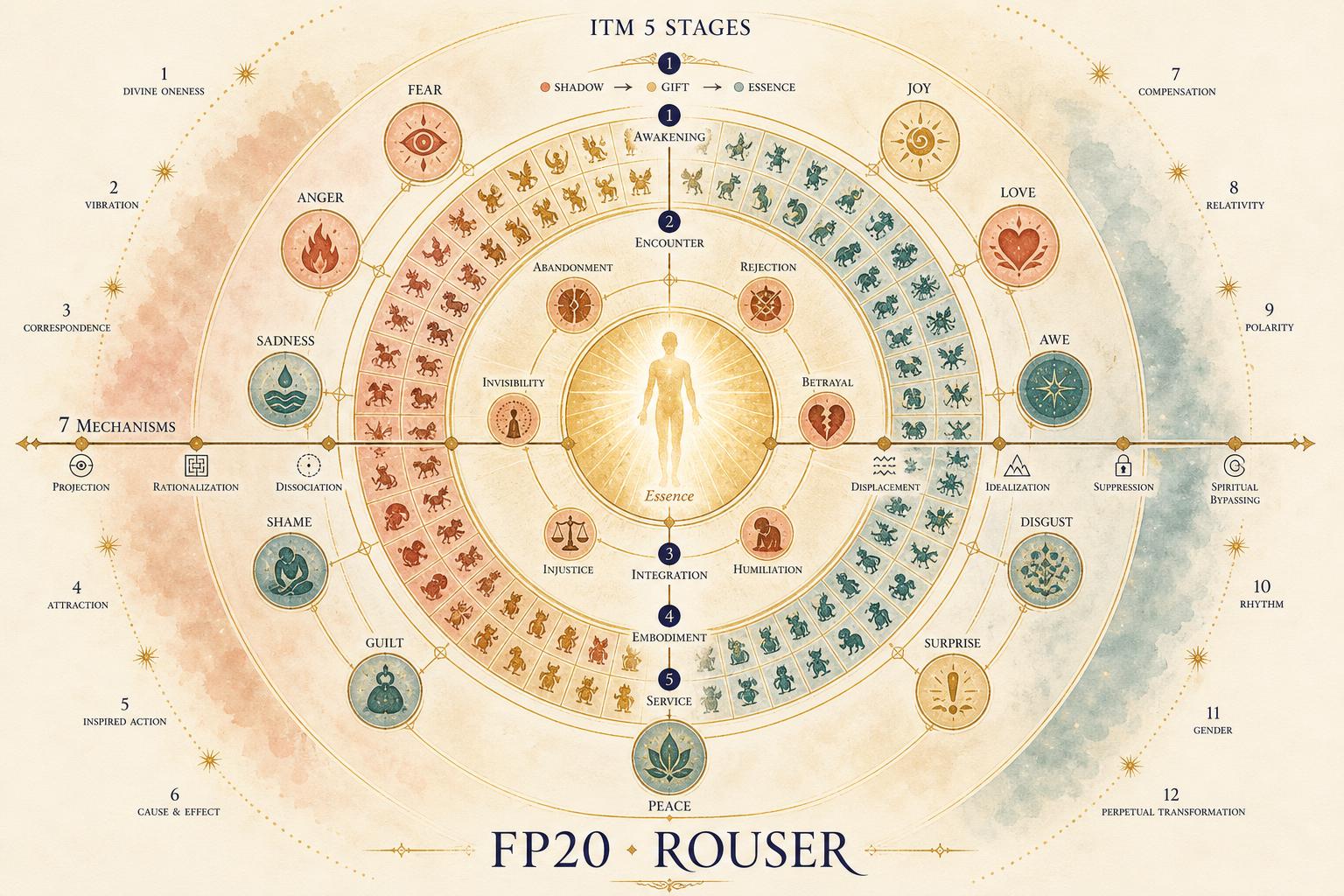
It helps to see the layers side by side. Read the figure below slowly, as a meditation rather than a reference — each row a layer, each column a different question the system answers:
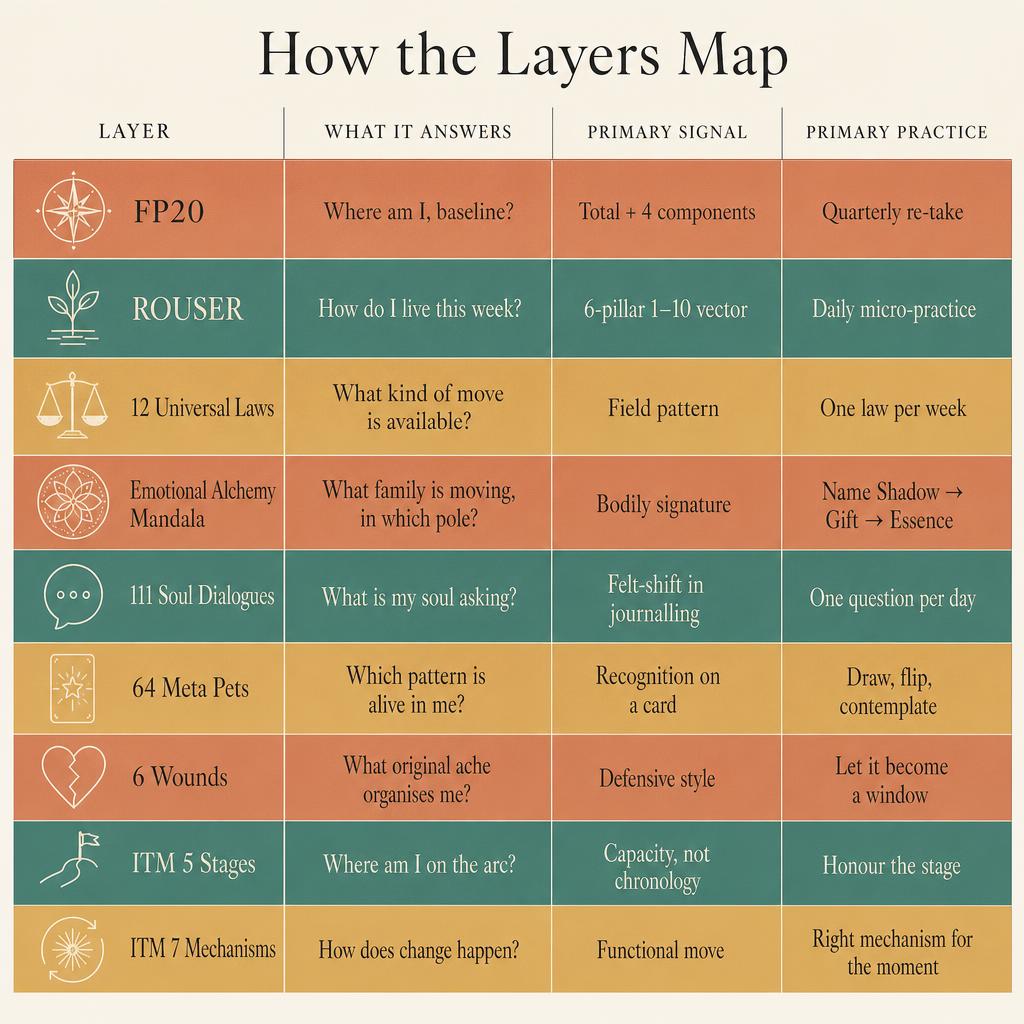
There is no hierarchy of importance — only of function. A leader who tries to embody (Essence Embodiment, Stage 4) before she has done Recognition & Awareness (mechanism 1) will spiritualise her wound. A leader who recognises without ever doing Relational Mirroring (mechanism 6) will become an excellent diagnostician of her own paralysis. The mechanisms are sequential within a moment, but recursive across a life.
11. A worked example
Let me walk one composite case through the whole architecture, so you can see the system move.
A founder, mid-forties, comes to me after the third senior departure in eighteen months. Her FP20 is 82, with relational ease at 3.4 (low) and meaning-coherence at 5.8. Her ROUSER shows Self-Awareness at 8 (high), Relations at 4 (low), Reflection at 5. She is firmly in ITM Stage 1 — Unconscious Reactivity.
- Recognition & Awareness (mechanism 1, via the Emotional Alchemy Mandala) reveals that the dominant family is Anger in its contempt pole, hiding Sadness in its grief pole. She moves into Stage 2 — Conscious Recognition.
- Compassionate Witnessing (mechanism 2) over two weeks of journalling lets her sit with the contempt without acting on it.
- Positive Intention Discovery (mechanism 3) opens the Gift inside the anger: clear boundaries in service of the work she loves. This is Stage 3 — Gift Discovery.
- Symbolic Integration (mechanism 4) lands the work. She draws Meta Pet #29 — the Tyrant — and meets, on a single card, its Shadow (fear-driven control), its Gift (protective clarity) and its Essence (fierce love). The card does in one evening what a year of analysis had not done.
- Embodied Practice (mechanism 5): ROUSER's Relations pillar gets a weekly ritual — a thirty-minute walking 1:1 with a different team member, no agenda — and a daily HeartMath-style coherence breath. The Law of Perpetual Transmutation becomes a deliberate practice for one weekly executive meeting.
- Relational Mirroring (mechanism 6): she invites two trusted peers into a monthly triad to mirror her, not advise her.
- Meaning-Making (mechanism 7): Soul Dialogue 47 — "Whose voice, that came before mine, do I hear when I am most hard on others?" — uncovers the primary Wound of Rejection (with its healing virtue Gentleness) and the secondary Wound of Separation (with its healing virtue Care / Love). The wound becomes a window. She enters Stage 4 — Essence Embodiment. Over six months FP20 rises to 108; two departed executives ask to come back.
Eighteen months in, she opens a quarterly two-hour internal session called "the unguarded hour", where she models naming her own family, her own Meta Pet and her own wound in front of her team. The culture shifts. This is Stage 5 — Transcendent Integration.
She did not "fix herself". She let the system live through her.
12. A closing word on integrity
I want to be transparent about one thing. The numbers in this architecture — twenty items, six pillars, twelve laws, eleven families, one hundred and eleven dialogues, sixty-four Meta Pets, six wounds, five stages, seven mechanisms — are not numerology. They are the structural choices that two decades of practice converged on, the way a luthier eventually settles on a particular curve for the violin's belly. Other practitioners will draw the curve differently. What matters is not the count, but the coherence: that every layer has a clear job, that no layer is doing another layer's work, and that the whole thing is in the service of a real human being trying to lead from soul rather than from script.
This is the unified system. It is what I teach in The Transpersonal Leader, what the FP20 and ROUSER assessments measure, what the Daily Pulse and the Peace Journal practice, what the Emotional Alchemy Mandala and the ITM describe in detail, and what the 64 Meta Pets make intimate. None of it works without the others. All of it works, with patience, when held together.
If you are reading this and feeling the quiet pull to begin, my counsel is simple: take the FP20 once, the ROUSER once, draw one Meta Pet tonight, write one Soul Dialogue, and let the system meet you where you are. The path will reveal itself one mechanism at a time.
With an embrace,
Luis Miguel.