

Transpersonal Leadership · Essay
The Neuroscience of Fundamental Peace in Leadership
Explore the neural correlates underlying fundamental peace, revealing how practices attentive to our physiological and cognitive landscapes can cultivate this essential state for impactful, compassionate leadership.
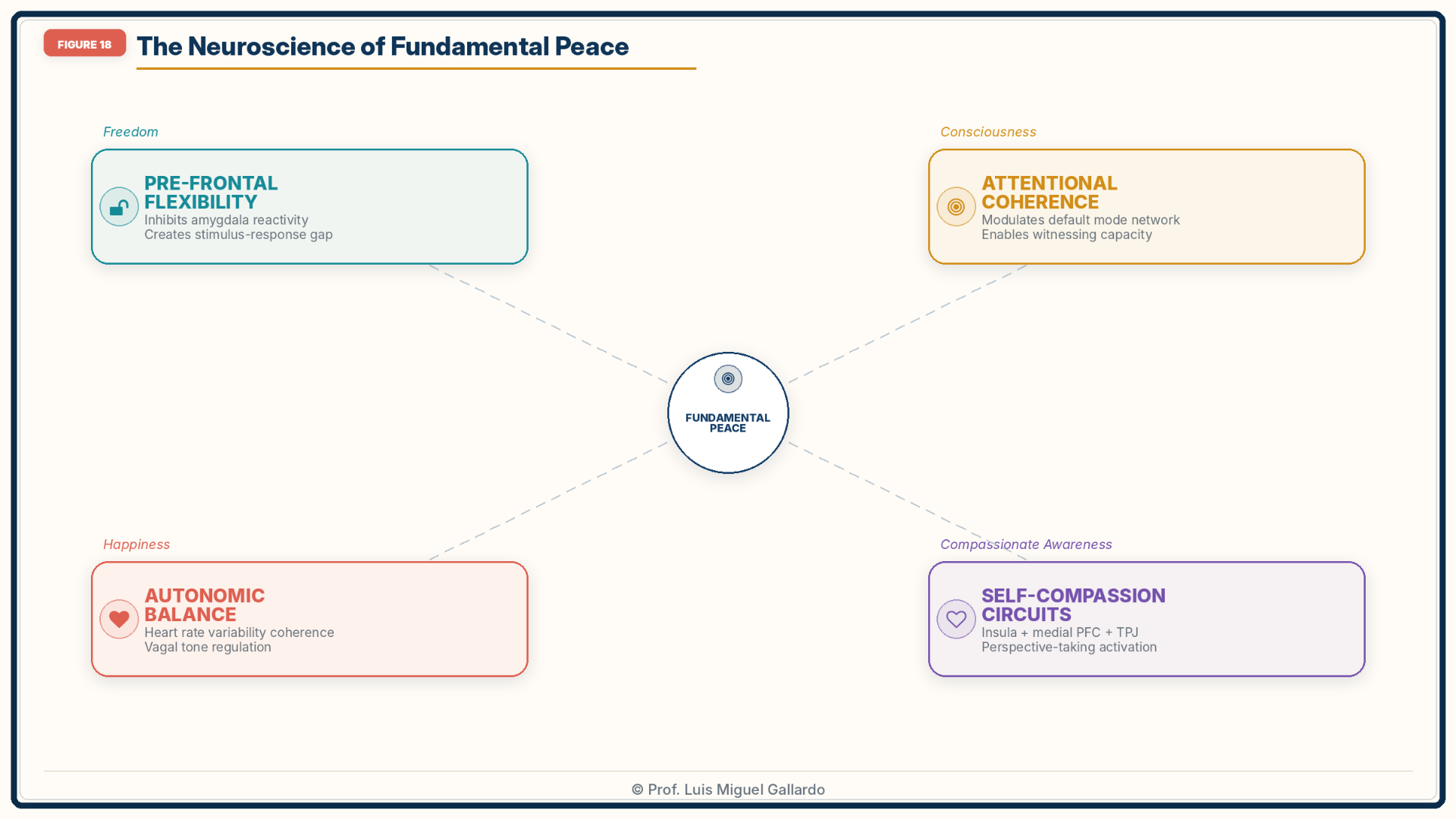
In my work on transpersonal leadership, particularly in Chapter 5, I delve into the profound concept of fundamental peace, differentiating it from mere absence of conflict. This isn't a passive state, but an active, generative wellspring from which authentic leadership emerges. To truly understand its depth, we must turn to the brain, exploring the neuroscience of fundamental peace and its vital role in developing leaders capable of guiding with wisdom and compassion.
Our human experience is profoundly shaped by our nervous system. When we speak of fundamental peace, we are touching upon a state of deep physiological and psychological regulation. This state is not accidental; it is underpinned by specific neural signatures that can be cultivated and strengthened through conscious practice. It’s here that the convergence of ancient wisdom and modern science truly shines, offering tangible pathways toward more integrated and effective leadership.
One of the primary neural correlates of fundamental peace is a well-regulated vagal tone. The vagus nerve, a key component of the parasympathetic nervous system, plays a crucial role in mediating our 'rest and digest' response. A higher vagal tone signifies greater resilience, emotional regulation, and social engagement—qualities inherent to a peaceful, centered leader. When the vagus nerve is operating optimally, we are less susceptible to the reactive patterns of fight, flight, or freeze, allowing for more thoughtful and intentional responses. Stephen Porges’ Polyvagal Theory offers an eloquent framework for understanding how our autonomic state profoundly impacts our capacity for connection and regulation, which is essential for embodying this deep state of neuroscience peace leadership.
Simultaneously, fundamental peace is characterized by changes in our brain's default mode network (DMN). The DMN is a network of brain regions that are active when our minds are wandering, envisioning the future, or ruminating on the past. While vital for self-reflection and meaning-making, an overactive DMN can lead to excessive self-referential thought and anxiety, pulling us away from the present moment. In states of deep peace, the DMN tends to quiet down, allowing for a greater sense of presence, clarity, and non-distraction. This quieting is not an absence of thought, but a shift towards less entangled, more spacious awareness, providing the mental clarity necessary for strategic and empathetic decision-making.
Another critical aspect is the enhanced prefrontal-amygdala coupling. The prefrontal cortex (PFC), particularly the ventromedial PFC, is associated with executive functions, emotional regulation, and reasoned decision-making. The amygdala, on the other hand, is a key player in processing emotions, especially fear and anxiety. In leaders experiencing fundamental peace, there's a stronger, more coherent connection between these two areas. This allows the PFC to exert greater top-down control over amygdala activity, preventing emotional hijackings and fostering a measured response to stress. This nuanced interplay helps leaders to remain calm under pressure, making judicious decisions rather than reactive ones.
Figure 18 in "The Transpersonal Leader" beautifully illustrates these interconnected neural processes, demonstrating how they collectively contribute to the state of fundamental peace. It’s not about isolating one neural correlate, but understanding their synergistic dance. This dance is further harmonized by heart rate variability (HRV) coherence. HRV coherence reflects the healthy, rhythmic oscillations between the sympathetic and parasympathetic nervous systems. When we achieve HRV coherence, our physiological systems operate with greater efficiency and synchronicity. Organizations like HeartMath have extensively researched the positive impact of HRV coherence on cognitive function, emotional stability, and overall well-being. A leader operating from a state of high HRV coherence is better able to sustain attention, manage stress, and inspire others through their calm and steady presence.
"To lead from a place of fundamental peace is to lead from the very core of one's regulated being, where wisdom meets compassion and intention aligns with impact." This quote from my book encapsulates the essence of what happens when the neuroscience of peace leadership becomes a lived reality.
Cultivating these neural states is not mystical; it is practical and achievable. Practices such as mindfulness, conscious breathing, self-compassion, and embodied awareness directly influence these neural pathways. By regularly engaging in such practices, leaders can intentionally sculpt their brains and nervous systems, moving beyond a state where peace is merely an intellectual concept to one where it is deeply embodied. This neurophysiological grounding empowers leaders to navigate complexity with grace, foster genuine connection, and inspire transformation from a place of genuine inner serenity. The ongoing exploration of neuroscience peace leadership will continue to deepen our understanding and refine our approaches to developing leaders who can truly make a difference in our turbulent world.
With an embrace, Luis Miguel.