Transpersonal Leadership · Essay
Navigating the Four Movements of Transformation: From Defended to Essential Self
Explore the subtle yet profound internal journey of leaders as they move through the Defended, Wounded, and ultimately towards the Essential Self, unlocking their deepest potential.
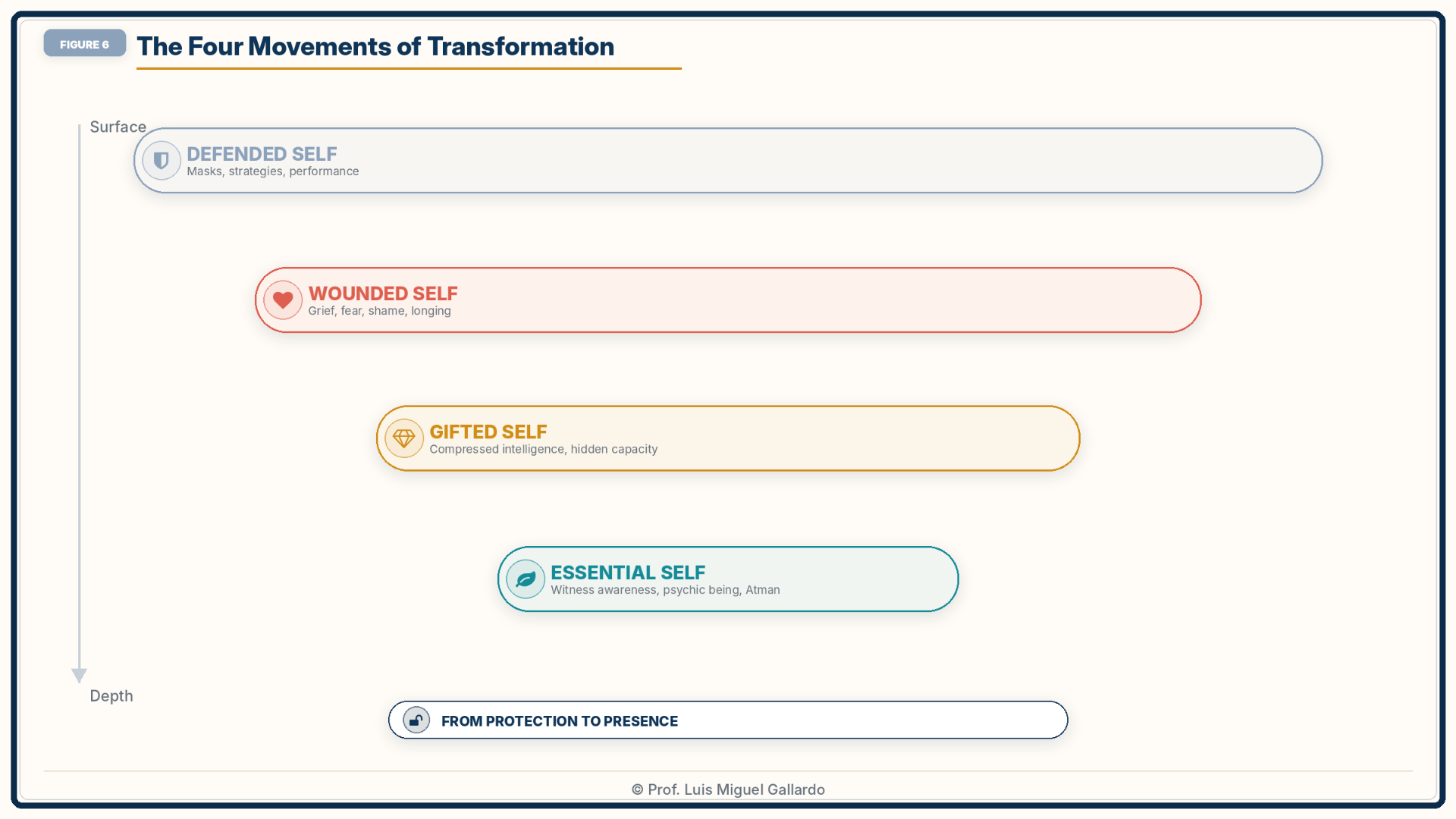
My work in The Transpersonal Leader delves into the profound interior shifts that define authentic leadership. One of the central frameworks for understanding this journey is captured in Figure 6: The Four Movements of Transformation. This isn't a linear progression, but rather a dynamic, often recursive, unfolding of our inner landscape.
At the outset, many leaders operate from a place I describe as the Defended Self. This is the self that, for various developmental and experiential reasons, has erected walls—psychological and emotional barriers—to protect itself from perceived threats, vulnerabilities, and potential judgment. These defenses, often unconsciously adopted, manifest as controlling behaviors, excessive intellectualization, a need for external validation, or an inability to truly listen. It's a survival mechanism, perfectly logical in its formation, yet limiting in its mature expression. We see this in leaders who prioritize process over people, metrics over meaning, or control over collaboration. The defended self, while seeking safety, paradoxically isolates us, preventing genuine connection and hindering the emergence of our full capacity.
Beneath the layers of the Defended Self lies the Wounded Self. This is the vulnerable core containing past hurts, unresolved traumas, fears, and insecurities that the defenses were built to shield. Encountering this layer can be disorienting, even painful. Yet, as Carl Jung so eloquently described, it is often in the 'shadow' that our greatest potential for growth resides. A leader willing to genuinely confront their wounded self—not to dwell in it, but to acknowledge and integrate its lessons—begins to dismantle the very foundations of their defenses. This might involve recognizing patterns of self-sabotage, understanding the origins of their anxieties, or processing past failures with greater compassion. This movement requires a particular kind of courage, moving from the often comfortable but constricting fortress of the defended self into the open, tender field of self-awareness. It's a process akin to what Otto Scharmer refers to as 'presencing,' a deep listening to the emergent future from the field of highest potential.
As the wounds are acknowledged and integrated, a remarkable shift begins to occur. The energy previously consumed by defending and avoiding is liberated, paving the way for the emergence of the Gifted Self. This is not about external accomplishments or talents, but about the inherent positive qualities that were either suppressed by the defenses or obscured by the pain of the wounded self. It's the intrinsic compassion, creativity, resilience, wisdom, and intuitive knowing that resides within us. Here, leadership becomes less about 'doing' and more about 'being.' The leader starts to lead from a place of genuine curiosity, empathy, authenticity, and courage. They access their unique contribution—their 'gift'—not as something to prove, but as something to offer. This phase is characterized by a growing sense of inner freedom and a natural inclination towards service and contribution, transcending mere self-interest. It is the spontaneous overflow of a heart that has found its balance and expression.
The culmination of this fluid process, though never truly 'finished,' is the unveiling of the Essential Self. This is our deepest being, our authentic core, untainted by conditioning or personal history. It is the self that transcends ego, fully interconnected with all of life, operating from a place of profound inner peace, unshakable clarity, and boundless compassion. The Essential Self embodies true transpersonal leadership – leading from a place of wholeness, where personal agenda dissolves into universal purpose. This state is not about achieving perfection, but about realizing our innate interconnectedness and allowing our actions to flow from this deep wellspring of wisdom. Daniel Siegel's work on 'interpersonal neurobiology' hints at how our integrated self contributes to a more integrated, coherent collective.
These four movements — from the Defended Self, through the Wounded Self, unveiling the Gifted Self, and ultimately resonating with the Essential Self — represent a profound journey of internal transformation. It is a journey marked by humility, courage, and a deep commitment to self-awareness. For true leadership to emerge, we must be willing to continuously engage with this internal tapestry, understanding that each movement informs and enriches the others. It is in this ongoing dance that we discover the true meaning of leading from within.
With an embrace, Luis Miguel.