

Transpersonal Leadership · Essay
Essential Self Leadership: Integrating the Defended Self at Work
Discover how to lead authentically from your essential self in the workplace by compassionately integrating your defended aspects, fostering genuine transformation and deeper connections.
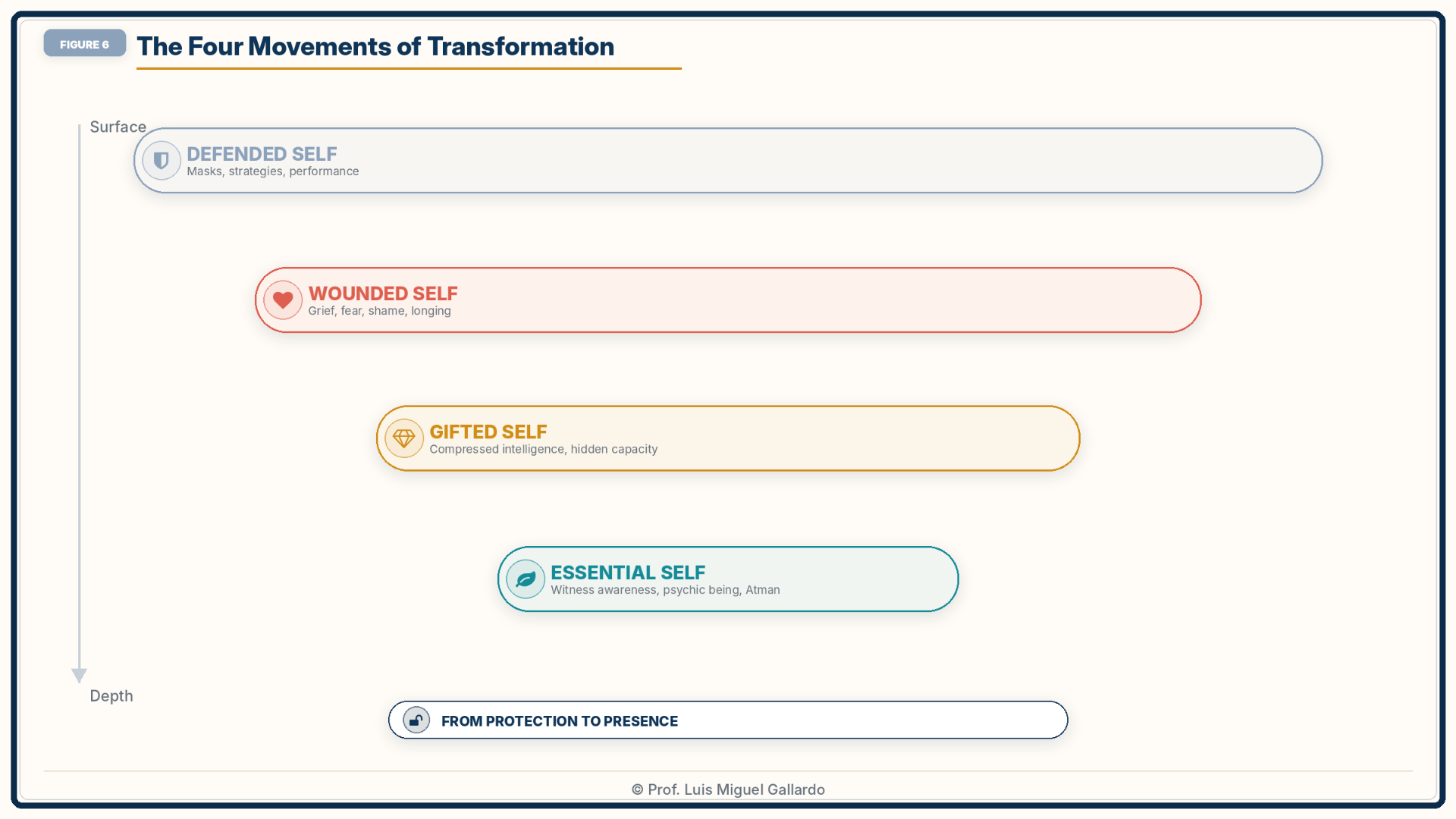
In my work, elaborated in The Transpersonal Leader, I often return to a foundational truth: authentic leadership stems from a profound connection to one's essential self. This isn't about ignoring the complexities of our human experience, but rather engaging with them from a place of depth and coherence. The journey to essential self leadership is not a bypassing of our vulnerabilities or defenses, but a thoughtful, compassionate integration of these very protective layers.
The Dance of the Essential and the Defended Self
Many conventional leadership models encourage us to power through challenges, to project an image of unwavering strength. While resilience is vital, this often means pushing aside the parts of ourselves that feel vulnerable, anxious, or insecure – what I term the 'defended self.' These defenses, as Daniel Siegel’s work on integration and attachment beautifully illustrates, often arise from early experiences where our essential needs for safety and belonging were not fully met. They are not weaknesses to be overcome, but rather sophisticated strategies our psyche developed to protect a more tender core.
Yet, true essential self leadership demands a different approach. When we lead solely from our defenses – from a place of fear, control, or the need for external validation – our leadership becomes brittle, unsustainable, and often alienating. Colleagues and teams can sense this disjunction; they perceive the mask, even if they cannot articulate it. The key lies in understanding that our defended self, while sometimes limiting, also carries vital information and a deep longing for safety and acceptance.
Integrating, Not Transcending: A Path to Whole Leadership
How then do we lead from our essential self without inadvertently shaming or suppressing the defended self? The answer lies in integration, not transcendence. It is about bringing compassion and presence to these protective parts, understanding their positive intention, and gradually inviting them into dialogue with our essential wisdom. This is one of the profound movements depicted in Figure 6 of The Transpersonal Leader, "The Four Movements of Transformation," particularly in the journey from 'Separation' towards 'Integration' and 'Coherence.' It's a continuous circular movement, not a linear progression, where integration is a felt sense, not a logical step.
Consider a leader who finds themselves constantly micromanaging, perhaps a hallmark of a defended self driven by anxiety about outcomes. Instead of simply trying to `stop` micromanaging through willpower (which often leads to a different, equally defended behavior), an integrative approach would involve:
- Acknowledging the defense: "I notice I'm feeling a strong urge to control this project detail very closely."
- Exploring its positive intention: "What is this urge trying to protect? Perhaps it's a fear of failure, or a desire for the team to succeed at all costs."
- Connecting to the essential self: "From my deeper wisdom, what truly serves this team? What kind of leader do I aspire to be in this moment?"
- Responding from choice: "Instead of controlling, can I offer empowering guidance? Can I trust my team more deeply?"
This is a process of mindful self-inquiry, echoing Otto Scharmer's concept of 'presencing' – sensing from the emerging future rather than reacting from past patterns. It allows us to hold our defended parts with empathy, recognizing their historical purpose, while consciously choosing to lead from the expansive, creative, and courageous space of the essential self.
"Our defenses are not enemies to be vanquished but old friends who need reassurance that they are no longer solely responsible for our safety. The essential self offers this reassurance, providing a new foundation of trust and inner security."
By engaging with our defended selves from a place of kindness and curiosity, we diminish their grip. We demonstrate to ourselves that we can hold discomfort, learn from it, and still operate from our deepest values. This internal integration then naturally extends outwards, fostering environments of psychological safety, trust, and genuine collaboration within our teams. It is the cornerstone of sustainable essential self leadership – a leadership that is both powerful and profoundly human.
With an embrace, Luis Miguel.