
Transpersonal Leadership · Essay
The Ripple Effect Leadership: Conscious Choices and Collective Transformation
Discover how a single conscious leader's actions initiate a powerful ripple effect, transforming teams, families, and broader ecosystems through neurobiological contagion and co-regulation.
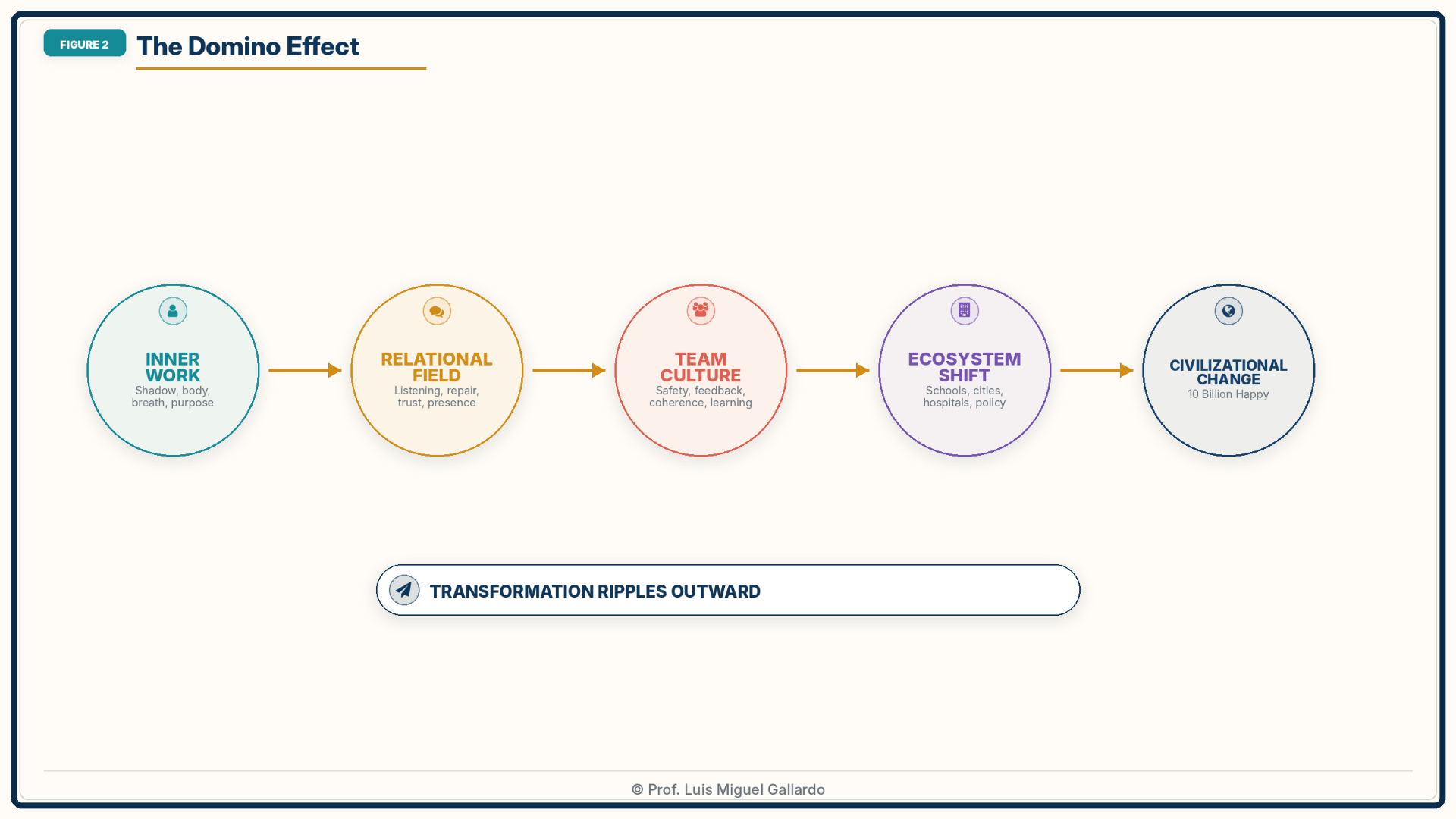
In my work on transpersonal leadership, I often find myself contemplating how individual actions, particularly those rooted in deep presence and awareness, can extend far beyond their immediate context. This notion is beautifully captured in what I term the "Domino Effect," as illustrated in **Figure 2 of The Transpersonal Leader. While a domino's fall is a sequential, physical event, the human realm's equivalent, which we might call ripple effect leadership**, is far more intricate, deeply psychological, and neurobiologically resonant.
Consider the conscious leader. This isn’t merely someone with good intentions, but an individual committed to a journey of self-awareness, compassion, and authentic presence. When such a leader stands in their truth, embodying values like empathy, integrity, and radical curiosity, their very being sends out signals. These signals are not just verbal; they are energetic, emotional, and even physiological. Neurologically, humans are wired for connection and resonance. Stephen Porges’ Polyvagal Theory illuminates how our autonomic nervous system constantly scans for cues of safety or danger in our environment, and crucially, in others. A leader who embodies calm, presence, and genuine care inadvertently signals safety, inviting others into a state of ventral vagal activation – a state conducive to connection, cooperation, and creativity.
This neurobiological contagion is the bedrock of the ripple effect leadership. When a leader consistently operates from a place of coherence, they create an atmosphere that encourages others to align with that coherence. Imagine a team where the leader approaches challenges not with anxiety or blame, but with thoughtful inquiry and an open heart. This approach becomes contagious. Team members, consciously or unconsciously, begin to mirror this behavior. Stress responses diminish, allowing for clearer thinking and more collaborative problem-solving. Daniel Siegel speaks of \"mindsight,\" the ability to perceive the internal landscapes of ourselves and others. A transpersonal leader cultivates this mindsight, fostering an environment where emotional intelligence flourishes and interpersonal understanding deepens.
"The quality of our presence shapes the future that can emerge." — Otto Scharmer
This ripple then extends beyond the immediate team. The employee who feels seen and valued at work carries that sense of well-being home to their family. They might be more patient, more attuned, more present with their children and partners. The positive emotional state, nurtured by conscious leadership at work, then seeds healthier family dynamics. This is not a fanciful idea; it’s the lived experience of countless individuals whose daily lives are profoundly shaped by their professional environments. The workplace, far from being an isolated sphere, is a crucial node in the larger social fabric. A leader's choices are not just organizational decisions; they are contributions to collective well-being.
Furthermore, the impact of ripple effect leadership scales up to the broader ecosystem. Organizations with transpersonal leaders tend to develop cultures that are more ethical, more sustainable, and more attuned to their societal impact. They are more likely to engage in practices that benefit communities, uphold ecological responsibility, and contribute to the common good. This is where the wisdom traditions, which inform much of my work, speak of interconnectedness – a profound understanding that individual flourishing is inextricably linked to collective thriving. From an Integral perspective, as Ken Wilber might describe, conscious leadership integrates personal growth with cultural transformation and systemic evolution.
The journey of becoming a transpersonal leader is arduous and beautiful. It requires:
- Deep self-reflection and inner work.
- A commitment to continuous learning and unlearning.
- Cultivating radical empathy and compassion.
- The courage to lead from vulnerability and authenticity.
Each of these steps, taken with sincerity, strengthens the leader's inner coherence, making them a more powerful catalyst for positive change. The world does not need more transactional managers; it yearns for leaders who understand that their consciousness is their most potent tool, capable of sparking a magnificent ripple effect across all dimensions of human experience. This is the essence of my message, an invitation to lead not just with strategy, but with soul.
With an embrace, Luis Miguel.