Transpersonal Leadership · Essay
Mastering the Leadership Learning Loop: A Catalyst for Transpersonal Growth
Discover the six-step continuous developmental practice that embodies the essence of transpersonal leadership, fostering profound self-awareness and impactful action weekly.
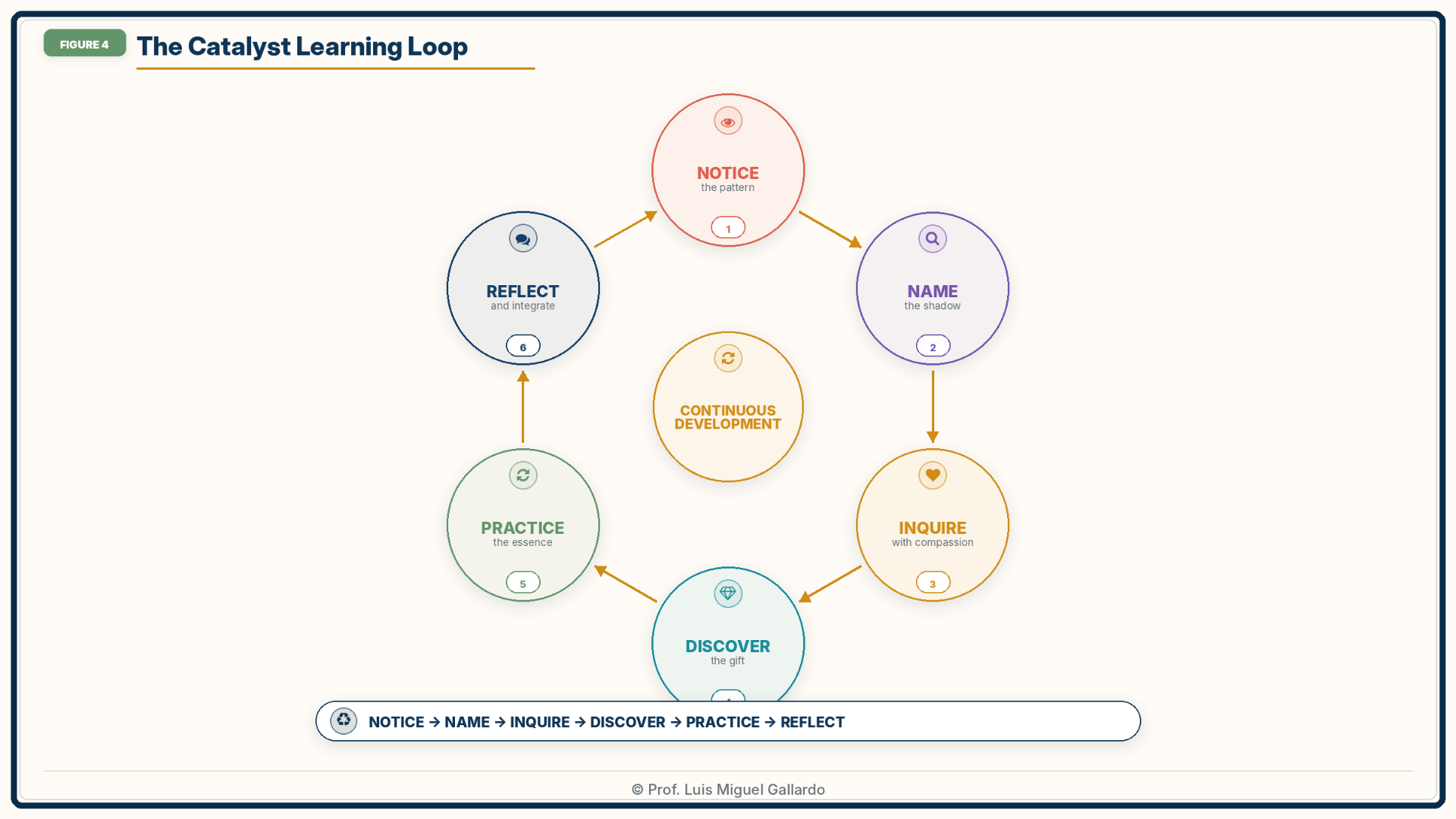
In a world demanding more than mere management, the transpersonal leader emerges not by chance, but through deliberate, continuous development. This journey is not a solitary sprint, but a sustained, cyclical process of introspection, action, and learning. At the heart of this continuous development lies what I term the Catalyst Learning Loop, a six-step journey that, when practiced weekly, transforms experience into wisdom and intent into impact.
As explored in The Transpersonal Leader (2024), Figure 4, 'The Catalyst Learning Loop,' beautifully illustrates this dynamic process. It begins with Intention, moves through Observation, then Reflection, leading to Inquiry, culminating in Integration, and finally closing with Action. This is not a linear path but a spiraling ascent, each cycle deepening our understanding and refining our capacity for transpersonal influence.
Let's unpack each stage, seeing how a transpersonal leader might engage with this leadership learning loop in their daily or weekly practice:
1. Intention: Setting the Navigational Star
The journey begins not with a grand strategic plan, but with a clear, heartfelt intention. This is about aligning our inner compass with a desired outcome, both for ourselves and for the collective we serve. For instance, a transpersonal leader might begin their week with the intention: "This week, I aspire to foster deeper psychological safety within my team, ensuring every voice feels heard and valued." This isn't just a goal; it's a commitment rooted in purpose, drawing from the wellspring of their authentic self. Without a clear intention, our actions can become reactive and disconnected, lacking the coherence that defines transpersonal leadership.
2. Observation: The Art of Attentive Presence
With intention set, the leader then moves into a state of attentive observation. This is not about judgment, but about pure, unfiltered presence. Like a scientist in a laboratory, they are gathering data – not just from external events, but from their own internal landscape. Following the example above, the leader might observe team meetings, paying close attention to body language, patterns of participation, moments of silence, and instances of interruption. They also observe their own reactions: Am I feeling impatient? Am I truly listening, or am I formulating my next response? This practice echoes Otto Scharmer's concept of 'presencing,' where we observe from a deeper, more open state of awareness, allowing new insights to emerge.
3. Reflection: Making Sense of the Seen and Felt
Post-observation, the transpersonal leader engages in deep reflection. This is the stage where raw data transforms into potential meaning. They might journal, meditate, or engage in contemplative walks. What did I notice? What patterns emerged? How did my observations align with my intention for psychological safety? Perhaps they noticed that certain team members consistently deferred to others, or that creative ideas were quickly shut down. They also reflect on their own contributions – Did my questions create space, or did they inadvertently shut it down? This introspective pause is crucial for moving beyond superficial understanding.
4. Inquiry: Unearthing Deeper Truths
Reflection naturally leads to inquiry. Here, the leader asks open-ended questions, probing deeper into the 'why' and 'how.' This isn't about finding quick answers, but about expanding the scope of understanding. Examples include: What might be the underlying fears preventing full participation? How might my own leadership style inadvertently contribute to these dynamics? What resources, both internal and external, could help us cultivate greater safety? This stage often involves seeking external perspectives, perhaps through a trusted mentor or a peer coaching circle, further enriching the leadership learning loop.
5. Integration: Weaving New Understanding into Being
Integration is where insights from inquiry begin to reshape one's internal landscape. It's not just about intellectual understanding, but about a felt shift in perspective. The leader might integrate the understanding that psychological safety isn't just about what they say, but about how they show up – their nervous system regulation, their capacity for empathy, their non-verbal cues. This stage often involves making sense of conflicting data, finding harmony between different viewpoints, and internalizing new learnings into their core beliefs about leadership and human interaction. As Daniel Siegel might suggest, this is about making meaning and fostering neural integration.
6. Action: Embodiment of Evolved Consciousness
The final step of the leadership learning loop, and simultaneously the beginning of the next, is Action. This is where the integrated understanding manifests as conscious, intentional behavior. Based on their insights, the leader might decide to:
Implement a new team meeting format that prioritizes individual check-ins.
Proactively seek out quiet voices for their input.
Model vulnerability by sharing a personal learning or challenge.
Seek further training on active listening skills.
Each action, however small, is now infused with deeper awareness and intention, setting the stage for the next cycle of observation and reflection. This continuous motion epitomizes the transpersonal leader's commitment to ongoing evolution, not just for themselves but as a catalyst for the growth of those they lead.
The Catalyst Learning Loop is more than a framework; it is a living practice. By consciously engaging with these six steps weekly, leaders transform challenges into opportunities for growth, moving beyond transactional leadership to foster environments of genuine connection, purpose, and collective flourishing. This continuous spiral of growth is the very engine of transpersonal leadership, reshaping organizations from the inside out.
"The true measure of a leader is not the number of followers, but the number of other leaders they develop."
This continuous cultivation of self and others is the ultimate aim of the leadership learning loop.
With an embrace, Luis Miguel.