Transpersonal Leadership · Essay
Mastering the Conscious Leader Competencies: A Daily Practice Guide
Explore the ten essential competencies of the conscious leader, providing practical daily habits to cultivate each, fostering profound personal and organizational transformation.
My journey with leaders has consistently revealed a profound truth: true leadership transcends mere strategy and operations. It delves into the very essence of who we are, demanding a deep engagement with our inner landscape. This conviction is at the heart of The Transpersonal Leader, particularly in understanding what I term the “conscious leader competencies.” These are not just skills; they are ways of being that ripple outwards, transforming teams, organizations, and even society.
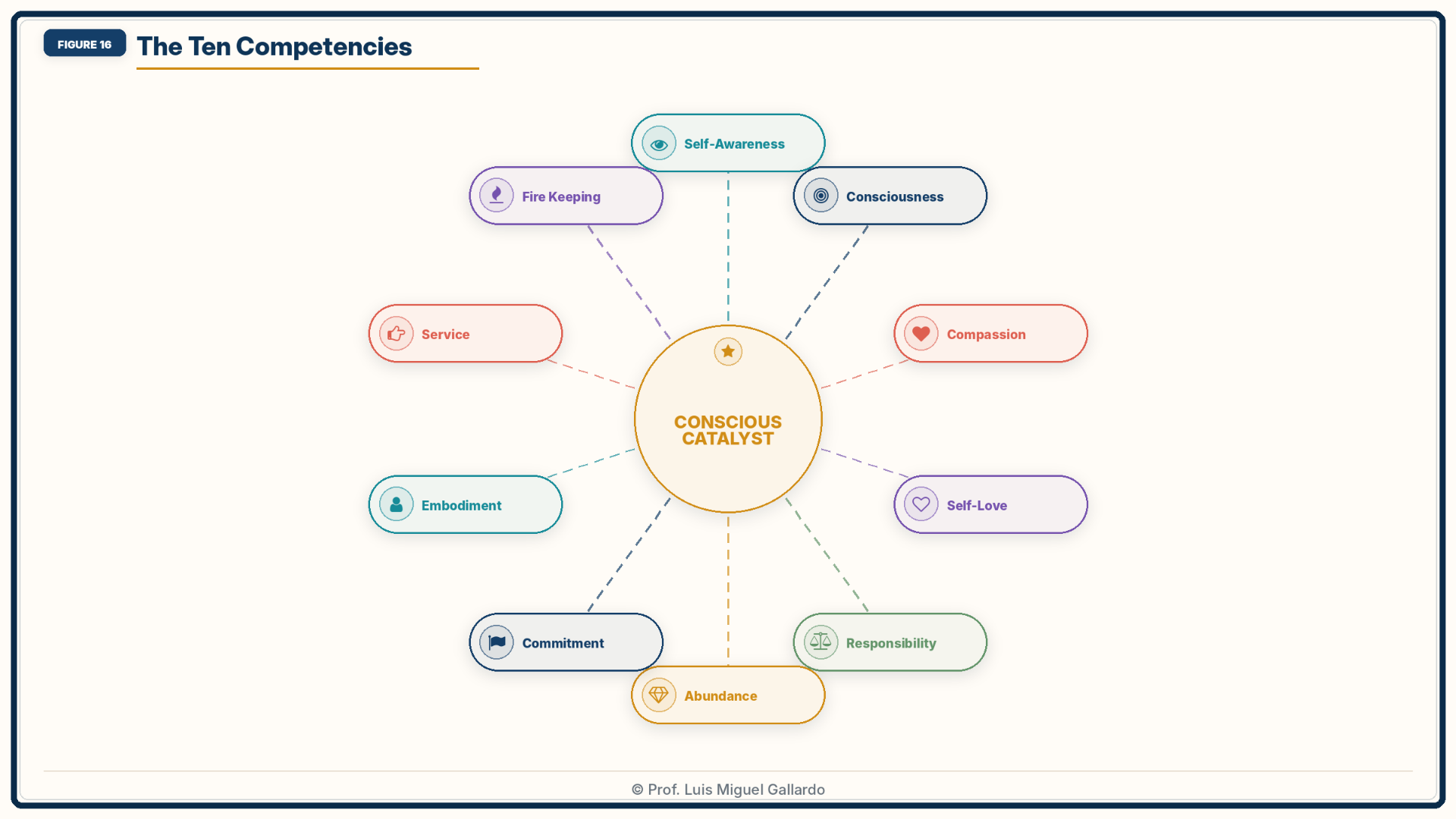
In Figure 16 of my book, I lay out these ten competencies, which describe the conscious catalyst. Let's explore each, coupled with a simple, daily practice to help you integrate them into your leadership journey.
1. Radical Self-Awareness: The Inner Compass
This is the bedrock, the capacity to observe one's thoughts, emotions, and bodily sensations without judgment. It's about knowing your triggers, your gifts, and your shadows. Jung, with his emphasis on individuation, understood this fundamental quest for self-knowledge. For the conscious leader, this involves a constant, gentle inquiry into one's inner world.
- Daily Practice: Start each day with a 5-minute 'check-in.' Sit quietly and ask yourself: "What emotions am I carrying? What thoughts are occupying my mind? What sensations are present in my body?" Simply observe, without trying to change anything.
2. Embodied Presence: Grounding in the Now
Beyond just being 'present,' embodied presence means bringing our full, sensory self to every moment. It's about being profoundly here, accessible and responsive. Stephen Porges’ Polyvagal Theory highlights how our physiological state impacts our ability to connect and lead effectively. An embodied leader is a calming, centering force.
- Daily Practice: Choose one routine activity (e.g., walking to your office, drinking coffee). For that time, concentrate fully on the sensory experience: the warmth of the cup, the sounds around you, the feeling of your feet on the ground. Fully inhabit the moment.
3. Deep Listening: Beyond the Words
Deep listening transcends hearing; it’s about attunement. As Otto Scharmer eloquently describes in Theory U, it's about listening from a place of genuine curiosity, suspending judgment, and sensing the emerging future. A conscious leader listens for coherence, for what's unsaid, for the underlying energetic currents.
- Daily Practice: In your next conversation, make a conscious effort to listen for the emotions behind the words. Pay attention to body language and tone of voice. Resist the urge to formulate your response while the other person is speaking.
4. Emotional Intelligence & Regulation: Navigating the Inner Ocean
This competency involves not only recognizing emotions in oneself and others but also skillfully managing them. It’s about not being hijacked by fear, anger, or frustration, and instead, choosing a skillful response. The HeartMath Institute's work on heart coherence provides powerful tools for this.
- Daily Practice: When you feel a strong emotion arise, pause. Take three deep breaths, focusing on your exhale. Before reacting, ask yourself: "What is the most skillful response right now?"
5. Compassionate Action: Leading with Heart
Compassion is not just empathy; it's empathy coupled with the desire to alleviate suffering. It means moving from understanding to active care. A conscious leader recognizes the interconnectedness of all beings and acts from a place of genuine concern for the well-being of others and the planet.
- Daily Practice: Each day, identify one opportunity to offer genuine help, support, or kindness to a colleague, family member, or even a stranger. Make it a conscious, intentional act.
6. Visionary Alignment: Purposeful Direction
This is the capacity to articulate a compelling future that inspires and unites. Yet, it also involves aligning one's actions and decisions with this higher purpose. Sri Aurobindo spoke of integral vision, seeing the whole and acting from it. For the conscious leader, vision is not just a strategic document; it's a living force.
- Daily Practice: Spend a few minutes reflecting on your personal and organizational purpose. Before making a significant decision, ask: "Does this align with our highest vision and values?"
7. Systems Thinking: Seeing the Interconnections
No organization, no challenge, exists in isolation. Systems thinking involves understanding the complex web of relationships and interdependencies. It's stepping back to see patterns, feedback loops, and leverage points, rather than just isolated events.
- Daily Practice: When facing a problem, instead of immediately seeking a solution, map out the stakeholders and their relationships. Ask: "Who else is impacted by this? What are the ripple effects?"
8. Adaptive Resilience: Thriving Amidst Change
Change is the only constant. Adaptive resilience means not just bouncing back from adversity but growing through it. It involves flexibility, courage, and a deep trust in one's capacity to navigate uncertainty. The conscious leader sees disruption not as an end, but as an invitation for emergence.
- Daily Practice: When you encounter an unexpected challenge or setback, resist the urge to immediately solve or fix. Instead, pause and ask: "What can I learn from this? How can this experience make me (or us) stronger?"
9. Co-Creative Collaboration: Unleashing Collective Genius
This competency emphasizes the profound power of working with others, not just delegating to them. It's about fostering environments where diverse perspectives are welcomed, and collective intelligence flourishes. It's about shared ownership and emergent solutions, where the outcome is greater than the sum of its parts.
"The most profound innovations often arise not from individual genius, but from the synergistic interplay of diverse minds, committed to a shared, benevolent aim." – LMG
- Daily Practice: In your next team meeting, consciously invite quiet or less vocal members to share their perspectives. Actively seek divergence before convergence.
10. Integrity & Authenticity: Leading from the Core
Finally, integrity is the congruence between one's values, words, and actions. Authenticity is being genuinely oneself, without pretense. This is where leadership becomes a truly transpersonal act, grounded in an unwavering ethical compass and a deep commitment to truth. These conscious leader competencies, when practiced consistently, don't just improve performance; they elevate the human experience of work.
- Daily Practice: At the end of each day, review your actions. Ask: "Did my actions today align with my deepest values? Was I true to myself?" If not, reflect on what adjustments you can make tomorrow.
These practices are not meant to be burdensome. Begin with just one or two, allowing them to naturally weave into the fabric of your daily life. The journey toward becoming a conscious leader is continuous, a beautiful unfolding.
With an embrace, Luis Miguel.