

Transpersonal Leadership · Essay
Cultivating Joy: How Six Dimensions Make Schools of Happiness
Discover how reimagining education through six core dimensions can transform schools into vibrant communities where students, teachers, and leaders genuinely flourish in a school of happiness.
In our ever-evolving educational landscape, the pursuit of academic excellence often overshadows the equally vital quest for student well-being and genuine flourishing. My work, particularly the framework articulated in The Transpersonal Leader (Gallardo, 2024), seeks to redress this imbalance, proposing a holistic vision for what I term 'schools of happiness.' These are not merely institutions focused on test scores, but vibrant ecosystems where every individual—student, teacher, and principal—can thrive.
The Six Dimensions of a School of Happiness
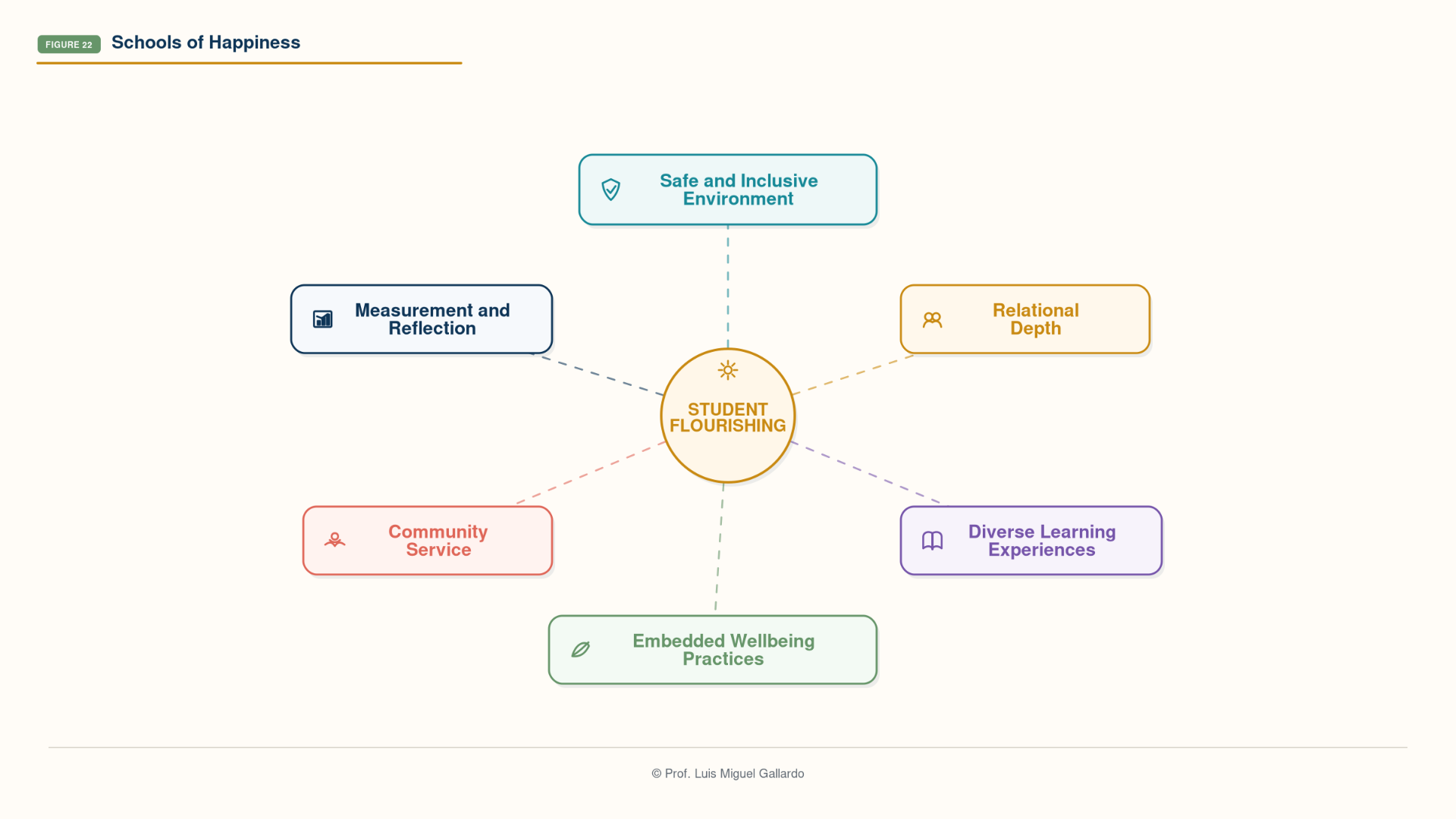
Figure 22 in The Transpersonal Leader illustrates the six crucial dimensions that underpin a true school of happiness. These dimensions are interdependent, creating a synergistic effect that elevates the entire educational experience. They are:
- Meaning and Purpose: This goes beyond curriculum. It's about helping students discover their unique contributions, fostering a sense of belonging to something larger than themselves. When education connects to a student's innate desire for meaning, learning becomes intrinsically motivated and deeply fulfilling. Teachers, too, find renewed purpose when they see their roles as guiding spirits, not just information transmitters.
- Emotional Intelligence & Regulation: In a world rife with complexity, the capacity to understand and manage one’s emotions, and empathize with others, is paramount. A school of happiness actively teaches emotional literacy, providing tools for self-awareness and self-regulation. Think of practices like mindfulness or HeartMath techniques, which help regulate the nervous system, as Stephen Porges' Polyvagal Theory illuminates, creating a state conducive to learning and connection.
- Positive Relationships: Humans are social beings. The quality of our relationships significantly impacts our well-being. Schools of happiness prioritize building strong, supportive connections among students, between students and teachers, and among staff. This involves cultivating trust, respect, and effective communication, fostering a sense of community where everyone feels seen and valued.
- Flow and Engagement: Borrowing from Mihaly Csikszentmihalyi's concept, 'flow' describes that state of complete absorption in an activity where time seems to vanish. A school of happiness designs learning experiences that challenge students appropriately, aligning with their skills and interests, thereby maximizing engagement and intrinsic motivation. For teachers, this means having the autonomy and resources to create such environments.
- Agency and Empowerment: Students flourish when they feel they have a voice, can make choices, and impact their learning journey. Empowering students fosters responsibility, resilience, and a sense of ownership over their education. Similarly, principals empower teachers by fostering shared leadership and respecting their professional judgment, nurturing a sense of collective efficacy.
- Growth Mindset & Resilience: Life is full of challenges. A school of happiness cultivates a belief that abilities can be developed through dedication and hard work, rather than being fixed. It teaches grit, adaptability, and the capacity to bounce back from setbacks, viewing failures not as endpoints but as opportunities for learning and growth. This dimension is crucial for navigating academic and life challenges successfully, fostering a deep-seated inner strength.
Leadership in a School of Happiness
For these dimensions to truly come alive, leadership is paramount. Principals, as transpersonal leaders, must embody these very qualities themselves. Their role extends beyond administration; they are the chief architects of culture, the cultivators of possibility. They create the psychological safety (borrowing from Amy Edmondson's work on team effectiveness) and structural conditions for these six dimensions to flourish. When a principal authentically models emotional intelligence, fosters positive relationships, and empowers their staff, they inherently transform the school's climate. They understand, as Carl Jung might suggest, that the collective unconscious of the institution is shaped by the conscious and unconscious actions of its leaders. A leader’s inner state profoundly impacts the entire ecosystem.
Teachers are not just instructors, but facilitators of blossoming. In a school of happiness, their role is to skillfully weave these dimensions into daily classroom life. This requires continuous professional development, spaces for collaborative learning, and a supportive environment where experimentation and growth are encouraged. When teachers feel fulfilled and supported, their capacity to inspire and nurture their students grows exponentially. They become exemplars of well-being, radiating their own flourishing into the classroom.
Ultimately, a school of happiness is a place where academic rigor meets profound human development. It's an environment where the 'whole child'—and indeed, the 'whole adult'—is seen, valued, and nurtured. This vision requires a fundamental shift in perception, moving from an industrial model of education to one that acknowledges and cultivates the boundless potential within each person. It’s an investment not just in future success, but in present joy and well-being.
"The deepest education is not about filling a pail, but lighting a fire."
This ancient wisdom perfectly encapsulates the ethos of a school of happiness. It's about kindling the inner spark, fostering a love for learning, and equipping individuals with the capacities to lead meaningful, fulfilling lives.
With an embrace, Luis Miguel.