

Transpersonal Leadership · Essay
The Transpersonal Leader: Cultivating Wholeness with the ROUSER Hexagon
Discover the six ROUSER leadership pillars – Relations, Openness, Understanding, Self-awareness, Empowerment, Reflection – a daily practice for profound leadership.
To truly lead, we must first learn to lead ourselves, not just through the mind, but through the entirety of our being.
The Heartbeat of Transpersonal Leadership
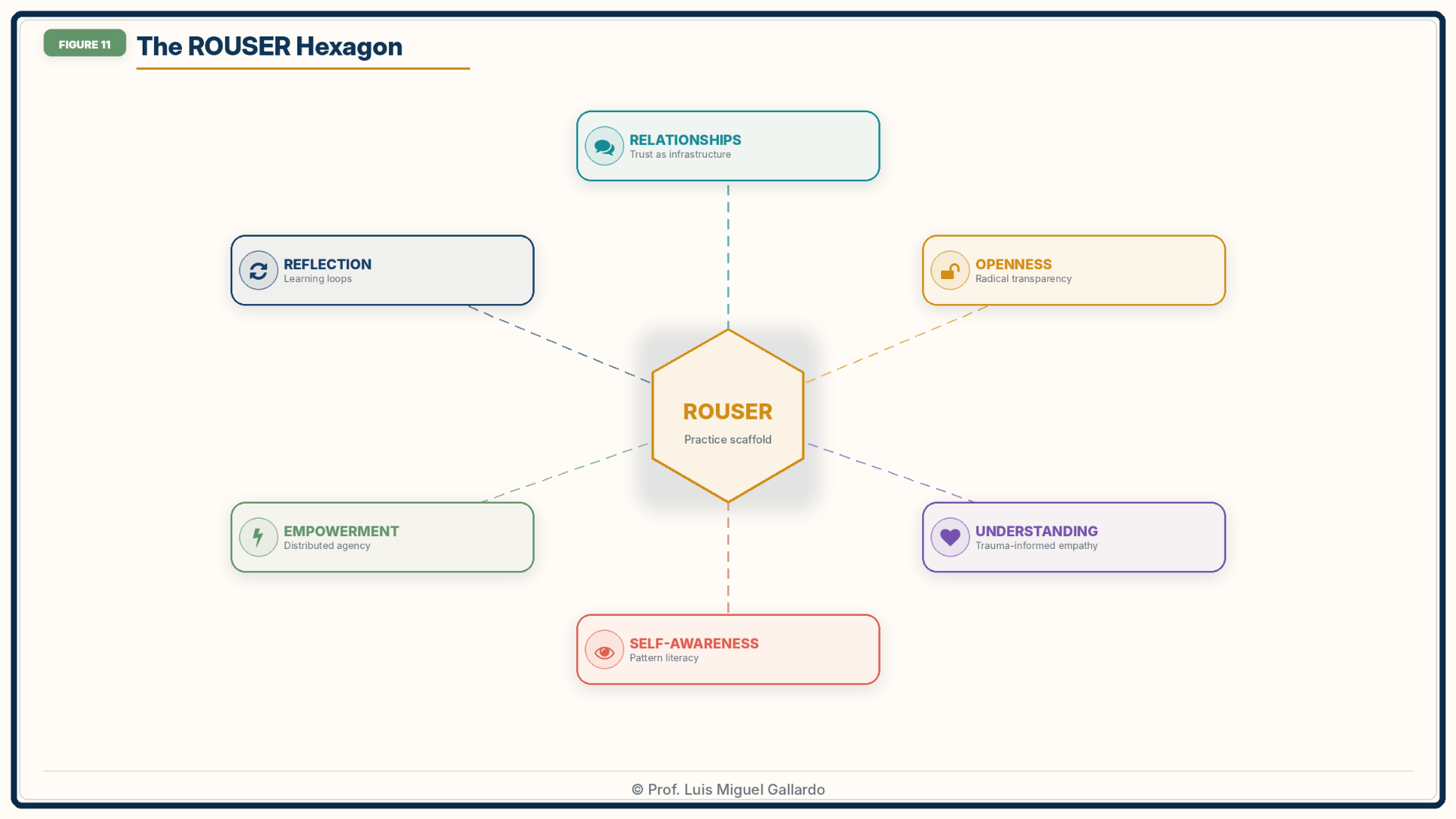
For years, my work has centred on the profound interconnection between inner well-being and outer impact. From the insights of contemplative traditions to the rigorous findings of neuroscience, a consistent truth emerges: our capacity for meaningful leadership is directly proportional to our capacity for presence and inner coherence. This is the ground of what I call Transpersonal Leadership — a leadership that transcends the ego, drawing from a deeper wellspring of wisdom and compassion. To make that journey practicable, I developed the ROUSER Hexagon: six interconnected pillars — Relations, Openness, Understanding, Self-awareness, Empowerment and Reflection — each a daily practice designed to nurture the whole person at the helm.
Neuroscience, particularly Stephen Porges's polyvagal theory and Daniel Siegel's concept of integration, supports the idea that our internal states directly shape our relational capacity. Richard Davidson's research on compassion and HeartMath's work on heart-brain coherence show that cultivating positive emotional states and physiological balance is fundamental to our ability to connect, empathise and inspire. The ROUSER leadership pillars are built on these foundations, offering a practical pathway to bring these insights into daily leadership.
Relations: The Fabric We Lead Within
Relations is the first pillar: building bonds of trust, respect and support. Leadership does not happen inside a single head; it happens in the space between people. The work here is to sense the subtle energies of a room, to hear the unspoken, and to create a field where genuine interaction can unfold. Its shadow is isolation or dependency — we either close in on ourselves or lose ourselves in the other. Its gift is the present bond: full connection without abandoning who we are. As Sri Aurobindo suggested, individual consciousness is a ripple in a vaster ocean; to feel that interconnectedness is to lead from a place of profound belonging.
Openness and Understanding: The Pillars of Growth
Openness is more than receptivity to new ideas. It is a radical willingness to meet reality as it is, without the immediate imposition of our preconceptions — the maturity Ken Wilber associates with the capacity to hold complexity and ambiguity. It asks us to lean into discomfort, suspend judgment, and let experience change us. Its shadow is rigidity or dispersion; its gift is embodied curiosity, reception with discernment.
Understanding goes deeper than intellectual comprehension. It is empathy and emotional intelligence: the capacity to make sense of complex systems, inner and outer, and of the people inside them. Robert Kegan's stages of adult development and Susanne Cook-Greuter's ego-development theory map how understanding matures over time, letting us hold more perspectives and integrate greater nuance. Its shadow is quick judgment or fusion — reducing the other, or losing ourselves in their story. Its gift is lucid empathy: attunement without self-abandonment.
Self-awareness and Empowerment: Presence and Purpose
Self-awareness is the pillar that keeps the others honest. It is the ability to observe our own thoughts, emotions and patterns without being swept away by them — to know our triggers, our defences, and the stories we tell about ourselves. As Stan Grof's work on non-ordinary states suggests, consciousness is not confined to the head; it permeates the whole psycho-physiological system. A self-aware leader does not merely speak of integrity; their presence radiates authenticity and calm authority.
Empowerment turns that inner clarity outward. Once we relate, open, understand and see ourselves clearly, our natural inclination shifts from self-centredness to contribution: giving others autonomy, confidence and the conditions in which they can grow. This is not charity but a recognition of our fundamental interdependence. Leadership blossoms here, moving beyond personal ambition towards collective flourishing.
"The greatest leader is not necessarily the one who does the greatest things. He is the one that gets the people to do the greatest things." — attributed to Ronald Reagan, though the sentiment echoes deeper wisdom across traditions
Reflection: The Continuous Wellspring
Finally, Reflection. The journey of Transpersonal Leadership is demanding, and without intentional pauses for review and replenishment we risk depletion, burnout, and losing contact with the deeper source. Reflection encompasses contemplative practice, journaling, rest, nature, creative expression and spiritual nourishment — the cycle of withdrawal and return that allows for integration and growth. This consistent inner tending is not selfish; it is a foundational act of responsible leadership, ensuring the wellspring never runs dry.
The six ROUSER pillars, practised daily, create an upward spiral of development. They are not discrete steps but interwoven threads in the fabric of a conscious life. Strong Relations invite Openness; through Openness, our Understanding deepens; deeper Understanding sharpens Self-awareness; self-aware leaders Empower others; and Reflection returns us to the beginning, wiser. This hexagon is a compass, guiding us towards a leadership that is not only effective but deeply humane and regenerative.
With an embrace, Luis Miguel.