Transpersonal Leadership · Essay
Mastering Integrative Leadership Transformation: Beyond Breakthroughs
Discover how the seven mechanisms of LMG's Integrative Transformation Model guide leaders from fleeting insights to a deeply embedded, sustainable essence of enlightened leadership.
In my work, I've observed countless leaders experience profound personal breakthroughs—moments of clarity, expanded awareness, or sudden shifts in perspective. These epiphanies are powerful, often catalyzing significant personal growth. Yet, the challenge lies not just in experiencing these moments, but in transforming them from transient sparks into a stable, enduring state of being and leading. This is where the concept of integrative leadership transformation becomes pivotal, moving beyond momentary insight to embodied wisdom.
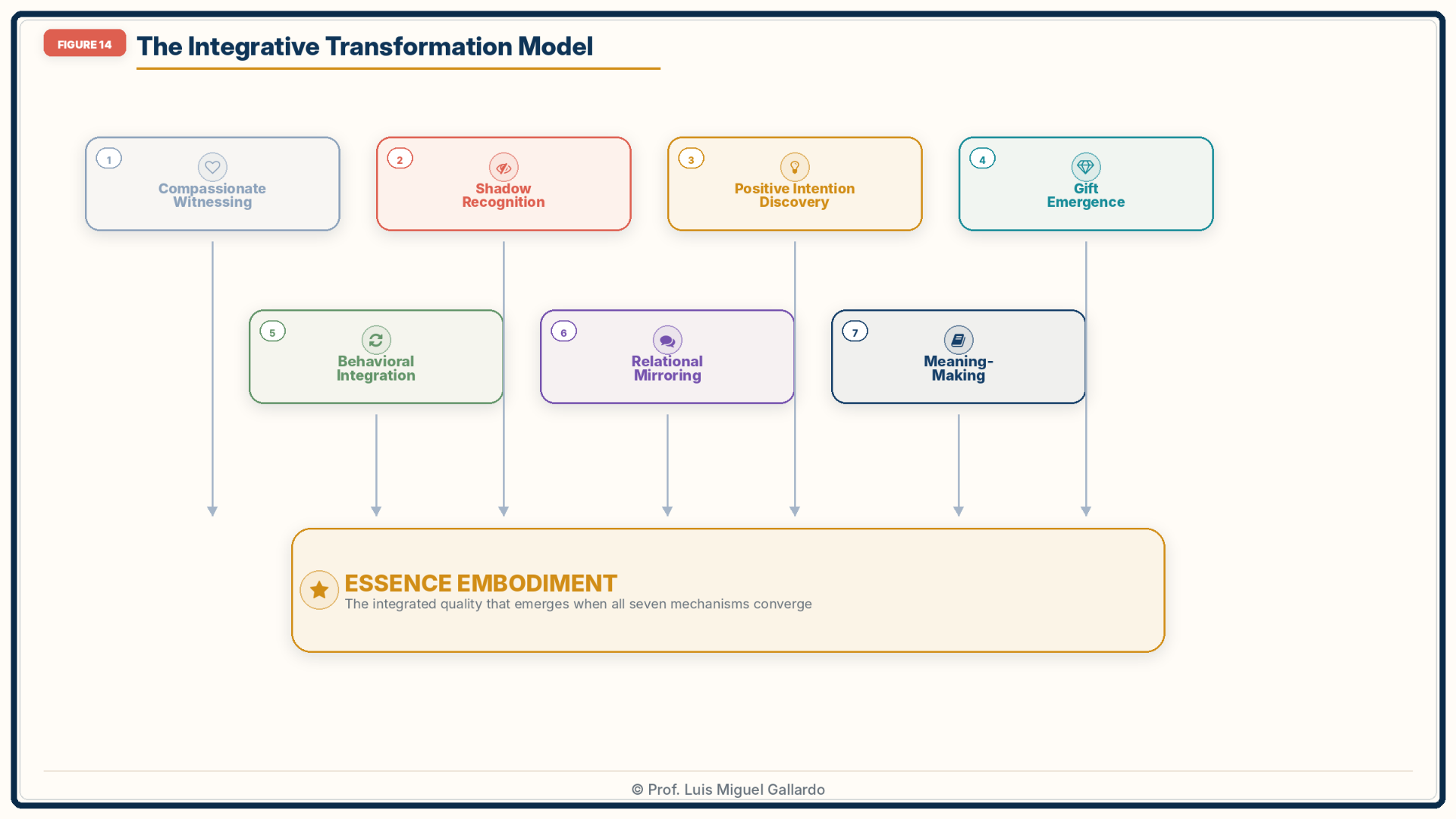
My book, The Transpersonal Leader, delves into this very process, outlining a structured yet deeply human approach to anchoring such transformations. Figure 14, which I call 'The Integrative Transformation Model,' illustrates seven interconnected mechanisms that serve as both a map and a compass for this journey. These mechanisms are not linear steps to be checked off, but rather dynamic processes that interact and reinforce one another, allowing leaders to cultivate a truly sustainable and impactful presence.
The Seven Mechanisms of Deep Transformation
The journey typically begins with a disruptive element—a crisis, a profound insight, or a jarring encounter that shakes the leader out of their habitual patterns. This is the mechanism to disrupt. It's the necessary tremor that creates space for something new to emerge, a break from the conventional 'how things are done' that often defines our leadership default. Without disruption, there is little impetus for authentic change. As Otto Scharmer eloquently describes in Theory U, sensing into potential future rather than clinging to the past requires a certain 'presencing' that often necessitates a disruption of our ingrained mental models.
Once disrupted, the leader is then invited to witness. This is the art of detached observation, a non-judgmental awareness of one's inner states, thoughts, and emotions, as well as the external circumstances without immediate reaction. It's about creating a contemplative space, a pause, to truly see what is unfolding, both within and without. This practice aligns with the work of Daniel Siegel on mindfulness and the capacity to 'name and tame' internal experiences, fostering greater self-regulation and cognitive flexibility.
Following witnessing, the crucial step is to befriend. This involves approaching discomfort, fear, or vulnerability not as adversaries, but as messengers. It's a compassionate embrace of all parts of oneself, including those deemed 'negative' or 'unacceptable.' This mechanism draws from Jungian shadow work, inviting leaders to bravely integrate disowned aspects of their psyche, recognizing that true wholeness stems from acknowledging and accepting every facet of our being.
"The challenge is not just in experiencing breakthroughs, but in transforming them from transient sparks into a stable, enduring state of being and leading. This is where the concept of integrative leadership transformation becomes pivotal."
From befriending, we move to integrate. This is the synthesis, the weaving together of previously disparate elements—insights, emotional experiences, and new perspectives—into a coherent and expanded sense of self. It's about forming new narratives and internal structures that can hold the complexity of our experiences without fragmentation. This integration goes beyond mere understanding; it's an embodied knowing, where new patterns of thought, feeling, and behavior become naturally available.
Next, leaders learn to reframe. This mechanism involves consciously shifting one's lens, altering the interpretation and meaning assigned to past events, current challenges, and future possibilities. It's an active process of constructing empowering narratives that serve leadership purpose and well-being, moving away from limiting beliefs that often constrain our potential. A reframe can turn a 'failure' into a 'learning opportunity,' fundamentally altering its emotional charge and implications for action.
The penultimate mechanism is to embody. This is where the transformation moves from cognitive understanding and emotional assimilation into physical presence and consistent action. It's about living the new insights, allowing them to inform posture, voice, and daily interactions. Embodiment suggests that the change is no longer just in the mind, but profoundly rooted in the physiological and energetic systems, influenced by practices like those explored by HeartMath in connecting heart coherence with leadership effectiveness. The fully integrated leader doesn't try to be transpersonal; they are transpersonal.
Finally, the seventh mechanism is to serve. This is the outward expression of the inner transformation. A truly integrated leader does not hoard their insights or breakthroughs for personal gain alone; their expanded awareness naturally seeks to contribute to the greater good. This mechanism highlights the inherently selfless nature of transpersonal leadership, where the self is understood as interconnected with a larger whole, and leadership becomes an act of conscious co-creation for collective flourishing. This cyclical process ensures that integrative leadership transformation is not a destination but a continuous journey of growth and contribution.
With an embrace, Luis Miguel.