
Transpersonal Leadership · Essay
Fundamental Peace: The Bedrock of Transpersonal Leadership
True leadership begins with inner tranquility. Explore how fundamental peace, grounded in neuroscience & ancient wisdom, is crucial for transpersonal leaders.
The cacophony of modern life often deafens us to the quiet revolution happening within: the imperative of fundamental peace.
The Unmistakable Call for Inner Calm
In a world reeling from poly-crises, from geopolitical tremors to the persistent hum of digital overwhelm, the demand for truly effective, resilient, and insightful leadership has never been greater. But what constitutes such leadership? It's not merely about strategic acumen or charismatic presence. It’s about a deeper, more enduring quality: fundamental peace. For me, this inner sine qua non is the prerequisite for any individual daring to step into the mantle of a transpersonal leader.
My journey, spanning years of working with leaders globally and delving into the profound depths of both ancient wisdom and cutting-edge neuroscience, has solidified my conviction that without this intrinsic sense of calm, leadership is fragile, reactive, and ultimately, unsustainable. Think of it: how can one guide others through storms if their own inner compass is spinning wildly? How can they inspire grounded action if their own nervous system is in a constant state of alarm? This is where the concept of fundamental peace leadership truly takes root.
Neuroscience Echoes Ancient Wisdom
It’s fascinating how contemporary science now provides compelling frameworks for what contemplatives have understood for millennia. Individuals like Daniel Siegel, with his work on interpersonal neurobiology, illuminate how our integrated brains are capable of profound coherence. He speaks of the “river of well-being,” a state of integration where our minds are neither rigid nor chaotic, but flow with flexible adaptation. This flexible adaptability, for me, is a direct manifestation of fundamental peace.
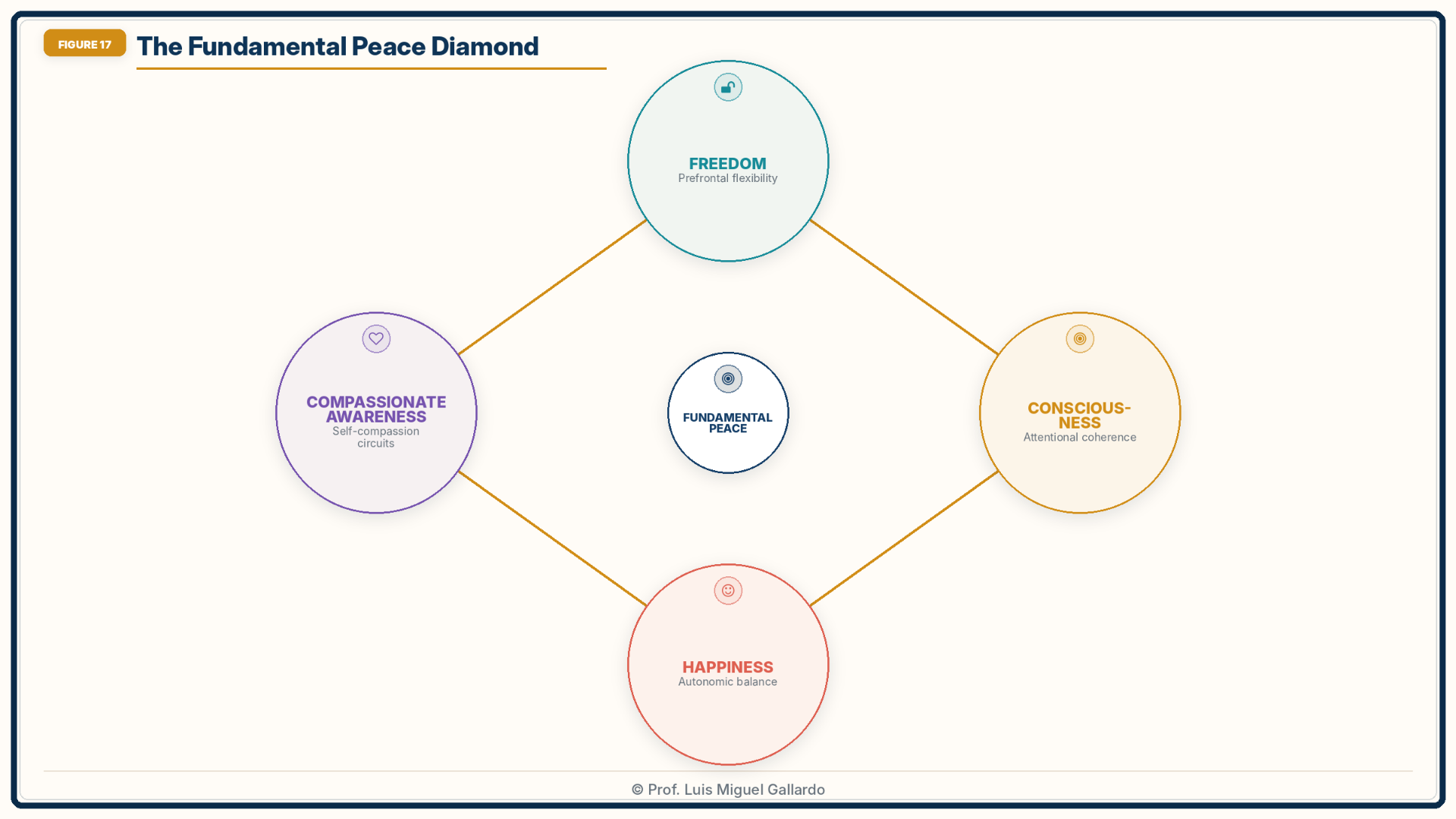
Stephen Porges’ Polyvagal Theory offers another crucial lens. He details the autonomic nervous system’s intricate dance between states of fear, freeze, and social engagement. A leader operating from a state of chronic sympathetic activation (fight-flight) or dorsal vagal freeze will inevitably project that distress onto their teams and decisions. Fundamental peace, in this context, signifies a healthy ventral vagal state—a physiological and psychological anchor for connection, presence, and compassionate action. It's the capacity to return to a state of calm and connection even amidst external stressors.
HeartMath Institute’s pioneering research on heart-brain coherence further underscores this. They demonstrate how a state of heart-rate variability coherence, achieved through practices like intentional breathing and appreciation, significantly enhances cognitive function, emotional regulation, and intuitive clarity. This physiological coherence isn't just a fleeting feeling; it’s a measurable state that fundamentally alters our capacity for perception and response. A leader embodying this coherence—this fundamental peace—is not just leading from their intellect, but from a deeply integrated self.
"The capacity to remain centered amidst chaos is not a luxury, but a necessity for leadership that truly serves, rather than merely manages, the human experience."
The Transpersonal Imperative: Beyond the Self
For the transpersonal leader, one who seeks to lead not just for personal gain or organizational profit, but for the greater good—for humanity, for the planet—fundamental peace isn't just beneficial; it’s absolutely essential. How can one genuinely connect with universal purpose, cultivate empathy for diverse stakeholders, and navigate complex ethical dilemmas if their inner state is fragmented or reactive?
From the contemplative traditions, we learn of the need to transcend the ego, to access deeper states of awareness. Sri Aurobindo spoke of the “supramental consciousness,” a state beyond the limitations of the ordinary mind. Ken Wilber's integral theory offers maps of development that move us through ever-widening circles of identity and concern. Individuals like Otto Scharmer at MIT's Presencing Institute speak of leading from a future that wants to emerge, a feat impossible without a deep, quiet listening that only fundamental peace can afford.
For a transpersonal leader, fundamental peace means:
- Enhanced Self-Awareness: The ability to observe one's own thoughts and emotions without being overwhelmed by them.
- Emotional Regulation: Not the suppression of emotions, but the skillful navigation of them.
- Deep Empathy: The capacity to truly understand and feel with others, without losing oneself.
- Ethical Clarity: Making decisions grounded in universal principles, rather than personal fear or ambition.
- Resilience: The ability to bounce back from setbacks, maintaining a steady inner core.
This isn't about being perpetually blissful; it's about cultivating a stable inner ground, a resting heartbeat for the soul, allowing us to meet life's challenges with courage and wisdom. It allows us to access deeper wellsprings of creativity and intuition, moving beyond mere problem-solving to truly innovative, systems-changing solutions.
Cultivating the Inner Sanctuary
So, how do we cultivate this fundamental peace? It's not a destination but a practice. It involves regular engagement with contemplative practices—meditation, mindfulness, reflective journaling—that quiet the incessant chatter of the mind. It demands conscious attention to our nervous system, learning to self-regulate through breathwork and mindful movement. It requires engaging our hearts, fostering appreciation and compassion. It calls for deep introspection and a willingness to transcend the limiting beliefs of the ego.
This isn't a soft skill; it’s the hardest, most rewarding work a leader can undertake. It's the courageous journey inward that ultimately allows for truly expansive and impactful leadership outward. As we see the burgeoning recognition of fundamental peace leadership become less of a fringe idea and more of a core competency, we pave the way for a more integrated, humane, and sustainable future.
With an embrace, Luis Miguel.