Transpersonal Leadership · Essay
From Scarcity to Flourishing: Crafting Abundance Goals for a Better World
Discover how reframing our collective aspirations from deficit-based scarcity goals to abundance goals, as exemplified by the UN SDGs, can unleash transformative energy for widespread flourishing.
In the ongoing human endeavor to create a more just and sustainable world, our language and conceptual frameworks hold immense, often unrecognized, power. My work on transpersonal leadership, particularly as explored in The Transpersonal Leader (2024), delves deeply into how our inner states and collective consciousness shape outer realities. A critical area where this dynamism is evident is in how we articulate our shared objectives.
Consider the United Nations Sustainable Development Goals (SDGs). They represent a monumental, globally agreed-upon roadmap for humanity. Yet, a close examination of their phrasing reveals a pervasive orientation towards scarcity goals. Phrases like "no poverty," "zero hunger," "no more disease" are certainly laudable and absolutely vital. However, by focusing on the absence of a negative, we inadvertently anchor our collective psyche in the very deficits we wish to eradicate. This is not a critique of the SDGs' intent, which is profoundly noble, but rather an observation about the inherent psychological and vibrational impact of their linguistic framing.
The Subtle Power of Linguistic Framing
When we declare "no poverty," we are, of course, striving for a world where poverty does not exist. But what if, instead, we focused on the presence of its opposite? What if our abundance goals were articulated not as the absence of something undesirable, but as the flourishing of something desirable? Instead of "no poverty," perhaps "universal economic well-being." Instead of "zero hunger," consider "nourishing sustenance for all." This shift is more than semantic; it is a fundamental reorientation of our collective intention.
Otto Scharmer's work on Theory U often speaks to the importance of going to the emerging future, of sensing what wants to come into being. When we frame our goals negatively, we are often reacting to current problems, stuck in a problem-solving loop that can reinforce the very patterns we wish to overcome. Daniel Siegel's concept of integration in mental health, or Stephen Porges's polyvagal theory, both highlight how our systems respond to cues of threat or safety. A deficit-based goal, even if well-intentioned, can subtly function as a threat cue, keeping us in a reactive, rather than a co-creative, state.
From Scarcity to Abundance: A Transpersonal Perspective
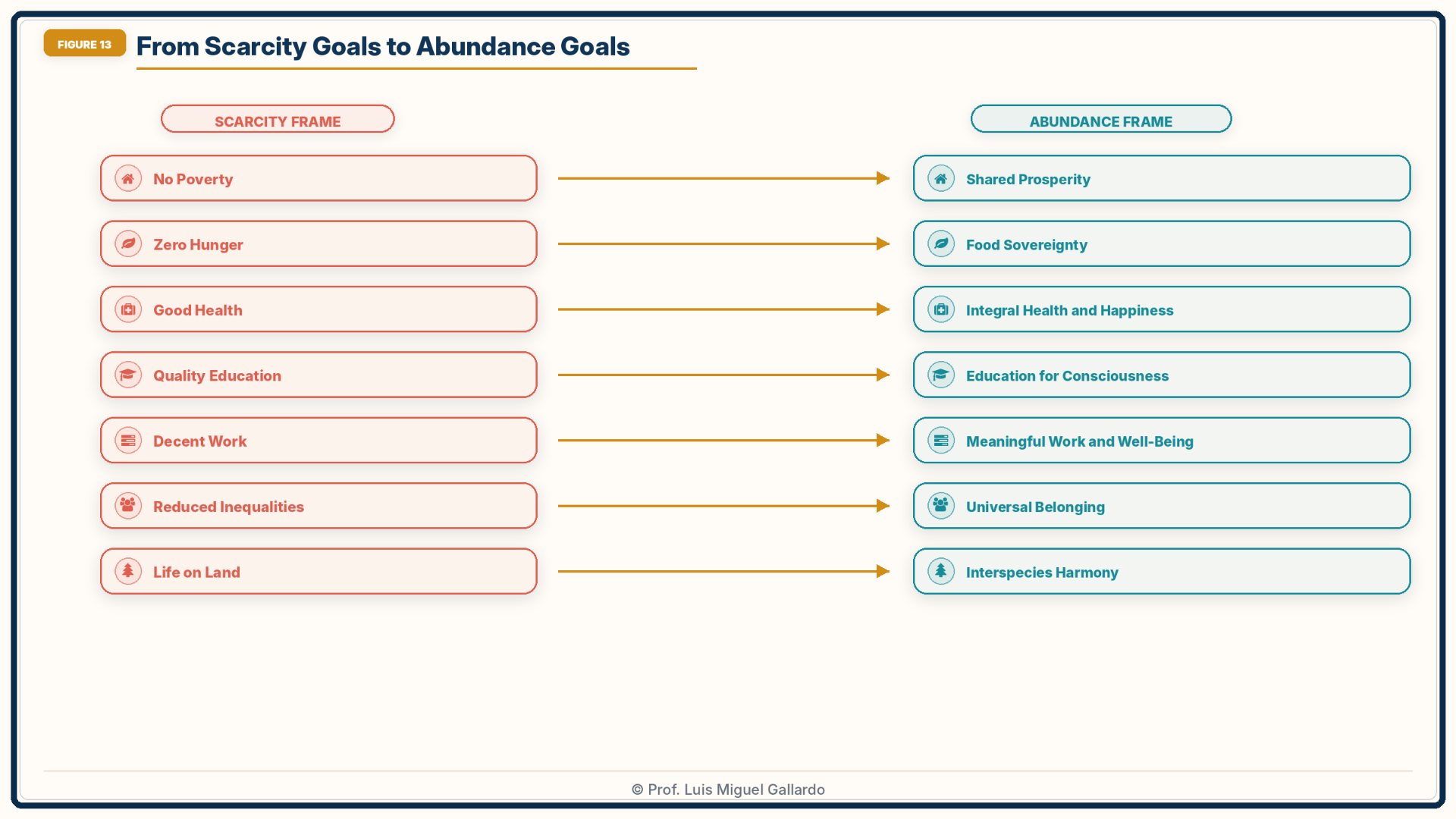
In The Transpersonal Leader, I introduce Figure 13, which vividly illustrates this transition “From Scarcity Goals to Abundance Goals.” This diagram is not merely about renaming; it's about a foundational shift in how we conceive of progress. When we frame an objective as an abundance goal, we engage different psychological and spiritual registers. We step out of a scarcity mindset, which often fuels competition, fear, and a sense of limited resources, and into an abundance mindset, which fosters collaboration, creativity, and the belief in limitless potential.
For example, consider SDG 3, "Good Health and Well-being." While positive, it still carries a hint of remediation. A truly abundance-oriented rephrasing might be "Vibrant Health and Holistic Flourishing for All." This language speaks to an expansive vision, one where health is not just the absence of illness, but a dynamic state of vitality and complete well-being.
"The re-framing of our collective aspirations from deficit to abundance is perhaps one of the most potent, yet overlooked, levers for transpersonal transformation. It shifts us from merely patching holes to actively building cathedrals."
This shift is particularly relevant for leaders. A transpersonal leader understands that their internal state, their intentionality, and the language they use profoundly influence the environments they lead. To articulate abundance goals is to invite an entirely different energy into the collective endeavor. It moves us from a mindset of struggle and deprivation to one of creative possibility and generous provision.
Cultivating Collective Flourishing
While the UN Sustainable Development Goals are profoundly important, we, as global citizens and leaders, can and should engage with them through an abundance lens. This implies:
- Reframing: Consciously re-articulating the SDGs in terms of positive outcomes and flourishing states.
- Intentionality: Cultivating an internal state of abundance and possibility, rather than scarcity and fear, when working towards these goals.
- Communication: Using language that inspires hope, collaboration, and a sense of shared abundance in all our efforts.
This is not to dismiss the very real suffering and challenges embodied by the current phrasing of the SDGs. Rather, it is to suggest that by embracing the power of abundance goals, we can more effectively tap into humanity's collective capacity for innovation, compassion, and shared prosperity. It is a call to lead not just from the mind, but from the heart, envisioning a world teeming with life, joy, and comprehensive well-being.
With an embrace, Luis Miguel.