
Transpersonal Leadership · Essay
Mastering Leadership Competency Development: The Four Integrating Engines
True leadership competency development isn't forged in isolation; it arises from the dynamic interplay of contemplative practice, embodied rehearsal, relational feedback, and real-stakes action, shaping profound capability.
In my work, I often encounter a well-intentioned yet ultimately limited approach to growth, particularly in the realm of leadership competency development. We attend workshops, read books, and perhaps even engage in coaching, yet find that the deepest shifts remain elusive. Why is this? The answer, I believe, lies in understanding that genuine growth, especially in complex areas like leadership, is not a singular event but a continuous, multi-dimensional process.
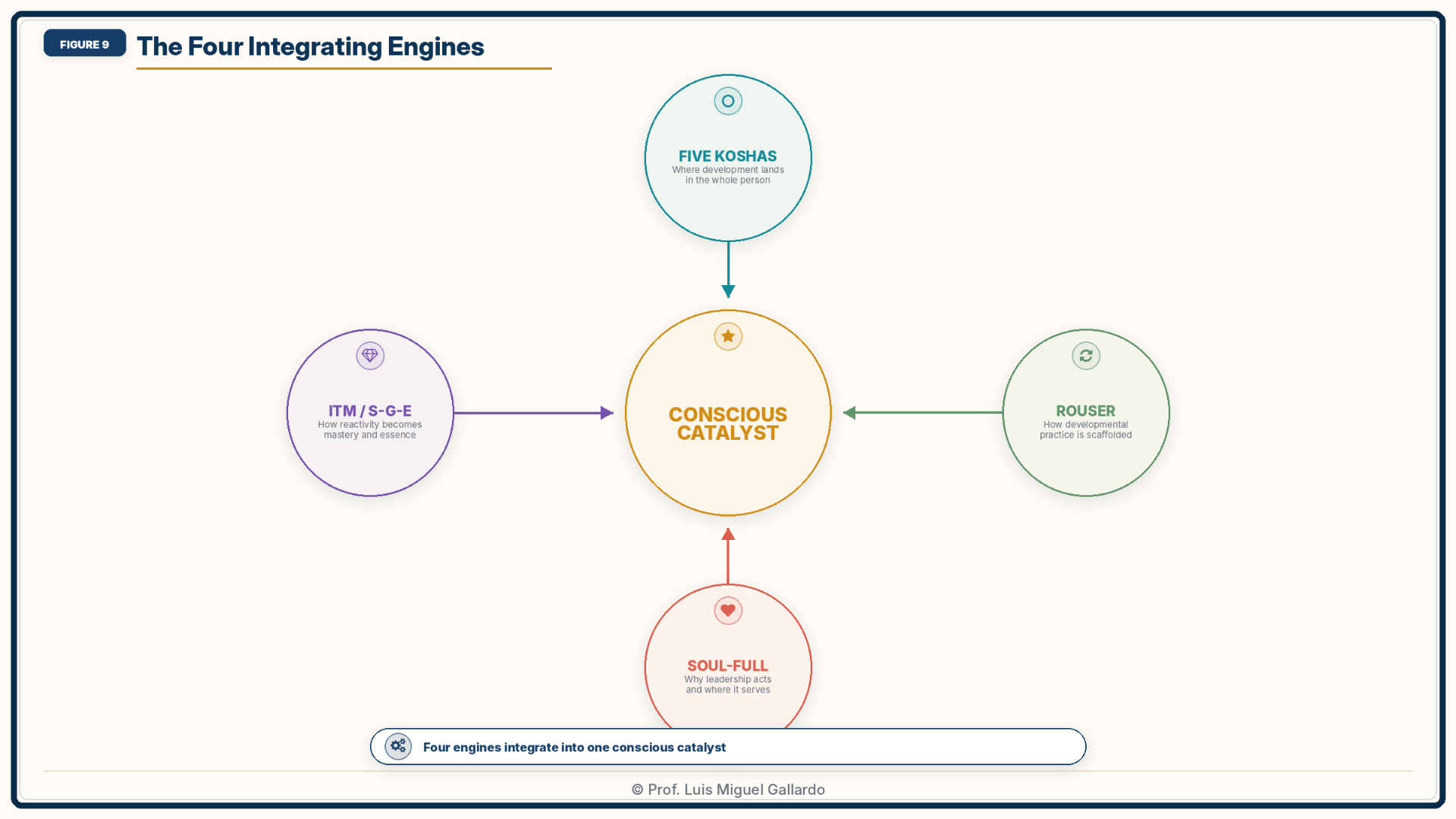
Our human experience is profoundly integrated, and so too must be our approach to developing new capacities. This is precisely the premise of what I call the Four Integrating Engines, elaborated in Figure 9 of The Transpersonal Leader. These engines – Contemplative Practice, Embodied Rehearsal, Relational Feedback, and Real-Stakes Action – are not merely additive; they are synergistically interwoven, each fueling and refining the others. Neglecting any one of them inevitably weakens the entire structure of leadership competency development.
Let's consider Contemplative Practice. This engine cultivates presence, self-awareness, and the ability to attune to one's inner landscape. Think of Otto Scharmer's concept of "presencing," the deep listening to the emerging future. Without this internal tuning, how reliably can we understand our intentions, biases, or subtle reactions before they manifest externally? A leader who operates solely from reactive impulses, lacking this introspective capacity, will struggle to lead with intention and clarity. This engine builds the reflective muscle crucial for ethical decision-making and emotional regulation.
Next, Embodied Rehearsal shifts the focus from inner awareness to physical manifestation. It's not enough to intellectually understand a concept; we must internalize it within our nervous system. Daniel Siegel's work on neurobiology emphasizes the importance of integration – connecting differentiated parts into a functional whole. Embodied rehearsal, whether through role-playing, simulation, or even mindful movement, allows us to physically practice new behaviors and responses. It's about literally feeling what it's like to inhabit a new leadership posture, to deliver difficult feedback, or to hold space for conflict. Without this, our skills remain abstract, easily forgotten under pressure.
Then comes Relational Feedback, the critical external mirroring. We are, by our very nature, social beings. Our self-perception is always, to some extent, a product of how we are perceived by others. Stephen Porges' Polyvagal Theory highlights our innate need for co-regulation and social engagement. Honest, constructive feedback from peers, subordinates, and superiors provides invaluable data points, revealing blind spots and validating growth. A leader who avoids or dismisses feedback deprives themselves of crucial information, essentially trying to navigate complex terrain without a map. This engine makes our leadership competency development truly adaptive and context-aware.
Finally, the ultimate crucible for any new capacity: Real-Stakes Action. This is where the rubber meets the road, where theoretical understanding and rehearsed behaviors are put to the test in the messy, unpredictable reality of leadership. It's in the moments of genuine challenge – leading a crisis, navigating organizational change, or making a high-impact decision – that our true capabilities are revealed. Without this engine, our perceived leadership competency development remains untested, a potential that has never been actualized. The insights gleaned from real-stakes action then feed back into contemplative practice, refining our understanding and shaping future rehearsal.
Consider how neglecting one engine can undermine the others:
- Extensive Contemplation without Embodied Rehearsal or Action: Leads to intellectual masturbation, a deep understanding of theory with no practical application. The leader knows what to do but can't actually do it.
- Constant Action without Contemplation or Feedback: Results in burnout and repetitive mistakes, a leader operating on autopilot without learning or adjusting.
- Embodied Rehearsal without Relational Feedback: Cultivates artificial performance, a leader who thinks they are effective but is out of sync with their team's reality.
"The effective cultivation of higher capacities demands a holistic approach, moving beyond fragmented training models to embrace the integrated wisdom of mind, body, and spirit in action." - LMG
True leadership competency development, then, is a dynamic dance among these four engines. They are not sequential steps but simultaneous propellers, each drawing strength from and contributing to the others. To develop a genuinely transpersonal leader, one must intentionally design experiences that engage all four, creating a continuous loop of learning, embodying, refining, and acting. This integrated approach ensures that growth is not superficial but deeply embedded, resilient, and transformative.
With an embrace, Luis Miguel.