
Transpersonal Leadership · Essay
The Unfolding Tapestry of Joy: Cultivating the Five Ecosystems of Happiness
From Schools to Cities, I envision a world where well-being is intentionally designed and nurtured, guided by Transpersonal Leadership and the Conscious Catalyst.
Imagine a world where joy isn't a fleeting emotion, but a foundational principle woven into the very fabric of our institutions and communities.
As a writer, a founder, and a student of human potential, I've spent decades exploring how we can move beyond simply alleviating suffering to actively cultivating flourishing. My journey, deeply informed by the profound insights of thinkers like Daniel Siegel and Stephen Porges in neuroscience, the heart-coherence work of HeartMath, and the contemplative wisdom distilled by Sri Aurobindo, Ken Wilber, and Robert Kegan, has led me to a central conviction: genuine, sustainable happiness must be intentionally designed and nurtured across society. This is where the concept of ecosystems of happiness truly comes alive, an impact arc driven by Transpersonal Leadership and the role of the Conscious Catalyst.
The Quintuple Helix of Well-being
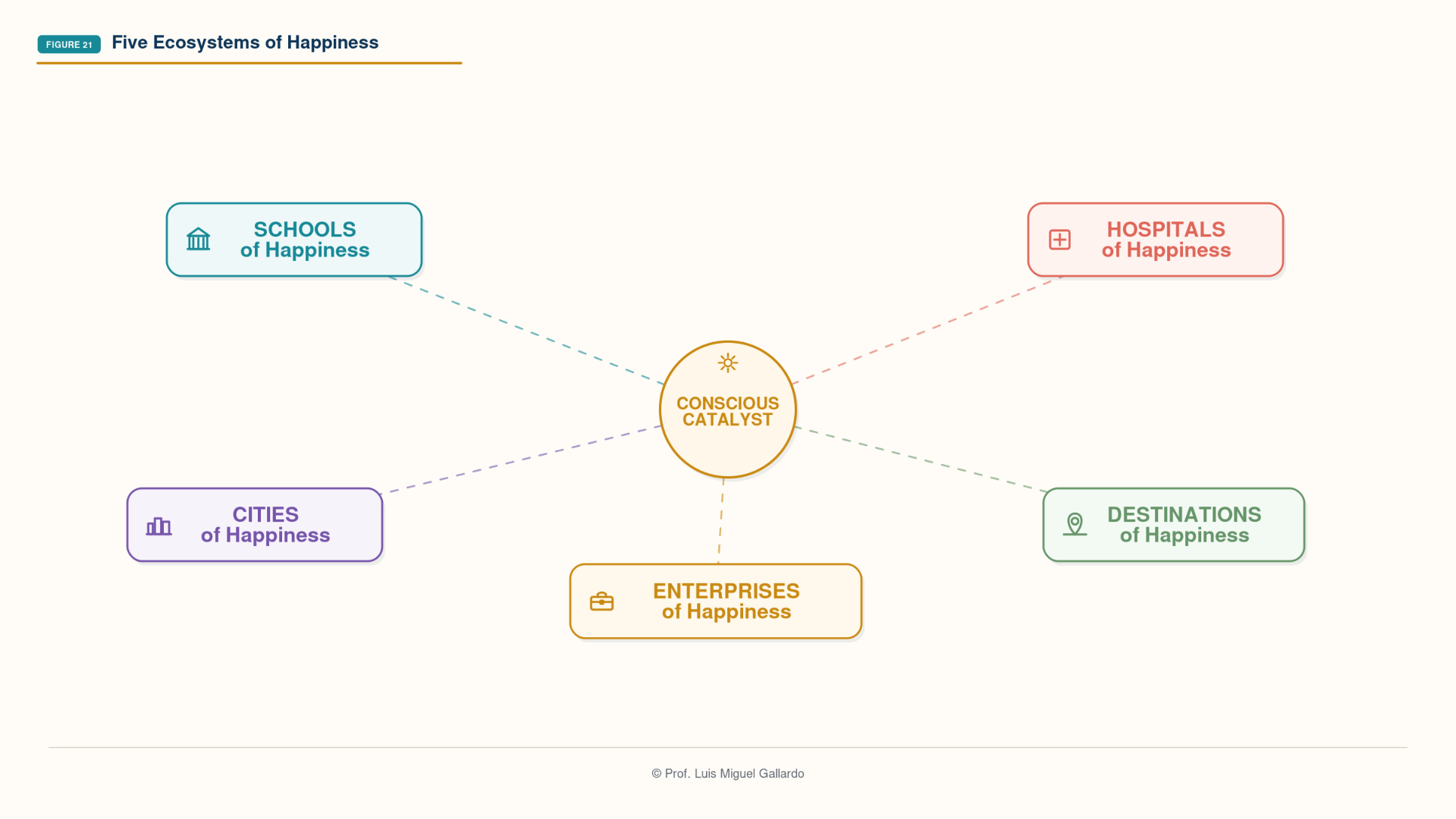
I see five critical societal ecosystems that, when intentionally cultivated for well-being, form a powerful quintuple helix for civilizational transformation. These are not merely sectors; they are dynamic, interconnected spheres where life unfolds, where character is forged, and where our collective future is shaped.
- Schools: Our educational institutions are the cradles of the future. When we integrate emotional intelligence, mindfulness, and purpose-driven learning into the curriculum, we're not just teaching facts; we're nurturing whole human beings. Imagine schools where children learn about neuroception and co-regulation, understanding their own nervous systems and how to connect empathetically with others. This creates a foundation for resilient, compassionate citizens.
- Hospitals: Beyond treating illness, hospitals can become centers of healing and holistic well-being. By embracing a transpersonal approach, we can foster environments where patients are seen as more than their diagnoses, where the human spirit is acknowledged and supported. This involves training healthcare professionals in compassionate communication, integrating contemplative practices for both patients and staff, and designing spaces that promote calm and restoration. The work of Polyvagal Theory, for instance, offers profound insights into creating safe and connected care environments.
- Enterprises: The workplace, arguably where many adults spend the majority of their waking hours, holds immense potential for cultivating well-being. A Transpersonal Leader understands that true productivity and innovation stem from a workforce that feels connected, purposeful, and supported in their growth. This isn't about superficial perks; it's about fostering psychological safety, promoting ethical leadership, encouraging self-organization, and recognizing the profound human need for meaning beyond the bottom line. It's about designing organizations that align with our deepest human values.
- Cities: Our urban landscapes can be designed not just for efficiency, but for human flourishing. From accessible green spaces and vibrant community centers to inclusive policies and opportunities for deep connection, cities can become epicenters of collective well-being. A "happier" city considers its citizens' mental health, fosters social cohesion, and designs infrastructure that encourages movement, interaction, and a sense of belonging. The essence of a thriving city is its capacity to be a living, breathing ecosystem of happiness.
- Destinations: Whether they are tourist spots, cultural heritage sites, or natural preserves, destinations offer unique opportunities for inspiration, reflection, and rejuvenation. When managed with a transpersonal lens, they can become catalysts for personal transformation and intergenerational connection. This means curating experiences that go beyond mere consumption, fostering deep engagement with nature, culture, and self.
"The greatest revolution of our generation is the discovery that human beings, by changing the inner attitudes of their minds, can change the outer aspects of their lives." — William James
Transpersonal Leadership and the Conscious Catalyst
Navigating these transformations requires a particular kind of leadership, what I call Transpersonal Leadership. It's a leadership not solely driven by ego or external achievement, but deeply rooted in a sense of service, an understanding of interconnectedness, and a commitment to systemic flourishing. It acknowledges the developmental insights of Kegan and Cook-Greuter, recognizing that leaders must continually evolve their own consciousness to effectively lead others through complex societal shifts.
The Conscious Catalyst is the individual embodying this leadership, operating within these ecosystems. They are not merely managers; they are weavers of meaning, facilitators of growth, and architects of joy. They understand the neuroscience of attachment and belonging. They have cultivated their own inner landscape, enabling them to hold space for others, to inspire vision, and to guide collective action towards a more humane and joyful future. They are the ones who can see the potential for a thriving ecosystem of happiness in every school, hospital, enterprise, city, and destination.
This is not a utopian dream; it is an urgent imperative. By intentionally cultivating these five ecosystems of happiness, guided by evolving leaders and conscious catalysts, we can collectively engineer a new civilizational paradigm—one where well-being is not a luxury, but the very foundation of our shared existence.
With an embrace, Luis Miguel.