
Transpersonal Leadership · Essay
Emotional Alchemy for Leaders: Transforming Difficult Emotions into Wisdom
True leadership hinges on the capacity to transmute challenging emotions like anger, fear, and shame into profound sources of insight and strength, guiding you and your team toward deeper efficacy and connection.
In the demanding landscape of contemporary leadership, we often encounter a powerful, often unsettling, array of emotions. The pervasive advice tends to be either to suppress these 'negative' feelings or, conversely, to vent them without much conscious discernment. Neither approach serves us well as leaders aiming for sustained impact and authentic presence. My work, particularly explored in The Transpersonal Leader, proposes a third path: emotional alchemy leadership.
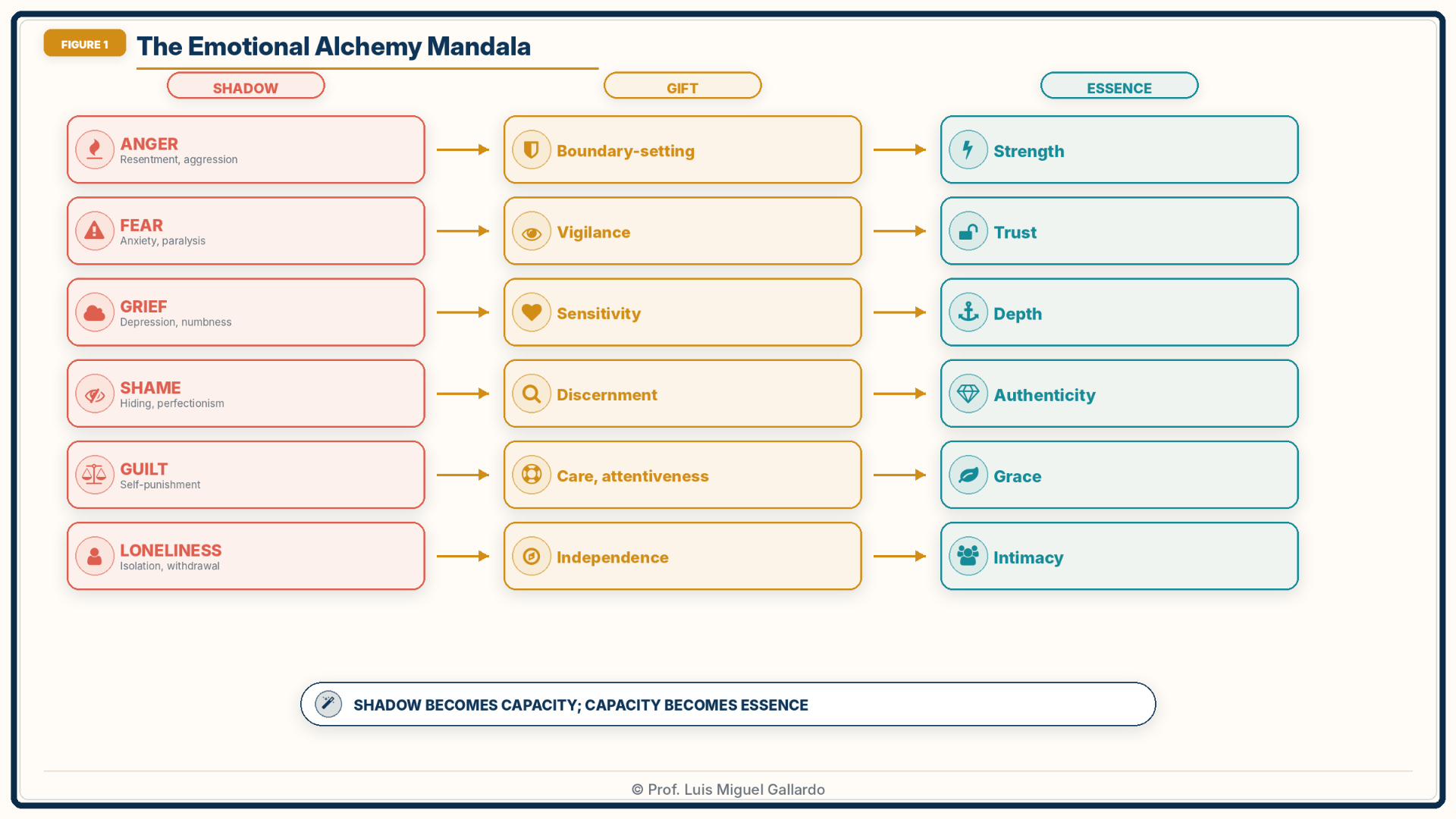
Emotional alchemy is not about denying or indulging emotions but about consciously engaging with them, understanding their inherent intelligence, and transforming their raw energy into beneficial capacities. As Carl Jung profoundly understood, the shadows within us hold immense potential for growth, if only we are brave enough to explore them. This process is beautifully encapsulated in Figure 1 – The Emotional Alchemy Mandala, which illustrates how each difficult emotion, when met with awareness and intention, can be transmuted into a powerful leadership quality.
The Intelligence Within Difficult Emotions
Each emotion, no matter how uncomfortable, carries a signal, a piece of information intended for our survival, growth, or protection. When we dismiss or avoid these signals, we lose access to their vital message. Leaders, in particular, cannot afford such blind spots. The fear of being wrong, for instance, can paralyze decision-making, yet beneath it lies a potent desire for accuracy and impact. The anger at a perceived injustice can devolve into unproductive conflict, or it can be alchemized into a fierce commitment to fairness and ethical action.
Consider the eight emotions highlighted in the Emotional Alchemy Mandala and their alchemical transmutations:
- Fear is not merely anxiety; it's an indicator of perceived threat, often pointing to what we value most. When processed consciously, fear transmutes into Courage and Prudence—the capacity to act despite risk, informed by careful assessment.
- Anger, frequently seen as destructive, signals boundary violations or a sense of injustice. Transmuted, it becomes Justice and Action—a powerful drive to rectify wrongs and uphold principles.
- Shame, a deeply uncomfortable emotion, often arises from a perceived failure to meet expectations. Alchemized, it transforms into Humility and Learning—a readiness to acknowledge imperfections, seek growth, and remain teachable.
- Grief, the profound response to loss, can feel debilitating. Yet, through its depths, it transmutes into Compassion and Resilience—a deepened empathy for others' suffering and an inner fortitude to navigate adversity.
- Envy, often suppressed due to its social undesirability, points to our unfulfilled desires and aspirations. Consciously engaged, it transmutes into Inspiration and Aspiration—a clear vision for what is possible and motivation to pursue it.
- Guilt, distinct from shame, stems from a feeling of having done something wrong. When alchemized, it leads to Responsibility and Accountability—a commitment to repair, learn, and act with integrity.
- Disgust, signaling a repulsion from something unwholesome, morphs into Discernment and Purity of Intention—the ability to distinguish between what serves and what detracts, fostering clarity of purpose.
- Sadness, a more diffuse form of grief, signals disconnection or a recognition of life's transient nature. It transmutes into Empathy and Connection—deepening our capacity to relate to others and appreciate the preciousness of relationships.
Practicing Emotional Alchemy Leadership
The practice of emotional alchemy leadership is not a one-time event but an ongoing process of self-awareness and intentional engagement. It begins with pausing, much like Otto Scharmer's concept of 'presencing' in Theory U. Instead of reacting, we learn to observe the emotion, name it without judgment, and then deliberately ask: What intelligence does this emotion hold for me right now? What is it trying to tell me?
"The greatest challenge of leadership is not mastering others, but mastering oneself, especially the landscape of one's own inner world." - L.M. Gallardo
This requires a robust capacity for self-regulation, as explored by thinkers like Daniel Siegel and Stephen Porges, who highlight the criticality of our vagal tone and interoceptive awareness. Practices like mindfulness, contemplative reflection, and even the techniques offered by HeartMath, can significantly enhance our ability to remain present with difficult emotions rather than being overwhelmed by them. It is in this conscious engagement that the magic of alchemy happens. We move from a state of raw emotional reactivity to one of empowered, discerning response.
As transpersonal leaders, our ability to effectively navigate the complexities of our own inner world directly impacts our capacity to lead others through their challenges. By transforming our difficult emotions, we not only cultivate inner wisdom but also model an authentic, resilient, and deeply human form of leadership that inspires profound trust and fosters genuine connection within our teams and organizations.
With an embrace, Luis Miguel.