Transpersonal Leadership · Essay
The Transpersonal Leadership Model: Eight Streams, One River
Discover how the eight essential streams of Transpersonal Leadership converge into a unified, potent practice, fostering profound inner and outer transformation for leaders and their organizations.
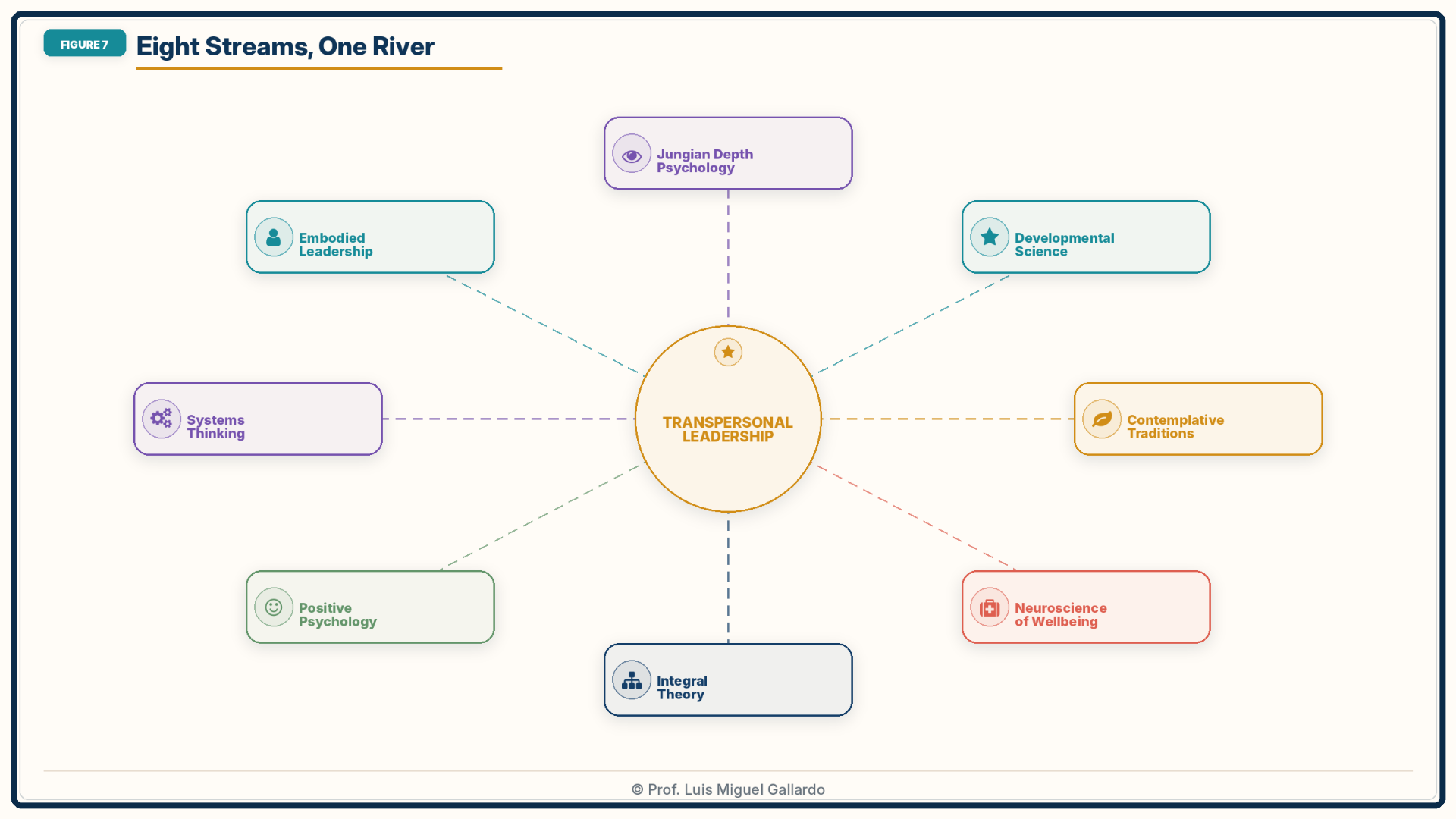
In my journey of understanding and articulating leadership for our complex era, I observed a profound truth: true leadership, especially transformative leadership, does not arise from a singular focus but from a confluence of distinct yet interconnected capacities. This insight led to the development of the Transpersonal Leadership Model, beautifully illustrated in Figure 7 of my book as "Eight Streams, One River." This model posits that effective, impactful leadership emerges from the harmonious integration of eight fundamental dimensions, each a vital tributary feeding the broader river of transpersonal practice.
The first three streams—Somatic, Emotional, and Cognitive—form the bedrock of our inner world. The Somatic Stream acknowledges that leadership is embodied. Our physical presence, our ability to regulate our nervous system (as Stephen Porges' polyvagal theory profoundly illustrates), directly impacts our capacity for presence, resilience, and authentic connection. Without somatic awareness, we are susceptible to unconscious reactions rather than conscious responses.
Following closely is the Emotional Stream. This is not merely about managing emotions, but about cultivating emotional intelligence—understanding, processing, and leveraging our emotional landscape and that of others. Daniel Siegel's work on interpersonal neurobiology underscores the critical role of emotional attunement in healthy relationships, a cornerstone of effective leadership.
The Cognitive Stream encompasses critical thinking, strategic foresight, and the systematic processing of information. It's about developing mental models that are both nuanced and expansive, moving beyond reductionist views to embrace complexity. Yet, even advanced cognitive capacities must be rooted in somatic and emotional intelligence to avoid the pitfalls of intellectualism devoid of wisdom.
Next, we encounter the Relational Stream, emphasizing the imperative of fostering genuine connections, building trust, and facilitating collaborative ecosystems. This stream recognizes that leadership is fundamentally a relational practice, not a solitary act. It’s about cultivating psychological safety and enabling collective intelligence, echoing Otto Scharmer’s concept of 'presencing' in U-Lab, where deep listening and co-creation are paramount.
The Ethical Stream speaks to our moral compass and our commitment to values-driven decisions. Transpersonal leadership demands an unwavering dedication to integrity, fairness, and the greater good, often requiring us to transcend self-interest for collective flourishing. This stream asks us to consider our impact beyond immediate gains.
Broadening our perspective, the Systemic Stream invites us to perceive patterns and interdependencies within organizations and broader societal structures. It moves beyond individual blame to understand the forces at play, fostering a holistic approach to problem-solving and change. This systemic lens is crucial for designing sustainable solutions.
The river of transpersonal leadership flows only when these individual streams are recognized, cultivated, and allowed to merge. To neglect one is to diminish the power and sustainability of the whole.
Then comes the Transpersonal Stream itself, the very essence of the model. This stream draws from traditions that speak to our higher consciousness, our connection to something larger than ourselves. It involves cultivating intuition, wisdom, and a sense of purpose that transcends ego. Thinkers like Carl Jung and Sri Aurobindo offer rich insights into this dimension, pointing towards an unfolding of deeper human potentials.
Finally, the Civilizational Stream calls us to consider our legacy and our impact on the long arc of human civilization and the planet. It’s about leading with a profound sense of responsibility for future generations and contributing to a more conscious and sustainable world. This stream elevates leadership from mere managerial function to a calling for global stewardship.
Each of these eight streams contributes uniquely to the richness and depth of the Transpersonal Leadership Model. They guide us inward for self-mastery, outward for relational harmony and systemic understanding, and upward for a sense of purpose and contribution that extends beyond our transient selves. They are not to be pursued in isolation but as an integrated practice where each reinforces the other, creating a powerful, coherent flow—a truly transpersonal leadership model.
With an embrace, Luis Miguel.