
Transpersonal Leadership · Essay
Unpacking the Transpersonal Leadership Architecture: A Holistic View
Explore the complete transpersonal leadership architecture, understanding how its five interconnected dimensions guide leaders from inner foundation to impactful global change, fostering awareness and ethical responsiveness.
My work, rooted in a deep understanding of human development and organizational transformation, culminates in a comprehensive model designed to cultivate a new kind of leader—one who transcends egoic concerns to serve a greater good. This model, which I term the transpersonal leadership architecture, offers a coherent framework for understanding and enacting profound change, both individually and collectively.
From its foundational elements to its most far-reaching impacts, this architecture is a mental map for anyone seeking to lead with greater consciousness and responsibility. It moves beyond conventional leadership paradigms that often focus solely on external metrics or superficial skills, instead delving into the deeper currents of being and becoming.
The Five Interconnected Dimensions
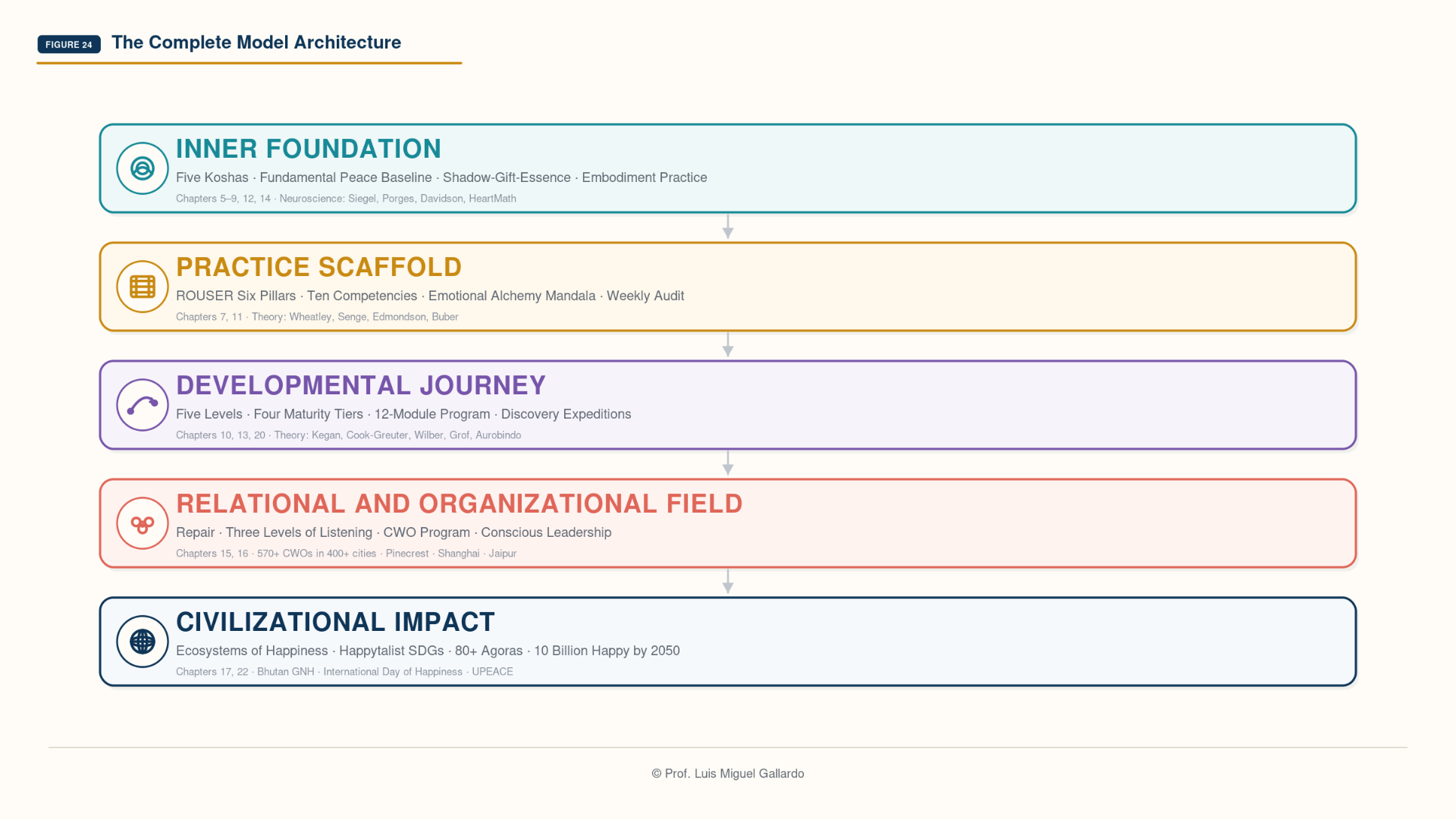
At the heart of the transpersonal leadership architecture are five interconnected dimensions, each building upon the last, yet all operating in dynamic interplay. These are: the Inner Foundation, the Practice Scaffold, the Developmental Journey, the Relational Field, and the Civilizational Impact. Together, they articulate a holistic journey.
- The Inner Foundation: This is the bedrock of transpersonal leadership. It involves deep self-awareness, emotional intelligence, and a cultivated presence. It's about understanding one's own motivations, biases, and inner landscape—the very ground from which all actions spring. Without this stable foundation, leadership efforts can be fleeting or misdirected. As Otto Scharmer eloquently puts it with his "presencing" concept, accessing deeper sources of knowing involves turning attention inward. This dimension encourages practices such as mindfulness and contemplative inquiry, allowing leaders to connect with a sense of purpose beyond self-interest.
- The Practice Scaffold: Once the inner foundation is established, the practice scaffold provides the tools and techniques for its ongoing development and manifestation in the world. This includes practices for emotional regulation, cognitive reframing, ethical discernment, and cultivating compassion. It's not merely about knowing what to do, but consistently doing it, integrating these practices into daily life and leadership activities. These are the muscles of transpersonal action, strengthened through consistent application.
- The Developmental Journey: Leadership is not a static state but a continuous process of growth and evolution. The developmental journey within the transpersonal leadership architecture acknowledges that leaders must perpetually stretch their boundaries, challenging assumptions and expanding their capacity for complexity and paradox. This dimension draws heavily on developmental psychology, recognizing that as our consciousness evolves, so too does our ability to lead more effectively and inclusively. It's about moving through stages of awareness, from ego-centric to socio-centric to world-centric, as thinkers like Ken Wilber have explored.
- The Relational Field: Leaders do not operate in a vacuum. The relational field emphasizes the interconnectedness of all beings and the profound impact leaders have on their environment and the people within it. This dimension calls for cultivating empathy, fostering genuine dialogue, building trust, and creating inclusive spaces where diverse perspectives can flourish. It recognizes that leadership is a co-creative process, shaped by the quality of relationships and the collective intelligence of the system. The work of Daniel Siegel on interpersonal neurobiology deeply informs this understanding of interconnectedness.
- The Civilizational Impact: The ultimate aim of the transpersonal leadership architecture is to contribute to a thriving world. This dimension focuses on the larger systemic impact of leadership—addressing global challenges, promoting sustainability, fostering social justice, and contributing to the evolution of human consciousness itself. It's about aligning individual and organizational purpose with the needs of the planet and future generations, recognizing our shared responsibility for the health and well-being of the whole Earth community. Here, leadership transcends immediate goals to embrace a legacy of transformative change.
Visualizing the Interplay
These five dimensions are not sequential steps but rather layers of an integrated system, each informing and enriching the others. As depicted in Figure 24 — The Complete Model Architecture of my book, they form a dynamic interplay, continuously shaping and being shaped by each other. The inner foundation, for example, directly influences the effectiveness of one's practices, which in turn fuels developmental growth, enhances relational skills, and ultimately contributes to greater civilizational impact.
The deeper one delves into the self, the more profoundly one connects with the collective. This paradox is central to transpersonal leadership.
This continuous feedback loop means that growth in one area ripple through the entire system. A leader who deepens their inner foundation through contemplative practices can bring greater presence and wisdom to their relationships, innovate more effectively through their practices, accelerate their developmental journey, and contribute more meaningfully to societal challenges. The transpersonal leadership architecture thus provides a comprehensive guide for conscious evolution.
In essence, the transpersonal leadership architecture is an invitation to leaders to embark on a journey of deep self-discovery and collective contribution. It challenges us to look beyond immediate results and understand the profound interconnectedness of our actions, fostering a leadership that is both deeply personal and universally impactful.
With an embrace, Luis Miguel.