

Transpersonal Leadership · Essay
Becoming a Conscious Catalyst: Leading with Wisdom and Impact
Discover the actionable, week-to-week behaviors that define conscious catalyst leadership, offering guidance without adopting the mantle of a guru or savior.
In the complex, interconnected tapestries of our organizations and communities, the role of a leader transcends the conventional. We are increasingly called to be more than managers or strategists; we are invited to become conscious catalysts. This phrase, central to my work in The Transpersonal Leader, speaks to a profound shift from directive command to generative influence.
But what does it actually mean to be a conscious catalyst in the day-to-day rhythm of leadership? It certainly doesn’t imply a messianic posture—no capes or infallible pronouncements. Nor is it about becoming a guru, an individual whose wisdom is seen as singular and untouchable. Rather, it’s about a deeply intentional, empathetic, and ultimately selfless engagement with the systems and individuals we are a part of. It’s about understanding that our presence, our state of being, and our choices reverberate powerfully.
The Subtle Art of Influence
The conscious catalyst doesn't demand change; they invite it. This invitation is extended through several key behaviors. Firstly, it involves cultivating a profound self-awareness, an inner sensing that allows us to understand our own biases, triggers, and aspirations. Daniel Siegel's concept of 'mindsight' is particularly relevant here, emphasizing the ability to see our own mind and the minds of others with clarity. Without this internal compass, our actions, however well-intentioned, can easily become reactive rather than generative. A conscious catalyst leads from a place of inner coherence, a state often cultivated through practices like mindfulness or contemplative inquiry, as explored by Otto Scharmer in Theory U.
Secondly, a conscious catalyst is an exquisite listener. This isn't just about hearing words, but about sensing the unspoken, the underlying currents of emotion and meaning. Stephen Porges' Polyvagal Theory highlights how our nervous systems are constantly attuned to signals of safety and threat. A conscious catalyst creates a psycho-social environment where others feel safe enough to truly express themselves, to venture beyond the familiar, and to engage in candid dialogue. This deep listening builds trust, which is the bedrock upon which any meaningful transformation is built. They understand that wisdom often resides not in their own pronouncements, but in the collective intelligence of the group.
Embracing the Domino Effect
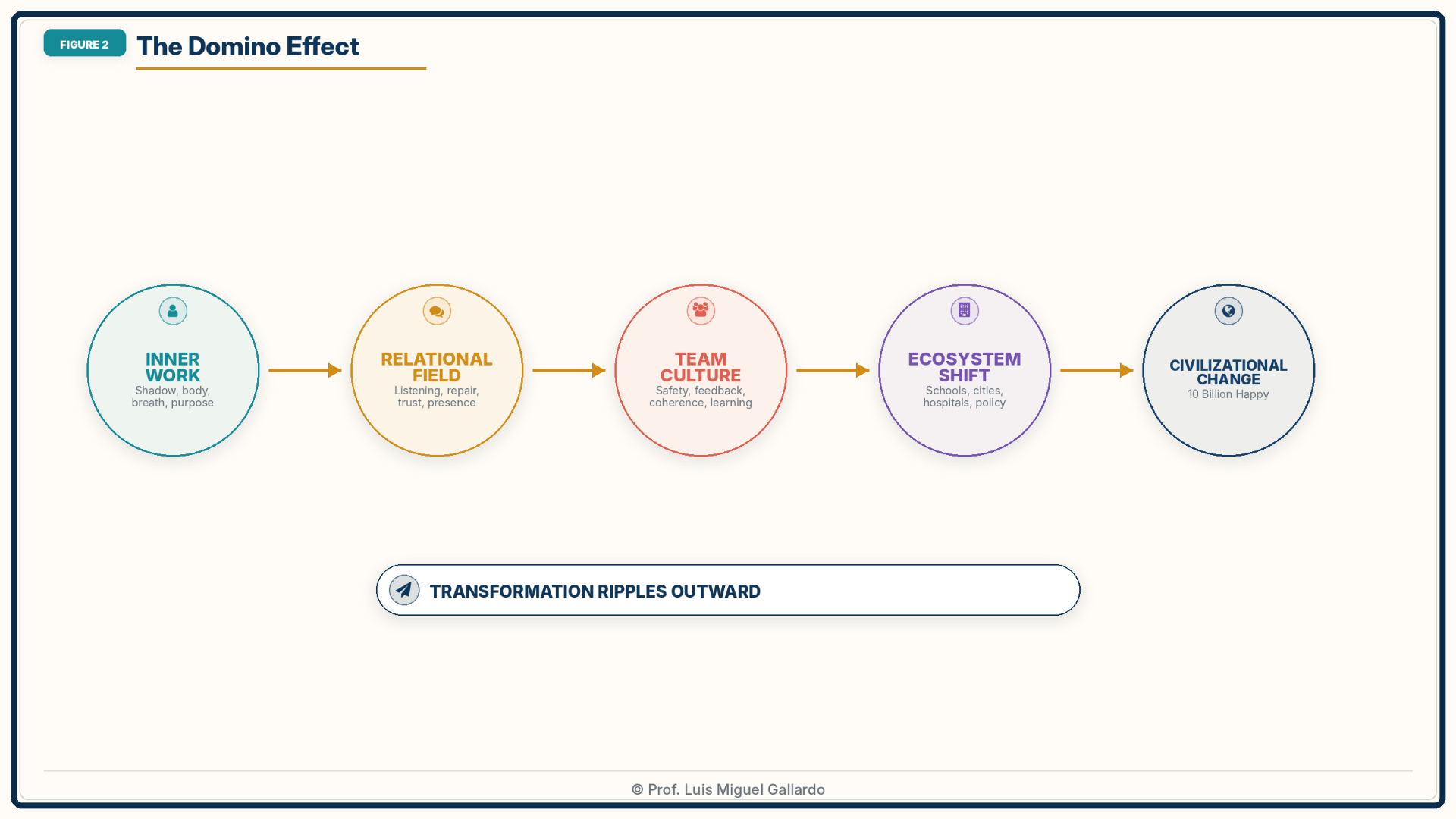
One illuminating way to envision the impact of a conscious catalyst is through Figure 2: The Domino Effect from The Transpersonal Leader. This figure illustrates how a small, well-placed impulse can initiate a chain reaction, leading to significant, wide-ranging transformations. The conscious catalyst understands that their initial action—a conversation, a question posed, a new framework introduced, or a modeling of a desired behavior—is the first domino. It sets into motion a cascade of subsequent actions and reactions that can redefine organizational culture, foster innovation, and cultivate well-being.
"The true measure of a conscious catalyst is not how many followers they attract, but how many leaders they empower to discover their own catalytic potential."
This perspective frees the leader from the immense pressure of having all the answers. Instead, it places the emphasis on creating the conditions for others to thrive and innovate. They are not the sole engine of change but the spark that ignites the collective engine. This means dedicating time to mentoring, coaching, and empowering others, rather than solely focusing on directives. It means celebrating small breakthroughs and encouraging experimentation, understanding that progress is often iterative and emergent.
In essence, becoming a conscious catalyst leadership involves a commitment to:
- Continual Self-Reflection: Regularly assessing one's inner state and impact.
- Deep Empathy and Listening: Truly understanding the perspectives and needs of others.
- Strategic Interventions: Identifying leverage points where a small input can yield significant change.
- Empowering Others: Fostering agency and capability throughout the system.
The conscious catalyst recognizes that true leadership is not about personal glory but about the flourishing of the whole. It’s a path that demands humility, courage, and a deep sense of connection to something larger than oneself. It is a journey of becoming, not just doing.
With an embrace, Luis Miguel.