
Fundamental Peace · Essay
Rejection: the no that landed and the self that survived it
The message arrived, or the message did not arrive. The job went to someone else. The friend stopped writing back. The lover turned, gently or cruelly, and chose somewhere else to be. For a moment the room kept its shape, and then a much older trapdoor opened underneath the room and your stomach went through it. You were not just told no. You were told, by the most ancient part of you, that something about you must be wrong — because if it were not, this would not be happening.
The reframe: Fundamental Peace
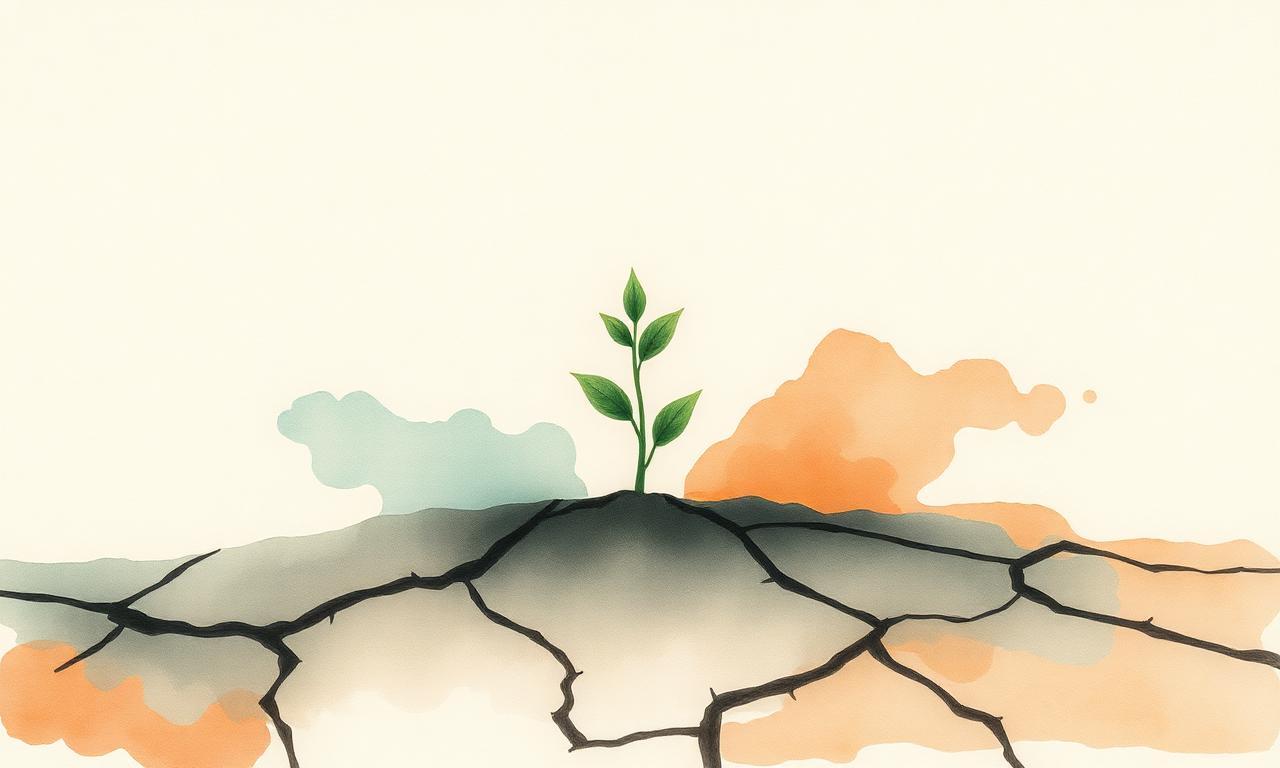
From the perspective of ICEF and FP20, the sting of rejection is almost never proportional to the event itself. The current 'no' lands on top of every earlier 'no' that was never grieved — the playground, the parent's distracted eyes, the unread message at fifteen, the role you did not get at twenty-two. Fundamental Peace does not pretend the no did not happen, and it does not perform false serenity. It separates two things that have been stitched together: the information ('this person, this door, this season, not a fit') from the verdict ('therefore I am not enough'). The first is true. The second is an old story borrowing this moment to repeat itself.
Shadow · Gift · Essence
The lurch in the stomach. The replay loop — what I should have said, what I should have been. The temptation to make yourself smaller, faster, more impressive, more agreeable, so that the next door cannot do this to you.
Precise data about fit. Rejection is one of life's quickest filters — it shows you which doors were never yours, freeing you from spending a decade walking through one. It also reveals exactly where the old wound still lives, which is the only place healing can begin.
A self whose value is not on the line in every encounter. You can hear a no, feel it cleanly, grieve what needed grieving, and walk on without becoming smaller. Doors open and close; you remain.
The practice
Separate the No from the Verdict — a 5-minute practice
Sit down. Name the rejection out loud, plainly and specifically: 'X said no to Y on Z.' Resist the urge to summarise it as 'I always get rejected' or 'no one wants me'. The specific is medicine; the global is the wound talking.
Hand on chest. Three slow breaths. Ask: 'How old does this hurt feel?' Trust the first number. Often it is much younger than today. You are not only feeling this no — you are feeling a stack.
Write two sentences on a single page. Sentence one: 'The information here is …' (this fit, this timing, this person, this door). Sentence two: 'The verdict my younger self is adding is …' (I am unloveable, I am not enough, I will always be alone). Read them. They are not the same sentence.
Place a hand on the part of the body that hurts most — chest, throat, belly. Say silently: 'You did not deserve to be left / overlooked / unchosen back then. This no today is not that no. I am here now.' Let the younger one be held for a full minute, without trying to fix.
Return to the present. Decide one small action that is for you, not against the rejection — a walk, a message to someone who knows you, a meal, a closing of the laptop. Choosing yourself in a small, real way is how the nervous system learns the no was survivable.
When to seek more support
If a rejection has triggered panic, suicidal thoughts, an inability to eat or sleep for more than a few days, or you are in the early shock of a major loss (job, partner, community), please reach for support. Crisis lines: US/CA 988, UK 116 123, ES 024, MX SAPTEL 55 5259 8121, AR 135. A therapist trained in attachment work or IFS can be especially helpful when present rejections keep dragging much older ones up with them.
Frequently asked
Doesn't repeated rejection mean something is wrong with me?
It usually means something is wrong with the fit, the strategy, or the door. Repeated rejection in one domain (jobs, romance, a creative field) is information about the approach or the field, not a verdict on your worth. Worth is not adjudicated by gatekeepers.
How do I stop taking it personally?
You do not stop feeling. You learn to separate the data from the verdict — to feel the sting cleanly and refuse to add a global story to it. That separation is a practice, not a switch.
Where does FP20 fit in?
Painful rejection usually correlates with a tender Sense of Self and disrupted Emotional Coherence. FP20 shows which inner ground most needs care, so the next no lands on stronger floor and finds less to hurt.
Sources & further reading
- Eisenberger — Social rejection and physical pain (Nature Reviews Neuroscience)
- APA — Rejection
- Greater Good Science Center — How to bounce back from rejection
These references are provided for educational purposes. Hypnotherapy complements, and does not replace, medical or psychological care.
Measure where your inner peace stands today
FP20 is the Fundamental Peace Scale — 20 questions, about 4 minutes. It reveals which of the four components (including Emotional Coherence) most needs your attention right now, with a personal reading from Luis.
Take FP20 →Continue reading