
Fundamental Peace · Essay
Powerlessness: the doorway you cannot push and cannot leave
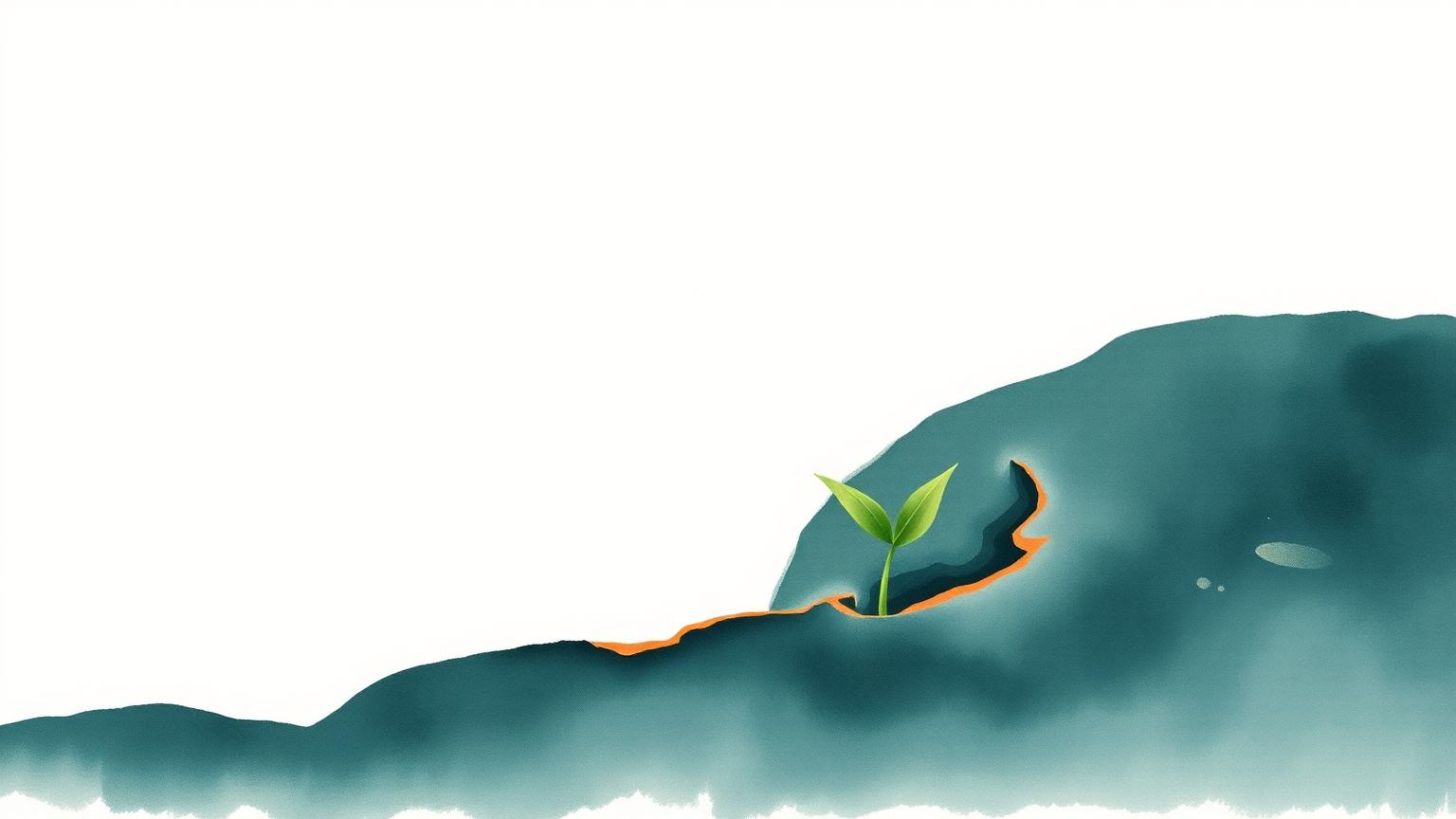
There are situations you cannot fix. The diagnosis. The election. The parent who will not change. The child who will not call. The war you watch on a small screen at night and cannot stop. The body that is slowly losing a capacity. You have tried strategy. You have tried protest. You have tried prayer. The door does not move. You cannot push it. You also cannot walk away.
The reframe: Fundamental Peace
From the perspective of ICEF and FP20, powerlessness is the moment a kind of false power runs out — the power that believed if it just tried hard enough, the door would open. Real life keeps presenting doors that do not open. Fundamental Peace does not ask you to pretend the door is open, or to numb out the wanting. It asks you to stand in front of the door without leaving and without pushing — and to discover, slowly, that something in you stays alive even when nothing is moving. That aliveness is the deeper power, and you cannot find it while you are still trying to bend reality with your fists.
Shadow · Gift · Essence
Rage at people who 'just do not care'. The cynicism that closes the heart so it stops hurting. The compulsive scrolling for news about the unfixable thing. The collapse into despair. The numbed-out 'I cannot think about it' that is its own slow loss of self.
An honest meeting with the limits of the small self. Powerlessness is the only door through which a deeper, quieter agency arrives — the agency that can love, witness, accompany, pray, vote, mourn, and refuse to look away, even when nothing it does makes the wall move.
A self that can stand inside what it cannot fix. The hands stay open. The heart stays in the room. Power becomes presence. You discover that bearing witness, with love, is itself a kind of action — and the only one that is always available.
The practice
Stand at the Door — a 5-step practice
Name the door, plainly. 'My mother's dementia.' 'The war in ___.' 'The system that will not change in my lifetime.' Honest naming is the first refusal to lie to yourself about scale.
Sit. Feet on the floor. Both hands on the thighs, palms up. Breathe. Say silently: 'I am standing in front of this. I will not leave it. I will not pretend I can push it.' Notice the relief that this honesty produces, even in the middle of the grief.
Find one true small action that is actually inside your reach. Not a fix — an act of presence. A call. A donation. A meal. A vote. A letter. A vigil. A walk with the person who is also bearing this. Do exactly that one thing, today, without using it to convince yourself the door has moved.
Find one true offering for the part that is beyond your reach. A prayer if you pray. A candle. A song. A moment of silence. The naming of names. Ritual is what the soul does when the body cannot. It is not nothing; it is what humans have always done in front of immovable doors.
Return to your life. Not because the door has opened — it has not — but because life on this side of the door is also yours to inhabit. Powerlessness held with love is not despair; it is the most adult form of love.
When to seek more support
Sustained powerlessness — especially in caregivers, activists, parents of seriously ill children, refugees, and people inside structurally unjust systems — can produce burnout, depression, PTSD, and complicated grief. Please surround yourself with peers who know the same door, and consider trauma-aware therapy. If you have thoughts of harming yourself, please reach a crisis line: US/CA 988, UK 116 123, ES 024, MX SAPTEL 55 5259 8121. You are not weak for needing company in front of a door that does not move.
Frequently asked
Isn't this just giving up?
No. Giving up walks away. Powerlessness, met as a practice, stays. The difference is whether the heart remains in the room. Surrender of the small power is not the abandonment of love — it is what allows love to survive what it cannot change.
What about action, organising, fighting?
All of those are powerlessness practices when they are honest. They become escape when their unspoken purpose is to prove to yourself that you are not powerless. Both can be true: act fully, and stand in front of what your action cannot reach.
Where does FP20 fit?
Chronic powerlessness usually strains Inner Peace and Emotional Coherence. FP20 names which inner ground most needs tending, so you can stand at the door without being slowly emptied by it.
Sources & further reading
- Seligman — Learned helplessness (Annual Review of Medicine)
- APA — Locus of control
- Greater Good Science Center — How agency builds resilience
These references are provided for educational purposes. Hypnotherapy complements, and does not replace, medical or psychological care.
Measure where your inner peace stands today
FP20 is the Fundamental Peace Scale — 20 questions, about 4 minutes. It reveals which of the four components (including Emotional Coherence) most needs your attention right now, with a personal reading from Luis.
Take FP20 →Continue reading